


Table of Contents
Most helicopters cruise between about 110 and 165 knots, which is 125 to 190 mph (200 to 305 km/h). A two-seat piston trainer like the Robinson R22 sits at the bottom of that range at up to 96 knots (110 mph). A medium twin like the Leonardo AW139 sits at the top at 165 knots (190 mph).
If you want one number for an average helicopter speed, use 140 knots, or about 161 mph (259 km/h). That is the median published cruise speed of the 20 civil helicopters in our model table below.
The official speed record for a conventional helicopter is 249 mph (400.87 km/h), set by a Westland Lynx in 1986. Experimental compound helicopters with extra propellers have since flown faster, up to 255 knots (293 mph) in level flight.
| Helicopter class | Examples | Typical cruise (mph) | km/h | Knots |
|---|---|---|---|---|
| Two-seat piston trainer | Robinson R22, Guimbal Cabri G2 | 110 to 115 mph | 178 to 185 | 96 to 100 |
| Four-seat piston | Robinson R44 Raven II | 125 mph | 202 | 109 |
| Light single turbine | Robinson R66, Bell 505, Bell 407GXi, Airbus H125 | 127 to 157 mph | 204 to 252 | 110 to 136 |
| Light twin turbine | Airbus H145, Leonardo AW109, Bell 429 | 150 to 178 mph | 241 to 287 | 130 to 155 |
| Medium twin | Airbus H160, Leonardo AW169, Sikorsky S-76D, Leonardo AW139 | 159 to 190 mph | 255 to 306 | 138 to 165 |
| Super-medium and heavy | Airbus H225, Airbus H175, Leonardo AW101, Sikorsky S-92A+, Leonardo AW189 | 163 to 183 mph | 263 to 294 | 142 to 159 |
| Military transport and attack | Bell AH-1Z, Sikorsky UH-60M, Boeing CH-47F | 160 to 181 mph | 257 to 291 | 139 to 157 |
| Experimental compound (top level speed) | Airbus Racer, Sikorsky X2, Eurocopter X3 | 261 to 293 mph | 420 to 472 | 227 to 255 |
How we measured
Every speed in our tables comes from the manufacturer or an official military source, quoted in knots and converted to mph and km/h. Manufacturers label cruise differently: Leonardo and Bell publish max cruise, while Airbus often publishes a lower recommended cruise. We note the label in the model table so you can compare like with like.
Helicopter speed by model
Here are the published cruise speeds of 20 civil helicopters in production, from the slowest trainer to the fastest medium twin. Each figure is the one the manufacturer prints, with its label.
| Helicopter | Cruise (mph) | km/h | Knots | Figure type |
|---|---|---|---|---|
| Robinson R22 Beta II | 110 | 178 | 96 | Cruise at max weight |
| Guimbal Cabri G2 | 115 | 185 | 100 | Cruise |
| Robinson R44 Raven II | 125 | 202 | 109 | Cruise at max weight |
| Robinson R66 | 127 | 204 | 110 | Cruise at max weight |
| Bell 505 Jet Ranger X | 144 | 231 | 125 | Max cruise |
| Airbus H130 | 147 | 237 | 128 | Fast cruise |
| Airbus H145 | 150 | 241 | 130 | Recommended cruise |
| Bell 407GXi | 153 | 246 | 133 | Max cruise |
| Airbus H125 | 157 | 252 | 136 | Fast cruise |
| Airbus H160 | 159 | 255 | 138 | Recommended cruise |
| Airbus H225 | 163 | 263 | 142 | Recommended cruise |
| Airbus H175 | 166 | 267 | 144 | Cruise |
| Leonardo AW169 | 166 | 267 | 144 | Max cruise (wheels) |
| Leonardo AW109 Trekker | 170 | 274 | 148 | Max cruise |
| Sikorsky S-92A+ | 174 | 280 | 151 | Max cruise |
| Leonardo AW109 GrandNew | 176 | 283 | 153 | Max cruise |
| Bell 429 | 178 | 287 | 155 | Max cruise |
| Sikorsky S-76D | 178 | 287 | 155 | Max cruise |
| Leonardo AW189 | 183 | 294 | 159 | Max cruise |
| Leonardo AW139 | 190 | 306 | 165 | Max cruise |
The slowest machines are the piston helicopters that most pilots learn on. They are light, cheap to run and built for training and short hops, not for speed.

Turbine power adds speed quickly. The single-engine Airbus H125 reaches a fast cruise of 136 knots (157 mph), more than 25 knots quicker than the piston R44.
The fastest civil helicopters in production are the medium twins used for offshore, rescue and VIP flying. Leonardo lists the AW139 at a 165-knot (190 mph) max cruise, and the Bell 429 and Sikorsky S-76D both reach 155 knots (178 mph).
Bigger is not always faster. The heavy Sikorsky S-92A+ lists a maximum cruise of 151 knots (174 mph), 14 knots slower than the AW139.

Want the fastest helicopters ever built rather than the typical ones? Our ranking of the fastest helicopters in the world covers the record machines in detail.
Cruise speed, top speed and VNE: why the numbers disagree
Search for one helicopter’s speed and you will often find three different numbers. They are usually all correct, because they measure different things.
- Recommended or long-range cruise: the efficient speed a pilot flies to stretch fuel.
- Max or fast cruise: the highest speed the helicopter can hold in level flight at maximum continuous power.
- VNE (never-exceed speed): the red line on the airspeed indicator, which the pilot must never pass.
The Airbus H225 shows the gap clearly. Airbus lists a recommended cruise of 142 knots (163 mph) and a never-exceed speed of 175 knots (201 mph).
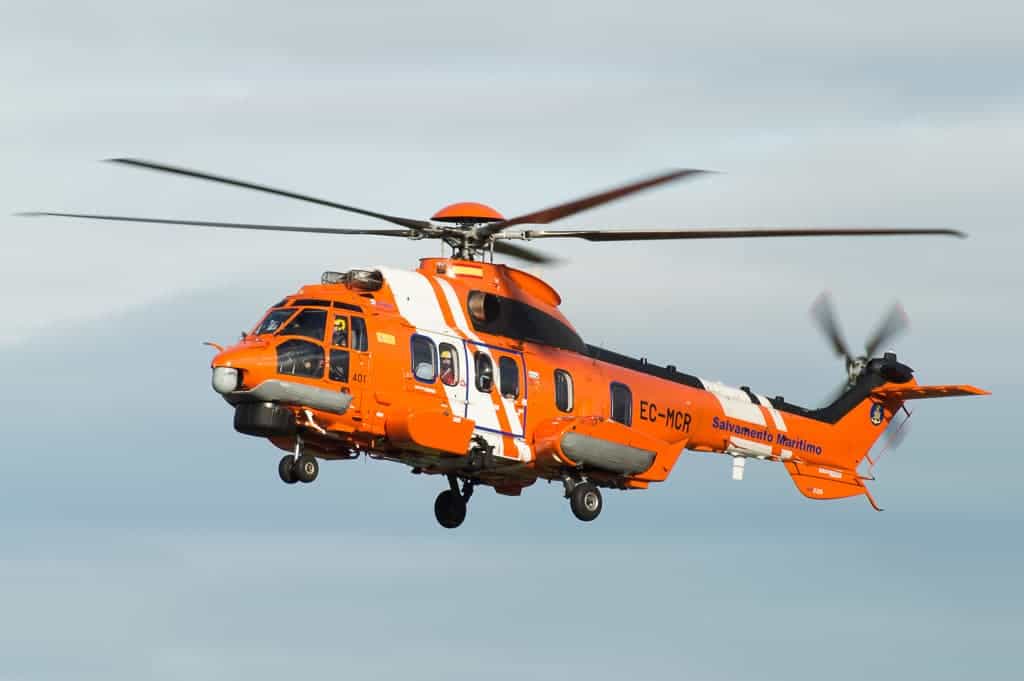
Airbus even prints two figures for the H160 on its own pages: a recommended cruise of 138 knots and a fast cruise of 150 knots. Compare an Airbus recommended cruise with a Leonardo max cruise and the Leonardo will look faster than it really is.
Weight and altitude matter too. Most figures above are quoted at maximum gross weight, so a lightly loaded helicopter can cruise a little faster than its brochure number.
Why helicopters cannot fly faster
The limit is the main rotor itself. As a helicopter flies forward, one side of the rotor disk is moving into the wind and the other side is moving away from it.
The FAA’s Helicopter Flying Handbook calls the result dissymmetry of lift. The advancing blade meets faster air and makes more lift, while the retreating blade meets slower air and makes less.
A 200-knot difference across one rotor
The FAA’s own example: a rotor with a blade tip speed of about 400 knots, flying forward at 100 knots, sees 500 knots of wind on the advancing side and only 300 knots on the retreating side. The faster the helicopter flies, the wider that gap grows.
The retreating blade has to work at a high angle of attack to make its share of lift. At high forward speed it eventually stalls, which the FAA calls retreating blade stall, and the pilot feels vibration, a nose pitch-up and a rolling tendency.
That is why every helicopter has a never-exceed speed. According to the FAA, retreating blade stall also arrives at a lower airspeed as altitude increases, so VNE usually falls the higher a helicopter climbs.
Engineers work around the limit by unloading the rotor. Compound helicopters add propellers for thrust, and some add short wings for lift, which is how the experimental machines below fly so much faster.
How long does a helicopter take to fly 100 miles?
At typical cruise speeds, a helicopter covers 100 miles in about 30 to 50 minutes. Here is the flying time for three common helicopters at their published cruise speed.
| Helicopter | Cruise | 100 miles | 300 miles |
|---|---|---|---|
| Robinson R44 Raven II | 125 mph | 48 minutes | 2 hours 24 minutes |
| Bell 407GXi | 153 mph | 39 minutes | 1 hour 58 minutes |
| Leonardo AW139 | 190 mph | 32 minutes | 1 hour 35 minutes |
Real trips take longer than the table shows. Wind can add or subtract many minutes, and a light helicopter may need a fuel stop on a 300-mile trip once legal reserves are counted.
Range is the other half of the question, and it varies just as widely. Our guide to how far helicopters can fly covers it model by model.
How fast do military helicopters fly?
Military helicopters fly at roughly the same speeds as civil medium and heavy twins, because the same rotor physics applies. The US types below all publish figures between 139 and 170 knots.
Boeing lists the CH-47F Block II Chinook at a cruise speed of 157 knots (181 mph) and a maximum speed of 170 knots (196 mph).
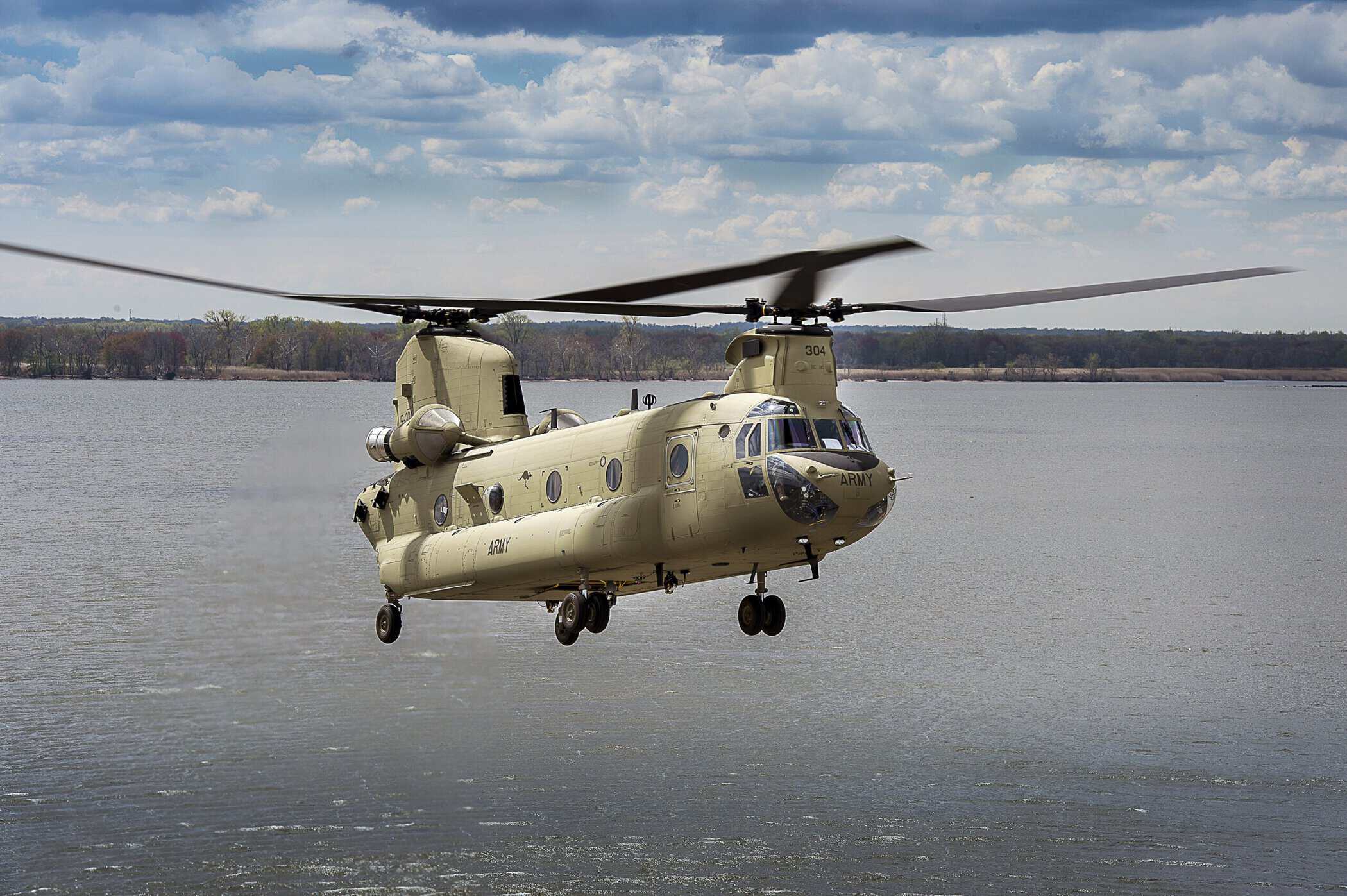
The US Army’s 2012 Weapon Systems Handbook gives the UH-60M Black Hawk a cruise speed of 152 knots (175 mph). Boeing lists the AH-64E Apache’s maximum level flight speed as “150+ knots” (173 mph or more).
Bell gives its AH-1Z Viper attack helicopter a cruise speed of 139 knots (160 mph). You can compare these and other gunships in our guide to attack helicopters.
Outside the US, India’s HAL Dhruv Advanced Light Helicopter has a maximum cruise speed of 250 km/h (155 mph), according to India’s Ministry of Defence. The Leonardo AW101 lists a 150-knot (173 mph) max cruise.

Is the Chinook really the fastest military helicopter?
Guinness World Records lists the CH-47F as the fastest military helicopter at 315 km/h, and it is the answer you will see most often. But maximum speeds are not published on a common basis. The US Navy lists the MH-60 Seahawk at 180 knots maximum and Bell lists the AH-1Z at 200 knots maximum indicated airspeed, both above the Chinook’s 170 knots true airspeed. Without a like-for-like test, fastest is a claim, not a measurement.
For the wider picture of what each type does, see our guide to the types of military helicopters.
The fastest helicopters ever flown
The official record belongs to a modified Westland Lynx. On August 11, 1986, Westland chief test pilot Trevor Egginton flew G-LYNX at an average 400.87 km/h (249.1 mph) over a straight course near Glastonbury, England, setting the FAI absolute speed record for helicopters.
Compound helicopters have flown faster since, in runs their makers called unofficial records. The X3 used two propellers mounted on short wings beside its main rotor. Sikorsky’s X2 reached 250 knots (288 mph) in level flight on September 15, 2010, and the Eurocopter X3 reached 255 knots (293 mph) in level flight on June 7, 2013.
Airbus’s Racer demonstrator, which builds on the X3’s layout of a main rotor plus two lateral rotors, hit 420 km/h (227 knots) on June 21, 2024, less than two months after its first flight. Its target is a fast cruise of 220 knots (253 mph), well above any production helicopter in our tables.
Faster than a Cessna
A Leonardo AW139 cruises at 165 knots. Cessna lists the maximum cruise of its Skyhawk, the classic four-seat training plane, at 124 knots. A medium twin helicopter will comfortably outrun the plane Cessna calls a flight training favorite.
Tiltrotors go faster still, but they are not helicopters. Bell’s V-280 Valor reached its 280-knot (322 mph) cruise speed in 2019. Its US Army derivative, named the MV-75 Cheyenne II in April 2026, still had its first test aircraft under construction that summer.
Are helicopters faster than airplanes?
Not usually. A fast helicopter can outrun a light piston airplane like the Cessna Skyhawk, but no helicopter comes close to a jet airliner.
Helicopters trade speed for the ability to hover, land on a rooftop or a ship deck, and lift loads on a hook. Our guide to how fast airplanes go covers everything from trainers to airliners.
FAQ
Sources and references used for research and fact-checking.
- Robinson Helicopter Company, R22 Beta II
- Robinson Helicopter Company, R44 Raven II and Clipper II
- Robinson Helicopter Company, R66 Police
- Hélicoptères Guimbal, Cabri G2
- Bell Textron, Bell 505
- Bell Textron, Bell 407
- Bell Textron, Bell 429
- Airbus Helicopters, H125 technical information
- Airbus Helicopters, H130 technical information
- Airbus Helicopters, H145 technical information
- Airbus Helicopters, H160 technical information
- Airbus Helicopters, H175 technical information
- Airbus Helicopters, H225 technical information
- Leonardo Helicopters, AW109 Trekker
- Leonardo Helicopters, AW109 GrandNew
- Leonardo Helicopters, AW139
- Leonardo Helicopters, AW169
- Leonardo Helicopters, AW189
- Leonardo Helicopters, AW101
- Lockheed Martin, Sikorsky S-76D VIP brochure
- Lockheed Martin, S-92A+ offshore technical information
- Federal Aviation Administration, Helicopter Flying Handbook, Chapter 2: Aerodynamics of Flight
- Federal Aviation Administration, Helicopter Flying Handbook, Chapter 11: Helicopter Emergencies and Hazards
- Boeing, CH-47 Chinook
- Boeing, AH-64 Apache
- US Army (hosted by FAS), Weapon Systems Handbook 2012: UH-60 Black Hawk
- Bell Textron, Bell AH-1Z
- US Navy, MH-60 Seahawk helicopter fact file
- Department of Defence Production, Ministry of Defence (India), Advanced Light Helicopter Mk III (Dhruv)
- Guinness World Records, Fastest military helicopter
- FAI, 11 August 1986: the FAI world record of John Trevor Egginton
- Leonardo, G-LYNX: 35 years of an unrivalled speed record
- Smithsonian National Air and Space Museum, Sikorsky X2 Technology Demonstrator
- Sikorsky (via Airframer), Sikorsky X2 Technology Demonstrator achieves 250 knots
- AIN, Eurocopter X3 sets unofficial helicopter speed record
- Eurocopter (via Helis.com), Eurocopter X3 reaches 255 knots
- Airbus, Airbus Racer speeds past 400 km/h
- Bell Textron, Record performance: Bell V-280 Valor reaches 280 knots true airspeed
- US Army, US Army names next generation assault aircraft Cheyenne II
- Vertical, Bell notes big year for MV-75 as build begins on first six test aircraft
- Textron Aviation, Cessna Skyhawk
Get the Newsletter
The latest aviation news and stories sent to your inbox.
About the Author

Tim is the owner and lead editor of AeroCorner since 2019, overseeing aviation content covering aircraft, airlines, airports, and the broader aviation industry. Through years of researching, writing, editing, and publishing aviation-focused content, he has developed extensive practical knowledge of commercial aviation and air travel. Based in Asia and a frequent traveler himself, Tim also brings firsthand passenger experience to AeroCorner’s coverage. Outside of publishing, he has also explored aviation firsthand through hands-on flight training in New Zealand.