

Table of Contents
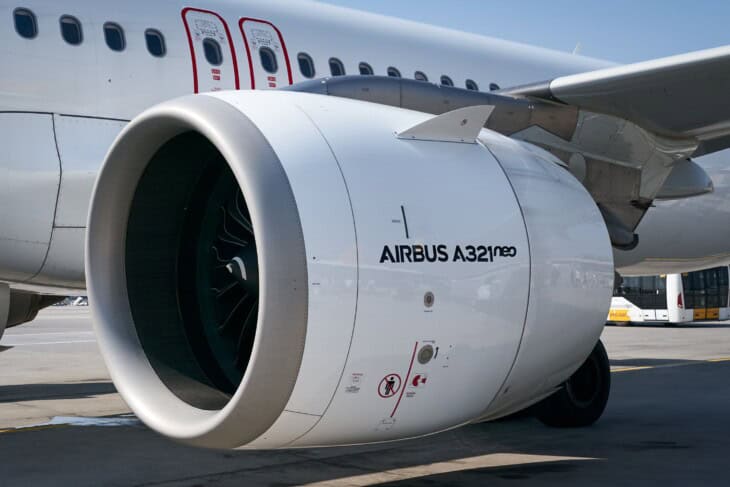
Stand at a boarding gate next to a Boeing 777 and the engine slung under the wing is close to eleven feet across at the intake. An adult can stand inside the front of it without stooping, and there are two of them.
On takeoff, each one produces more than 100,000 pounds of thrust. The standard explanation for how it does that is four words long: suck, squeeze, bang, blow.
That summary is not wrong. It is just where most explanations stop, and almost everything genuinely strange about a jet engine happens past that point. This article picks up where the four words leave off.
How Does a Jet Engine Work?
A jet engine works by taking hold of a large mass of air, speeding it up, and throwing it backwards. The forward push on the aircraft is the exact mirror of the momentum handed to that air.
The core of the engine is the machine that makes that possible. A compressor squeezes incoming air to many times its original pressure, fuel burns continuously in that compressed air, and the hot gas expands through a turbine on its way out the back.
Here is the part the four-word version hides. The turbine’s job is not to push the aircraft anywhere. It is to harvest enough energy from the exhaust to drive the compressor sitting in front of it, which is what keeps the cycle self-sustaining once it is running.
The cycle, in order
Intake: air enters and slows down. Compressor: on a GE9X, fifteen rows of blades raise the pressure more than sixty times. Combustor: fuel burns steadily in that compressed air. Turbine: eight rows of blades extract energy from the hot gas to drive the compressor and the fan. Nozzle: whatever is left leaves out the back.
Getting that loop started from cold is a separate problem entirely, since a turbine cannot drive a compressor until air is already moving through it. That is why jet engines need an external air or electric starter before the first fuel is introduced.
Everything below applies to the turbofan, the engine on essentially every airliner flying today. It is one branch of a wider family that also includes turboprops, turboshafts and piston engines, and the differences between aircraft engine types come down mostly to what the turbine’s output is spent on.
Why the Compressor Needs Nearly Twice as Many Stages as the Turbine
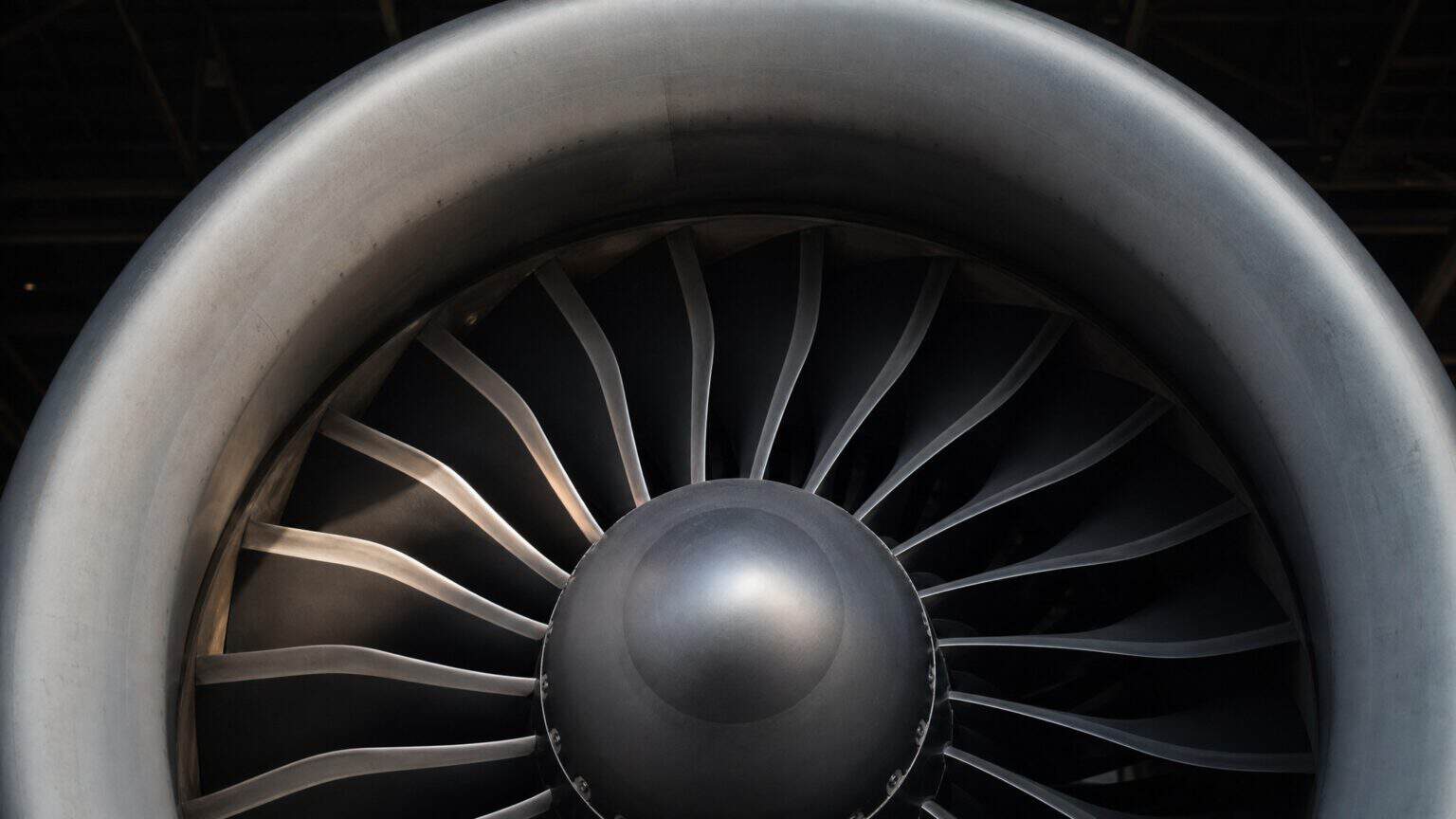
Count the blade rows on a GE9X, the engine built for the Boeing 777X. One fan, three booster stages and eleven high-pressure compressor stages: fifteen rows whose job is to compress air.
Now count the rows that take energy back out. Two high-pressure turbine stages and six low-pressure turbine stages, so eight in total. Same engine, same air, and nearly twice as much machinery going in as coming out.
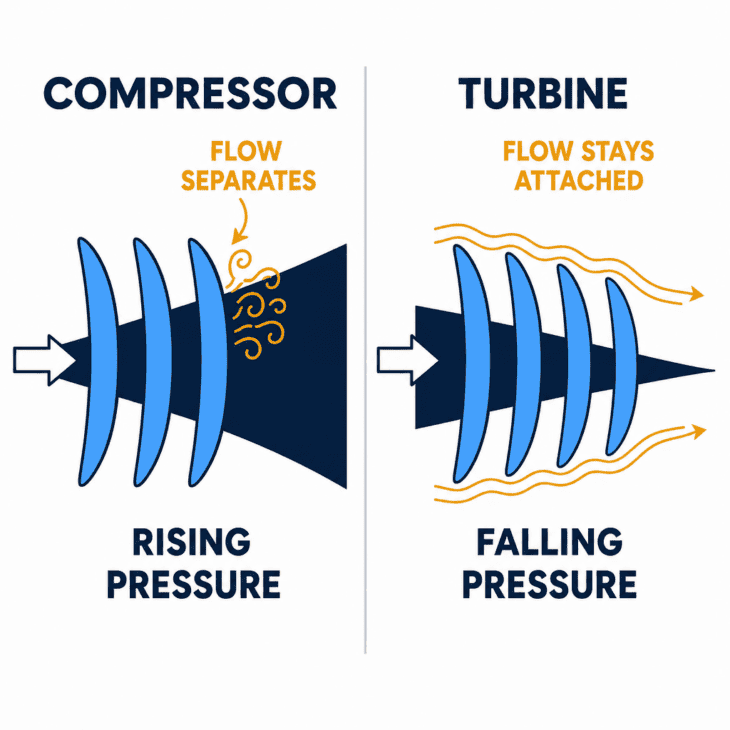
The reason is one of the most useful ideas in engineering, and it is the same idea that makes a wing stall. A compressor blade is trying to push air into a region of higher pressure than the air it just came from.
Air does not enjoy that. Push too hard and the flow separates from the blade surface, exactly as it does over a wing at too high an angle of attack, and the compressor stalls or surges.
So each row can only ask for a small amount. NASA puts the pressure rise across a typical single axial compressor stage at a factor of about 1.2, which is why serious compression takes a long line of them.
The turbine has the opposite situation, which is to say it has no problem at all. Pressure falls across a turbine stage, and falling pressure keeps the flow pinned to the blades rather than peeling it away.
That lets a turbine blade turn the gas through a large angle and take a big bite of energy in one row. As NASA’s guide puts it, a single turbine stage can drive several compressor stages.
The asymmetry, in other words, is not a design preference. Compression has to be done in small careful increments, and expansion can be done in large greedy ones.
| Section | Rows of blades | What it does |
|---|---|---|
| Fan | 1 | Moves the bypass air and feeds the core |
| Booster (low-pressure compressor) | 3 | First squeeze on the core air |
| High-pressure compressor | 11 | Raises core pressure by a further 27 times |
| High-pressure turbine | 2 | Drives the high-pressure compressor |
| Low-pressure turbine | 6 | Drives the fan and the booster |
By the time air reaches the combustor it has been squeezed more than sixty times and is several hundred degrees hot from compression alone, before any fuel is added. What burns in it is a tightly specified kerosene, and the difference between jet fuel and ordinary kerosene is mostly a matter of freezing point and contamination limits.
Most of the Thrust Never Goes Through the Engine at All
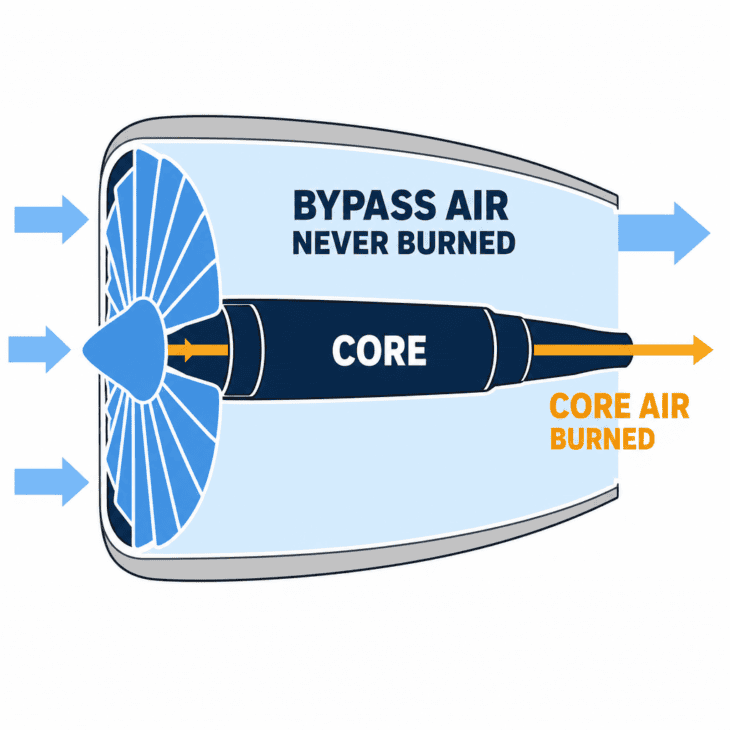
The GE9X has a bypass ratio of roughly 10:1. Ten pounds of air go around the outside of the core for every one pound that goes through it.
That bypass air is never burned. The fan accelerates it, it travels down the duct between the core and the nacelle, and it leaves out the back having done nothing but speed up.
In a high-bypass engine that cold stream produces the large majority of the thrust, commonly cited at around 80 percent at takeoff. The hot core exhaust, the part that gets all the attention, contributes the smaller share.
The reason comes straight out of the thrust equation. Thrust is mass of air multiplied by how much you change its velocity, but the energy you have to spend rises with the square of that velocity change.
Move a small amount of air very fast and you get thrust expensively. Move an enormous amount of air slightly faster and you get the same thrust for far less fuel.
That single trade is why engines got fat. The GE9X fan is 134 inches across, which is 11 feet 2 inches (3.4 m), roughly the width of a Boeing 737’s cabin, and it does the job with just 16 composite blades. It sits at the top of the list of the largest commercial aircraft engines ever built.
Functionally, then, a modern airliner engine is much closer to a ducted propeller driven by a gas turbine than to the pure jets of the 1950s. That is the real content of the turbojet versus turbofan distinction: a turbojet throws its entire mass flow out at high speed, and a turbofan refuses to.
It also made flying quieter, because most of the noise from an old turbojet came from a fast hot jet shearing against still air. Slowing the exhaust stream down is a large part of why jet engines are not as deafening as they used to be.
Fighters go the other way deliberately. High bypass is efficient at airliner speeds but a liability well past the speed of sound, so combat engines run low bypass and add an afterburner that dumps raw fuel into the exhaust when thrust matters more than fuel does.
134,300 pounds, once
On 10 November 2017, at GE’s outdoor test site in Peebles, Ohio, a GE9X reached 134,300 pounds of thrust and took the Guinness World Record for the most powerful commercial aircraft engine. Its certified in-service rating is 110,000 pounds. The record is what the engine survived on a test stand, not what it is asked for on a wing.
The Turbine Blades Run Hotter Than the Metal They Are Made Of
Here is the fact that should not be true. Gas leaving the combustor and arriving at the first turbine stage of a modern engine is hotter than the melting point of the alloy those turbine blades are cast from.
Turbine blades are made from nickel-based superalloys, which melt somewhere in the region of 2,400°F to 2,500°F (1,300°C to 1,370°C). Manufacturers do not publish exact turbine entry temperatures, but the research literature is consistent that modern ones sit above that line.
The University of Cambridge’s materials group defines a superalloy as a metal usable above roughly 0.7 of its absolute melting temperature. Turbine designers then push past even that, using three tricks stacked on top of each other.
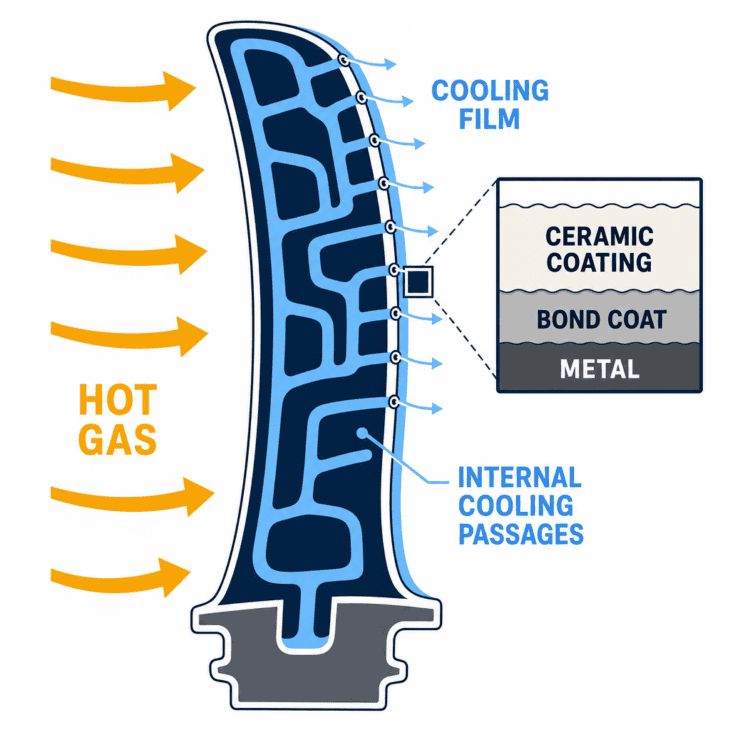
The first is cooling from the inside out. Air is bled off the compressor before it reaches the flame, so it is relatively cool, piped through winding passages cast inside each hollow blade, and pushed out through hundreds of tiny holes in the blade skin.
That escaping air does not blow the heat away. It clings to the surface as a thin film, so the blade is never actually touching the hottest gas, which is why the technique is called film cooling.
The second trick is metallurgical, and it is the strangest thing in the whole engine. Cast a metal part normally and you get a mosaic of crystal grains packed together, and the boundaries between those grains are fast paths for atoms to diffuse along.
Under load at high temperature, those boundaries are where the metal slowly stretches and fails. So a high-pressure turbine blade is not cast as a mosaic at all. It is grown as one single continuous crystal with no grain boundaries in it anywhere.
One blade, one crystal
A single-crystal turbine blade is free of the grain boundaries that make ordinary cast metal creep at high temperature. Removing them also lets metallurgists strip out the additives that were only ever there to strengthen those boundaries, which raises the temperature at which the alloy can be heat-treated and used.
The third trick is a coating. A ceramic thermal barrier, typically yttria-stabilised zirconia sprayed over a metallic bond coat, insulates the metal underneath and can pull its temperature down by 100°C to 300°C on its own.
The GE9X goes a step further and replaces some of the metal outright. It carries more than 100 ceramic matrix composite parts in the combustor and high-pressure turbine, and GE says those parts need 59 percent less cooling air than the metal components they replace.
That last number matters more than it looks. Every pound of air bled off for cooling is a pound that was compressed at fuel cost and then never burned, so cooling air is one of the quiet taxes on engine efficiency.
The Myth: the Bang Is What Pushes the Plane
The common assumption
That fuel explodes inside the engine, and the blast escaping out of the back is what shoves the aircraft forward.
Nothing explodes. Combustion in a gas turbine is a continuous flame burning at roughly constant pressure, lit once and then sustained for the entire flight, which is the opposite of the intermittent detonations in a car engine.
The exhaust is not pushing against the outside air either. Thrust is the reaction to accelerating a mass of air rearwards, which is precisely why a rocket works perfectly well in a vacuum with nothing behind it to push on.
But the deepest correction is the one the bypass ratio already gave away. In a high-bypass engine, nearly all the energy released by burning the fuel is captured by the turbine before the gas ever gets outside.
The turbine spends that energy turning the shaft, and the shaft turns the fan. The core is not the thing that pushes you forward. The core is a generator whose product is fan rotation, and it is the fan, moving cold air that never went near a flame, that does most of the pushing.
Suck, squeeze, bang, blow describes the core accurately and then stops one step short of the point. On a modern airliner the bang is not the payoff. It is the power supply.
Next time you have a window seat over the wing, look at the front of the engine rather than the back. That spinning disc is doing four fifths of the work, and the fire buried behind it, hot enough to melt the machinery containing it, is there to keep the disc turning.
The wing is still the part holding the aircraft up. The engine’s only job is to keep the whole assembly moving fast enough for the wing to do it, and it accomplishes that by being very, very good at throwing air backwards.
Sources and references used for research and fact-checking.
- GE Aerospace, GE9X Commercial Aircraft Engine
- GE Aerospace, GE9X Breaks GUINNESS WORLD RECORDS Title for Thrust
- NASA Glenn Research Center, Beginner's Guide to Aeronautics, Axial Compressor
- NASA Glenn Research Center, Beginner's Guide to Aeronautics, Power Turbine
- University of Cambridge, Department of Materials Science and Metallurgy, Superalloys: A Primer and History
- IOP Conference Series: Materials Science and Engineering, Effect of Thermal Barrier Coating in Sustainable Power Production of Gas Turbines
Get the Newsletter
The latest aviation news and stories sent to your inbox.
About the Author

Tim is the owner and lead editor of AeroCorner since 2019, overseeing aviation content covering aircraft, airlines, airports, and the broader aviation industry. Through years of researching, writing, editing, and publishing aviation-focused content, he has developed extensive practical knowledge of commercial aviation and air travel. Based in Asia and a frequent traveler himself, Tim also brings firsthand passenger experience to AeroCorner’s coverage. Outside of publishing, he has also explored aviation firsthand through hands-on flight training in New Zealand.