


Table of Contents
A carburetor and a fuel injection system both mix fuel with air, and the difference is how the fuel gets in. A carburetor lets the suction of air rushing through a narrow throat draw fuel into the airstream before it reaches the cylinders. Fuel injection pumps fuel under pressure and sprays a metered dose at each cylinder.
That one difference decides the rest: carburetor ice, how evenly each cylinder is fed, cold and hot starts, and whether the engine keeps running upside down. Cars settled the argument decades ago. Airplanes have not: more than half of the US piston fleet still runs on a carburetor.
We compared the two on eight criteria as of October 2026, using the FAA’s Pilot’s Handbook of Aeronautical Knowledge, the NTSB’s accident data, Lycoming’s engine nomenclature, and our own count of every piston airplane on the FAA registry.
| Criterion | Carburetor | Fuel injection |
|---|---|---|
| How fuel gets in | Low pressure in a venturi draws fuel into the air, mixed before the intake manifold (FAA) | A pump and control unit meter fuel to a nozzle at each cylinder intake port, or into the cylinder (FAA) |
| Icing | Carb ice possible at outside temperatures up to 100°F (38°C) and humidity as low as 50% (FAA) | No carburetor ice; impact ice on the air intake is still possible (FAA) |
| Anti-ice cost | Carburetor heat cuts power by up to 15% (FAA) | No carburetor heat needed |
| Mixture and fuel spread | Mixture grows richer with altitude; fuel spread between cylinders less even | “Precise control of mixture” and “better fuel distribution” (FAA) |
| Starting | Starting is “relatively straightforward” (Boldmethod) | Easier cold starts; harder hot starts and vapor lock on hot days (FAA) |
| Abrupt maneuvers | Float type “does not function well” (FAA) | Keeps feeding fuel; all 2,056 registered AE (aerobatic) Lycoming-type engines are injected |
| Fuel burn, same maker | Rotax 912 ULS (baseline) | Rotax 912 iS: up to 36% less fuel in Rotax’s year-long test (2013) |
| US piston airplanes, October 2026 | 128,297 (57%) | 70,853 (32%); 24,284 (11%) unclassified |
How we compared
Mechanism, icing limits and the advantages and disadvantages of each system come from the FAA Pilot’s Handbook of Aeronautical Knowledge (FAA-H-8083-25B, chapter 7). Accident figures come from NTSB Safety Alert SA-029. The fleet count is our own: we took every fixed-wing airplane with a piston engine and a valid registration in the FAA releasable aircraft database (downloaded October 6, 2026, 223,434 airplanes) and classified it by the engine model on file. Lycoming marks fuel injection with an I in the model prefix (IO, TIO, AEIO), and Continental uses the same convention. O-series engines, the old Continental A, C and E series and the radials count as carbureted. Engines with no model on file stay unclassified, and a later engine swap or injection kit is not visible in the registry.
How each system gets fuel into the cylinders
The FAA handbook draws the line in two sentences. A carburetor system “mixes the fuel and air in the carburetor before this mixture enters the intake manifold.” A fuel injection system mixes them “immediately before entry into each cylinder or injects fuel directly into each cylinder.”
In the float-type carburetor fitted to most small airplanes, outside air passes through a venturi, a narrow throat that speeds the air up and drops its pressure. That low pressure pulls fuel out of a main jet and into the airstream.
A float in the fuel bowl works a needle valve that keeps the fuel level steady, and the throttle valve sets how much mixture reaches the engine.
A fuel injection system replaces suction with pressure. The FAA lists six basic parts: an engine-driven fuel pump, a fuel-air control unit, a fuel manifold, a discharge nozzle in each cylinder head, an auxiliary fuel pump, and fuel pressure or flow indicators.
The control unit “essentially replaces the carburetor,” metering fuel by the mixture setting at a rate set by the throttle.
There is a middle ground. The pressure-type carburetor sprays fuel under pump pressure on the engine side of the throttle valve, which the FAA says practically eliminates fuel vaporization icing. It is “usually not found on small aircraft.”
Takeaway: a carburetor pulls fuel in with suction, while fuel injection pushes it in with pressure, at each cylinder.
Carburetor ice: the carb’s biggest weakness
The FAA calls icing the “chief disadvantage” of the float-type carburetor. Two things chill the air in the venturi at once: the drop in pressure, and fuel soaking up heat as it evaporates. The handbook puts the temperature drop at as much as 60 to 70°F (33 to 39°C).
That is enough to freeze moisture on a hot day. The FAA’s own example: at an outside temperature of 100°F (38°C), a 70°F drop leaves the air in the carburetor at 30°F (-1°C). Ice builds around the throttle valve and in the venturi throat, chokes the mixture, and can stop the engine.
Carb ice is most likely below 70°F (21°C) with relative humidity above 80%, and it is “particularly dangerous” at the reduced power of a descent, when it can build unnoticed until the pilot adds power. The fix, carburetor heat, routes warmed air to the carburetor and costs power: “sometimes up to 15 percent,” according to the FAA.
Myth: carb ice is a cold-weather problem
It is not. The NTSB found that some pilots in carb-icing accidents wrongly believed it was only a cold- or wet-weather problem. Its safety alert warns that serious carburetor icing can occur at temperatures as high as 90°F, or with relative humidity as low as 35%, at glide power. From 2000 to 2011, carburetor icing was a cause or factor in about 250 accidents, and it causes or contributes to two fatal accidents a year on average.
Fuel injection removes the problem at its source, because there is no venturi chilling the fuel at a throttle plate. The FAA still calls an injected engine “less susceptible” rather than immune: ice can form on the outside of the airplane and block the air intake, which is why injected engines carry an alternate air source.
Takeaway: fuel injection eliminates carburetor ice, the failure that the NTSB tied to about 250 accidents in twelve years.
Mixture, fuel distribution and fuel burn
Both systems need leaning as the airplane climbs. Carburetors are calibrated at sea level, and as the air thins while the fuel stays just as dense, the mixture grows “progressively richer,” fouling spark plugs and costing power until the pilot pulls the mixture control back.
Fuel injection does that job more precisely. The FAA’s list of its advantages includes “precise control of mixture,” “better fuel distribution” and “better fuel flow.” The handbook adds that better fuel economy on injected engines comes from leaning with an exhaust gas temperature gauge, one of the engine instruments pilots use to set the mixture.
A carburetor feeds every cylinder through a shared intake manifold, and Boldmethod notes that how evenly the fuel spreads depends on the engine’s design. Injecting a metered dose at each cylinder takes the manifold out of the equation.
The biggest measured gap comes from Rotax. In a year-long side-by-side test in identical club airplanes, the company found its fuel-injected 912 iS used up to 36% less fuel than the carbureted 912 ULS, with at least 30% consistently achievable.
That is the maker’s own test of a new engine generation, not of injection alone, but it shows the size of the prize.
Takeaway: fuel injection meters fuel more precisely and spreads it more evenly, which is where its economy advantage comes from.
Starting a cold engine and a hot one
Fuel injection gives “easier cold weather starts,” according to the FAA. Boldmethod describes cold starts on a carbureted engine as relatively straightforward too.
The trade-off is the hot start. The FAA lists three disadvantages of fuel injection, and two are about heat: “difficulty in starting a hot engine” and “vapor locks during ground operations on hot days.” Boldmethod explains why: after shutdown, fuel can vaporize in the injector lines, so injected airplanes have their own hot-start procedure.
The third disadvantage is “problems associated with restarting an engine that quits because of fuel starvation,” for example after running a tank dry. None of the three appears on the FAA’s list of carburetor drawbacks.
Takeaway: fuel injection starts better in the cold, while the carburetor starts better when the engine is hot.
Aerobatics and negative g
A float carburetor depends on gravity to keep fuel at the bottom of its bowl. The FAA’s first listed disadvantage of the float type is that it does “not function well during abrupt maneuvers.”
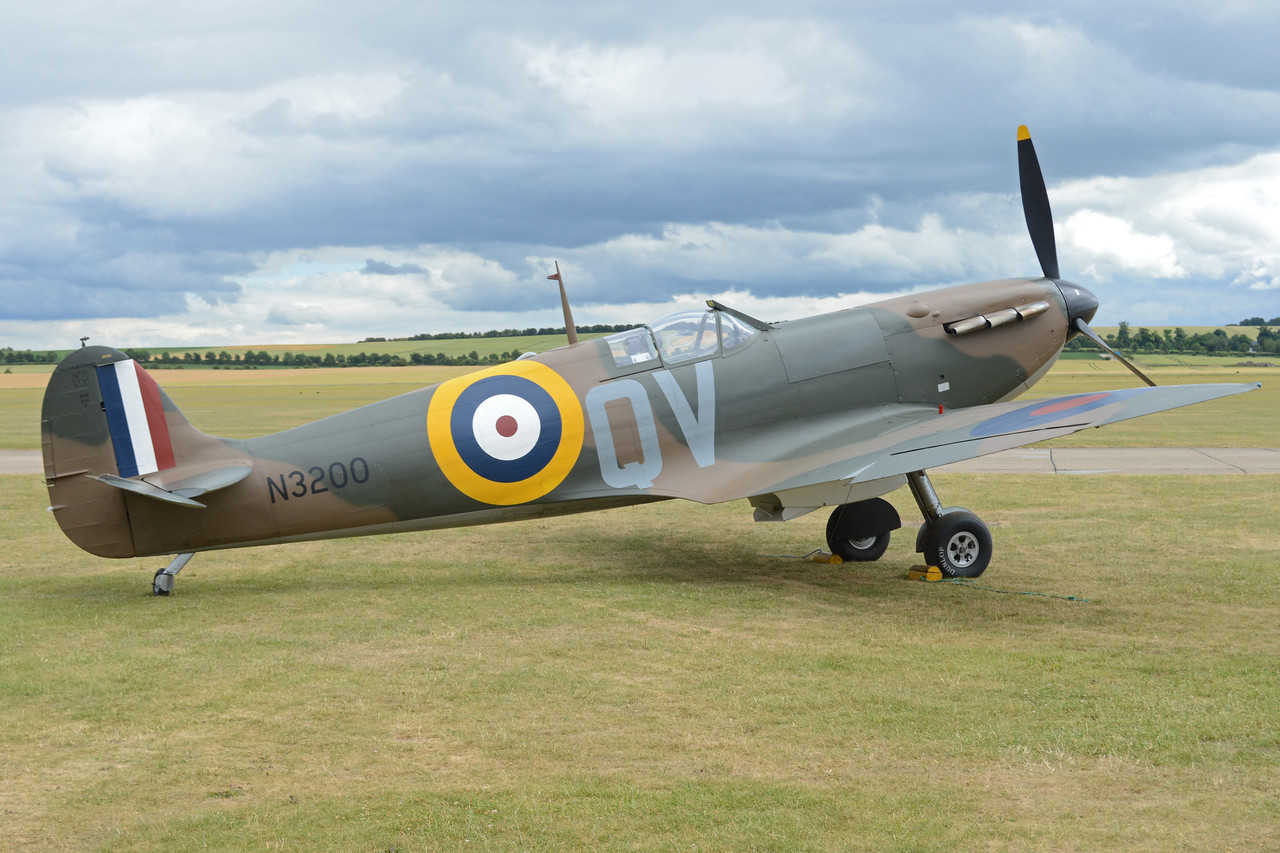
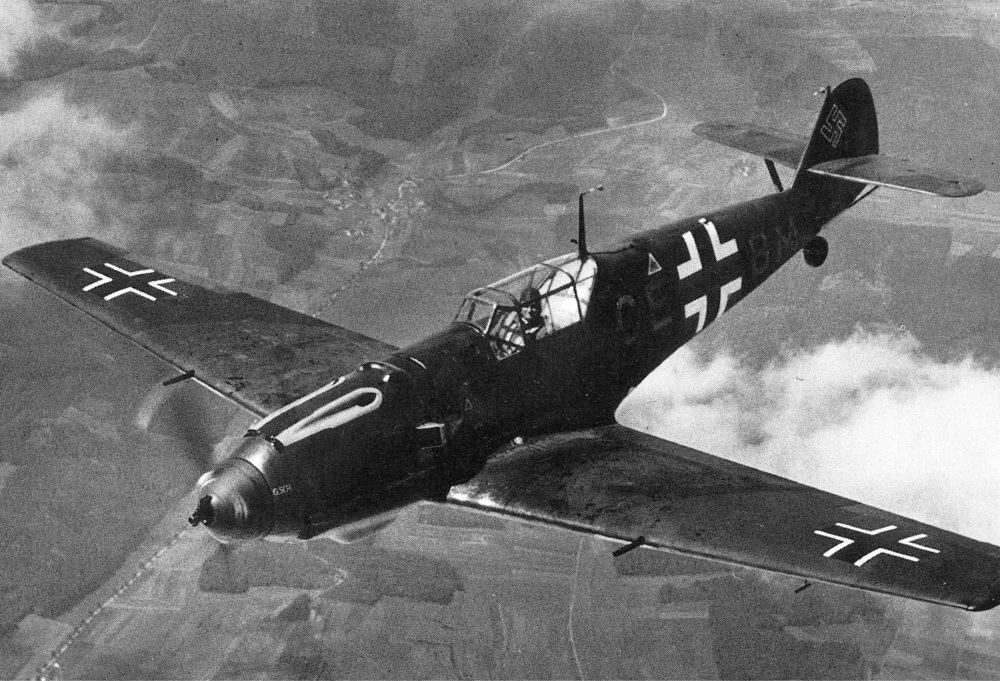
The most famous proof came in the Battle of France and the Battle of Britain in 1940. When a Rolls-Royce Merlin went into negative g, fuel was forced to the top of the float chamber, the carburetor flooded, and the engine cut out.
The Daimler-Benz DB 601 in the Messerschmitt Bf 109 used direct fuel injection, which kept fuel at constant pressure. German pilots could escape by pitching steeply forward while opening the throttle, a move the British fighters chasing them could not copy.
Miss Shilling's orifice
Engineer Beatrice Shilling’s fix was a thimble-shaped brass restrictor in the Merlin’s fuel line, installed throughout RAF Fighter Command by March 1941. It let Spitfire and Hurricane pilots make quick negative-g maneuvers without losing power, though it did not allow sustained inverted flight. The problem was only fully solved when the Bendix pressure carburetor arrived in 1943.
The fix ended up in the Supermarine Spitfire and the Hurricane, and the lesson ended up in every aerobatic engine since.
.jpg)
Lycoming’s nomenclature makes the point in the model name: AE stands for Aerobatic Engine and I for Fuel Injected, so its example engine, an AEIO, is “an aerobatic engine with opposed cylinder that is fuel injected.” On the FAA registry, all 2,056 airplanes with an AE-designated engine have the AEIO version.
Takeaway: fuel injection keeps feeding the engine under negative g, which is why aerobatic engines use it.
Which airplanes use which
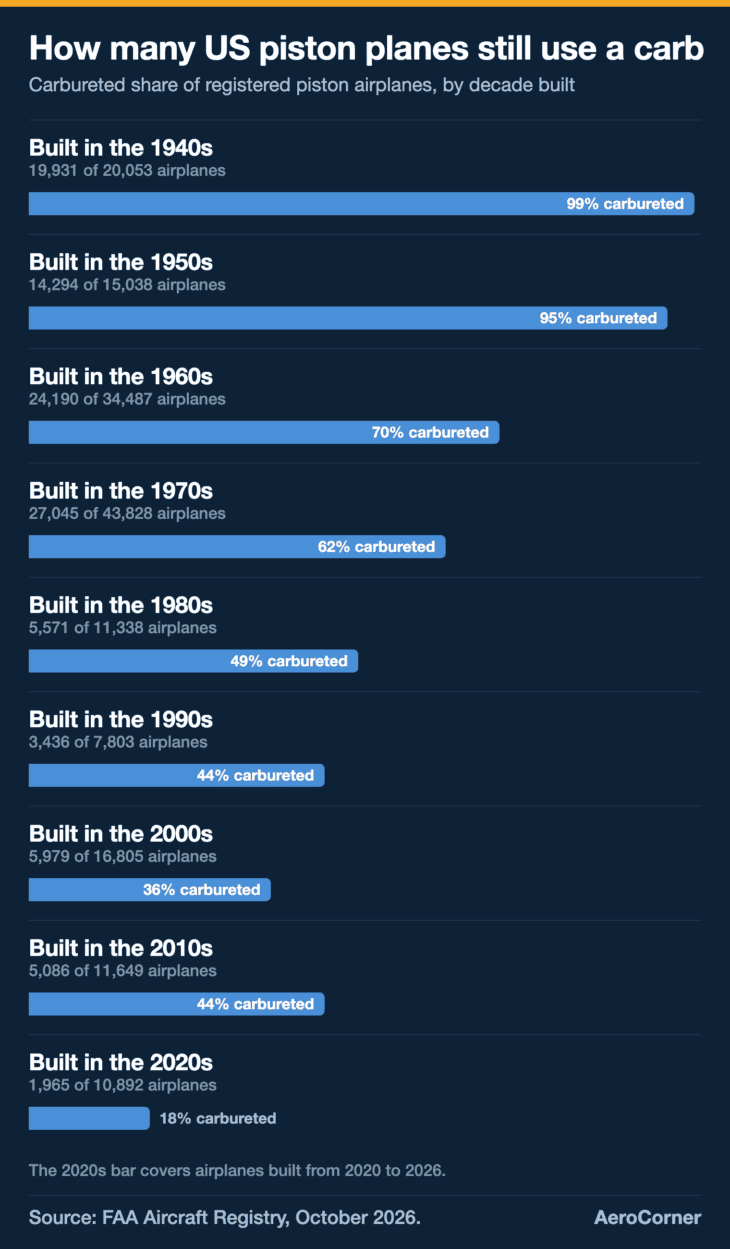
For all of fuel injection’s advantages, the carburetor still dominates the US fleet. Of the 223,434 fixed-wing piston airplanes with a valid FAA registration in October 2026, 128,297 (57%) have a carbureted engine on file and 70,853 (32%) a fuel-injected one. We could not classify the other 24,284 (11%), most of them because no engine model is on file.
| Decade built | Carbureted | Fuel-injected | Carbureted share |
|---|---|---|---|
| 1940s | 19,931 | 122 | 99% |
| 1950s | 14,294 | 744 | 95% |
| 1960s | 24,190 | 10,297 | 70% |
| 1970s | 27,045 | 16,783 | 62% |
| 1980s | 5,571 | 5,767 | 49% |
| 1990s | 3,436 | 4,367 | 44% |
| 2000s | 5,979 | 10,826 | 36% |
| 2010s | 5,086 | 6,563 | 44% |
| 2020 to 2026 | 1,965 | 8,927 | 18% |
The reason is age. The 1940s, 1960s and 1970s alone left about 71,000 carbureted airplanes on the register, and a well-kept piston airplane flies for decades. The trend in new production runs the other way: only 18% of the airplanes built since 2020 are carbureted.
The bump in the 2010s comes from small carbureted engines: the most common carbureted engine among airplanes built that decade is Rotax’s 912 ULS, on 1,357 of them, ahead of Lycoming’s O-360-A4M on 240.
The Cessna 172 Skyhawk shows the switch in one model. When Cessna restarted production, the 172R that flew in October 1996 was, in AOPA’s words, “the first factory Skyhawk with a fuel-injected Lycoming,” an IO-360-L2A rated at 160 hp at 2,400 rpm. Today’s Skyhawk uses the same engine at 180 hp.

Fuel injection also pairs naturally with forced induction. The FAA notes that a float carburetor has “difficulty in discharging fuel into some types of supercharged systems,” and more than 99% of the turbocharged Lycoming and Continental engines on the register carry an I in their names, from the TIO-540 to the TSIO-550.
Our supercharger vs turbocharger comparison covers that half of the engine bay.
Takeaway: most piston airplanes flying in the US today are carbureted, but most new ones are fuel-injected.
Cars and motorcycles: the switch that already happened
On the road, the carburetor lost long ago. Bosch’s electronic D-Jetronic system first went on sale on the Volkswagen 1600TL/E in 1967, and by the early 1990s fuel injection had replaced carburetors in most new gasoline cars sold in developed countries.
The driver for cars was emissions. Fuel injection atomizes fuel through a small nozzle under high pressure instead of relying on intake suction, which gave engineers the precise control that tightening emissions rules demanded through the 1980s and 1990s.
In the air the switch is still under way. The registry shows the carburetor surviving mostly on airplanes built from the 1940s through the 1970s, while new production has moved to injection.
Takeaway: cars switched to fuel injection by the early 1990s, while airplanes are getting there one new airframe at a time.
The difference in one sentence
A carburetor uses suction to mix fuel into the air before it reaches the engine, and fuel injection uses pressure to spray metered fuel at each cylinder.
Suction is simple, but it chills the venturi enough to make ice and stops working under negative g. Pressure needs more parts and a hot-start routine, and in return brings even fuel distribution, precise leaning and an end to carb ice.
For a pilot flying a carbureted airplane, the practical lesson is the NTSB’s: carb ice is a warm-day problem too.
FAQ
Sources and references used for research and fact-checking.
- Federal Aviation Administration, Pilot's Handbook of Aeronautical Knowledge, Chapter 7: Aircraft Systems
- National Transportation Safety Board, Engine Power Loss Due to Carburetor Icing (SA-029)
- Federal Aviation Administration, Aircraft Registration Releasable Aircraft Database
- Lycoming Engines, SSP-110-3 Certified Engines
- Boldmethod, Carbureted vs. Fuel Injected Engines
- Aviation Consumer, Rotax 912 iS Efficiency: Better Than Claimed
- AOPA, First New 172
- Textron Aviation, Cessna Skyhawk
- Wikipedia, Miss Shilling's orifice
- Wikipedia, Fuel injection
Get the Newsletter
The latest aviation news and stories sent to your inbox.
About the Author

Tim is the owner and lead editor of AeroCorner since 2019, overseeing aviation content covering aircraft, airlines, airports, and the broader aviation industry. Through years of researching, writing, editing, and publishing aviation-focused content, he has developed extensive practical knowledge of commercial aviation and air travel. Based in Asia and a frequent traveler himself, Tim also brings firsthand passenger experience to AeroCorner’s coverage. Outside of publishing, he has also explored aviation firsthand through hands-on flight training in New Zealand.