

Table of Contents
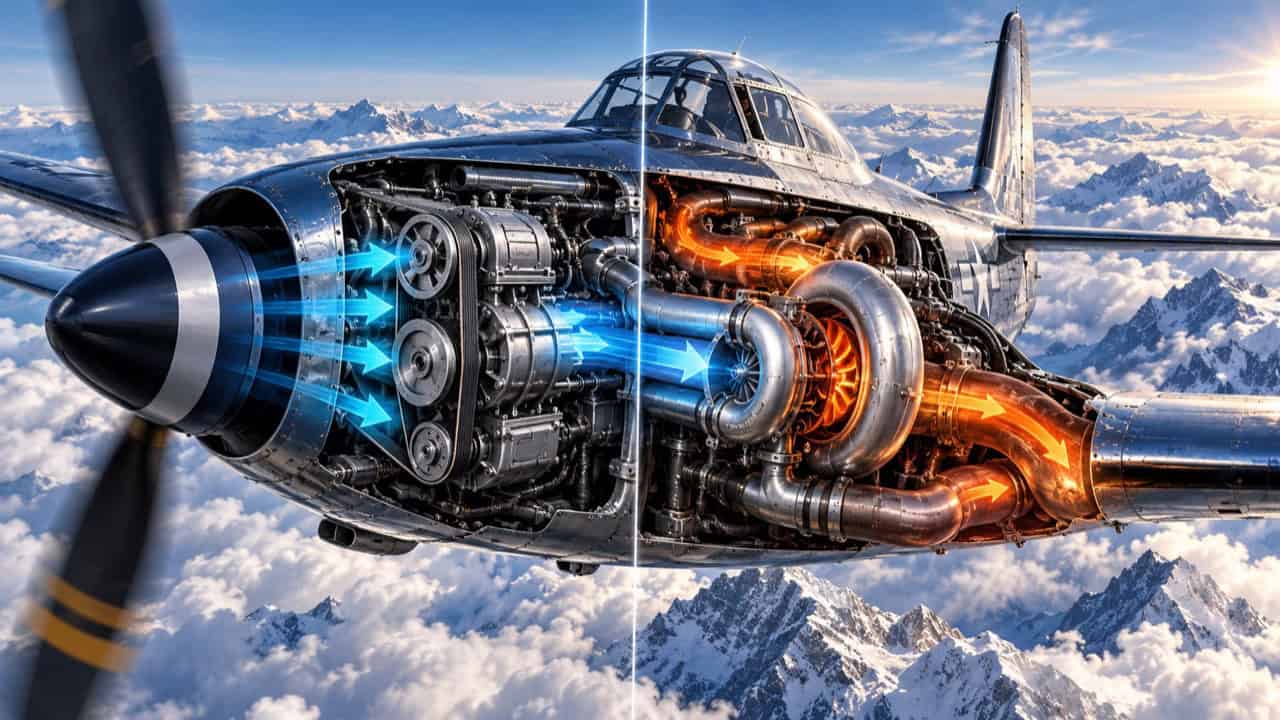
A supercharger and a turbocharger both squeeze extra air into an engine, and the core difference is what spins the compressor. A supercharger is driven by the engine itself, so it responds instantly but costs power. A turbocharger is driven by exhaust gas the engine would otherwise throw away, so it is more efficient but has to wait for that exhaust to build.
That one difference decides everything else: lag, fuel burn, heat, and above all what happens as an airplane climbs. On the ground the trade-off is close. At 18,000 feet, where an unboosted engine can draw only half the air pressure it had at sea level, it is not close at all.
We compared the two on nine criteria as of October 2026, using the FAA’s own pilot handbook, manufacturer data from Eaton and General Electric, and the engines that made both famous.
| Criterion | Supercharger | Turbocharger |
|---|---|---|
| What drives it | The engine itself: a gear train on aircraft engines, usually a belt or chain in cars | Exhaust gas spinning a turbine on the compressor’s shaft |
| Cost to the engine | Uses “a large amount” of engine power for the boost it makes (FAA) | Recovers exhaust energy that would otherwise be lost (FAA) |
| Compressor speed | Up to 24,000 rpm (Eaton TVS) | More than 80,000 rpm (FAA) |
| Boost response | Instant, no lag (Eaton) | Builds with exhaust flow, with lag at low engine speed |
| Power as you climb | Single-speed type: falls with altitude (FAA) | Holds rated power up to the critical altitude (FAA) |
| Boost control | Set by the gear ratio; two-speed types shift with a cockpit lever | A waste gate, automatic or manual |
| Heat | Hot charge: the two-stage Merlin needed two coolers | Hot charge: many aircraft engines add an intercooler (FAA) |
| Shutdown care | No turbine to cool down | Let it cool and spin down first, or oil cokes the bearings (FAA) |
| Famous aircraft | P-51D Mustang (two-stage, two-speed Merlin) | B-17, B-24, P-38, P-47; today the Cirrus SR22T |
How we compared
Mechanism, limits and pilot procedures come from the FAA Pilot’s Handbook of Aeronautical Knowledge (FAA-H-8083-25B, chapter 7). Pressures by altitude come from the same handbook’s standard atmosphere table. The altitude percentages are our own math: standard pressure at each altitude divided by 29.92 inHg at sea level, which is the ceiling on manifold pressure for an engine with no boost. Real manifold pressure runs slightly lower because of intake losses. Car-side figures come from Eaton’s TVS supercharger data.
Power source: crankshaft or exhaust
The FAA puts it in one line: “The key difference lies in the power supply.” Both devices compress intake air to make it denser, so each cylinder burns more fuel per stroke and the engine makes more power.
A supercharger is an engine-driven air pump. On aircraft engines it runs off a gear train at one speed, two speeds, or variable speeds, and it can compress the air in one, two, or more stages. In cars it is usually driven by the crankshaft through a belt or chain.
A turbocharger puts a turbine wheel in the exhaust stream and mounts the compressor on the other end of the same shaft. The hotter and faster the exhaust, the faster the compressor spins.
Myth: a turbo is not a supercharger
It is. Turbocharger is short for turbosupercharger, an exhaust-driven supercharger, and the FAA handbook files both under one heading, Superchargers and Turbosuperchargers. When people say supercharger today they mean the engine-driven kind. Both are forced induction; only the drive differs.
Takeaway: a supercharger borrows power from the crankshaft, while a turbocharger harvests power from the exhaust.
Efficiency: what the boost costs the engine
A supercharger is never free. The FAA calls its major disadvantage the “use of a large amount of the engine’s power output for the amount of power increase produced.” Some of the horsepower it creates goes straight back into turning it.
The turbocharger avoids that, because it runs on heat and pressure that would otherwise leave through the exhaust pipe. That is why the FAA handbook calls it “the most efficient method of increasing horsepower in an engine.”
Car superchargers have narrowed the gap at light load. Eaton, the world’s largest maker of Roots-type superchargers, builds its TVS units with an integrated bypass that lets air skip the rotors when boost is not needed.
Takeaway: the turbocharger wins on efficiency, because its power source is otherwise wasted.
Throttle response and turbo lag
Because a supercharger is tied to the crankshaft, its boost arrives with engine speed. Eaton describes its TVS units as giving “instantaneous boost response” and adding power “without lag,” with boost across the whole rpm range.
A turbocharger has to wait. At idle or low engine speed there is little exhaust energy to spin the turbine, so boost builds a moment after you open the throttle. That delay is turbo lag, and it is the supercharger’s strongest argument on a road car.
The two speeds tell the story. Eaton rates its TVS rotors at up to 24,000 rpm, while the FAA notes a turbocharger’s turbine and impeller can run above 80,000 rpm at very high temperature.
Takeaway: the supercharger wins on response, which matters far more in stop-and-go driving than in an airplane that sits at one power setting for hours.
Power at altitude: where airplanes settle it
Air pressure falls about 1 inch of mercury for every 1,000 feet of climb, according to the FAA. A normally aspirated engine, one with no boost at all, can never see more manifold pressure than the air outside, so its power falls as it climbs.
Here is how much of its sea-level breathing an unboosted engine keeps on a standard day. At 18,000 feet it is half.
| Altitude | Standard pressure | Share of sea-level manifold pressure, no boost |
|---|---|---|
| Sea level | 29.92 inHg | 100% |
| 5,000 feet | 24.89 inHg | 83% |
| 10,000 feet | 20.57 inHg | 69% |
| 15,000 feet | 16.88 inHg | 56% |
| 18,000 feet | 14.94 inHg | 50% |
| 20,000 feet | 13.74 inHg | 46% |
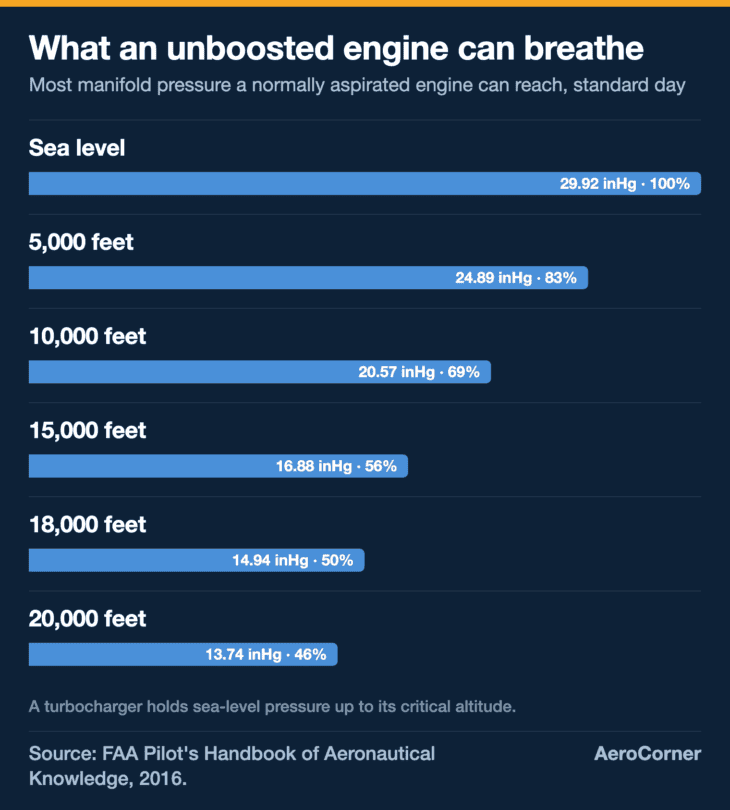
That loss is what sets a piston airplane’s service ceiling, and it is what both kinds of boost were invented to fight. The pilot watches the result on the manifold pressure gauge, one of the core engine instruments in any boosted airplane.
The simplest supercharger, the single-speed “sea-level” type, boosts power at every altitude, but its output still drops as the airplane climbs, because the gear ratio is fixed.
To keep power at height, engineers added a second gear speed, a “high blower” the pilot selects with a cockpit lever once the airplane reaches a set altitude, and then a second compression stage.
A turbocharger adjusts itself. As the airplane climbs, the waste gate closes a little at a time and sends more exhaust through the turbine, which holds manifold pressure steady.
When the waste gate is fully closed, the engine has reached its critical altitude, the highest point at which it can still make rated power. Above it, power falls like any unboosted engine.
Pikes Peak, 1918
The Liberty aircraft engine was rated at 350 horsepower at sea level, and its output dropped by half in the thin air at altitude. In 1918 GE engineer Sanford Moss bolted his exhaust-driven turbosupercharger to one on top of Pikes Peak, at 14,000 feet, and it delivered 352 horsepower. A turbocharged Le Pere biplane, first flown in 1919, later reached 137 mph at 18,400 feet, against 90 mph without the turbo.
Takeaway: the turbocharger wins at altitude, because it holds sea-level power without the extra gears, stages and lever work a supercharger needs.
Heat, cooling and care
Compressing air heats it, whichever device does the squeezing. Hot intake air is less dense and raises the risk of detonation, so many turbocharged aircraft engines run the air through an intercooler, a small heat exchanger cooled by outside air, before it reaches the fuel system.
Superchargers face the same problem. The two-stage Merlin in the P-51 needed an intercooler between its stages and a second cooler after them, because without cooling the compressed charge could heat up by as much as 369°F (205°C).
The turbocharger adds two pilot duties of its own. The FAA warns against overboost, a manifold pressure above the engine’s limit, which can happen with a manual waste gate left closed in a descent or with full throttle on cold oil.
And because the turbine runs so hot and fast, the pilot lets it cool and slow down before shutdown, so oil left in the bearings does not boil into hard carbon.
Takeaway: both need cooling at high boost, but the turbocharger asks more of the person running it.
From WWII fighters to today’s piston planes
Both technologies fought the same war. Swiss engineer Alfred Büchi patented the turbosupercharger in 1910, and in 1937 GE won an Army Air Corps order to build them for the B-17 and B-24 bombers and the P-38 Lightning and P-47 Thunderbolt fighters.
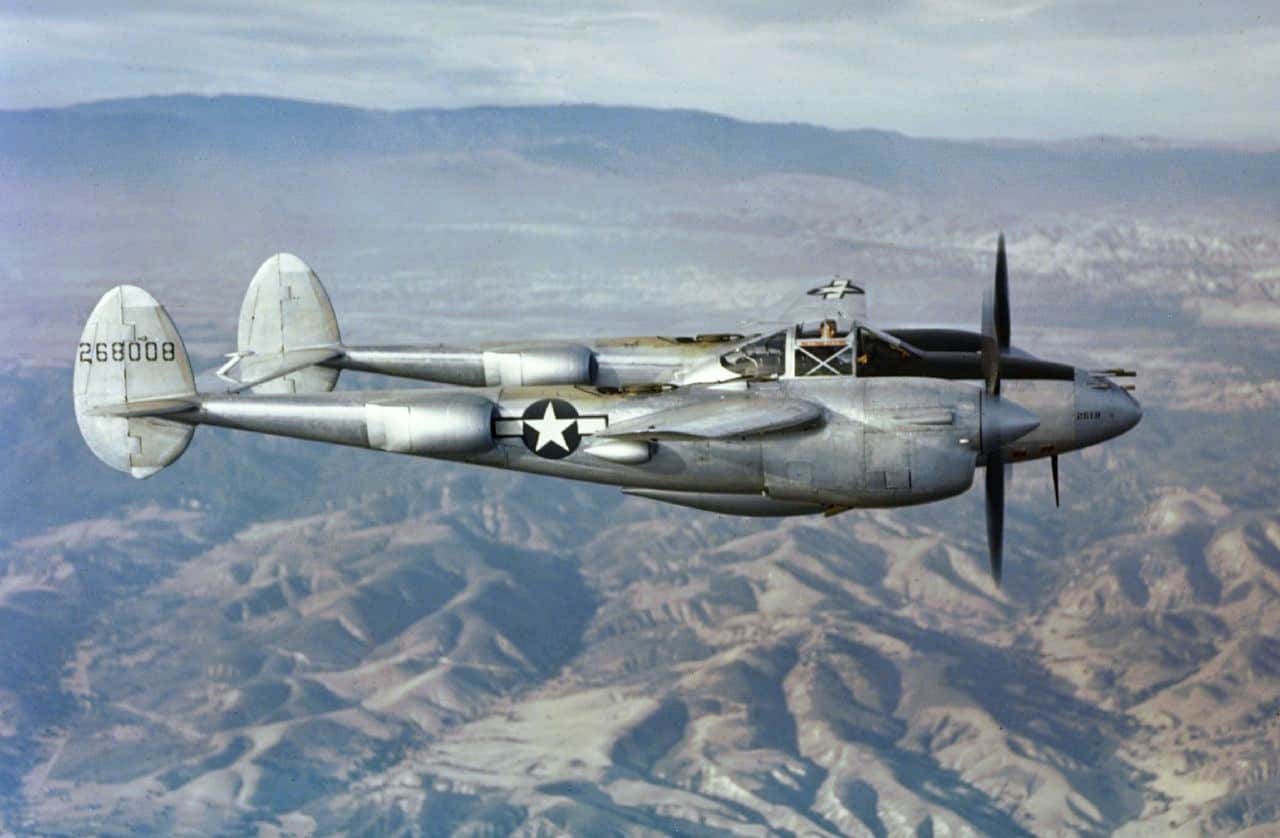

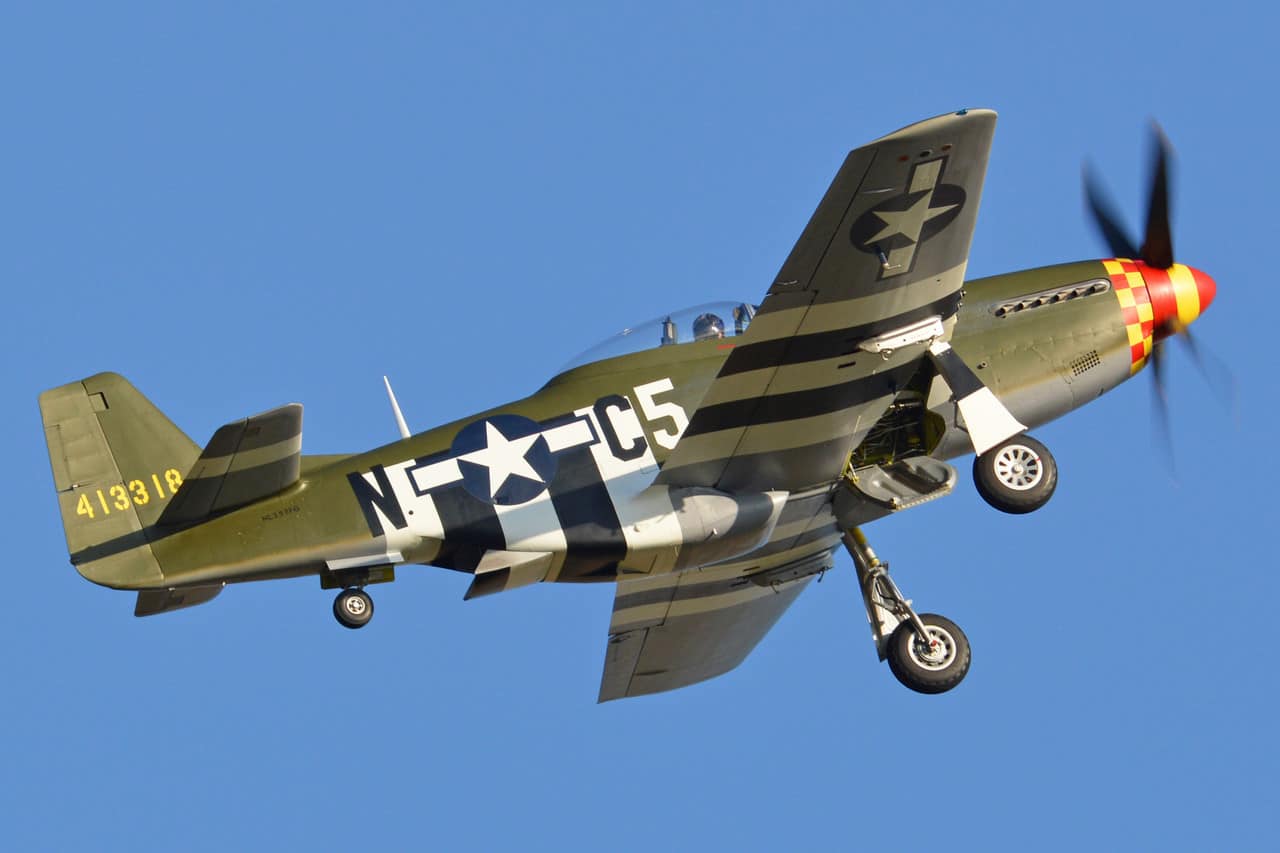
Britain went the gear-driven way. The two-stage, two-speed supercharger on the Merlin, built in the US by Packard as the V-1650, put two impellers on one shaft, geared at 6.391:1 or 8.095:1 and switched by hydraulic clutches. In V-1650-3 and V-1650-7 form it made more than 1,270 horsepower above 30,000 feet.
That engine turned the P-51 Mustang into a fighter that could escort heavy bombers to Germany and back.
Boldmethod sums up the history as “superchargers started it, but turbos are here to stay,” and the Cirrus SR22T shows why.
The SR22T launched in 2010 with a Continental TSIO-550-K that uses two turbochargers and intercoolers to make 315 horsepower at 2,500 rpm, at up to 36.5 inches of manifold pressure. AOPA put its maximum cruise at 214 knots, against 180 knots for a typical normally aspirated SR22.
Cirrus had already delivered more than 900 turbonormalized SR22s by then, and the two are not the same thing. A turbonormalizer only holds sea-level manifold pressure through the climb. A ground-boosted turbo like the SR22T’s pushes it above sea level, and the SR22T’s cylinders run a lower 7.5:1 compression ratio, against 8.5:1 on the normally aspirated IO-550.
The turbocharger also led somewhere bigger. In 1941 the US government asked GE, the turbosupercharger maker, to put one of the first jet engines into production, and it flew in the Bell XP-59A on October 1, 1942. A turbojet or turbofan engine works on the same idea: a turbine in the hot exhaust driving a compressor at the front.
Takeaway: superchargers peaked in the 1940s, and turbochargers took over the boosted piston airplane.
The difference in one sentence
A supercharger spends engine power to give instant boost, and a turbocharger spends exhaust energy to give efficient boost that holds up to altitude.
That is why a road car built for sharp throttle response may still carry a supercharger, and why a piston airplane built to cruise high above the weather carries a turbo. Eaton even offers systems that pair the two on one engine.
FAQ
Sources and references used for research and fact-checking.
- Federal Aviation Administration, Pilot's Handbook of Aeronautical Knowledge, Chapter 7: Aircraft Systems
- Federal Aviation Administration, Pilot's Handbook of Aeronautical Knowledge, Chapter 4: Principles of Flight
- Eaton, TVS Superchargers for Performance Automotive
- Boldmethod, What's The Difference Between Turbochargers and Superchargers?
- General Electric, Supercharged: GE's Aviation Business Rose From the Ashes of a World War
- Wikipedia, Packard V-1650 Merlin
- AOPA, Cirrus SR22T
Get the Newsletter
The latest aviation news and stories sent to your inbox.
About the Author

Tim is the owner and lead editor of AeroCorner since 2019, overseeing aviation content covering aircraft, airlines, airports, and the broader aviation industry. Through years of researching, writing, editing, and publishing aviation-focused content, he has developed extensive practical knowledge of commercial aviation and air travel. Based in Asia and a frequent traveler himself, Tim also brings firsthand passenger experience to AeroCorner’s coverage. Outside of publishing, he has also explored aviation firsthand through hands-on flight training in New Zealand.