Military Propellor Planes
The Supermarine Spitfire was the RAF's elliptical-winged fighter of the Second World War, built in 20,351 examples from 1938 to 1948 and best known for its role beside the Hurricane in the Battle of Britain.
Updated: by Tim de Vries

The latest aviation news and stories sent to your inbox.
The Supermarine Spitfire is the British single-seat fighter that flew from 1938 until the early 1950s and was the only British fighter built continuously through the Second World War. R. J. Mitchell designed it around a thin elliptical wing and a Rolls-Royce Merlin engine, and 20,351 were built across 24 marks. The panel on this page describes the Mk Vb, the most numerous Merlin-powered variant.
Live Fleet Activity (SPIT)
Fetching live data…
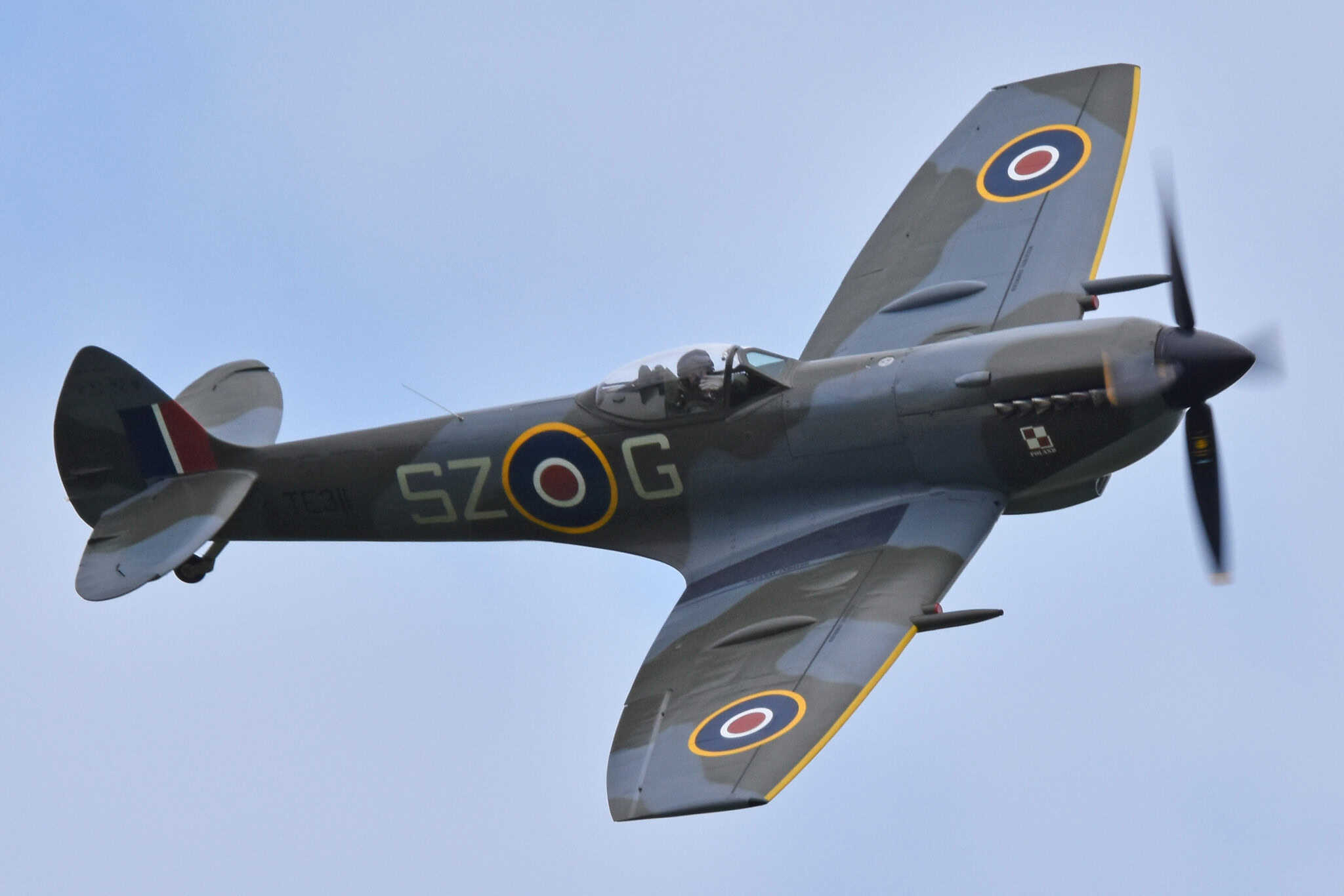


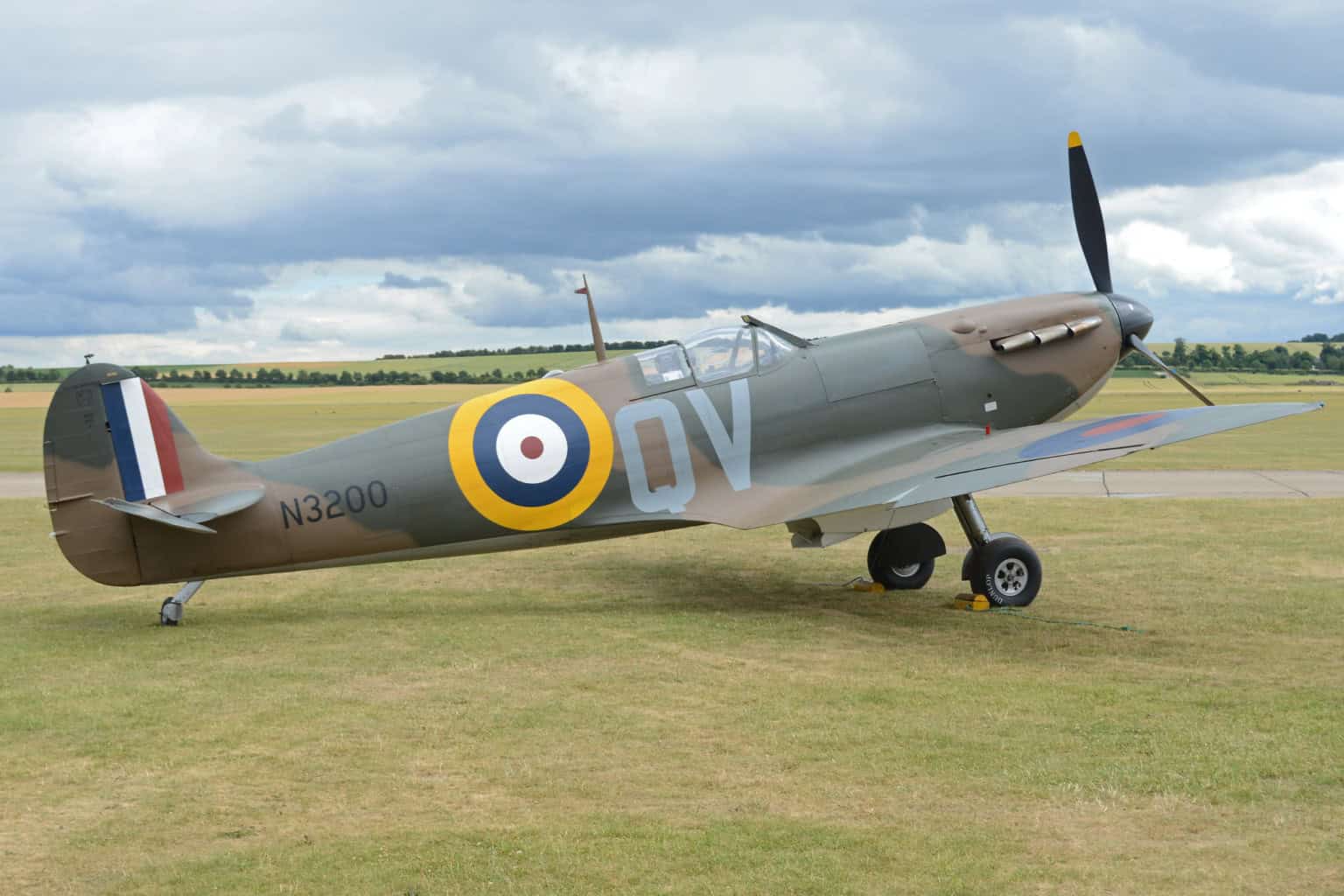

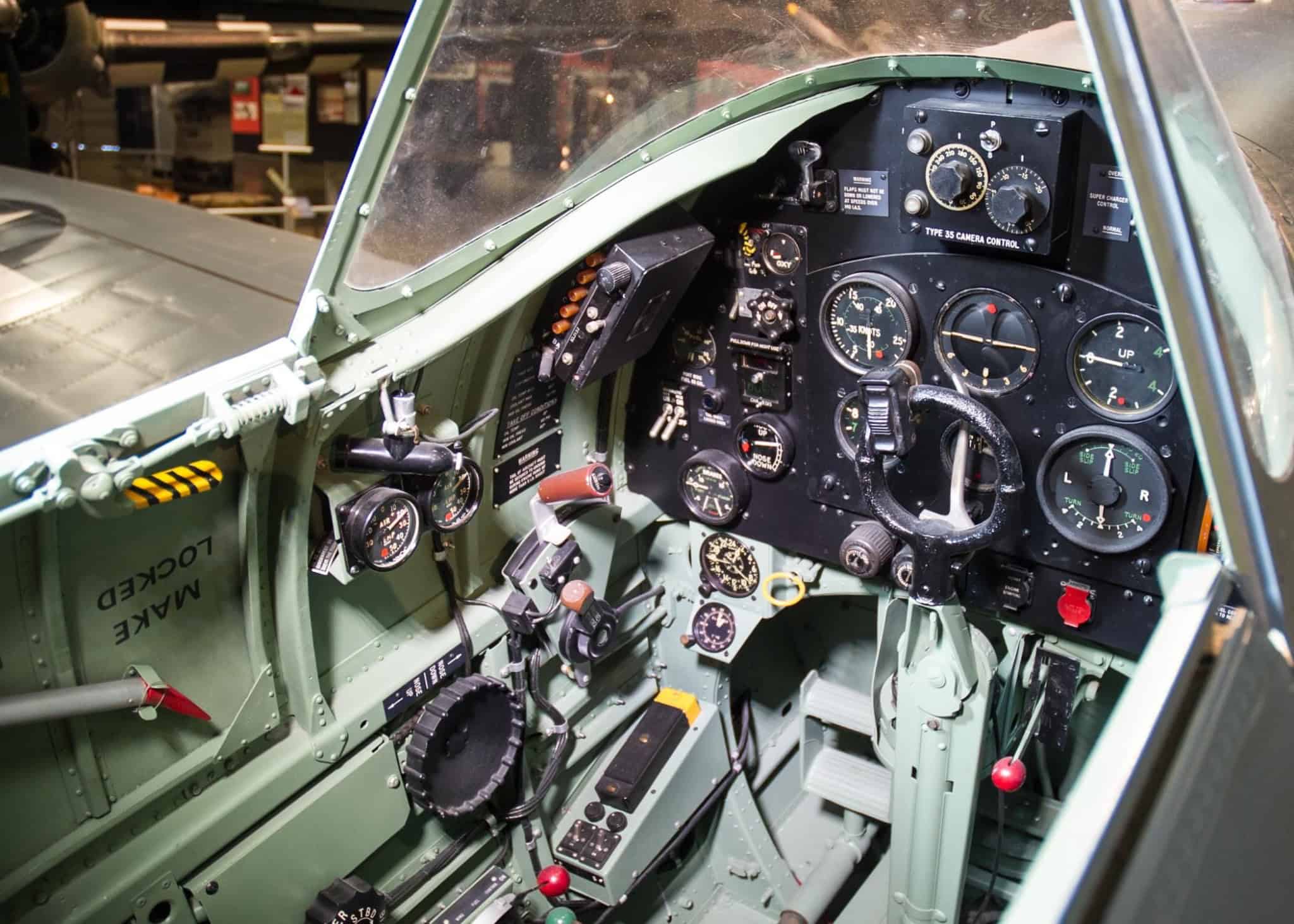
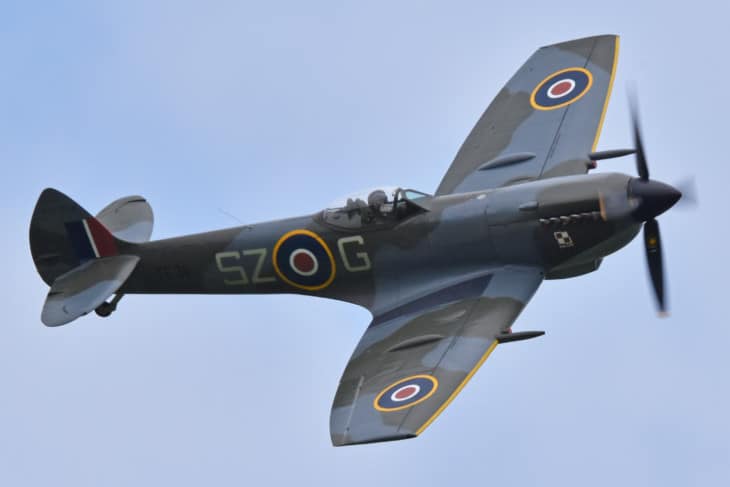
The Supermarine Spitfire was the only British fighter built continuously before, during and after the Second World War. A total of 20,351 were built between 1938 and 1948, across 24 marks and many sub-variants.
It was designed as a short-range interceptor, yet it grew into a fighter-bomber, a photo-reconnaissance aircraft and a carrier fighter. The Spitfire is the shape most people picture when they think of the Battle of Britain.
The page’s specification panel describes the Mk Vb. The Mk V was built in larger numbers than any other Spitfire.
Chief designer R. J. Mitchell had already failed once. His Type 224, an open-cockpit gull-winged monoplane built for the Air Ministry’s F7/30 fighter specification, was a disappointment and lost out to the Gloster Gladiator biplane.
Mitchell’s team “cleaned up” the design, drawing on their experience with Schneider Trophy racing seaplanes. The result was the Type 300, with retractable undercarriage, an enclosed cockpit and the new Rolls-Royce PV-XII engine that became the Merlin.
The prototype, K5054, first flew on 5 March 1936 at Eastleigh with Captain Joseph “Mutt” Summers at the controls. Mitchell died of cancer in 1937, so all later development was led by his chief draughtsman, Joe Smith.
The signature wing solved two conflicting needs. It had to be thin enough to avoid drag, yet thick enough to hold the retractable undercarriage, guns and ammunition.
An elliptical planform gives the lowest induced drag for an untwisted wing. Designer Beverley Shenstone’s shape also used a spar built from five square tubes that fitted inside each other and were cut away toward the tip, a lightweight and very strong arrangement.
The wing also had washout, a slight twist so the roots stalled before the tips. That gave pilots a buffet warning and made the Spitfire forgiving even for relatively inexperienced fliers.
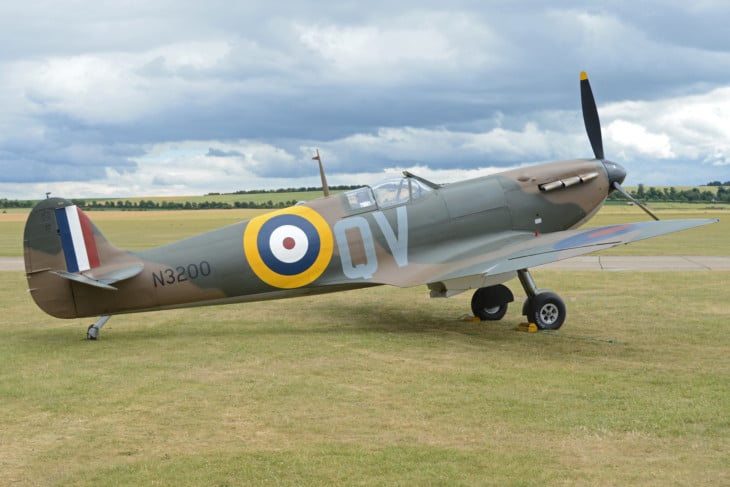
The name was not Mitchell’s idea. Sir Robert McLean, a director and chairman of Vickers (Aviation), suggested it because he called his spirited elder daughter Annie “a little spitfire”.
Mitchell reportedly thought it “just the sort of bloody silly name they would choose”. The word has been recorded since at least 1801 for a fiery, ferocious person, usually a girl or woman.
“Supermarine” is simply the manufacturer, Supermarine Aviation Works, which operated as a Vickers-Armstrong subsidiary from 1928. The Spitfire is a Supermarine aircraft, not a “supermarine” type.
During the Battle of Britain, from July to October 1940, the more numerous Hurricane flew more sorties. The Spitfire captured the public imagination, partly because it was generally the better fighter.
Spitfire units had a lower attrition rate and a higher victory-to-loss ratio than Hurricane units. They mostly met Messerschmitt Bf 109E fighters, which were a close match.
The Merlin’s carburettor was a weakness. Unlike the fuel-injected Bf 109E, Spitfires could not nose straight down without the engine starving. A metal disc with a hole, fitted in March 1941, eased the problem and became known as “Miss Shilling’s orifice”, after Beatrice “Tilly” Shilling.
For the fuller story of that summer, see our article on the Battle of Britain.
The original Merlin produced 1,030 hp. The airframe was strong enough to take ever more powerful engines, and later marks used Rolls-Royce Griffons producing up to 2,340 hp.
The Mk V was the most-built variant at 6,487 aircraft, followed by 5,656 Mk IXs. The Mk IX used a Merlin with a two-stage, two-speed supercharger.
The tail grew along with the engine. The fin and tailplane of the Mk 22 and Mk 24 were 25% larger in area than those of the Mk I.
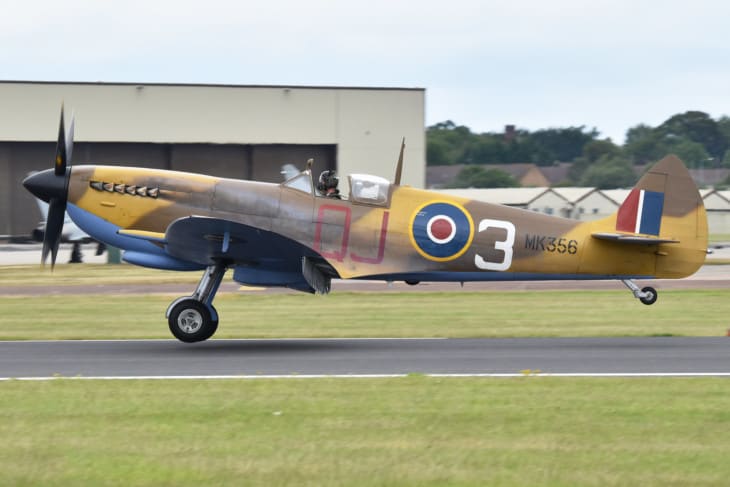
The full specification table for the aircraft is on this page, and it describes the Mk Vb. A few figures need context because the sources quote them differently.
The panel’s range of 956 nm · 1,100 mi · 1,770 km is the ferry range, flown with a drop tank. The standard Mk Vb range is 479 miles (771 km), and the combat range on internal fuel is 248 miles (400 km).
The Mk Vb’s top speed on the panel is 321 kt · 369 mph · 594 km/h. The panel stores speed in knots and converts, so the mph figure can sit a mile or two away from the round numbers in period sources.
The wingspan changed with the mission. The Mk Vb panel uses the standard tips, while the high-altitude marks used pointed tips that stretched the span to 40 ft 2 in (12.24 m). The “clipped” wing instead cut 3 ft 6 in from the standard span.

Spitfire armament was set by interchangeable wing types. The A wing carried eight .303 in Browning machine guns, with 350 rounds per gun.
The B wing had two 20 mm Hispano cannon and four .303 in machine guns. The C, or universal, wing could carry four cannon or two cannon with four machine guns.
Early cannon installations were unreliable. The first 30 cannon-armed Spitfires, the Mk IB, were so troublesome that 19 Squadron asked to swap them for Browning-armed aircraft until Supermarine improved the feed mechanism.
The Spitfire served as an interceptor, photo-reconnaissance aircraft, fighter-bomber and trainer. Unarmed PR Spitfires were the RAF’s first high-speed photo-reconnaissance aircraft and photographed German radar sites and the Peenemunde rocket base.
The Seafire was the carrier adaptation, used by the Fleet Air Arm from 1942 until the mid-1950s. Poor forward visibility meant pilots landed with their heads out of the cockpit, looking along the port cowling. See the Supermarine Seafire page for that story.
A two-seat trainer was never ordered officially. A few were built after the war by converting old Mk IX airframes with a second cockpit.
On 7 March 1942, 15 Mk Vs carrying 90 imperial gallon belly tanks flew off HMS Eagle on a 600-mile (970 km) run to Malta. They were the first Spitfire Vs to serve outside Britain.
The Soviet Air Force also received Spitfires, with Mk Vb deliveries beginning at the start of 1943. Most went to air defence units rather than the front line.
The US used them as well. The Eagle Squadrons transferred into the USAAF’s 4th Fighter Group in September 1942 and kept their Mk Vb aircraft until the group converted to the Republic P-47 Thunderbolt in March 1943. The 14th Photographic Squadron later flew Mk XIs from November 1943 to April 1945.

The first production Spitfire was flown by Jeffrey Quill on 15 May 1938. A production aircraft cost about 9,500 pounds, of which the hand-made fuselage was roughly 2,500 pounds and the Merlin engine about 2,000 pounds.
The Castle Bromwich factory near Birmingham built 12,129 Spitfires by the time production there ended in June 1945. After the Luftwaffe destroyed the Woolston and Itchen plants on 26 September 1940, production was dispersed to small workshops across southern England.
The type remained in production until 20 February 1948, when the last aircraft, VN496, left the line.
The final version, the Griffon-powered Mk 24, first flew on 13 April 1946. Only one regular RAF unit, 80 Squadron, flew it, patrolling from Germany and later defending Hong Kong.
The last operational sortie of an RAF Spitfire took place on 1 April 1954. It was flown by PR Mk 19 PS888 of 81 Squadron from Seletar, Singapore, and the ground crew painted “The Last” on its nose.
Roughly 240 Spitfires are preserved, and about 60 to 70 of them are airworthy, depending on the count. The Battle of Britain Memorial Flight operates five airworthy examples.
Mk IIa P7350 is the only airworthy Spitfire that fought in the Battle of Britain. Several former trainers survive, including the T Mk VIII and the “Grace Spitfire” ML407.
Airworthy Spitfires sell privately and rarely publish prices. A Mk IXB, MH415, was listed through an agent on a price-on-application basis in 2022, with reports of about 4.5 million pounds.
The mark, the aircraft’s history and its flying status all move the figure, and public sale results are scarce.
That is not confirmed. In December 2013 the Daily Mail reported that Pitt had bought a Spitfire for 2 million pounds, about $3.3 million, and would learn to fly it at the Boultbee Flight Academy in Oxford. The report did not name the seller or the Spitfire mark, and we found no later confirmation of whether he still owns it.
Yes. The USAAF flew Spitfires in the 4th Fighter Group, formed from the RAF’s Eagle Squadrons in September 1942, until they were replaced by P-47 Thunderbolts in March 1943. The 14th Photographic Squadron of the Eighth Air Force flew Mk XI reconnaissance Spitfires from November 1943 to April 1945.
There is no set price. A fully airworthy Mk IXB was reported at about 4.5 million pounds in 2022, while the reported 2013 price of Brad Pitt’s Spitfire was 2 million pounds. Variant, history, condition and flying status decide the figure.
Supermarine was the manufacturer, Supermarine Aviation Works, which became a Vickers-Armstrong subsidiary in 1928. The “Spitfire” name came from Vickers director Sir Robert McLean, who used it as a nickname for his daughter Annie.
A total of 20,351 were built between 1938 and 1948, including two-seat trainers. The Mk V was the most numerous at 6,487, followed by the Mk IX at 5,656.
Yes, roughly 60 to 70 are airworthy, depending on the source. Five fly with the RAF’s Battle of Britain Memorial Flight.
Early marks used the Rolls-Royce Merlin, starting at 1,030 hp. Later marks used the larger Rolls-Royce Griffon, producing up to 2,340 hp.
Sources and references used for research and fact-checking.