

Table of Contents
Delta retired the last American passenger 747 in December 2017. British Airways, which tied Atlas Air as the world’s largest 747 operator in 2019, announced in July 2020 that its whole fleet was going. Boeing handed over the final 747 in January 2023.
After that run of farewell flights, most people assume the jumbo jet is gone. It is not. Hundreds of them are in the air today, and a few still leave US airports with passengers aboard every day.
What changed is not how many 747s fly, but what they carry and who flies them. Here is the current count, who owns the survivors, and how long the Queen of the Skies is likely to keep flying.
How Many Boeing 747s Are Still Flying in 2026?
Roughly 420 Boeing 747s remain in service worldwide, out of 1,574 built from 1968, when the first one rolled out, to the final delivery in January 2023.
That figure comes from Planespotters.net fleet data reported by Simple Flying in January 2026, and it counts aircraft on active operator fleets, so a few may be in maintenance on any given day.
Only about 40 of them fly scheduled passenger flights, with four airlines. The rest are freighters, plus a small group of government, military and VIP jets. In other words, roughly nine in ten surviving 747s never carry a paying passenger.
The 747 fleet at a glance
Built: 1,574. Still in service: about 420. In scheduled passenger service: about 40, with Lufthansa, Air China, Korean Air and Rossiya. Largest operator: Atlas Air, a cargo airline, with 65. Newest: a 747-8 Freighter delivered to Atlas in January 2023.
The survivors are almost all from the last two generations. A mid-2025 Planespotters count found about 255 747-400s and 150 747-8s in service, against just 21 aircraft from all the older versions combined.
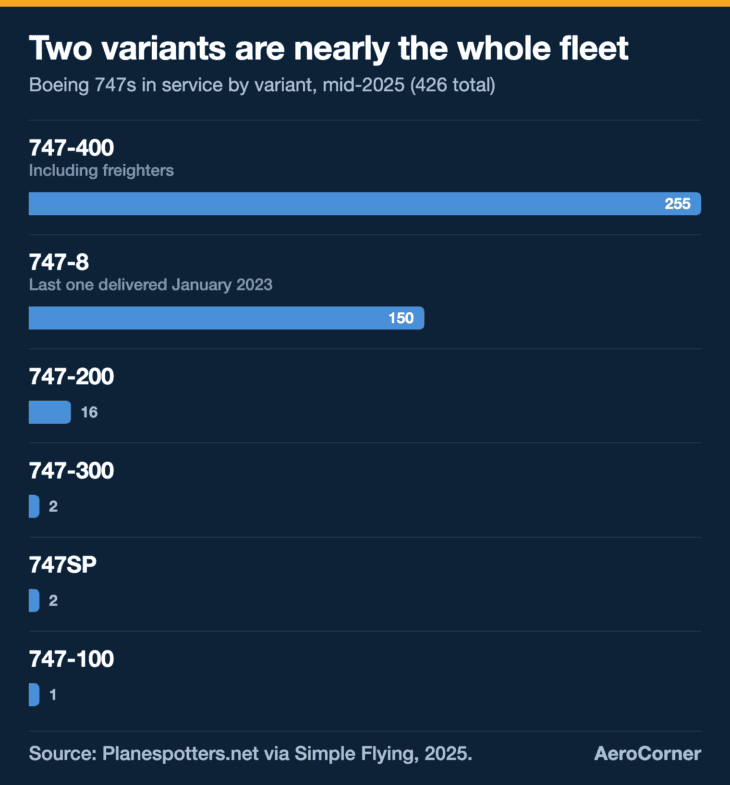
Those 21 older jets are mostly 747-200s, along with a couple of 747-300s, two short-bodied 747SPs and a single original 747-100. The US Air Force alone flies six 747-200-based aircraft: two Air Force One jets and four E-4B command posts.
The 747 became a cargo plane
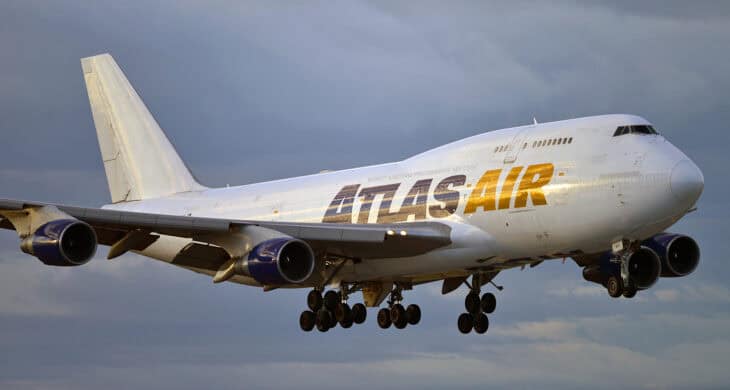
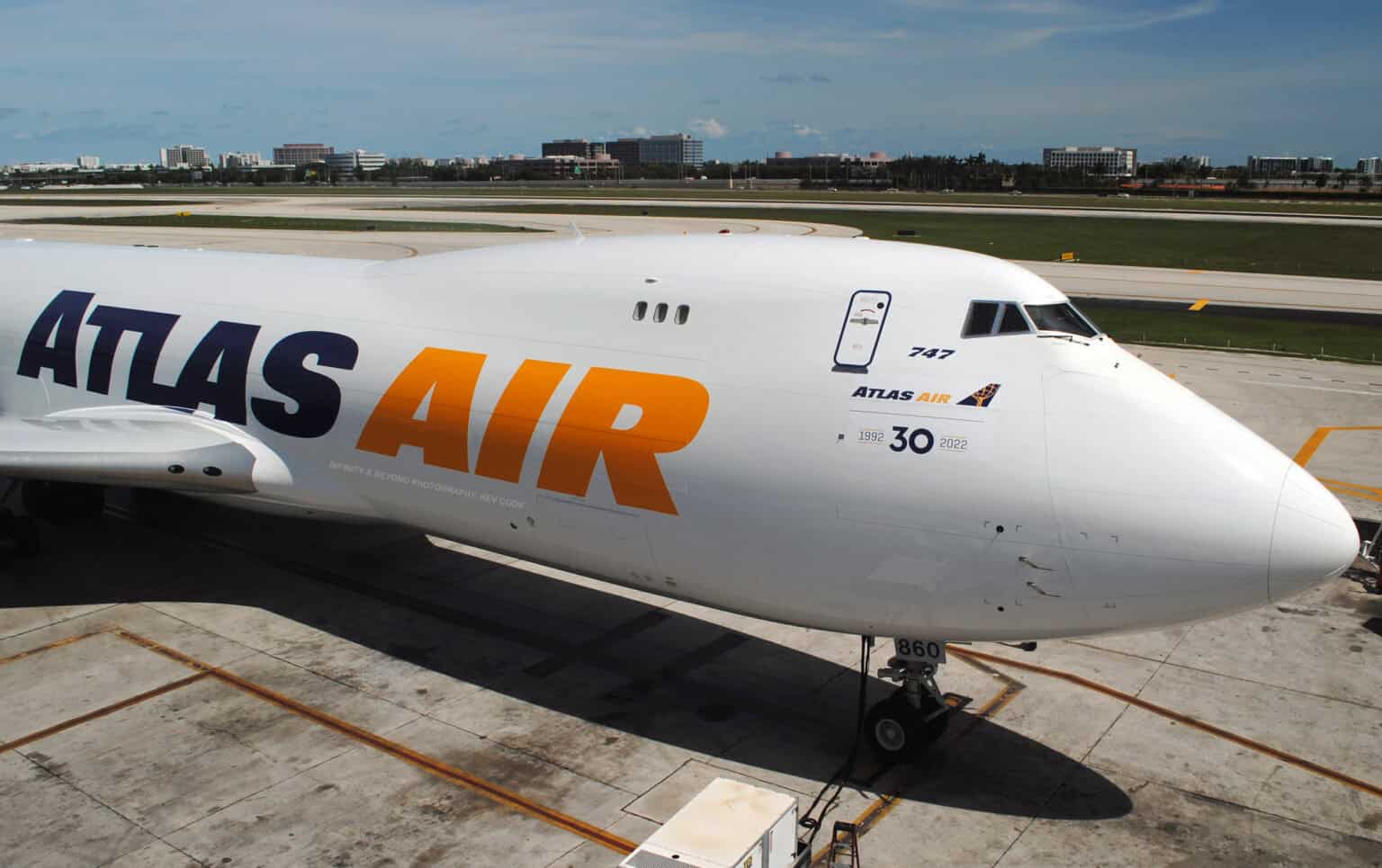
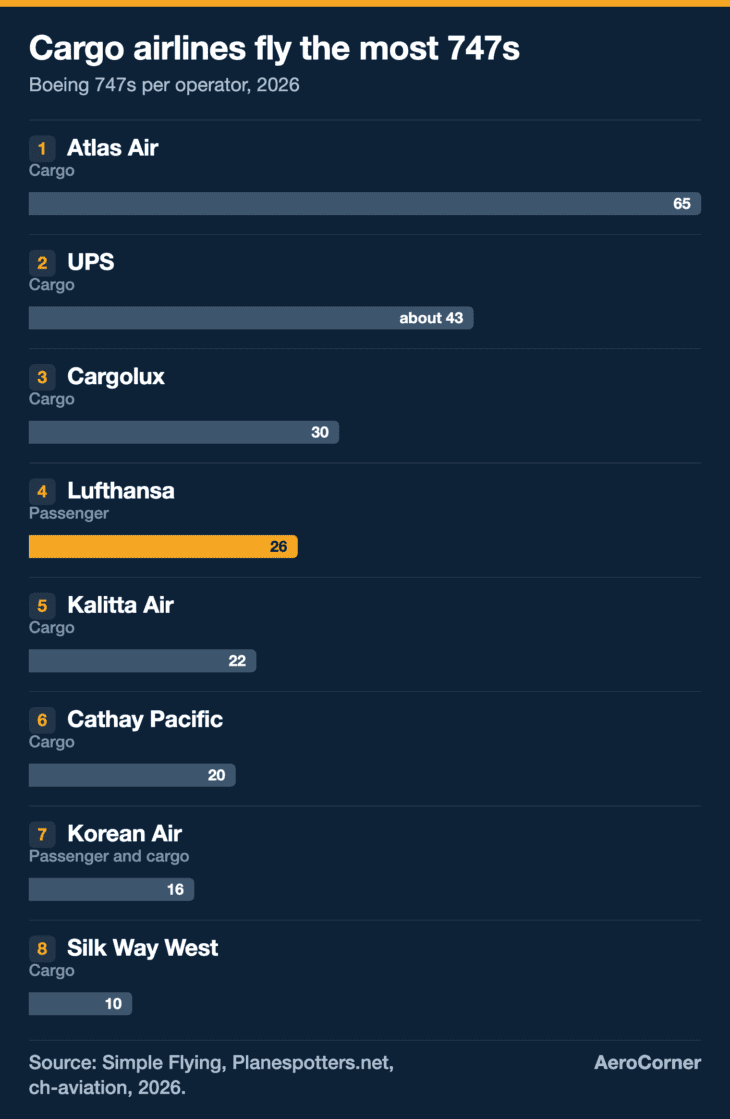
The biggest 747 operator in the world does not sell a single seat. Atlas Air flies 65 of them, according to the same January 2026 count, and it took delivery of the very last 747 Boeing built, a 747-8 Freighter, on January 31, 2023.
Behind Atlas come UPS with around 43, Cargolux with 30 and Kalitta Air with 22. Lufthansa, with about 26, is the only operator in the top five that puts passengers on its 747s.
Freight is where the 747’s oldest design decision pays off. The raised cockpit lets freighter versions load through a nose that swings open, which is the story behind the 747’s famous hump.
That nose door is a big part of why cargo airlines keep the type. Long, bulky loads go straight into the main deck, and the freighter combines that wide, unobstructed deck with a high payload.
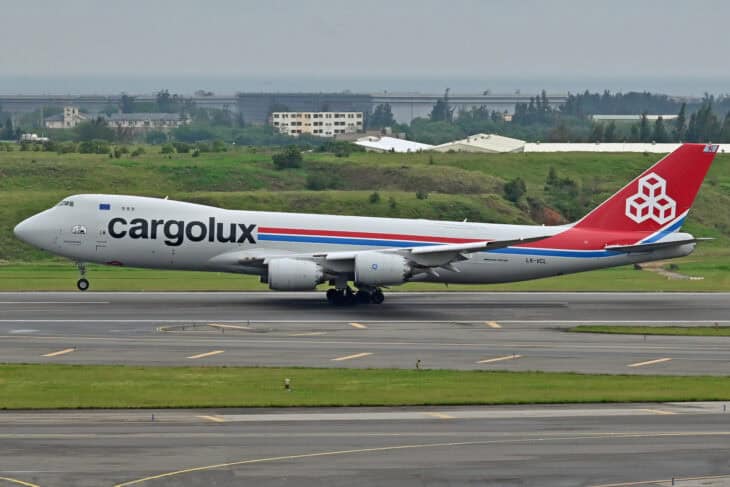
The freighters are also much younger than the type’s reputation suggests. Boeing built 107 747-8 Freighters, the last of them delivered in 2023, to carriers including Cargolux, Nippon Cargo Airlines, Cathay Pacific and UPS.
Even Boeing relies on the type. It built four 747 Dreamlifters, modified with a tail that swings open, to fly 787 Dreamliner parts to final assembly, and Atlas Air operates them.
Only four airlines still sell you a seat on one
If you want to fly on a 747 as a passenger in 2026, your options come down to four airlines. Only one of them flies the type to a long list of US cities.
| Airline | Passenger 747s | Variant | What is happening |
|---|---|---|---|
| Lufthansa | 25 to 26 | 747-8 and 747-400 | 747-8 kept into the 2030s; 747-400 farewell planned for 2027 |
| Air China | 7 | 747-8 | All seven it bought are still in service |
| Korean Air | 5 | 747-8 | Sold the other five of its ten to the US military program |
| Rossiya | 2 or more | 747-400 | Returning stored ex-Transaero jets to service under sanctions |
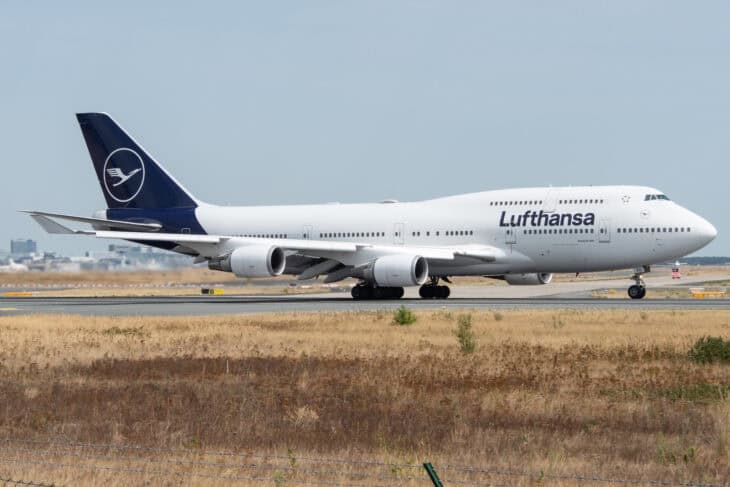
Lufthansa is the one most Americans can actually book. In summer 2026 its 747-8s fly daily from Frankfurt to Los Angeles, San Francisco, Chicago, Newark and Miami, and its older 747-400s serve Houston and Boston.
That 747-400 window is closing. Lufthansa Group said in April 2026 that two 747-400s would be grounded from October onward, with a final farewell to the type planned for 2027. The 747-8s are expected to stay well into the 2030s.

Korean Air is shrinking its passenger 747 fleet fastest. It sold five of its ten 747-8s to Sierra Nevada Corporation in 2024 for the US Air Force’s next-generation command post, and dropped the type from London Heathrow, leaving the UK with no scheduled passenger 747 service in 2026.
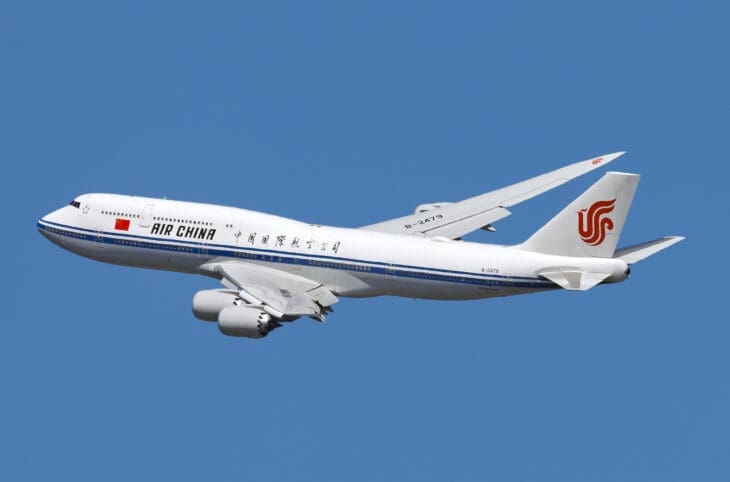
Air China still flies all seven of its 747-8s. Rossiya, a Russian airline, is the odd case: cut off from Western parts by sanctions, it has been pulling 747-400s it inherited from the bankrupt Transaero out of storage and back into service.
Iran’s Mahan Air also still lists 747-400s in its fleet. How often they fly under sanctions is hard to verify, so they are not in the count above.
Only three airlines ever bought the passenger 747-8
Boeing built 48 passenger 747-8s, and only 36 went to airlines: 19 to Lufthansa, 10 to Korean Air and 7 to Air China. The other 12 went to VIP customers, two unidentified buyers and the US Air Force, which bought two to become the next Air Force One.
The 747s that carry no airline’s name
The most famous 747s still flying belong to the US Air Force. The two VC-25As, highly customized 747-200Bs, have served as Air Force One since 1990.
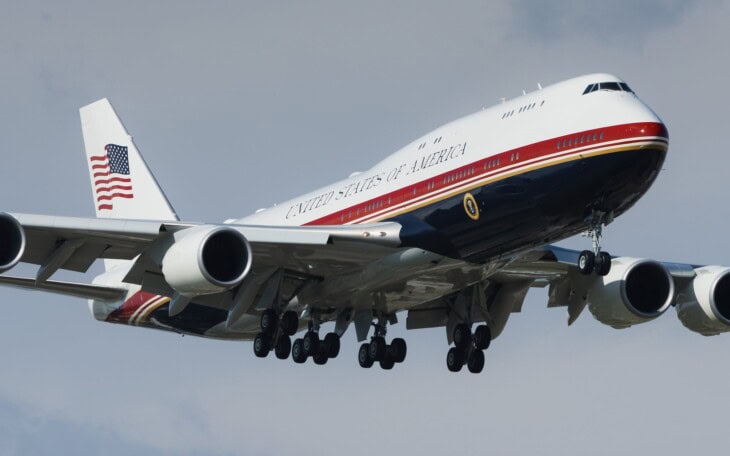
On July 1, 2026, they were joined by a third. A 747-8 donated by Qatar and converted by L3Harris, known as the VC-25B Bridge, flew its first presidential mission from Joint Base Andrews to North Dakota, as covered in our piece on the Qatar-gifted Air Force One.
The two permanent VC-25Bs, also 747-8s, are now due by 2028, years behind the original 2024 target. To train their crews, the Air Force first leased an Atlas Air 747-8 Freighter and then added a former Lufthansa 747-8 as a full-time trainer.

Then there is the E-4B, the “Doomsday Plane”: four 747-200-based airborne command posts, one of which is kept on alert around the clock. The five 747-8s Korean Air sold to Sierra Nevada are the start of their replacement, a program aiming for six to eight aircraft by 2036.
Add the VIP 747-8s delivered to the governments of Qatar, Kuwait, Oman, Brunei, Morocco, Saudi Arabia, Turkey and Egypt, and the 747 has quietly become a head-of-state airplane.
The myth: the 747 has been retired
Myth: the jumbo jet is gone
What retired was the passenger 747 at most airlines, not the airplane. The worldwide fleet has shrunk far less than the farewell flights suggest, because the jets that left passenger service were largely replaced by freighters.
Compare the numbers over time. In 1982 there were 542 747s in active service. In July 2019, Flight International counted 462 in airline service, and today the figure is around 420.
Those counts are not measured in exactly the same way, so treat them as a rough trend rather than a precise decline. But the direction is clear: the 747 fleet has shrunk only modestly since its passenger heyday. What has collapsed is the share of it carrying people.
The passenger retirements came from economics, not from the airplane wearing out. Long-range twinjets such as the 767, 777 and 787, cleared to fly far from land on two engines, proved cheaper to operate than four-engine jets. The same squeeze ended the Airbus A380 at most of its airlines.
Cargo runs on different math. A freighter earns its keep on how much it can lift and what shape of load it can take, which is where the 747’s size and nose door still count. The fuel bill is real: a 747’s full fuel load weighs almost as much as the empty plane.
How long will the 747 keep flying?
For decades yet. The newest 747 is less than four years old, and freighters routinely fly for 30 years or more: the 747-400Fs still active in early 2026 averaged 33.2 years old, according to ch-aviation data.
On the passenger side, the clock is shorter. Lufthansa’s 747-400s are due out in 2027, and the airline’s 747-8s are expected to remain into the 2030s, which will likely make them some of the last passenger jumbos in scheduled service.
The government fleet may outlast everyone. The permanent VC-25Bs are meant for several decades of presidential service from 2028, and the E-4B replacement program runs to at least 2036. On that schedule, 747s could plausibly still be carrying presidents in the 2050s.
So the next time you hear that the 747 has been retired, check the overnight arrivals at one of the busiest cargo airports in the US. The jumbo jet never left. It just stopped selling tickets.
Sources and references used for research and fact-checking.
- Boeing, Boeing, Atlas Air Celebrate Delivery of Final 747, an Airplane that Transformed Aviation and Global Air Travel
- Simple Flying, Which Airline Has The Largest Boeing 747 Fleet In 2026?
- Simple Flying, How Many Boeing 747s Are Left?
- Simple Flying, It's 2026, But Why Do Some Airlines Still Love The 747?
- Simple Flying, Only 3 Airlines Still Fly Passenger Boeing 747-8s: The US Military Wants Them All
- Simple Flying, How Many Boeing 747-400Fs Are Still Flying In 2026?
- Simple Flying, End Of An Era: UK Has No Boeing 747 Passenger Flights In 2026
- Lufthansa Group, Lufthansa Group accelerates strategy implementation
- Aerospace Global News, Where Lufthansa's quadjets are flying this summer
- AirlineGeeks, Lufthansa Selling Pair of 747-8s, Retire Two 747-400s
- Air Data News, Russia turns to grounded Boeing 747s and other aging aircraft to expand commercial fleets
- Defense News, Former Qatari aircraft on track for summer Air Force One delivery
- Army Recognition, Donald Trump makes first presidential flight with new VC-25B Bridge Air Force One gifted by Qatar
- Wikipedia, Boeing 747
- Wikipedia, Boeing 747-8
- Wikipedia, Boeing E-4
- Wikipedia, Boeing Dreamlifter
- Wikipedia, Air Force One
- Wikipedia, Mahan Air
Get the Newsletter
The latest aviation news and stories sent to your inbox.
About the Author

Tim is the owner and lead editor of AeroCorner since 2019, overseeing aviation content covering aircraft, airlines, airports, and the broader aviation industry. Through years of researching, writing, editing, and publishing aviation-focused content, he has developed extensive practical knowledge of commercial aviation and air travel. Based in Asia and a frequent traveler himself, Tim also brings firsthand passenger experience to AeroCorner’s coverage. Outside of publishing, he has also explored aviation firsthand through hands-on flight training in New Zealand.