

Table of Contents
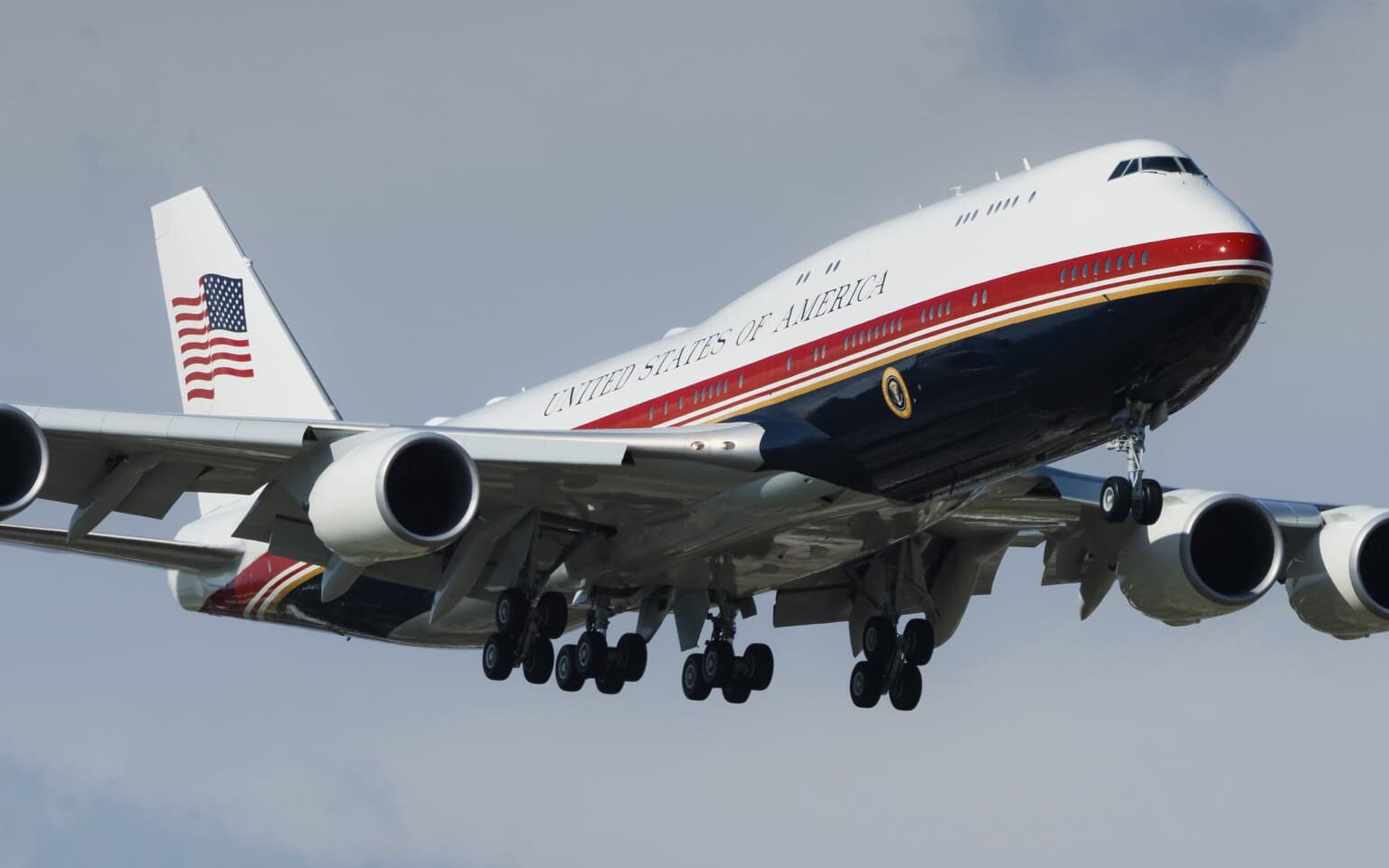
The Boeing 747-8 that Qatar handed to the United States makes its first flight outside North America on September 12. The last time it went overseas, a threat against the president put him on a different airplane to get out of Turkey.
President Donald Trump is scheduled to fly to Ireland on September 12 aboard the Qatar-gifted 747-8, according to reporting on September 4 by the Washington Post, CBS News and Defense News. It is the aircraft’s first international trip since July.
The gap has a reason. The jet the Air Force calls the Bridge aircraft still does not carry the missile warning sensors, laser countermeasure turrets and infrared jammers fitted to the two 1990s-vintage 747s that have served as Air Force One for 36 years.
On the evening of July 8 in Ankara, that difference put the president in the back of an airport catering cart and onto a C-32A.
A Gift, Not a Government Airplane
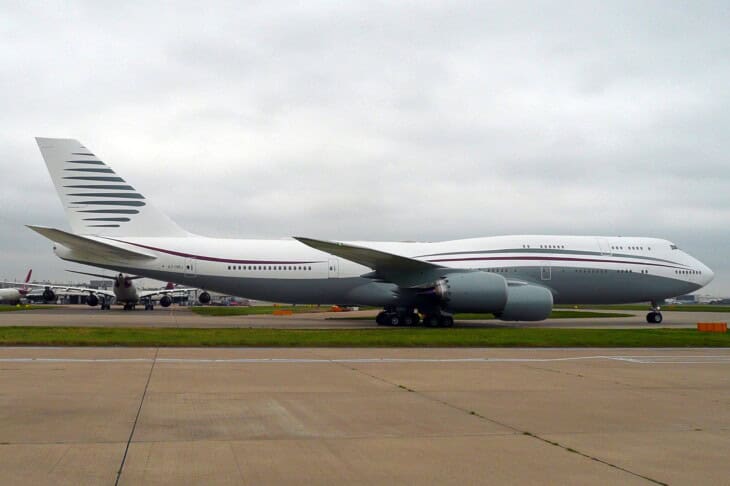
The airframe is a Boeing 747-8 BBJ, serial number 37075, delivered to the Qatar Amiri Flight in April 2012. It wore the registrations A7-HJA, then A7-HBJ, then P4-HBJ, and was flown for Hamad bin Jassim bin Jaber Al Thani, a former Qatari prime minister.
It was a private airplane in the fullest sense, configured for 89 passengers with sycamore and wacapou joinery and a Calder in the cabin. Nothing about it was built to fly a head of state through contested airspace.
Defense Secretary Pete Hegseth formally accepted the aircraft for the Air Force on May 21, 2025. It went onto the US civil register as N7478D that August and flew to Greenville, Texas, where L3Harris carried out the conversion.
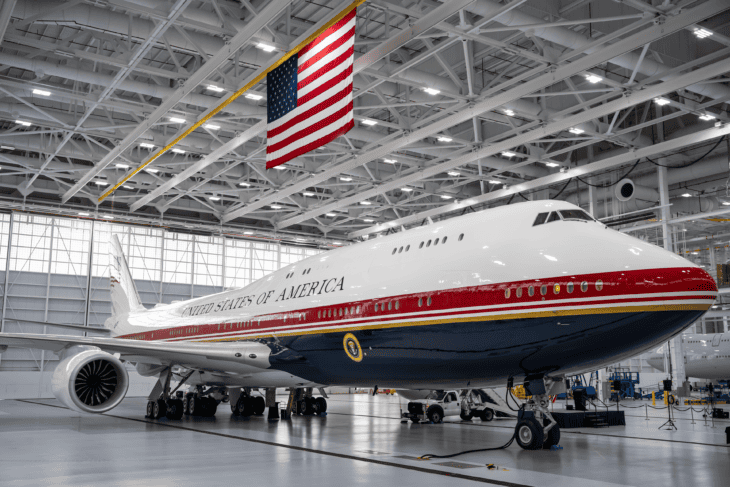
The Air Force described that work as focused on safety, security and mission communications rather than a rebuild. It also traded the pale blue and white scheme that has identified the presidential fleet since the Kennedy administration for red, white, gold and blue.
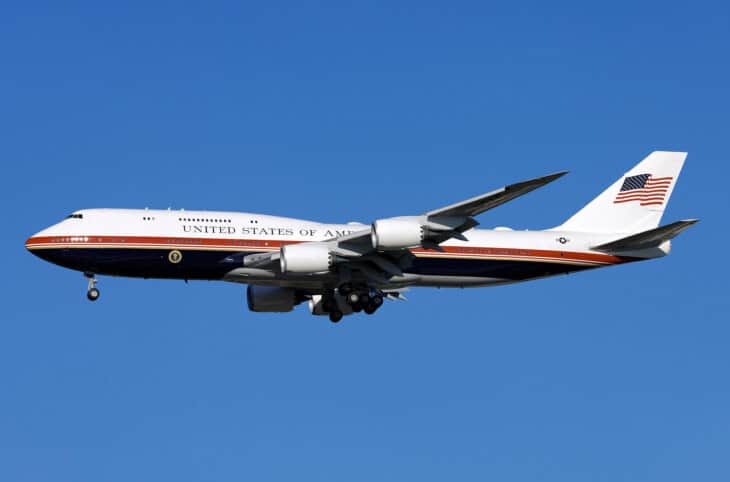
Modification and flight testing finished on May 1, 2026. The jet reached the Presidential Airlift Group by summer and flew its first presidential mission on July 1, 2026, carrying Trump to North Dakota.
What roughly a year of work could not add is the part that matters most under threat. Hardening an airliner against the electromagnetic pulse of a nuclear detonation means threading thousands of miles of shielded wiring through a finished airplane, which is a structural job rather than an installation.
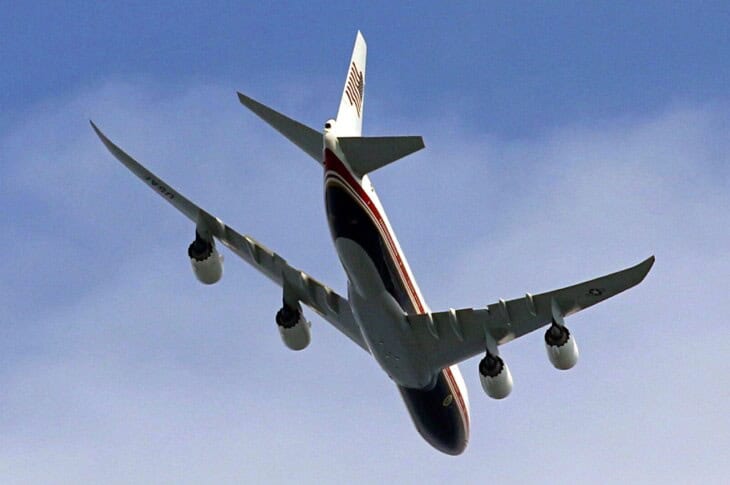
What the Bridge aircraft does not carry
The VC-25A fleet flies with AN/AAQ-24 directional infrared countermeasure turrets, AN/ALQ-204 infrared jammers, missile launch warning sensors and hardening against nuclear EMP. No external evidence of any of it has appeared on the ex-Qatari 747-8 in the months since its conversion, and officials have acknowledged the aircraft also lacks an emergency lower-level exit and a backup power system.
The Money Says This Was Never the Cheap Option
The gift is valued at roughly $400 million in almost every account of it. Bloomberg put the airframe’s open-market worth closer to $100 million to $125 million, which is what a 14-year-old 747-8 with a bespoke interior actually fetches.
In June 2025 the Air Force said the retrofit would cost less than $400 million. It has never published a line-item figure, because the conversion was funded inside a classified program, and outside estimates have run well past a billion dollars.
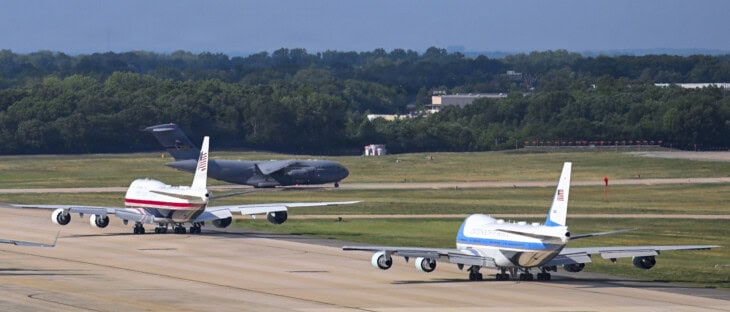
The aircraft it is standing in for are the two VC-25As, tail numbers 28000 and 29000, both 747-200Bs delivered in 1990 and 1991. Their designated replacements are late in a way now measured in years, not months.
Boeing signed a fixed-price contract worth about $3.9 billion in 2018 to convert two 747-8s into true VC-25Bs, with both due by the end of 2024. Delivery is now set for mid-2028 and mid-2029.
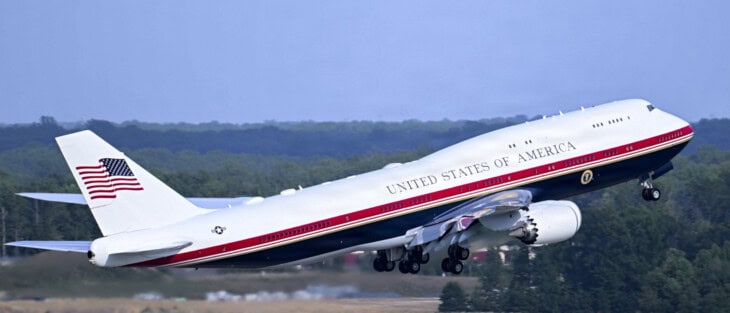
Boeing has absorbed roughly $3.13 billion in cumulative losses on that program, including a $280 million charge taken in July 2026. A Pentagon report released on August 3, 2026 found the cabin design still behind schedule.
That report counted 95 repairs or installations outstanding on the first aircraft and 142 on the second as of April 2026. Boeing and the Air Force have since moved the jets off FAA certification and onto a military certification path.
The supply of candidate airframes is finite and closed. Boeing built 155 747-8s in total, only 48 of them passenger Intercontinentals, and shut the line with a freighter handed to Atlas Air on January 31, 2023.
What Happened in Ankara on July 8
Trump left Joint Base Andrews at 9:41 p.m. Eastern on July 6 aboard the Qatar-gifted 747-8. He landed in Ankara at 1:51 p.m. local time the next day for the NATO summit.
US intelligence then picked up what officials characterized as a credible plot to fire a missile at Air Force One from the ground near the airport. It came against a collapsed Gulf ceasefire and reported Iranian threats against the president.
At 3:42 p.m. on July 8, Trump posted that he was sending the new aircraft ahead to RAF Mildenhall in England and would follow on the older jet. He boarded that older jet in front of the cameras at 8:24 p.m.
Six minutes later he was moved off it inside an airport catering cart and onto an Air Force C-32A, the militarized Boeing 757 that normally carries the vice president and cabinet secretaries.
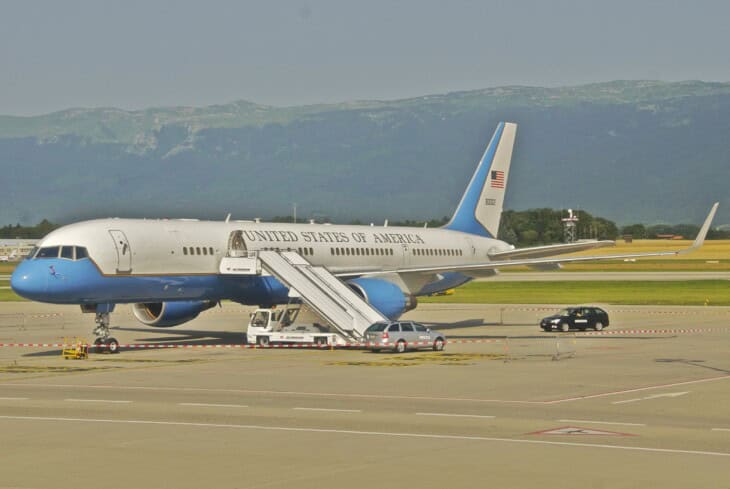
The VC-25A took off at 8:43 p.m. carrying the travelling press, who had been told to pull their window shades down. It was flying as a decoy, and most of the people aboard did not know it.
The Washington Post first reported the sequence on August 10. The White House did not dispute it, saying it uses every tool available, including distraction and misdirection, against threats to the president.
The detail that matters for the airplane is the one nobody disputes either. Faced with a specific missile threat, the presidential airlift mission did not put the president on the newest aircraft in the fleet.
What Happens After Ireland
The Ireland visit runs September 12 and 13. Trump is scheduled to attend the Irish Open at his Doonbeg golf course and to meet President Catherine Connolly and Taoiseach Micheal Martin.
After that, the airplane is supposed to go back into a hangar. Trump said in July it would be maxed out with upgrades, and later put the work at about 60 days beginning in October, with the older jets covering the gap.
No scope and no firm date have been published, and the window has already slipped once. Reporting on September 4 indicated the work may not start until after the November midterms.
None of the specific upgrades attributed to the aircraft in press accounts have been confirmed by the Air Force, which says only that it routinely evolves the capability as required. Treat any published list of what is going in as unverified.
The Bridge was always meant to be temporary. It covers the years until Boeing delivers the real VC-25Bs, and under the arrangement around the gift it is expected to transfer to the Donald J. Trump Presidential Library Foundation by January 1, 2029.
So an aircraft acquired to close a short gap is now expected to fly the president into 2029, against a replacement schedule that has moved almost every year since 2018. A bridge is only useful if it reaches the far side.
Sources and references used for research and fact-checking.
- The Washington Post, Trump to use Qatari plane for international trip despite security worries
- Defense News, Trump to travel aboard Qatari-donated Air Force One to Ireland
- The Washington Post, Contradicting public statements, Trump took secret flight from Turkey amid Iranian threat
- ABC News, Timeline: Trump's elaborate covert exit from Turkey amid Iranian threat
- The War Zone, New VC-25B Air Force One 'Bridge' Aircraft Now Fully Modified And Flight Tested
- Air & Space Forces Magazine, New Air Force One Delivery Shifts to 2028
Get the Newsletter
The latest aviation news and stories sent to your inbox.
About the Author

Tim is the owner and lead editor of AeroCorner since 2019, overseeing aviation content covering aircraft, airlines, airports, and the broader aviation industry. Through years of researching, writing, editing, and publishing aviation-focused content, he has developed extensive practical knowledge of commercial aviation and air travel. Based in Asia and a frequent traveler himself, Tim also brings firsthand passenger experience to AeroCorner’s coverage. Outside of publishing, he has also explored aviation firsthand through hands-on flight training in New Zealand.