

Table of Contents
A Cold War interceptor that first flew in 1954 is about to become a test bed for an air-launched rocket. The first flight will carry it, not drop it.
Lockheed and its licensed builders in Canada, Europe and Japan produced 2,578 F-104 Starfighters. The Italian Air Force flew the last military ones until 2004.
In December 2026, Starfighters Space plans to fly one of its F-104s from NASA’s Kennedy Space Center to Cecil Spaceport in Jacksonville with its STARLAUNCH 1 rocket hung under one wing. The company announced the plan on Oct. 13.
It is a captive-carry flight. The rocket stays attached the whole way and will not be released or ignited. The point is to see how the jet and the rocket fly together, as step one of a campaign meant to end with a rocket climbing past the 62-mile (100 km) edge of space.
Why a 1950s Interceptor Is the First Stage
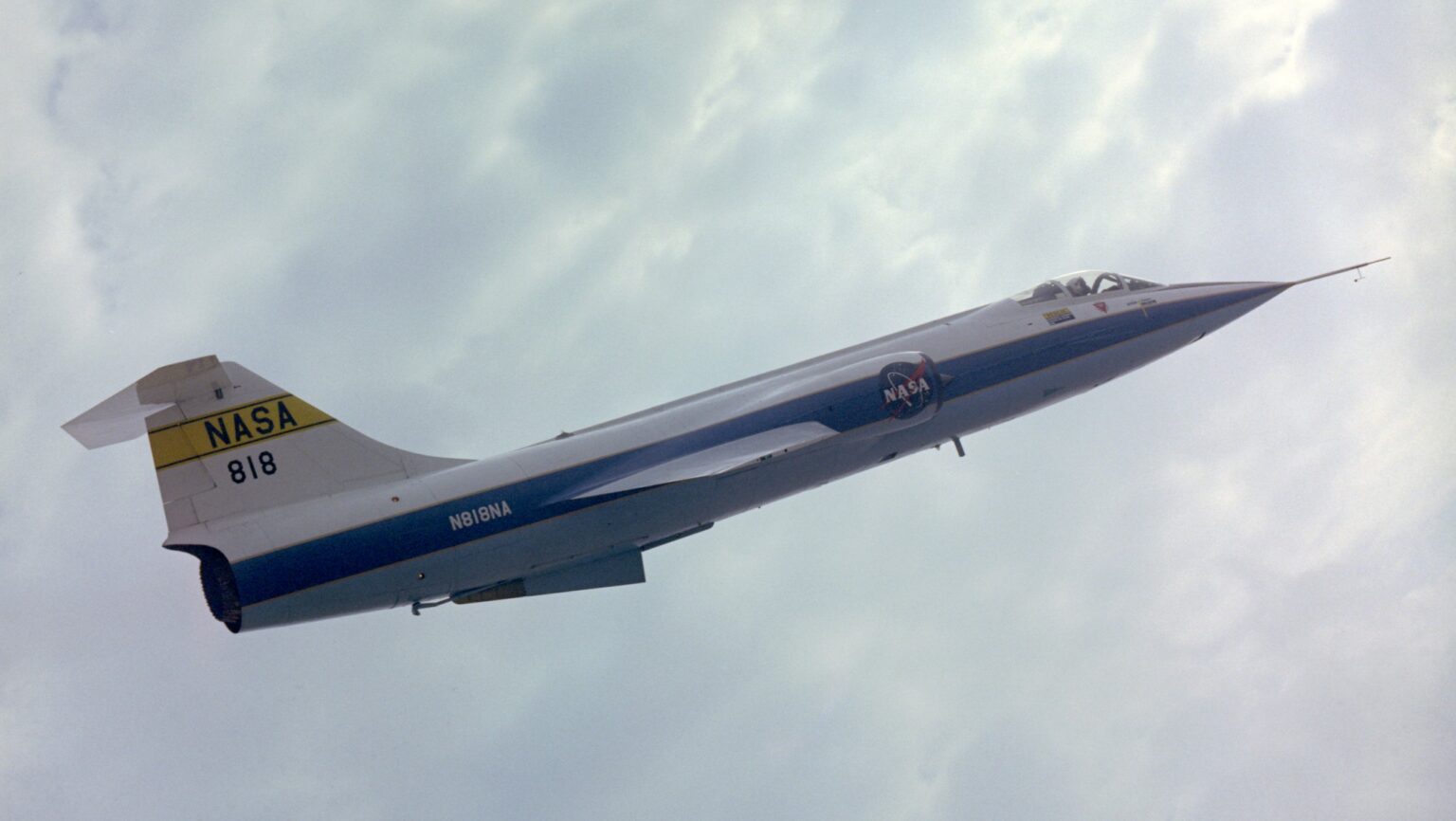
The F-104 was built to go fast and climb high. It first flew on March 4, 1954, and became the first production aircraft to reach Mach 2.
In 1958 it became the first aircraft to hold the world airspeed and altitude records at the same time. On Dec. 14, 1959, an F-104C flew to 103,389 feet (31,513 m), the first aircraft to take off under its own power and pass 100,000 feet.
That performance is the whole business case. In the planned profile reported by The Aviationist, the F-104 climbs to 45,000 feet at Mach 2 before it lets the rocket go.
A rocket that starts there is already high and fast before its motor lights. Starfighters Space calls itself the only commercial operator capable of sustained flight above Mach 2.
NASA saw the same potential in the jet decades ago. The research center now called NASA Armstrong operated 11 F-104s over 38 years, from August 1956 to Jan. 31, 1994, and logged more than 18,000 flights.
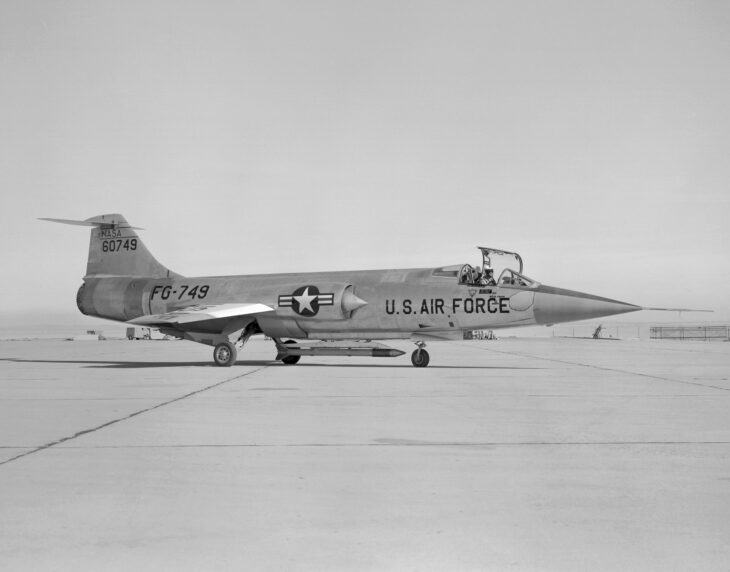
A NASA photo dated Dec. 16, 1959, shows a JF-104A on the ramp at Edwards with an Air Launched Sounding Rocket attached underneath. The idea of an F-104 carrying a rocket is older than the moon landings.

Nothing gets launched in December
The December flight is captive carry only. STARLAUNCH 1 stays bolted to the F-104 from takeoff to landing, and the inert flight hardware has no working motor. A drop test over the Atlantic and a powered flight are later steps, and neither has an announced date.
The Numbers Behind STARLAUNCH 1
Of the 2,578 Starfighters, Lockheed itself built 741. Canadair, Fiat, Fokker, Messerschmitt/MBB, Mitsubishi, SABCA and a multinational group built the rest.
Starfighters Space says it has a fleet of seven F-104s, flown from Kennedy Space Center and Midland International Air & Space Port in Texas. The Aviationist reports that five came from the Italian Air Force after it retired the type, including three TF-104G-M two-seat trainers.
The rocket’s airframe design is finished. Inert flight hardware ordered from Robby Moto Engineering, an Italian firm, is due at the company’s Kennedy hangar in November, where the team will assemble it and test how it mates to the jet.
Wind-tunnel tests at Mach 0.85 and Mach 1.3 found no adverse aerodynamic interactions during simulated separation from the F-104, according to Aerospace Global News. The Aviationist lists STARLAUNCH 1 at 41,000 pounds of thrust (182 kN), on a design based on the AIM-120 AMRAAM missile’s proven envelope.
The first powered test is designed to reach about 68 miles (109 km) and give more than five minutes of microgravity. It will carry paraffin as a mass simulator plus a camera.
The company listed on NYSE American under the ticker FJET in December 2025, after a Regulation A offering that raised $40 million.
Why a Rocket Under a Fighter Still Matters
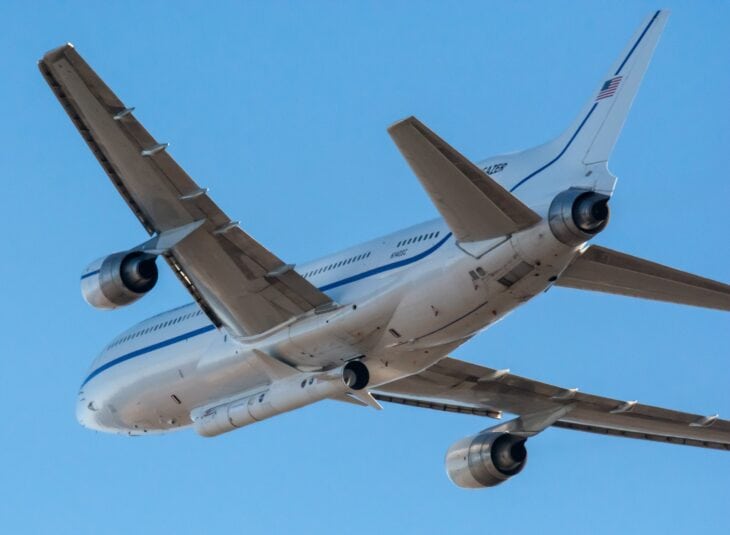
Air launch is not new, but the jets that do it are few. Northrop Grumman’s L-1011 TriStar Stargazer, modified in 1994 to carry the Pegasus rocket, flew a Pegasus mission from Kwajalein Atoll on July 3, 2026.
Stargazer is a converted airliner. Starfighters is betting on a jet that is still one of the fastest fighter jets ever built, and on the demand for supersonic test time.

Its Wind Tunnel in the Sky program hangs a test article about 12 feet (3.65 m) long and 7 inches (178 mm) wide under the wing. CEO Tim Franta told Aerospace Global News it could give more than five minutes of supersonic test time, against 30 seconds to a minute in some ground facilities.
The company said it was reviewing about 400 prospective suborbital payloads, around 70 of them likely. Two sensor payloads from separate customers were provisionally booked for the third powered mission.
The motor is still being built. Vaya Defense & Space is developing a hybrid rocket motor matched to STARLAUNCH 1, pairing a 3D-printed thermoplastic fuel grain with a liquid oxidizer, designed to be throttleable and restartable.
The company has been here before. In 2011, Starfighters and 4Frontiers ran fast-taxi tests at Kennedy’s Shuttle Landing Facility with a Star Lab sounding rocket on an F-104 pylon, hoping to launch a prototype the next year.
Fifteen years later, the company describes December as the flight that moves STARLAUNCH 1 from ground development into flight testing. “Our approach is deliberately incremental: build the hardware, integrate it with the aircraft, fly it, collect data,” Franta said.
What Happens After December
The December flight runs between the company’s Kennedy base and Cecil Spaceport, which holds an FAA spaceport license. Its job is to show how STARLAUNCH 1 flies on the jet and to test the integration between the two.
The other wing may carry a Wind Tunnel in the Sky article on a customer-funded rideshare, which would double as a counterweight. The two vehicles share interchangeable components.
Next comes a drop test over the Atlantic, then a demonstration of the integrated propulsion system. Flight data will go to the FAA and the U.S. Space Force, and no dates have been announced for the powered missions.
“December’s captive-carry mission would essentially be step one of a multi-flight campaign,” said Piercarlo Ciacchi, the company’s chief pilot. A larger STARLAUNCH 2 is meant to reach low Earth orbit.
The F-104 first flew 72 years ago. Its next test is whether it can carry a rocket from one Florida runway to another, and bring all of it home.
Sources and references used for research and fact-checking.
- Starfighters Space via Business Wire (Finviz), Starfighters Space Advances STARLAUNCH 1 Toward Planned December Flight
- The Aviationist, Starfighters Space Will Test Starlaunch 1 Suborbital Development Vehicle on an F-104 in December
- Aerospace Global News, F-104 Starfighter to carry rocket on first STARLAUNCH test flight in December
- Starfighters Space, Starfighters Space
- Wikipedia, Lockheed F-104 Starfighter
- NASA, F-104 Starfighter
- NASA, Air Launched Sounding Rocket (ALSOR) attached to F-104
- Universe Today, Star Lab: Space Science on the Wings of Starfighters
- Vintage Aviation News, Starfighters Space Completes $40 Million Regulation A IPO
- Wikipedia, Stargazer (aircraft)
Get the Newsletter
The latest aviation news and stories sent to your inbox.
About the Author

Tim is the owner and lead editor of AeroCorner since 2019, overseeing aviation content covering aircraft, airlines, airports, and the broader aviation industry. Through years of researching, writing, editing, and publishing aviation-focused content, he has developed extensive practical knowledge of commercial aviation and air travel. Based in Asia and a frequent traveler himself, Tim also brings firsthand passenger experience to AeroCorner’s coverage. Outside of publishing, he has also explored aviation firsthand through hands-on flight training in New Zealand.