

Table of Contents
On the night of June 20, 1944, the planes of a 226-aircraft American strike were feeling their way home across a black Pacific. There was a new moon and an overcast, almost none of the pilots had trained for a night carrier landing, and all of them were critically low on fuel.
Then the fleet waiting for them did something a fleet at war is supposed to avoid at all costs. Every light on every ship came on.
That night is the part of the Battle of the Philippine Sea that the famous nickname leaves out. Here is what happened in the largest carrier battle in history, who really sank Japan’s carriers, and why it ended the way it did.
What Happened at the Battle of the Philippine Sea?
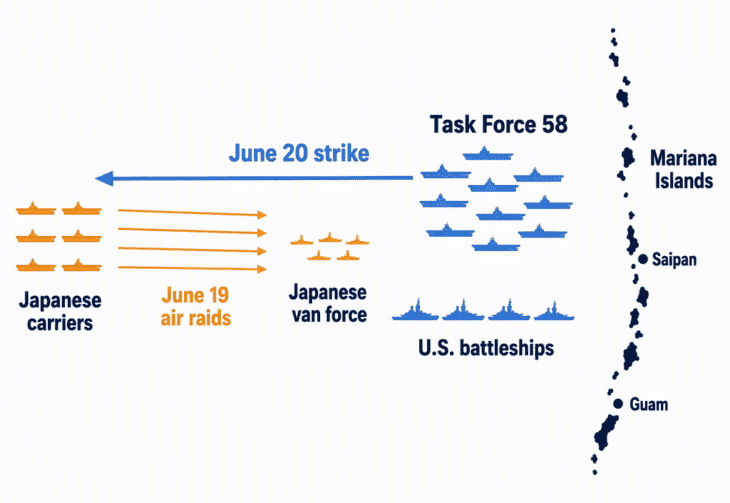
The Battle of the Philippine Sea was fought on June 19 and 20, 1944, west of the Mariana Islands. The U.S. Navy’s history office calls it the largest carrier battle in history: 15 American carriers against nine Japanese ones.
It started because the Americans had landed on Saipan on June 15, with 127,000 Marines and soldiers and 535 ships. From Saipan, the new B-29 bomber could reach Tokyo, so Japan sent its carrier fleet out to fight for the first time in almost two years.
Vice Adm. Jisaburo Ozawa brought nine carriers and about 430 carrier aircraft. Waiting for him was Vice Adm. Marc Mitscher’s Task Force 58, seven fleet carriers and eight light carriers with just over 900 aircraft, about 450 of them F6F Hellcat fighters.
Philippine Sea at a glance
Japan lost three fleet carriers, about 476 aircraft and probably close to 3,000 men. The U.S. Navy lost no ships, 42 aircraft in combat, about 123 aircraft from all causes, and 109 aviators and sailors. Navy figures, from the history office’s H-Gram 032.
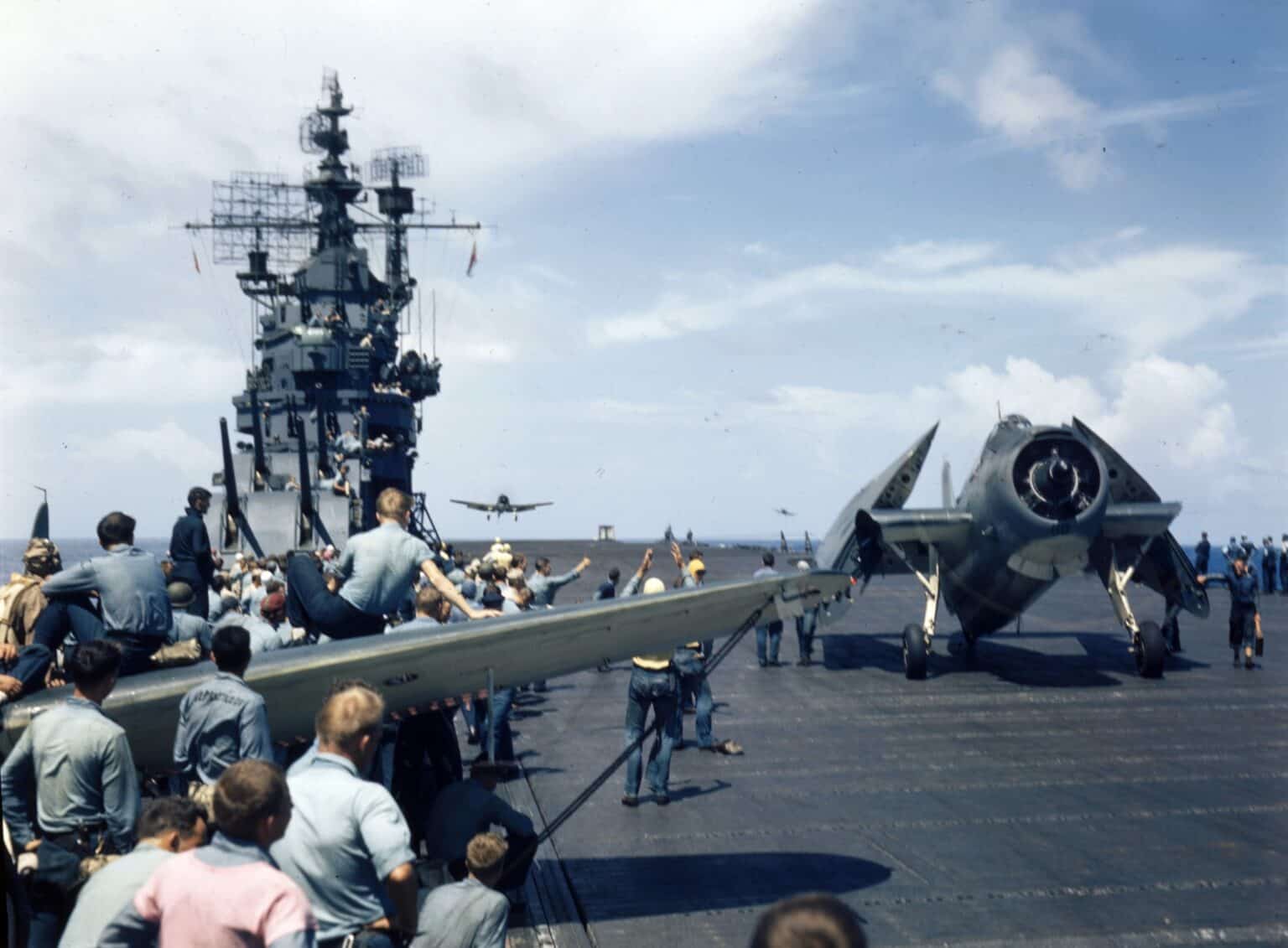
Six of Mitscher’s seven fleet carriers were brand new Essex-class ships that had not existed when the Pacific war began. His flagship was the second USS Lexington, named for the carrier lost at the Coral Sea two years earlier.
June 19: The Great Marianas Turkey Shoot
Ozawa had a sound plan on paper. Japanese planes could fly farther than American ones, so he would stay out of Mitscher’s reach and strike from long range, then let his aircraft land on Guam to rearm.
What he did not know was how badly American carrier raids had already beaten down Japan’s land-based air power in the Marianas. Guam was not a refuge. It was a trap with Hellcats over it.
Between about 8:30 and 11:30 a.m., Ozawa’s nine carriers launched 326 aircraft in four raids, almost as many as attacked Pearl Harbor. American radio intelligence teams heard Japanese radio operators running preflight checks, so Mitscher knew the raids were coming before they took off.
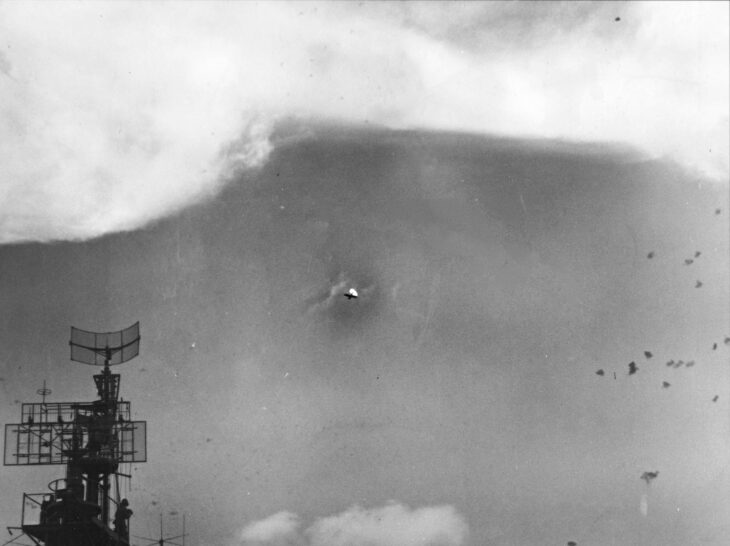
Shipboard radar picked up the first raid 150 nautical miles out. Fighter direction officers in the carriers’ new combat information centers then steered the Hellcats onto each formation.
_during_Battle_of_the_Philippine_Sea_1944.jpg)
Most of the Japanese pilots were hastily trained replacements for the veterans lost earlier in the war. The first raid of 69 aircraft lost 42 of them for three Hellcats, and the Navy’s history office says “the rest were slaughtered.”
The second raid, Ozawa’s main effort, lost 23 of 27 torpedo bombers and 42 of 53 dive bombers. Lt. (j.g.) Alex Vraciu shot down six aircraft on one flight and held up six fingers for a photographer when he landed, one of the most famous photos of the war.
Cmdr. David McCampbell, leading the Essex air group, shot down seven during the day. At a debriefing, a pilot from Lexington summed it up: “Why, hell, it was just like an old-time turkey shoot down home!”
Mitscher had put his seven fast battleships out in front, where they would be the first ships the Japanese reached. The few attackers who got through the fighters put a bomb on one battleship, and a torpedo plane crashed into another without its torpedo exploding. Two carriers took light bomb damage, and no American ship was put out of action.
By the Navy’s count, about 220 to 224 of the 326 attackers were shot down, along with 22 of Japan’s 35 squadron commanders. U.S. pilots claimed 299. The Navy lost 31 aircraft that day, 17 of them Hellcats in combat.
The Carriers Were Sunk by Submarines
The nickname belongs to the fighter pilots, but the two biggest Japanese losses that day had nothing to do with them. Both were sunk by submarines, while Japan’s air groups were out attacking the American fleet.
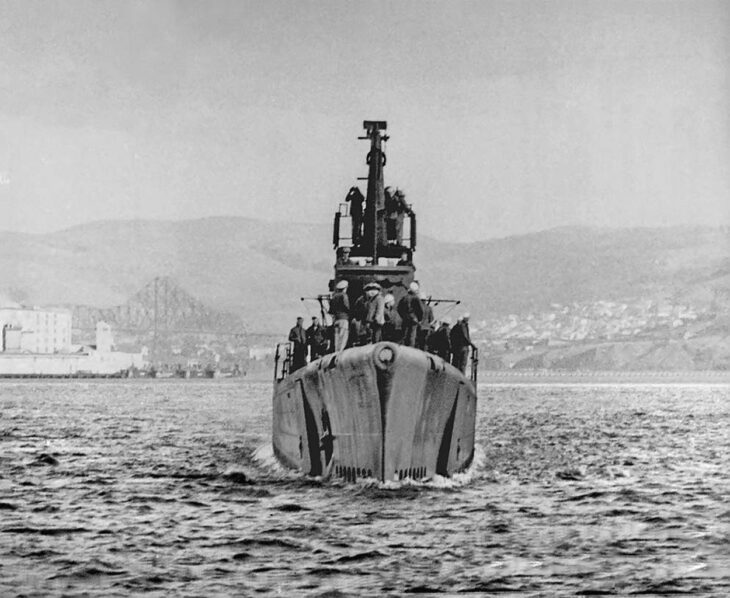
Just after 9 a.m., the submarine USS Albacore fired six torpedoes at Taiho, Ozawa’s flagship and the newest, largest carrier in his navy. Warrant Officer Sakio Komatsu, who had just taken off, saw one torpedo coming and dived his plane into it, blowing it up.

One other torpedo hit. It looked like light damage, and Taiho kept launching aircraft at 26 knots, but the hit had cracked an aviation fuel tank. Gasoline vapor spread through the ship for six hours until, at 3:30 p.m., a massive explosion tore it apart.
Around noon, USS Cavalla, on its first war patrol, put three or four torpedoes into Shokaku, a veteran of Pearl Harbor and the Coral Sea. Its crew fought fires for hours before the ship rolled over and sank, taking 1,272 men with it.
Cavalla escaped 106 depth charges
Three Japanese destroyers dropped more than 106 depth charges on Cavalla over three hours. In its emergency dive, the submarine went 100 feet below its test depth and took on about 15 tons of water, and still got away to report the attack.
Ozawa, who wanted to go down with Taiho, was talked into moving to a cruiser. He still believed many of his planes had reached Guam. Most were already in the sea.
June 20: The Flight Beyond Darkness
Mitscher spent June 20 chasing Ozawa to the northwest. A search plane from USS Enterprise finally found the Japanese fleet at 3:39 p.m., about 230 miles (370 km) away, near the limit of American strike range.
Launching meant the planes would come back after dark, and only a handful of their pilots had trained for night landings. Mitscher launched anyway, starting at 4:24 p.m., and 226 aircraft got away. Then a corrected report put the Japanese 60 nautical miles farther west.
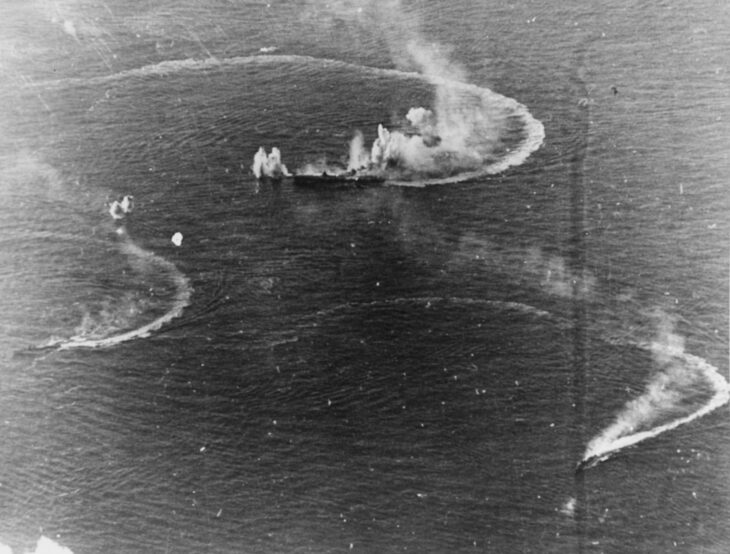
The strike reached Ozawa at sunset. Torpedo planes from the light carrier Belleau Wood sank the carrier Hiyo, and Lt. (j.g.) George Brown, his plane burning, pressed the attack and was never seen again. Bombs also hit Zuikaku, Junyo and Chiyoda, and SB2C Helldivers from Wasp sank two oilers.
.jpg)
By one count, Japanese fighters and flak destroyed about 20 American planes over the target. The real losses came on the way home.
Sunset was just before 7 p.m., and the carriers’ homing beacons reached only about 70 nautical miles. Pilots had to decide whether to ditch while they still had fuel for a controlled landing on the water, or gamble on reaching a deck.
At 8:30 p.m., Rear Adm. Joseph “Jocko” Clark lit up his carrier group without waiting for orders, and Mitscher ordered the whole task force to follow. It was a planned risk: Mitscher had worked out the lights plan days earlier, and Ultra intelligence told him there were probably no Japanese submarines nearby.
Cruisers fired star shells, searchlights pointed at the sky, and destroyers lit up the carriers. The Navy’s history office calls what followed the most chaotic recovery in its history: wave-offs ignored, two planes catching wires at once, and some pilots lining up on destroyers.
Any deck would do. USS Yorktown took aboard 10 of its own planes and 15 from six other carriers. The light carrier Bataan was closed for the night after its second landing, when a wrecked Hellcat jammed the barrier.
Of the 226 aircraft launched, 140 made it back to a carrier and 86 were lost. The Helldivers fared worst: of 51 that launched, eight were lost over the target and 32 more ditched or crashed.
The rescue that followed was almost as remarkable. Of the 172 pilots and aircrew who went into the water, all but 16 pilots and 33 aircrewmen were eventually picked up.
Who Won the Battle of the Philippine Sea?
The United States, by a margin the Navy’s history office calls more lopsided than Midway. Japan lost three fleet carriers and about 476 aircraft. The Navy lost no ships.
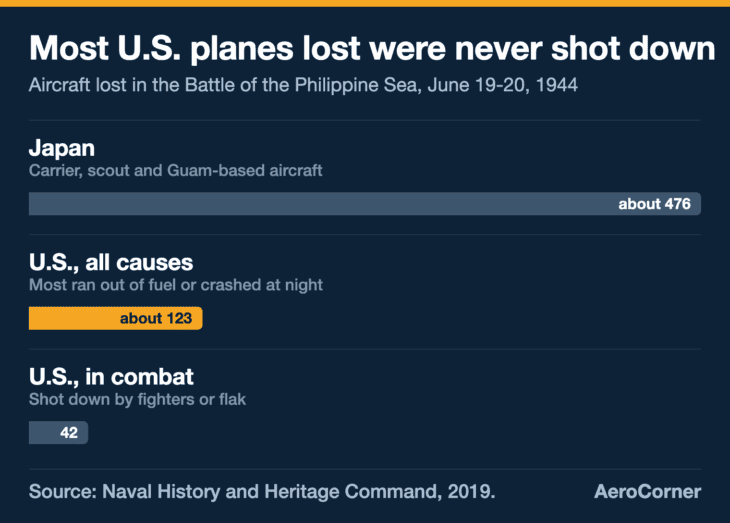
That is the twist in the American column. Of about 123 U.S. aircraft lost, only 42 went down in combat. The rest were operational losses, and most of them ran out of fuel or crashed coming home on the night of June 20.
The human cost was lopsided too. The U.S. lost 76 pilots and aircrew and 33 sailors. Japan lost 445 pilots and aircrew, and probably close to 3,000 men in all.
Those aircrew were what Japan could not replace. It had spent the time since the carrier battles of 1942 rebuilding its carrier air groups, and lost them in two days. Ozawa still had six carriers at the end of June 20, but only 35 operational carrier aircraft to fly from them.
Two future presidents were there
Lt. (j.g.) George H.W. Bush flew Avengers from the light carrier San Jacinto, though not on the June 20 strike. Gerald Ford was serving aboard the light carrier Monterey as a surface warfare officer.
The Myth: Spruance Let the Japanese Fleet Get Away
Myth: a cautious admiral wasted a chance to finish Japan's navy
Many aviators believed Adm. Raymond Spruance threw away a decisive win by keeping the carriers close to Saipan. Japan’s fleet did escape, but its carrier air arm did not.
The anger was real. On the night of June 18, Mitscher asked again and again to close on Ozawa, and Adm. Raymond Spruance, commanding the Fifth Fleet, said no each time.
Carrier staffs drafted furious messages they never sent, and one carrier captain threw his cap on the deck and stamped on it. After the battle, Vice Adm. John Towers, a naval aviation pioneer, demanded that Spruance be relieved. Adm. Chester Nimitz refused.
Spruance’s reasoning was that his job was Saipan, not Ozawa’s fleet. A Japanese force slipping around the carriers to hit the landing beaches could have turned the invasion into a disaster, and his reading of captured Japanese plans warned of exactly that move.
The critics had a point too. A Navy flying boat found the Japanese fleet that night, but its radio report never got through. Spruance later called it one of the battle’s greatest missed opportunities, because Mitscher could have struck at dawn.
What the “they got away” story misses is what got away. Four months later, at Leyte Gulf, Japan’s remaining carriers sailed with severely depleted air groups, and the Navy’s history office describes them as the decoy that drew the American fleet away from the landings.
Japan’s carriers had become bait. Carriers without trained pilots were no longer a striking force, and most of the trained pilots had died over the Marianas.
So the Turkey Shoot is a fair name for the first day, and an incomplete one for the battle. Submarines sank the two biggest carriers, and Hellcats broke Japan’s carrier aviation for good.
The American losses mostly happened in the dark, the night after the shooting was over. The lights that came on across Task Force 58 brought most of those crews home, which is why a fleet that was supposed to run dark is remembered for the night it lit up.
Sources and references used for research and fact-checking.
Get the Newsletter
The latest aviation news and stories sent to your inbox.
About the Author

Tim is the owner and lead editor of AeroCorner since 2019, overseeing aviation content covering aircraft, airlines, airports, and the broader aviation industry. Through years of researching, writing, editing, and publishing aviation-focused content, he has developed extensive practical knowledge of commercial aviation and air travel. Based in Asia and a frequent traveler himself, Tim also brings firsthand passenger experience to AeroCorner’s coverage. Outside of publishing, he has also explored aviation firsthand through hands-on flight training in New Zealand.