

Table of Contents
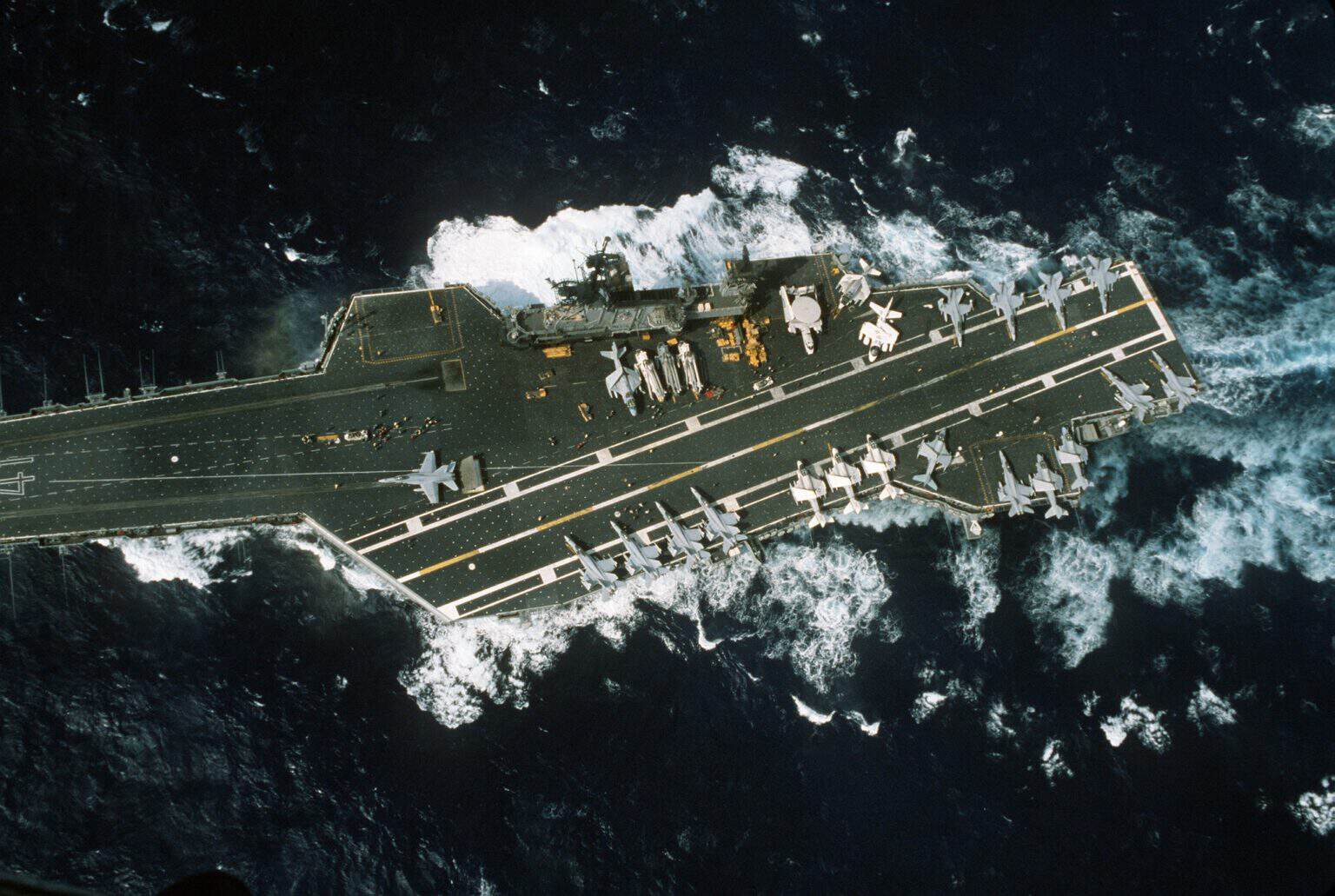
On September 10, 1945, the Navy commissioned the biggest aircraft carrier in the world at Newport News, Virginia. Japan had signed its surrender eight days earlier.
USS Midway had been designed to survive the bombs that had wrecked carriers since 1941, and it arrived just after the war that justified it ended. It then served for almost 47 years, through Vietnam, the fall of Saigon and Desert Storm.
Here is what the Midway class was, why the Navy built it so big, what its three ships did, and why only one of them is still afloat.
What Is a Midway-Class Aircraft Carrier?
The Midway class was a group of three US Navy aircraft carriers commissioned between 1945 and 1947: Midway, Franklin D. Roosevelt and Coral Sea. They were built around an armored flight deck, and they were the biggest carriers afloat until the supercarrier Forrestal joined the fleet in 1955.
They were ordered under the hull code CVB, for large carrier. The Essex-class fleet carriers that won the Pacific war carried the plain CV code.
The Midway class at a glance
Ships: 3 completed of 6 planned (CV-41, CV-42, CV-43). Commissioned: September 1945 (Midway) to October 1947 (Coral Sea). Length as built: 968 feet (295 m). Displacement: 45,000 long tons standard, 60,000 full load. Power: 212,000 shaft horsepower from 12 boilers. Speed: 33 knots. Crew: 4,104. Flight deck armor: 3.5 inches (89 mm). WWII combat: none. Last in service: Midway, decommissioned April 11, 1992. Preserved: 1, in San Diego.
How Many Midway-Class Carriers Were Built?
Three. Six were planned, but CVB-44 was canceled in January 1943 and CVB-56 in March 1945, and CVB-57 was never built either.
Newport News built two of the ships and the New York Naval Shipyard in Brooklyn built the third. Only one of the three survives.
| Ship | Built by | Commissioned | Decommissioned | Fate |
|---|---|---|---|---|
| Midway (CV-41) | Newport News | Sept. 10, 1945 | April 11, 1992 | Museum ship, San Diego |
| Franklin D. Roosevelt (CV-42) | New York Naval Shipyard | Oct. 27, 1945 | Sept. 30, 1977 | Scrapped at Kearny, New Jersey, 1978 |
| Coral Sea (CV-43) | Newport News | Oct. 1, 1947 | April 26, 1990 | Scrapped at Baltimore, finished 2000 |
| CVB-44, CVB-56, CVB-57 | Not built | Never | Never | Canceled |
The ships were later redesignated, first as CVA, attack carrier, in 1952 and finally as plain CV. That is why Midway is best known today as CV-41, not CVB-41.
Why the Midway Class Was Built So Big
The size came from armor. In 1940 the Navy studied what would happen if an Essex-sized carrier got an armored flight deck, and the answer was bad: the air group would shrink to about 64 aircraft, against 90 to 100 on an Essex.
The Royal Navy soon showed what the armor was worth. On January 10, 1941, German dive bombers hit HMS Illustrious six times off Malta, and the carrier limped into harbor still on fire. Naval historian J. D. Brown wrote that the armored deck saved it from destruction.
So the Navy kept the armor and made the ship bigger instead. The Midway design put 3.5 inches (89 mm) of armor on the flight deck and 2 inches (51 mm) on the hangar deck, with a side belt up to 7.6 inches (193 mm) thick.
An Essex had no armored flight deck. Its armor sat lower, at hangar-deck level, which kept weight down high in the ship but left the flight deck itself unprotected.
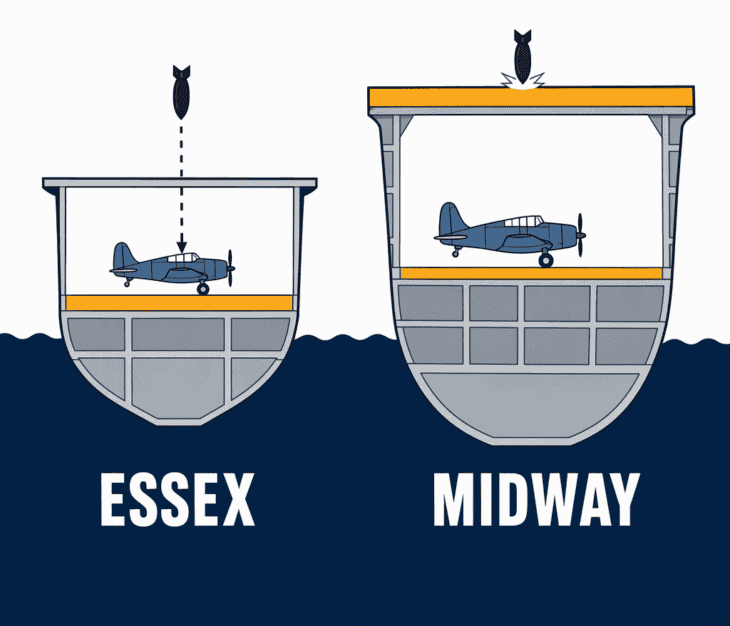
To pay for the armor, the designers dropped the 8-inch guns planned for the ship and fitted 18 single 5-inch guns instead of twin mounts. The machinery layout was borrowed from the Montana-class battleships, and 12 boilers fed turbines making 212,000 shaft horsepower for 33 knots.
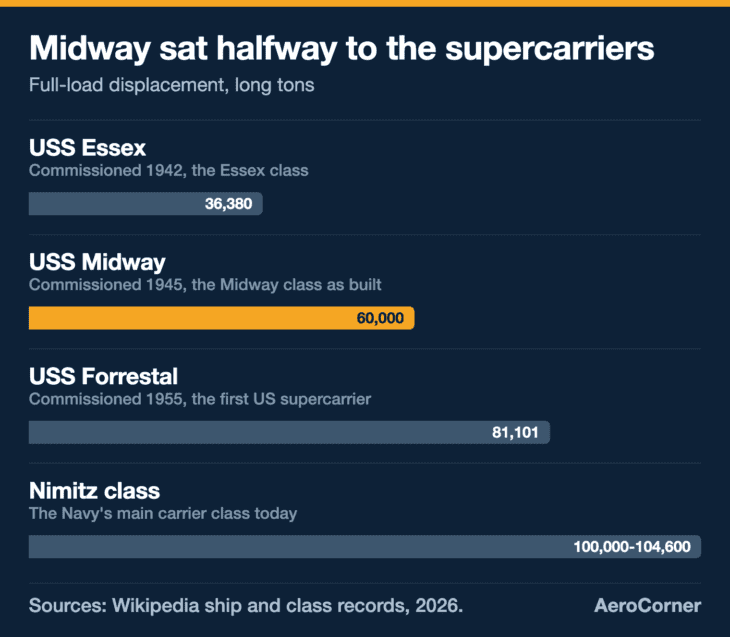
The result was 968 feet (295 m) long and displaced 45,000 long tons standard, about two-thirds heavier than an Essex at 27,100. Midway was the first American carrier too big to pass through the Panama Canal.
Sources disagree on how many aircraft it was meant to carry. The Navy’s own ship history gives 132 to 145, other references about 100 to 130, and by the 1980s the air wing was down to 65 to 70.
For comparison, today’s Nimitz-class carriers are 1,092 feet long and displace more than 100,000 tons fully loaded.
The Myth: USS Midway Fought at the Battle of Midway
Named for the battle, built after the war
USS Midway never fought in World War II. It was named for the Battle of Midway of June 4 to 7, 1942, and commissioned on September 10, 1945, eight days after Japan surrendered. Franklin D. Roosevelt followed in October 1945 and Coral Sea in October 1947, so none of the three saw combat in World War II.
The carriers that fought the Battle of Midway were an older generation. Midway’s keel was not laid until October 27, 1943, 16 months after the battle.
The second ship had a naming twist of its own. It was launched as Coral Sea on April 29, 1945, but President Truman approved renaming it for Franklin D. Roosevelt on May 8, about four weeks after Roosevelt died, and the third hull took the name Coral Sea.
“Largest carrier in the world” also needs a qualifier. Japan’s Shinano displaced about 72,000 long tons fully loaded, more than Midway, but a US submarine sank it on November 29, 1944, about ten days after it was commissioned.
So Midway was the largest carrier afloat from 1945, not the largest yet built. Shinano held that record until Forrestal, which displaced more than 81,000 long tons fully loaded.
Jets, a V-2 Rocket and the First Atomic Bombers at Sea
Because they missed the war, the Midways became the Navy’s test ships for what came next. On July 21, 1946, Franklin D. Roosevelt became the first American carrier to operate an all-jet aircraft, a McDonnell Phantom flown by Lt. Cmdr. James Davidson.
In September 1947, Midway test-fired a captured German V-2 rocket from its flight deck in Operation Sandy. It was the first launch of its kind from a moving platform, and the rocket broke up at about 15,000 feet.
Then came the bomb. In 1950, Franklin D. Roosevelt became the first carrier to take nuclear weapons to sea, and on April 21, 1950, Coral Sea hosted the first carrier takeoff of the AJ-1 Savage, a long-range bomber built for atomic attack.
That role kept the class mostly in the Atlantic and the Mediterranean, where the ships were central to the Navy’s nuclear strike role in Europe. Franklin D. Roosevelt alone made 20 Mediterranean deployments.
Vietnam, Saigon and Desert Storm
All three were rebuilt with angled flight decks, steam catapults and mirror landing systems, and the jets that followed took them to Vietnam. On June 17, 1965, two F-4B Phantom IIs from Midway shot down two MiG-17s with Sparrow missiles.
By the Navy’s count, Midway’s air wing downed the first three MiGs credited to US forces in Southeast Asia that June. Coral Sea made eight Western Pacific deployments between 1964 and 1975, while Franklin D. Roosevelt made only one, from August 1966 to January 1967.
Midway’s second rebuild, from 1966 to 1970, went badly. Its flight deck grew from 2.8 to 4 acres, but the cost climbed to $202 million, more than double the estimate, while a brand-new carrier, John F. Kennedy, was costing $277 million.
The rebuilt ship also handled worse in rough seas. Hull blisters added in 1986 to steady it made things worse, and the ship took water over the flight deck in heavy rolls, earning the nickname “Rock’n Roll carrier.”
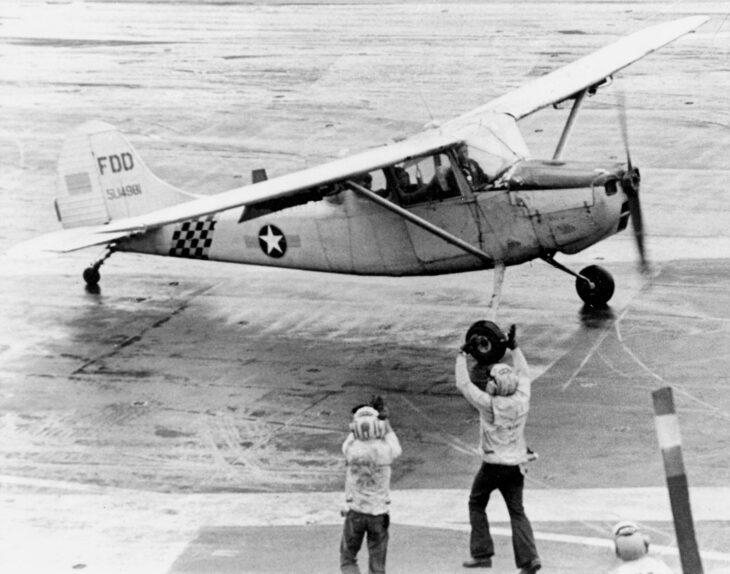
Midway’s best-known moment came on April 29, 1975, during the evacuation of Saigon. South Vietnamese Major Ly Bung, often spelled Buang, landed a Cessna O-1 Bird Dog on the deck carrying his wife and five children, after the captain had helicopters pushed overboard to make room.

About $10 million of helicopters went over the side
To clear a landing area for Major Ly Bung’s Bird Dog, Captain Larry Chambers ordered South Vietnamese helicopters on Midway’s deck pushed into the sea, an estimated US$10 million worth. Bung became the first Vietnamese pilot to land a fixed-wing aircraft on a carrier, and his O-1 now sits in the National Museum of Naval Aviation in Pensacola.
The Midway museum says the ship took aboard more than 3,000 refugees during the evacuation. In October 1973 it had already become the first carrier task group forward deployed to a Japanese port.
Coral Sea flew strikes during the Mayaguez incident in May 1975 and against Libya on April 15, 1986. In the Libya raid its F/A-18 Hornets flew their combat debut, and the AGM-88 HARM anti-radar missile was fired in combat for the first time.
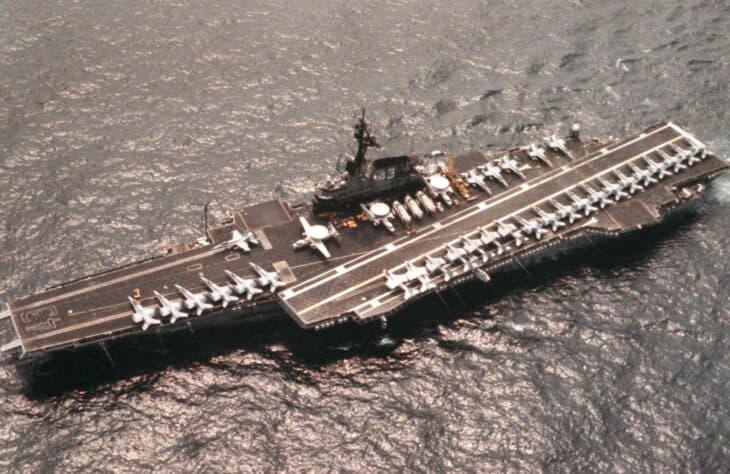
_aerial_photo_in_1986.JPEG)
Midway’s last war came at the age of 45. Its aircraft launched the first carrier strikes of Desert Storm at about 2 a.m. on January 17, 1991, and the museum says the ship flew more than 3,000 combat missions in the war without a loss.
How Many Midway-Class Carriers Are Left?
One. Franklin D. Roosevelt went first: decommissioned in September 1977, it was sold on April 1, 1978, for $2.1 million and broken up at Kearny, New Jersey, the same year.
Coral Sea, nicknamed the “Ageless Warrior,” was decommissioned on April 26, 1990, after nearly 43 years. It was sold for scrap in May 1993, and the scrapping in Baltimore was not finished until September 8, 2000.
Midway was decommissioned at North Island, San Diego, on April 11, 1992, and spent years in the reserve fleet at Bremerton, Washington. It moored at Navy Pier in San Diego in January 2004 and opened as a museum on June 7, 2004.
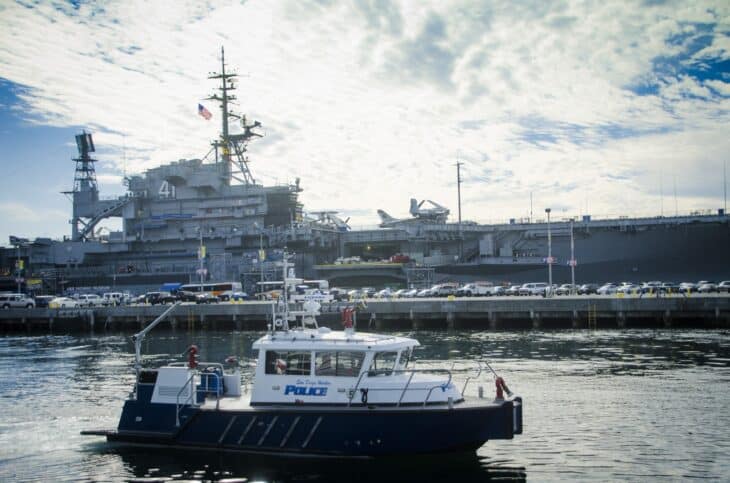

It drew 879,281 visitors in its first year, about double what was expected. By its 20th anniversary, the museum counted more than 20 million visitors and described itself as the most visited naval ship museum in the world.
The museum also calls Midway the longest-serving aircraft carrier of the 20th century. That holds with a footnote: the ship lay out of commission from 1955 to 1957 for its first rebuild, so its nearly 47 years from commissioning to decommissioning include about two years off the books.
The Midway is the only one of its class you can visit, but it is not the only preserved carrier of its era. Four ships of the earlier Essex class are museums too, and until Midway opened in 2004, every preserved aircraft carrier in the US was an Essex.
Stand on Midway’s flight deck in San Diego and you are on a ship designed for the kamikaze war it never saw. It spent the next 47 years in the wars that came after, and outlasted both of its sisters.
Sources and references used for research and fact-checking.
- Naval History and Heritage Command, Dictionary of American Naval Fighting Ships, Midway III (CVB-41)
- Wikipedia, Midway-class aircraft carrier
- Wikipedia, USS Midway (CV-41)
- Wikipedia, USS Franklin D. Roosevelt
- Wikipedia, USS Coral Sea (CV-43)
- USS Midway Museum, USS Midway Celebrates 20th Anniversary
- Wikipedia, Essex-class aircraft carrier
- Wikipedia, USS Essex (CV-9)
- Wikipedia, HMS Illustrious (87)
- Wikipedia, Japanese aircraft carrier Shinano
- Wikipedia, USS Forrestal
- Wikipedia, Nimitz-class aircraft carrier
Get the Newsletter
The latest aviation news and stories sent to your inbox.
About the Author

Tim is the owner and lead editor of AeroCorner since 2019, overseeing aviation content covering aircraft, airlines, airports, and the broader aviation industry. Through years of researching, writing, editing, and publishing aviation-focused content, he has developed extensive practical knowledge of commercial aviation and air travel. Based in Asia and a frequent traveler himself, Tim also brings firsthand passenger experience to AeroCorner’s coverage. Outside of publishing, he has also explored aviation firsthand through hands-on flight training in New Zealand.