

Table of Contents
On March 3, 2026, days after the war with Iran began, President Emmanuel Macron ordered the carrier Charles de Gaulle out of NATO exercises off Scandinavia and into the eastern Mediterranean. The carrier group covered about 3,700 miles (6,000 km) in six days.
Two weeks later, Le Monde reported exactly where it was, northwest of Cyprus. The source was not a spy satellite. A young sailor had been logging runs aboard the ship on a public Strava profile.
That is the Charles de Gaulle in miniature: a genuinely rare warship, with a habit of making headlines for the wrong reasons. Here is what it is, why it is built the way it is, and what happens when France’s only carrier is in the shipyard.
What Is the Charles de Gaulle Aircraft Carrier?
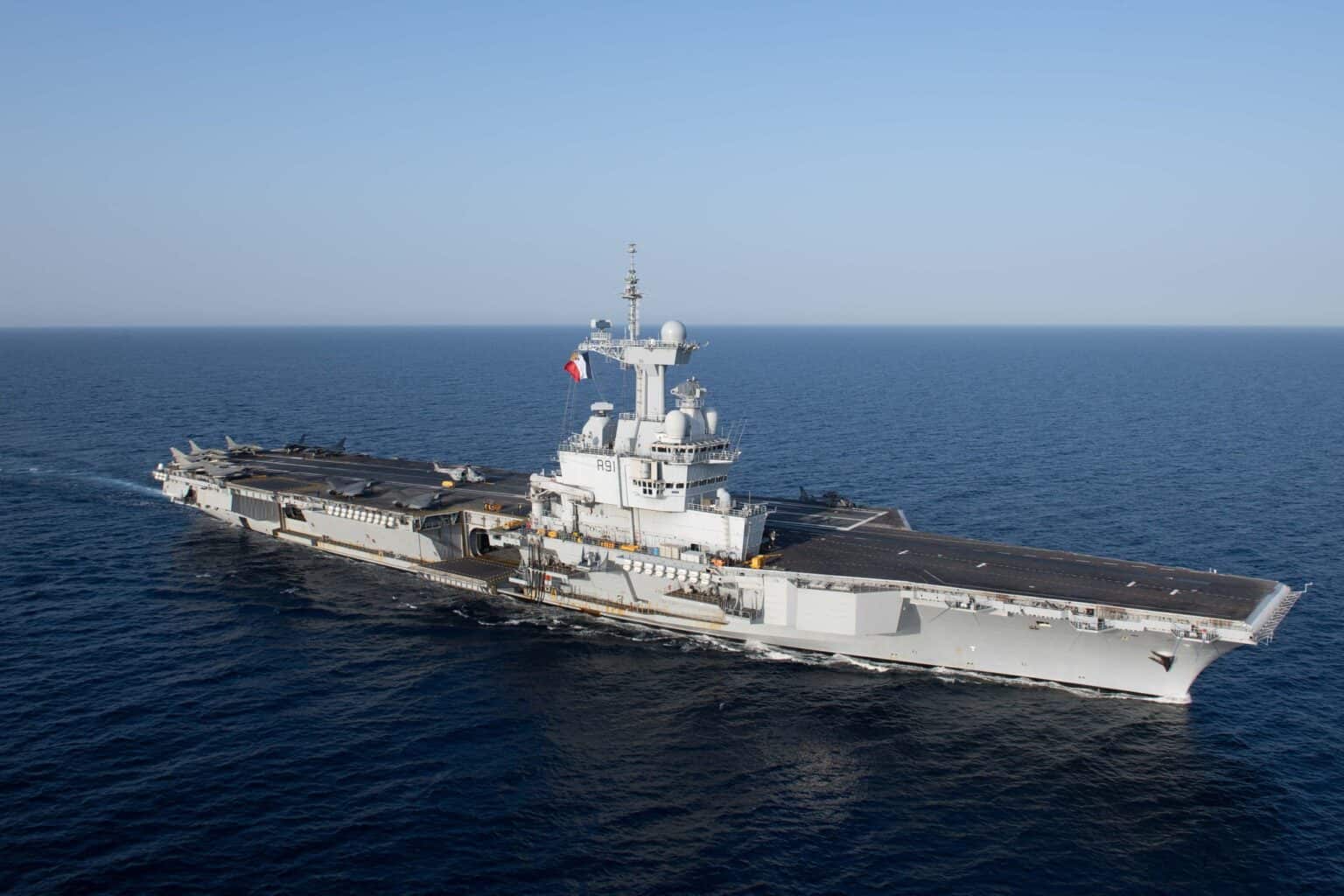
The Charles de Gaulle (hull number R91) is the French Navy’s flagship and its only aircraft carrier. It was commissioned on May 18, 2001, and is based at Toulon on the Mediterranean coast.
It is also the only nuclear-powered aircraft carrier any navy other than the US Navy has ever put into service. China’s Type 004, widely expected to be nuclear-powered, was still in its building dock at Dalian in satellite imagery from August 2026.
Unlike Britain’s two newest carriers, which launch jump jets off a ski ramp, the Charles de Gaulle has catapults and arresting wires like an American carrier. That lets it fly conventional fighters and a fixed-wing radar plane, the E-2C Hawkeye. It ranks fifth in our list of the best aircraft carriers in the world.
_in_2014.JPG)
The Charles de Gaulle at a glance
Commissioned: May 18, 2001. Builder: DCN (now Naval Group), Brest. Home port: Toulon. Length: 858 feet (261.5 m). Displacement: about 42,500 metric tons at full load. Power: two K15 nuclear reactors. Speed: 27 knots. Catapults: two US-designed C13-3 steam catapults. Aircraft: 30 to 40, mainly Rafale M fighters. Crew: about 1,350 sailors plus about 600 in the air wing. Cost: about 3 billion euros. Planned retirement: around 2038.
Why the Charles de Gaulle Is Less Than Half the Size of a Nimitz
The short version is that France built its carrier around a submarine power plant. The ship runs on two K15 pressurized-water reactors of about 150 megawatts (thermal) each, the same reactor type that powers France’s Triomphant-class ballistic-missile submarines.
A submarine-scale power plant caps the ship. Two Alstom steam turbines turn about 82,000 shaft horsepower into a design speed of 27 knots.
The size follows from that. At 858 feet (261.5 m) and about 42,500 metric tons, the Charles de Gaulle is shorter than Britain’s conventionally powered Queen Elizabeth class and less than half the displacement of a Nimitz-class carrier.
| Carrier | Length | Full-load displacement | Power | How jets launch |
|---|---|---|---|---|
| Charles de Gaulle (France, 2001) | 858 ft (261.5 m) | About 42,500 metric tons | 2 K15 reactors | 2 steam catapults |
| Queen Elizabeth class (UK, 2017 and 2019) | 932 ft (284 m) | About 80,600 metric tons (estimated) | Gas turbines and diesels | Ski jump, short takeoff jets only |
| France Libre (France, planned 2038) | 1,017 ft (310 m) | About 80,000 metric tons | 2 K22 reactors | 3 electromagnetic catapults |
| Nimitz class (US, 1975 to 2009) | 1,092 ft (333 m) | 100,000 to 104,600 long tons | 2 reactors | 4 steam catapults |
The catapults are the other piece of the puzzle. Each of the two is a 246-foot (75 m) C13-3 steam catapult, a shortened version of the system on US Nimitz-class carriers, one on the bow and one in the waist.
Two catapults are also a ceiling on how fast the ship can get jets into the air. Its successor gets three electromagnetic catapults, which are meant to launch heavier aircraft at a higher rate.
A 12-Year Build: Four Pauses, a Short Deck and a Broken Propeller
France ordered the ship on February 3, 1986, under the name Richelieu, and renamed it for General de Gaulle the next year. Its keel went down at the naval shipyard in Brest on April 14, 1989.
Then the money ran short. Work stopped four times, in 1990, 1991, 1993 and 1995, as the early-1990s recession squeezed the defense budget.
Feb. 3, 1986
Ordered as Richelieu. France orders a nuclear carrier to replace its two 1960s carriers, Clemenceau and Foch. It is renamed Charles de Gaulle in May 1987.
April 14, 1989
Keel laid at Brest. Construction by DCN, now Naval Group, is then suspended four times between 1990 and 1995.
May 7, 1994
Launched. The largest warship launched in Western Europe since HMS Ark Royal in 1950.
1999
Sea trials find a short deck. The flight deck is too short for the E-2C Hawkeye radar plane and is lengthened by about 14 feet (4.4 m).
Nov. 9-10, 2000
The port propeller breaks. In the western Atlantic, on the way to Norfolk, Virginia, the port propeller breaks and the ship returns to Toulon.
May 18, 2001
Commissioned. About five years behind schedule, running on spare propellers from Clemenceau and Foch.
2007-2008
First refueling. A 15-month overhaul refuels both reactors and fits new propellers, restoring the 27-knot design speed.
The propeller failure was the one that stuck. The fix was to borrow spares made for Clemenceau and Foch, which vibrated and held the ship to about 25 knots, against the 27 knots in the contract.
The Charles de Gaulle sailed on those borrowed propellers for its first six years of service. Purpose-built replacements only arrived in the 2007 to 2008 overhaul.
There was a radiation scare too. Reports of slightly high radioactivity in 2001 turned out to match the ship’s design; the problem was that the regulatory limits had been tightened while it was being built, so extra shielding was needed.
What the Charles de Gaulle Carries
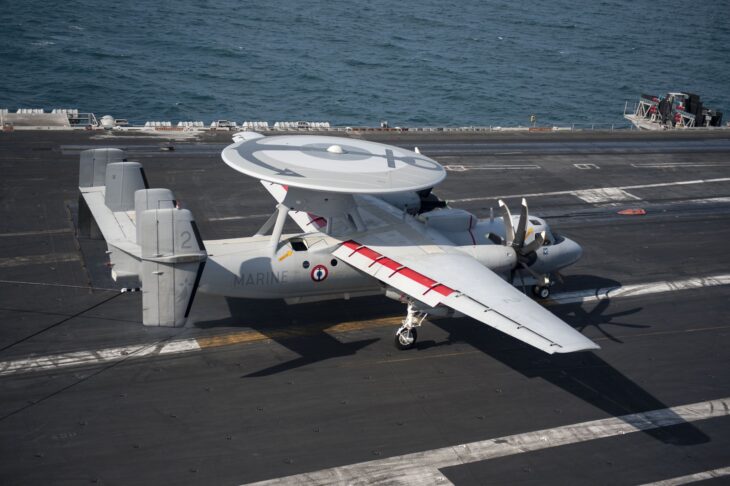
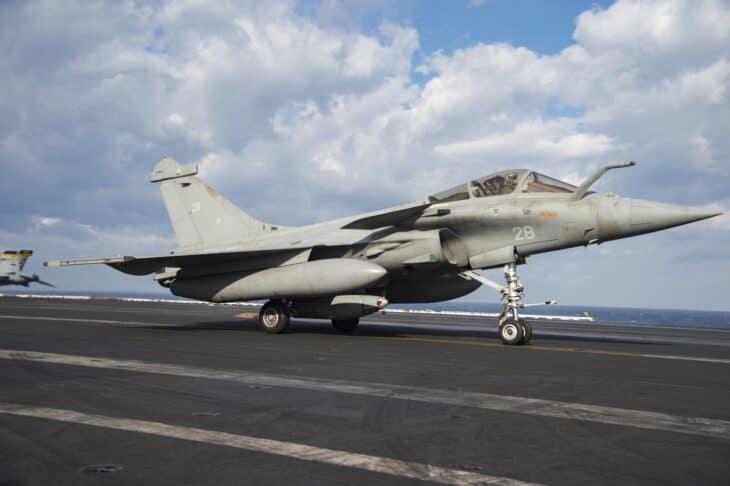
The air wing is built around the Dassault Rafale in its naval Rafale M version. A typical peacetime load is about 30 Rafale M fighters, two E-2C Hawkeye radar planes and a pair of helicopters, with room for about 40 aircraft in wartime.
The E-2C Hawkeye is the plane the flight deck had to be lengthened for in 1999. The 2027 refit is meant to ready the ship for its replacement, the E-2D Advanced Hawkeye.
Real deployments run lighter than the maximum. For the Clemenceau 25 deployment to the Indo-Pacific, which left in November 2024, the ship carried 24 Rafale M, two E-2Cs and four helicopters; in March 2026 it sailed for the eastern Mediterranean with about 20 Rafales and two Hawkeyes.
.jpg)
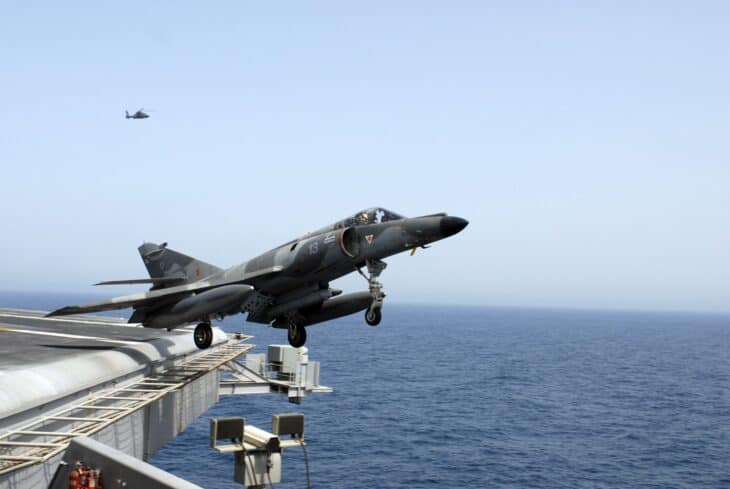
For its first 15 years the ship also flew the Dassault Super Étendard attack jet, a 1970s design. The French Navy retired its last Super Étendards on July 12, 2016, and the Rafale M took over every fighter and strike role on board.

Where the Charles de Gaulle Has Fought
The ship went to war within months of commissioning. Its jets flew their first combat missions over Afghanistan on December 19, 2001, and supported Operation Anaconda in early 2002.
It sailed for Libya on March 20, 2011, as the international no-fly zone took shape, and stayed until August. In 2015 it flew strikes on the Islamic State from the Persian Gulf, then left Toulon again on November 18, 2015, five days after the Paris attacks.
A French admiral in charge of a US task force
On December 7, 2015, a French rear admiral took command of US Navy Task Force 50 in the Persian Gulf, the first non-American officer to do so. The US Navy later gave the ship a Meritorious Unit Commendation for the campaign.
The worst moment came without an enemy. In April 2020 COVID-19 swept the ship, which docked at Toulon on April 12, two weeks early; by April 18, the armed forces said 1,046 of its 1,760 sailors had tested positive.
Its most recent deployment, La Fayette 26, began on January 27, 2026, and ran from the North Atlantic and the waters off Scandinavia to the eastern Mediterranean and the Arabian Sea. The ship came home to Toulon on July 11, 2026, after 166 days, the second-longest mission in its 25 years of service.
The Myth: A Nuclear Carrier Never Has to Stop
The myth
Nuclear power gives the Charles de Gaulle unlimited range, so France always has a carrier ready. In reality the reactors must be refueled about every 10 years, each refueling takes the ship out for well over a year, and France has no second carrier to cover the gap.
The reactors do give the ship effectively unlimited range between refuelings. They do not stop the clock: the fuel cores need replacing about every decade, and that means dry dock.
The first refueling ran 15 months, from September 2007 to December 2008. The midlife overhaul took 18 more, from February 2017 to September 2018.
The third is due in 2027: about 18 months at Toulon to refuel both reactors and rebuild the island around a new Thales Sea Fire radar. The ship then needs about six more months to work back up to operational status.
For that whole time, France will have no aircraft carrier at all. A second carrier, known as PA2, would have covered these gaps; it was canceled in the 2013 defense white paper.
The US Navy solves the same problem with numbers. It has 11 aircraft carriers, so some are always available while others are in overhaul.
When Will the Charles de Gaulle Retire?
Around 2038. That is when its successor, the France Libre, is due to be commissioned, and the French defense ministry treats it as the retirement date, although the procurement agency is studying whether the old ship could serve longer.
Macron named the new ship on March 18, 2026, at a Naval Group site near Nantes, after the Free French movement de Gaulle led during World War II. The program was known until then as PANG, for next-generation aircraft carrier.
The France Libre is planned at about 1,017 feet (310 m) and 80,000 metric tons, close to double the Charles de Gaulle’s displacement. It will carry two new K22 reactors, three American electromagnetic catapults and an air wing of up to 30 Rafale M and three E-2D Advanced Hawkeyes.
Macron put the cost at about 10 billion euros. Hull assembly is scheduled to start in 2032 at Chantiers de l’Atlantique, with sea trials in 2036.
If that schedule holds, the Charles de Gaulle will hand over after about 37 years. If it slips, France faces a choice its US ally never has to make: keep an aging nuclear carrier going, or go without one.
So the next time a French carrier group turns up in a war zone, and a sailor’s running app gives away where, it is worth remembering how much rides on one ship. France has spent 25 years proving it can run a nuclear carrier; it has never had a spare.
Sources and references used for research and fact-checking.
- Wikipedia, French aircraft carrier Charles de Gaulle
- Naval News, France's Next-Generation Aircraft Carrier Officially Named 'France Libre'
- Wikipedia, French aircraft carrier France Libre
- 19FortyFive, Charles de Gaulle: The 42,000-Ton Nuclear Aircraft Carrier With a Construction Saga
- SlashGear, France's Charles De Gaulle Deploys: Here's Where The Nuclear Carrier Is Headed
- La Gazette France (AFP), D'Orion à Ormuz, 166 jours d'odyssée pour le porte-avions français
- Stéphane Larue, Le porte-avions Charles de Gaulle de retour à Toulon après 166 jours en mer
- Presse-citron, Boulette : la position du porte-avions Charles de Gaulle révélée par le parcours Strava d'un marin
- L'Essentiel de l'Éco, La France sans porte-avions pendant dix-huit mois
- ActuNautique, Plus de 1000 marins testés positifs au coronavirus sur le porte-avions Charles de Gaulle
- The Aviationist, This fantastic video celebrates the French Super Etendard attack jets that flew for the last time today
- Wikipedia, French submarine Le Triomphant
- Wikipedia, Queen Elizabeth-class aircraft carrier
- 19FortyFive, France's Navy Has a Problem: Only 1 Nuclear Aircraft Carrier That Is Getting Old
- Wikipedia, Nimitz-class aircraft carrier
- The War Zone, China's Next Aircraft Carrier Is Taking Shape
Get the Newsletter
The latest aviation news and stories sent to your inbox.
About the Author

Tim is the owner and lead editor of AeroCorner since 2019, overseeing aviation content covering aircraft, airlines, airports, and the broader aviation industry. Through years of researching, writing, editing, and publishing aviation-focused content, he has developed extensive practical knowledge of commercial aviation and air travel. Based in Asia and a frequent traveler himself, Tim also brings firsthand passenger experience to AeroCorner’s coverage. Outside of publishing, he has also explored aviation firsthand through hands-on flight training in New Zealand.