

Table of Contents
On May 16, 2026, USS Gerald R. Ford sailed back into Norfolk after 326 days away. Its air wing had flown in the Caribbean during the Venezuela operations and struck Iran from the eastern Mediterranean.
Three months later, the White House ordered the Navy to plan how to strip the class’s signature technology out of a future sister ship. The electromagnetic catapults that define the Ford class could give way to steam, the system the class was designed to replace.
Both things are true at once, and that is the Ford class in one sentence. Here is what the class is, how many ships exist, what is actually new about them, and why its newest technology is still being argued over in 2026.
What Is a Ford-Class Aircraft Carrier?
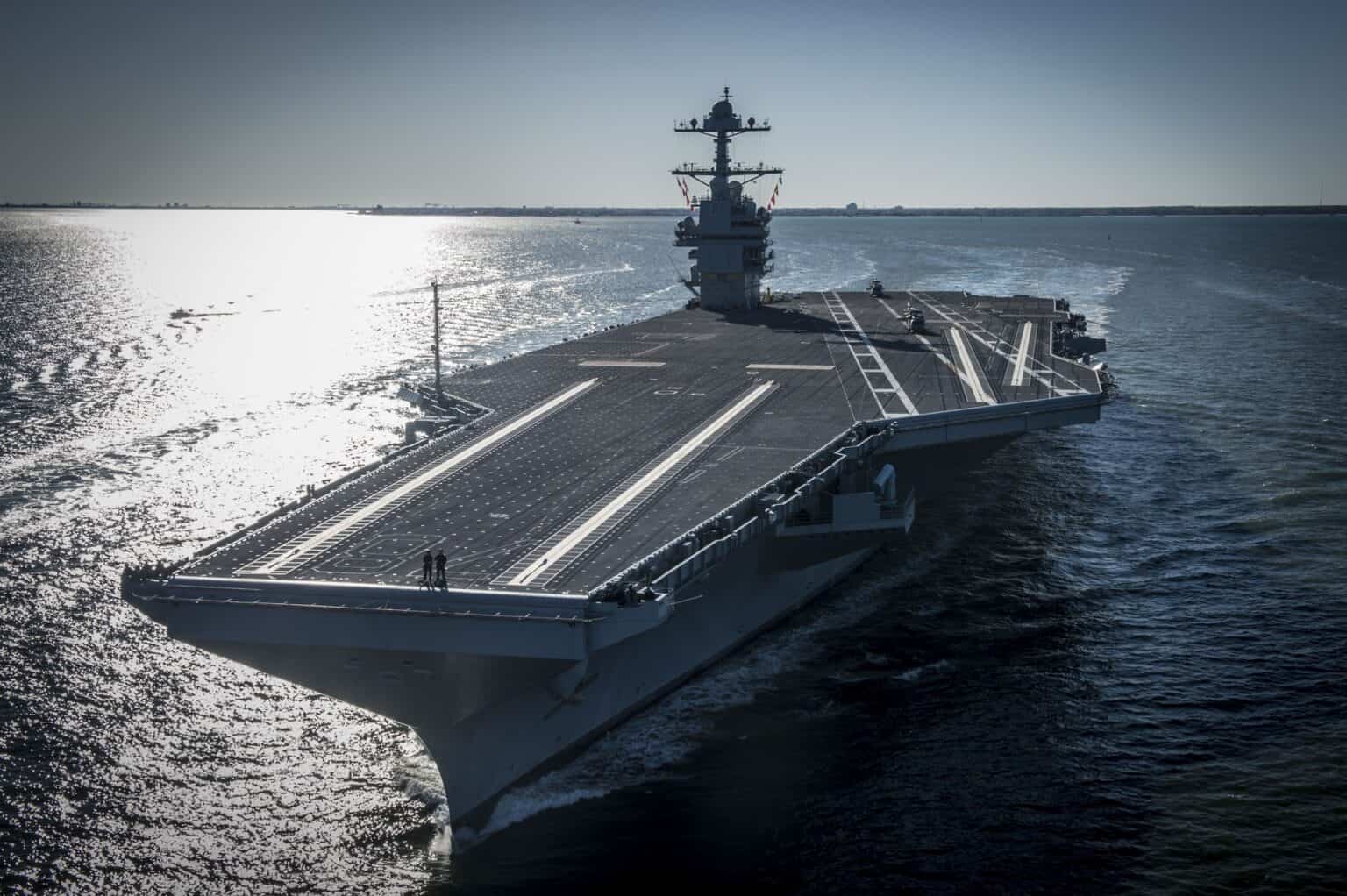
The Ford class is the US Navy’s newest class of nuclear-powered supercarrier, built by Huntington Ingalls Industries’ Newport News Shipbuilding in Virginia. It is the first new carrier design since the Nimitz class. The lead ship replaced the retired USS Enterprise, and later ships take over as the 10 Nimitz carriers retire.
_underway_in_the_Atlantic_Ocean_on_9_October_2022_(221009-N-TL968-1248).JPG)
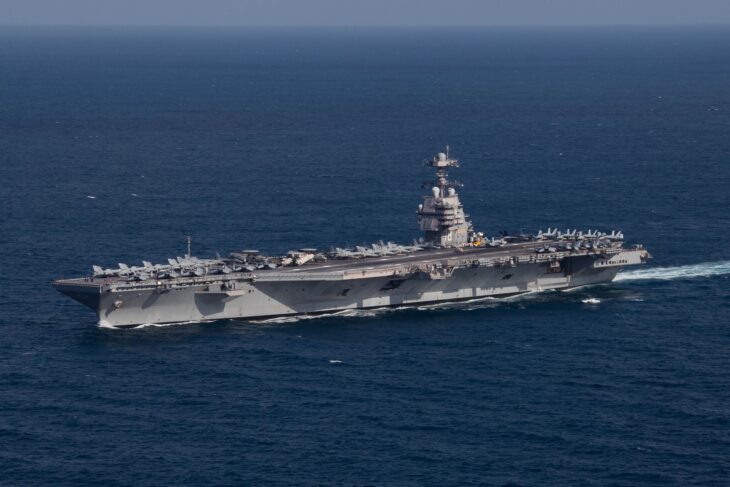
Only one Ford-class ship, USS Gerald R. Ford (CVN-78), is in commission. The Navy plans six in total, and the second, the future USS John F. Kennedy, is due to be delivered in March 2027. Until it arrives, Ford is the lone newcomer among the 11 carriers counted in how many aircraft carriers the US has.
The Ford class at a glance
Builder: Newport News Shipbuilding, Virginia. Ships planned: six (CVN-78 to CVN-83). In service: one, USS Gerald R. Ford, commissioned July 22, 2017. Size: 1,092 feet long, about 100,000 tons. Cost: about $13.3 billion for the lead ship. Signature systems: electromagnetic catapults (EMALS), Advanced Arresting Gear and electric weapons elevators.
How Many Ford-Class Carriers Are There?
Six are planned, one is in service, and every ship under construction has slipped. The Navy’s April 2026 Selected Acquisition Report, the program’s official status filing to Congress, gives these dates.
| Ship | Status (October 2026) | Delivery | Cost |
|---|---|---|---|
| CVN-78 Gerald R. Ford | In service since 2017 | Delivered May 2017 | $13.3 billion |
| CVN-79 John F. Kennedy | Preliminary acceptance, Sept. 29, 2026 | March 2027 | $13.2 billion |
| CVN-80 Enterprise | Under construction, 42% complete in April 2026 | March 2031 | $14.2 billion |
| CVN-81 Doris Miller | Under construction | February 2034 | $15.2 billion |
| CVN-82 William J. Clinton | Named; contract planned FY2029 | March 2039 | Not yet set |
| CVN-83 George W. Bush | Named | March 2043 | Not yet set |
The slips are measured in years. Kennedy was once due in September 2022; the Congressional Research Service counts its delay at 54 months. Enterprise was once due in September 2027, and its contract still says March 2028, but the Navy now projects March 2031, citing “shipbuilder performance and late material delivery.”
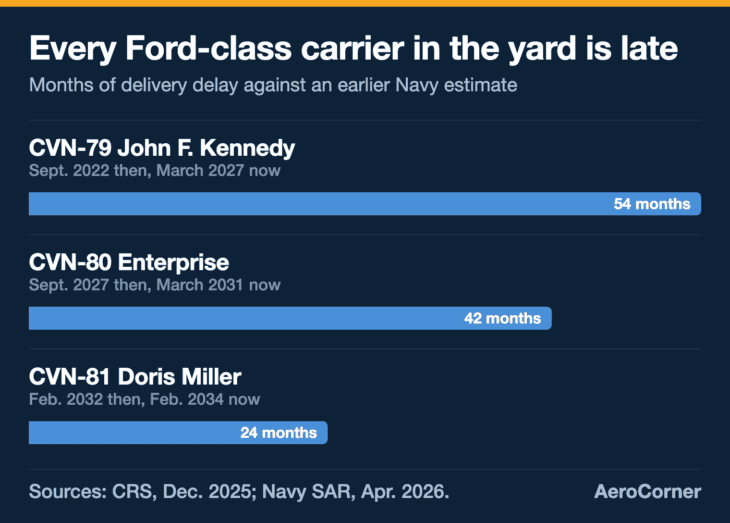
Kennedy’s delay is why the 51-year-old USS Nimitz is staying in commission until March 2027. Federal law requires at least 11 operational carriers, and the Navy cannot retire Nimitz before its replacement shows up.
The Navy blamed Kennedy’s slip on certifying its Advanced Arresting Gear and on weapons elevators that were installed more slowly than planned. When the Navy took preliminary acceptance on September 29, 2026, four of the ship’s 11 weapons elevators were still in testing.
How Big Is a Ford-Class Carrier?
The Navy lists the Ford class at 1,092 feet (333 m) long and about 100,000 tons. The design was pitched in 1998 as a large-capacity carrier for 75 aircraft.
In practice it deploys with a standard nine-squadron air wing. On its 2025 to 2026 cruise, Carrier Air Wing 8 brought four squadrons of F/A-18E/F Super Hornets, one of EA-18G Growlers, one of E-2D Hawkeyes, two helicopter squadrons and a logistics detachment. No F-35C squadron was aboard.
.jpg)
From the pier, a Ford looks like a close relative of a Nimitz. The differences that matter are on the flight deck and inside the hull, which is where the Navy spent its money.
What Makes the Ford Different From a Nimitz?
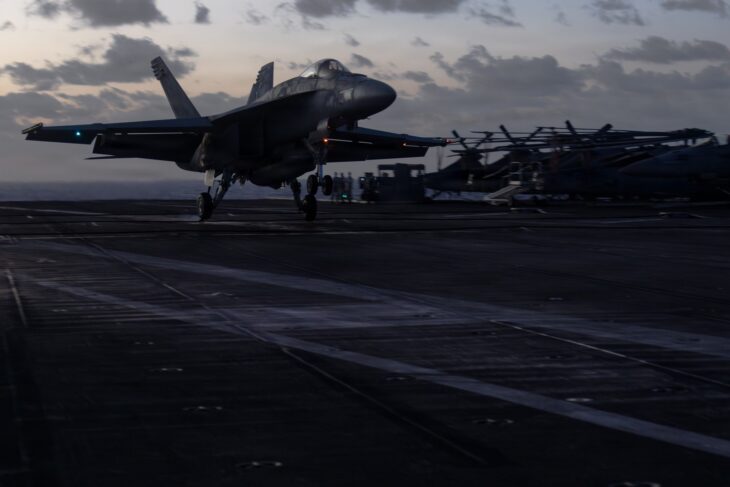
The headline change is the catapult. A Nimitz launches jets with steam catapults. A Ford uses EMALS, the Electromagnetic Aircraft Launch System, which drives the shuttle with a linear induction motor fed by stored energy.
NAVAIR says that gives “more accurate end-speed control and smoother acceleration.” It can be tuned for anything “from lightweight unmanned to heavy strike fighters,” with less stress on the airframe. A steam catapult has no sensors or feedback once a launch starts, so it cannot fine-tune the shove for a light, fragile drone.
Landing changed too. The Advanced Arresting Gear replaces the Mk 7 gear used on Nimitz carriers with water turbines and an induction motor that slow each jet under digital control. The 11 Advanced Weapons Elevators run on electromagnetic motors instead of hydraulics.
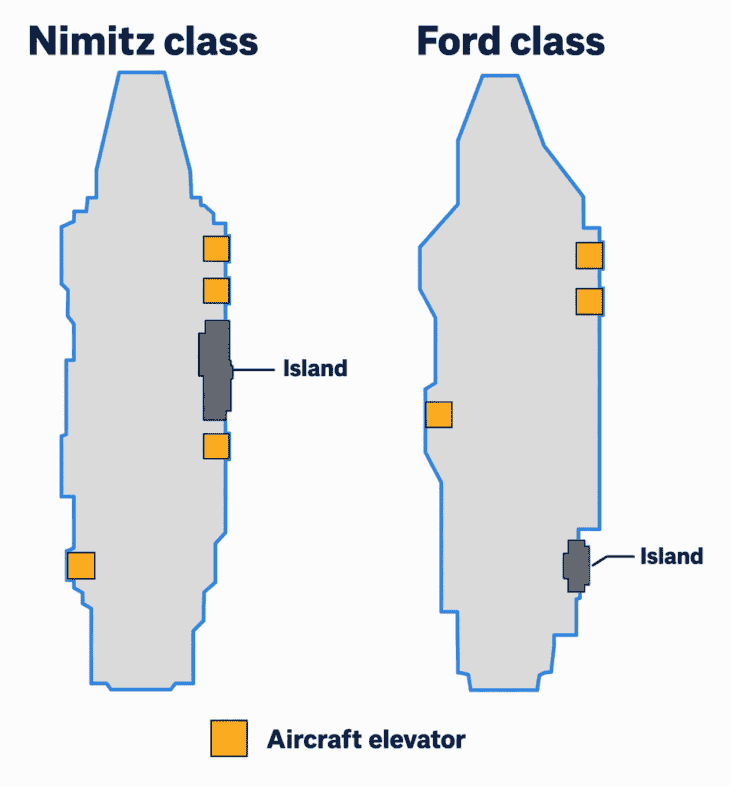
The deck itself was rearranged. The island is smaller and further aft, there are three aircraft elevators instead of four, and fueling stations sit in the deck itself rather than only along the catwalks. The idea is a pit stop: jets refuel where they park instead of queuing at the deck edge.
Below decks, a new reactor plant gives the ship 3.25 times a Nimitz’s electrical generating capacity, according to the Navy’s acquisition report. The Congressional Research Service says the class runs with several hundred fewer sailors and should save about $4 billion per ship over a 50-year life.
The redesign mattered more than the catapults
The Ford was required to sustain 160 sorties a day over a 12-hour flying day, against the 120 a Nimitz demonstrated, and to surge to 270 against 240. In 2014, GAO reported that Navy models showed the ship could meet those numbers primarily because of the flight deck redesign, not because of the new launch and recovery technology.
Ford ran a four-day sustained sortie-rate demonstration in February 2026. The Navy’s current estimates are 172 sorties a day sustained and 284 in a surge, both above the requirement, though the acquisition report still lists the demonstrated figures as “TBD.”
Do the Electromagnetic Catapults Actually Work?
Myth: the Ford's catapults do not work
They do. EMALS and the Advanced Arresting Gear passed 10,000 launches and recoveries in June 2022, and the air wing logged about 12,200 launches on the 2025 to 2026 deployment. The real problem is how often they break: both systems have tested far below the reliability the Navy required.
The numbers come from the Pentagon’s own testing office, DOT&E. Its FY2021 report found EMALS averaged 272 launches between failures that took it out of action, against a requirement of 4,166. A shorter test window in 2022 produced 614, still “well below” the requirement.
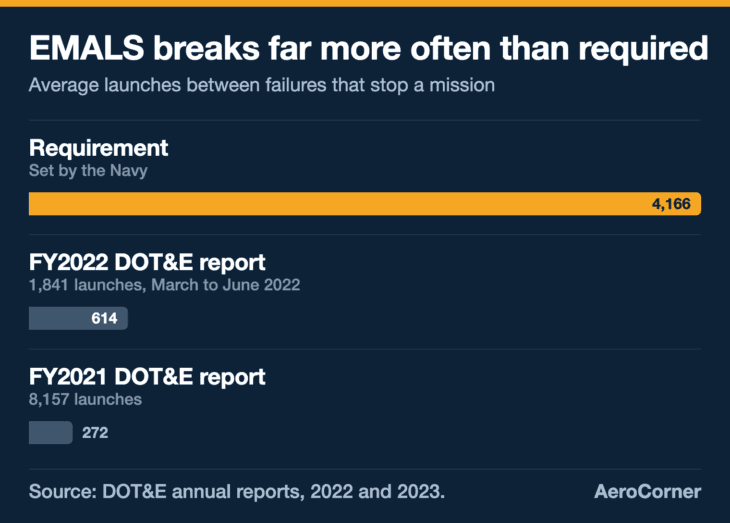
The arresting gear scored worse against its target: 41 recoveries between failures in the FY2021 report and 460 in 2022, against a requirement of 16,500. The ship was also built without a planned fourth arresting-gear engine, so it cannot rig its emergency barricade net if one engine fails.
The newest report, published in March 2026, says hardware and software upgrades “have produced gradual improvements,” but that the systems “continue to adversely affect sortie generation.” The ship still leans on off-ship technical experts to keep them running.
How the Ford’s launch system stacks up against China’s newest carrier is covered in our comparison of US and Chinese aircraft carriers.
Where Is USS Gerald R. Ford Now?
Since July 7, 2026, USS Gerald R. Ford has been at Norfolk Naval Shipyard in Portsmouth, Virginia, for planned maintenance, with a second work package for fire damage. In September the shipyard’s commander said he still expected to hand it back in about six months.
Getting it to sea took longer than building it. Ford was commissioned in July 2017, but its first deployment did not start until October 2022, more than five years later, held back largely by unfinished weapons elevators.
Nov. 2013
Christened and launched. The hull floats out at Newport News, four years after the keel was laid.
July 22, 2017
Commissioned. President Trump attends the ceremony at Naval Station Norfolk.
Oct.-Nov. 2022
First deployment. A short Atlantic cruise with about 80 percent of a full air wing and more than 1,250 sorties.
May 2023-Jan. 2024
First combat deployment. Extended 76 days after the October 7 attacks on Israel. 239 days, 10,396 sorties.
June 24, 2025
Leaves for an 11-month cruise. Europe and the Arctic first, then the Caribbean from November 2025.
Feb. 28, 2026
Strikes on Iran. Ford launches attacks from the eastern Mediterranean under Operation Epic Fury.
March 12, 2026
Fire aboard. A blaze in the main laundry spaces, not combat-related, damages about 100 sleeping berths.
May 16, 2026
Home after 326 days. 57,713 nautical miles sailed and about 12,200 launches by the air wing.
The 2025 to 2026 cruise was a test of the whole class. The Navy’s homecoming release credited it with Operations Southern Spear and Absolute Resolve in the Caribbean, then Epic Fury against Iran. In the middle of it, the March fire forced repair stops at Souda Bay in Crete and Split in Croatia.
The New York Times reported that the fire spread through vent ducts into berthing for more than 600 sailors and took over 30 hours to put out. NPR reported in May that NCIS and the ATF were investigating whether it was set deliberately. The ship also suffered repeated vacuum toilet failures during the cruise.
Long, but not a record
The 326-day cruise was widely reported as the longest US carrier deployment since the Vietnam War, beating USS Abraham Lincoln’s 294 days in 2020. It is not the all-time record: as AP noted, USS Midway spent 332 days deployed in 1972 and 1973.
For more on the destroyers and support ships that sailed with it, see how a carrier strike group is put together.
Why the White House Wants Steam Catapults Back
President Trump has disliked EMALS since 2017, when he told TIME it was “digital” and “very complicated,” and that the Navy should go back to “goddamned steam.” No order followed then. In October 2025, aboard USS George Washington, he promised an executive order putting steam catapults and hydraulic elevators on new carriers.
It arrived on August 13, 2026, as a presidential memorandum. It gives the Pentagon 60 days to produce “a plan on the required measures to replace the Electromagnetic Aircraft Launch System and Advanced Weapons Elevators with steam and hydraulic systems for the construction of CVN-81.”
The order is narrower than the headlines. It names one ship, Doris Miller, and only the catapults and weapons elevators, not the arresting gear. Ford, Kennedy and Enterprise keep EMALS.
Doris Miller is not a blank sheet either. EMALS-maker General Atomics has said its catapult and arresting-gear work for that ship is about half done, and it warned of “significant cost, schedule, and integration risks.” The Navy, for its part, still argues electromagnetic launch is smoother, adjustable for drones and less manpower-hungry.
The plan was due around October 12, 2026, and no version of it had been made public as of early October.
Separately, Navy Secretary John Phelan said in April that a review was asking whether the Navy is “getting the appropriate bang for our buck” from the Ford over the Nimitz, with CVN-82 and CVN-83 under the closest scrutiny.
How Much Does a Ford-Class Carrier Cost?
USS Gerald R. Ford’s final procurement cost was $13.3 billion in then-year dollars. A 2015 CRS breakdown put about $3.3 billion of the lead ship’s cost into one-time design and engineering for the whole class.
Later ships cost more, not less: $13.2 billion for Kennedy, $14.2 billion for Enterprise and $15.2 billion for Doris Miller. Across all six ships, the Navy’s April 2026 report puts total acquisition at $114.8 billion in then-year dollars.
Each of those ships is meant to serve about 50 years, which is why the catapult argument matters. Whatever goes into Doris Miller in the 2030s will still be launching jets in the 2080s.
So the next time a Ford-class carrier turns up in the news, keep both halves in view. It is the ship the Navy sends when it needs the most airpower on the water, and it is also a design still being tested, repaired and second-guessed nine years after the first one was commissioned.
Sources and references used for research and fact-checking.
- Congressional Research Service, Navy Ford (CVN-78) Class Aircraft Carrier Program: Background and Issues for Congress (RS20643, Dec. 4, 2025)
- Congressional Research Service via EveryCRSReport, Navy Ford (CVN-78) Class Aircraft Carrier Program (RS20643, Sept. 22, 2015)
- US Department of Defense, CVN 78 Gerald R. Ford Class Nuclear Aircraft Carrier, Modernized Selected Acquisition Report, FY2027 President's Budget
- Director, Operational Test and Evaluation, CVN 78 Gerald R. Ford-Class Nuclear Aircraft Carrier, FY2021, FY2022, FY2025 annual reports
- Director, Operational Test and Evaluation, CVN 78 Gerald R. Ford Class, FY2021 annual report
- Director, Operational Test and Evaluation, CVN 78 Gerald R. Ford Class, FY2022 annual report
- Director, Operational Test and Evaluation, CVN 78 Gerald R. Ford Class, FY2014 annual report
- US Government Accountability Office, Ford-Class Aircraft Carrier: Poor Outcomes Are the Predictable Consequences of the Prevalent Acquisition Culture (GAO-15-22)
- IEEE Spectrum, A High-Tech Launch System for Carriers
- US Navy, Aircraft Carriers - CVN
- Wikipedia, USS Gerald R. Ford
- The Maritime Executive, Decommissioning of USS Nimitz Delayed Until 2027
- Stars and Stripes, Trump directs Navy to put steam catapults on future carrier
- NAVAIR Lakehurst, Electromagnetic Aircraft Launch System (EMALS)
- NAVAIR Lakehurst, Advanced Arresting Gear (AAG)
- General Atomics, EMALS & AAG
- NAVAIR, EMALS and AAG reach 10,000 aircraft launches and recoveries
- NAVSEA, Advanced Weapons Elevators completed aboard USS Gerald R. Ford (CVN 78)
- US Navy via DVIDS, USS Gerald R. Ford Welcome Aboard guide
- Naval Air Force Atlantic, CVN 79
- HII, Gerald R. Ford-Class
- Ocean News, Navy Takes Preliminary Acceptance of Future USS John F. Kennedy CVN 79
- The Maritime Executive, U.S. Navy Completes Preliminary Acceptance of Future USS John F. Kennedy
- US Navy, Navy to commission new first-in-class aircraft carrier Gerald R. Ford
- DVIDS, Gerald R. Ford Carrier Strike Group returns to homeport, concluding inaugural deployment
- Navy Times, USS Gerald R Ford leaves Norfolk for first full-length deployment
- US Navy, Gerald R. Ford Carrier Strike Group returns from historic deployment
- US Fleet Forces Command, World's Largest Aircraft Carrier, Strike Group Return from Historic 11-Month Deployment
- US Fleet Forces Command, Gerald R. Ford Carrier Strike Group enters Caribbean Sea
- Stars and Stripes, USS Gerald R. Ford goes into maintenance following record-setting deployment
- Stars and Stripes, Ship fire unrelated to combat injures pair of USS Gerald R. Ford sailors
- Stars and Stripes, USS Gerald R. Ford leaves Croatia to resume operations
- The Maritime Executive, Report: USS Ford's Laundry Room Fire Left 600 Crewmembers Without Berthing
- Military Times, USS Gerald R. Ford to undergo maintenance after onboard fire and plumbing issues
- NPR, A nearly year-long deployment at sea takes a toll on military families
- VPM (Associated Press), USS Ford Returns to Norfolk After Historic Deployment
- Breaking Defense, Despite fire, lengthy deployment, Navy expects only six-month maintenance for USS Ford
- The White House, Rebuilding the United States Navy and America's Shipbuilding Industrial Base
- Defense One, Trump wants 'goddamned steam,' not digital catapults, on aircraft carriers
- The War Zone, Executive order to go back to steam catapults on new aircraft carriers coming: Trump
- The War Zone, Bringing back steam catapults on carriers is a huge risk
- The War Zone, Ford-class review puts Navy's future carrier plans into question
- Navy Lookout, Full steam in reverse: Trump orders US Navy back to old-style aircraft catapults
- Defense News, Steam catapults: US Navy appears to be sticking with electromagnetics on carriers
Get the Newsletter
The latest aviation news and stories sent to your inbox.
About the Author

Tim is the owner and lead editor of AeroCorner since 2019, overseeing aviation content covering aircraft, airlines, airports, and the broader aviation industry. Through years of researching, writing, editing, and publishing aviation-focused content, he has developed extensive practical knowledge of commercial aviation and air travel. Based in Asia and a frequent traveler himself, Tim also brings firsthand passenger experience to AeroCorner’s coverage. Outside of publishing, he has also explored aviation firsthand through hands-on flight training in New Zealand.