

Table of Contents
On July 12, 2019, the first parts of a Russian S-400 arrived at Murted air base outside Ankara. Five days later, the White House threw Turkey out of the F-35 program.
Seven years on, Turkey’s S-400s are reported to sit in storage, and Turkey is still under US sanctions. India bought the same system, credits it with the longest surface-to-air kill it says was ever recorded, and is shopping for five more.
In Ukraine, meanwhile, drones keep burning its launchers, and Russia fires its missiles at cities. Here is what the S-400 actually is, what its famous range really covers, and why governments keep risking Washington’s anger to own one.
What Is the S-400 and How Does It Work?
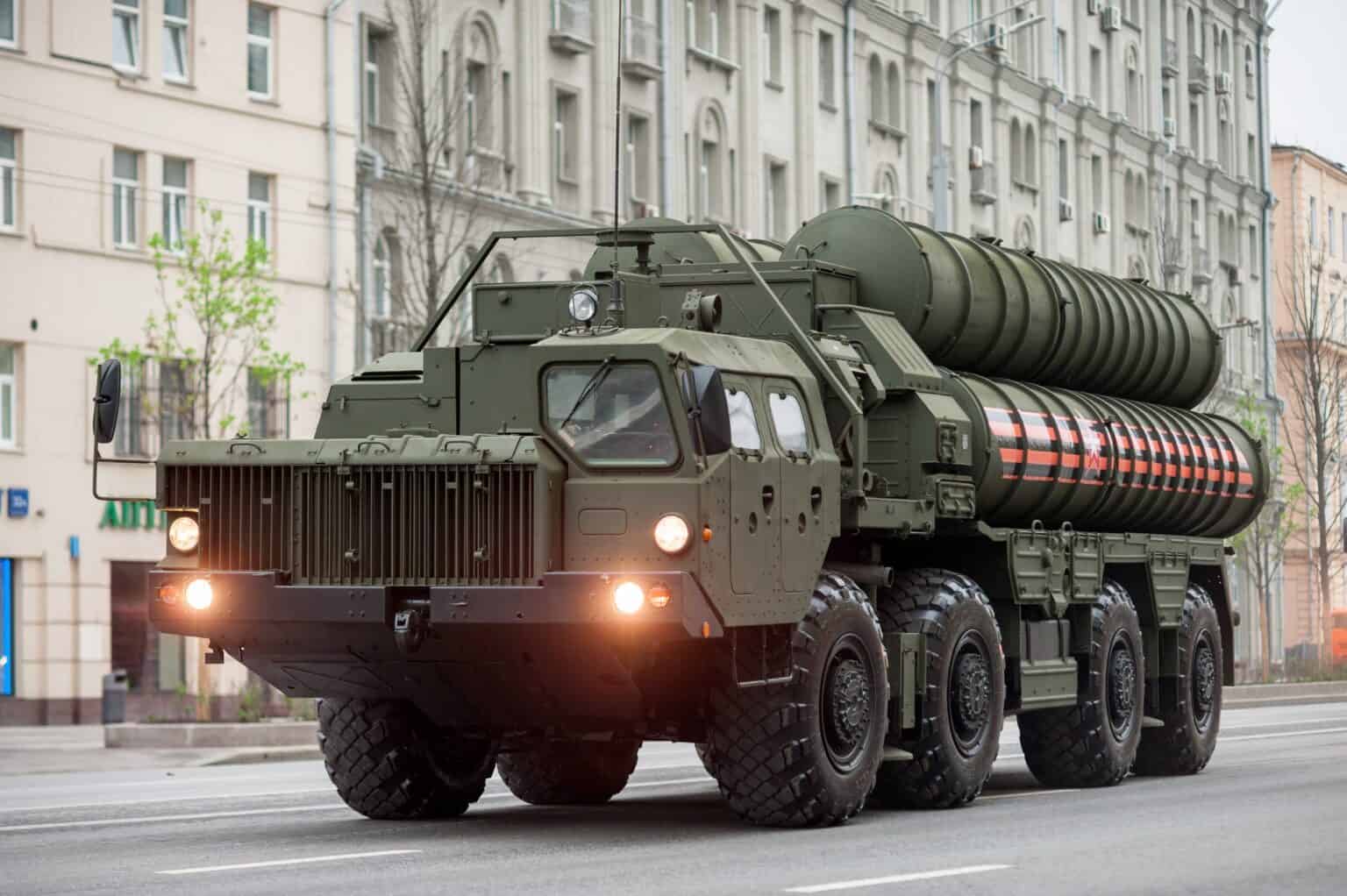
The S-400 Triumf, NATO name SA-21 Growler, is a mobile, long-range surface-to-air missile system built by Russia’s Almaz-Antey. It is designed to shoot down aircraft, drones and cruise missiles, with a limited ability to stop ballistic missiles in their final dive.
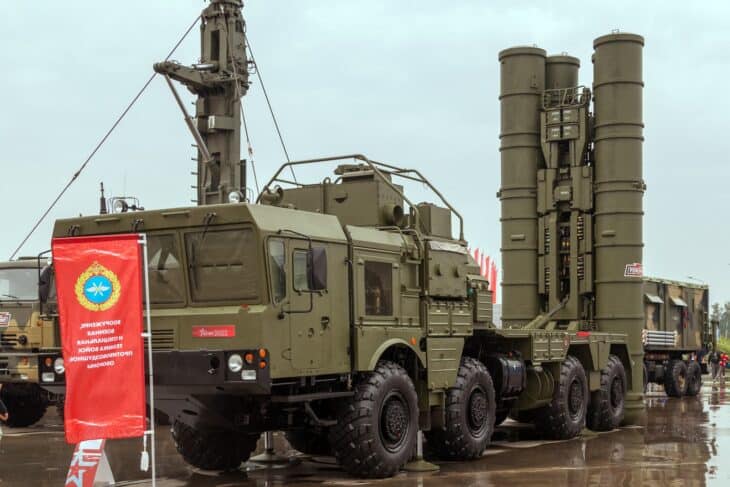

A long-range radar finds targets, a command post decides which to engage, an engagement radar guides the missiles, and truck-mounted launchers fire them. CSIS calls it roughly comparable to the American Patriot missile system.
It entered service on April 28, 2007, and its first battalion went on combat duty that August at Elektrostal, defending Moscow. It is an evolution of the S-300, and CSIS estimates that 70 to 80 percent of the original design’s technology was adapted from it.
The S-400 at a glance
Maker: Almaz-Antey, with missiles from the Fakel design bureau. In service: 2007. Job: defend a region against aircraft, cruise missiles and drones, plus limited ballistic missile defense. Longest-range missile: the 40N6, officially up to 380 km (236 miles) against aircraft. Buyers: Russia, China, India, Turkey and Belarus.
Inside an S-400 Battalion
The S-400’s eyes are the 91N6E “Big Bird,” an S-band surveillance radar that can detect targets up to 600 km (373 miles) away and track up to 300 at once, according to Army Technology. Those are advertised figures, and they describe detection, not shooting.
Shooting is the job of the 92N6E “Grave Stone,” an X-band engagement radar mounted on an eight-wheel truck. It tracks the chosen targets and guides the missiles toward them, while the 55K6E command post prioritizes threats and coordinates the batteries.
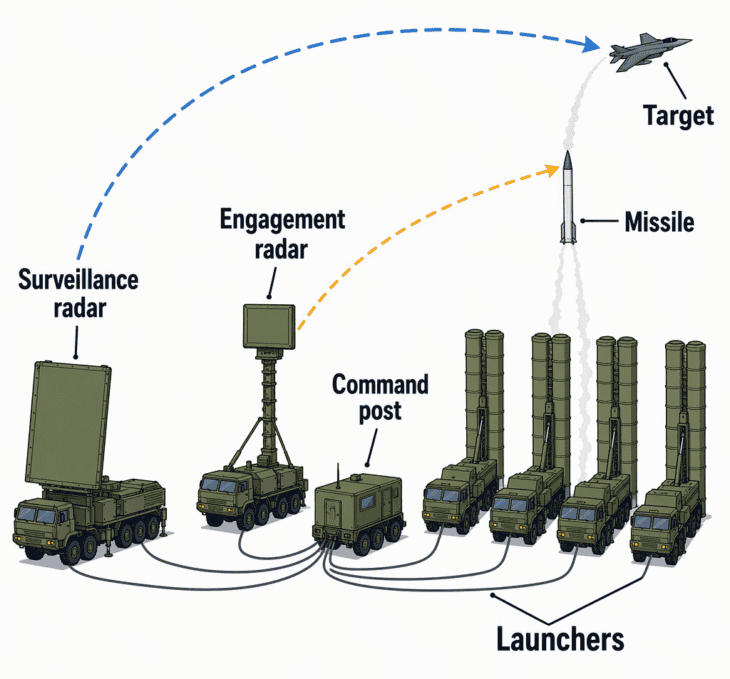
Each launcher carries four large tubes. Russia’s official TASS factfile allows up to 12 launchers per battalion; in practice, TASS reported 38 battalions with 304 launchers in 2017, an average of eight each. Two battalions make a regiment.
By TASS’s figures, a full system can engage up to 36 targets at once and guide 72 missiles, two per target. It can go from driving to deployed in 5 to 10 minutes, and engage targets moving at up to 17,300 km/h, about 10,750 mph.
How Many Missiles Are in an S-400?
Each launcher holds four large missiles, one per tube. Swap in the small 9M96 family, which is packed four to a canister, and the same launcher carries up to 16. The huge 40N6 is the exception: a launcher carrying it may hold only two.
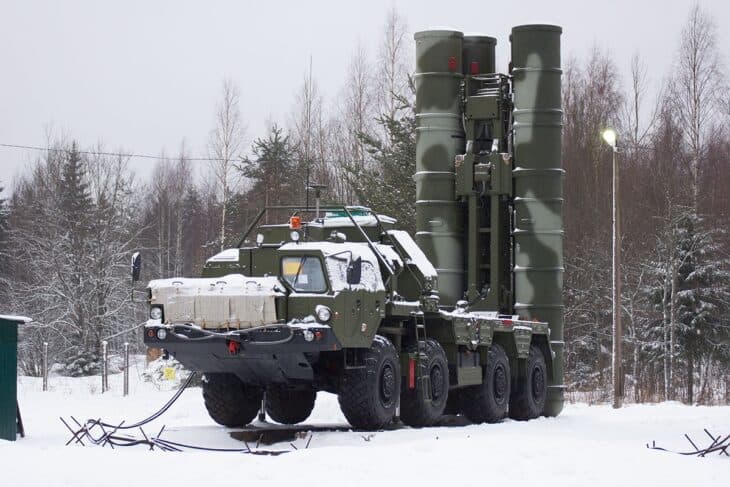

That mix is the point of the system. Small, agile missiles handle close threats, while the big ones reach out to aircraft flying far away and high up, letting one battery cover very different jobs.
| Missile | Range against aircraft | How it is loaded |
|---|---|---|
| 9M96E | 25 miles (40 km) | Four to a tube |
| 9M96E2 | 75 miles (120 km) | Four to a tube |
| 48N6E2 | 124 miles (200 km) | One per tube |
| 48N6DM (export: 48N6E3) | 155 miles (250 km) | One per tube |
| 40N6 (export: 40N6E) | 236 miles (380 km) | Two per launcher |
The 40N6 took years to arrive. CSIS had questioned whether the S-400’s radars could use its full range, and the Russian army only signed it into service in September 2018.
The myth: it can hit anything 400 km away
The headline reach of about 400 km belongs to one missile, the 40N6, and one kind of target: aircraft. Russia’s own official figure for the 40N6 is 380 km (236 miles). Against ballistic missiles, TASS gives the same missile 15 km (9 miles), and the whole system 60 km (37 miles).
Altitude cuts the range too. Long-range surface-to-air missiles reach farthest against targets flying high, so the classic counter is to fly low, as an Indian Centre for Air Power Studies analysis put it.
Ukraine’s pilots learned that the hard way. RUSI found that in 2022, the threat from S-400s based in Belarus and Crimea forced Ukrainian aircraft to fly below 100 feet for most of their sorties on the northern and southern fronts.
Can the S-400 Detect the F-35?
Probably, at some range. Shooting it down is a different problem, and that gap is the whole stealth argument.
Stealth jets like the F-35 Lightning II are shaped mainly to defeat the higher-frequency C, X and Ku bands that fire-control radars use. Lower-frequency early warning radars can detect and even track them, the National Interest reported in 2018, but they “don’t deliver a weapons quality track.”
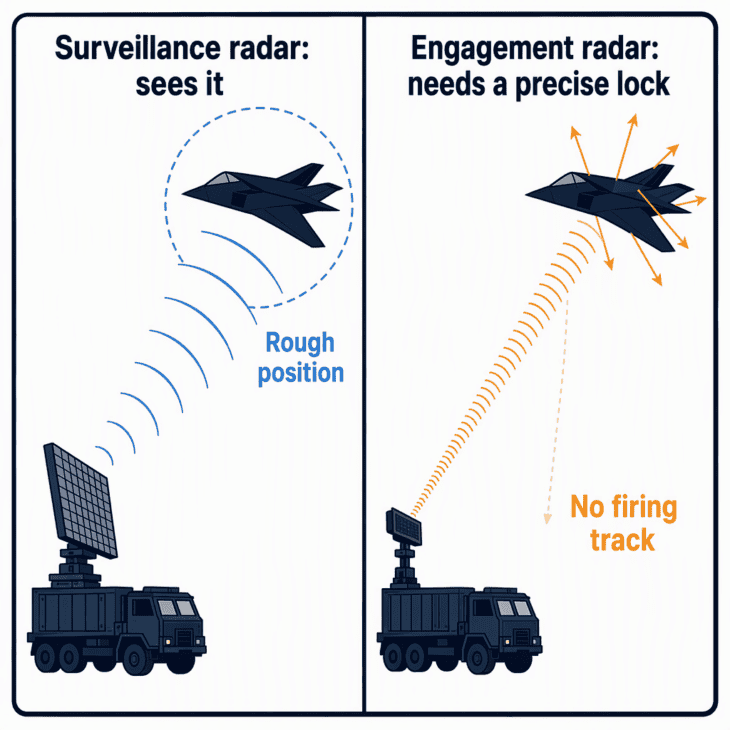
The S-400’s own engagement radar works in the X band. A 2014 study by Konstantinos Zikidis, as reported by Sandboxx, estimated it could target an F-35, but likely not until the jet came within about 20 miles of the system.
“Getting accuracy such that you can confidently get a missile near the target is the primary challenge,” CNA analyst Michael Kofman told the National Interest.
Nobody has tested that in combat. Russia decided to send an S-400 to Syria in November 2015, a day after Turkey shot down a Russian Su-24. Under a deconfliction deal, Russian-controlled S-400s there had never fired at the Israeli jets striking Syria, The War Zone reported in 2022.
What worried Washington was the opposite direction: what the S-400 could learn. “Much of the F-35’s strength lies in its stealth capabilities, so the ability to detect those capabilities would jeopardize the long-term security of the F-35 program,” Pentagon acquisition chief Ellen Lord said in July 2019.
Why Everyone Wants the S-400
Price is the first reason. In 2018, people with first-hand knowledge of a US intelligence assessment told CNBC that an S-400 cost about $500 million, against about $1 billion for a Patriot PAC-2 battery and about $3 billion for a THAAD battery.
Part of the gap is what is not included. Russian systems come without the extensive maintenance support of American ones, and buying American, CSIS’s Andrew Hunter told CNBC, means “buying a partnership with the U.S. military.”
Some buyers wanted that independence, and some wanted reach. The Congressional Research Service wrote that Indian planners appear to have concluded Patriot and THAAD lack the S-400’s purported range and versatility.
China was the first foreign customer, ordering two regimental sets for an estimated $3 billion under a 2014 contract and receiving the last of them in January 2020. Belarus said in 2022 that it had bought S-400s too. In September 2018, the US sanctioned the Chinese military office that took delivery.
A sale that nearly started a war
In 2018, Qatar said talks to buy the S-400 were at an advanced stage. Saudi Arabia’s King Salman then reportedly warned France’s president that the kingdom would take all necessary measures to eliminate the system, including military action. Saudi Arabia itself had signed a preliminary S-400 deal in 2017, then dropped it after buying the American THAAD.
Turkey: A $2.5 Billion System It Never Put Into Service
Turkey agreed in 2017 to buy four S-400 batteries for $2.5 billion. Turkish accounts say it turned to Russia after failing to get Patriot; CSIS argued in 2019 that Patriot had been offered “on numerous occasions,” and that the purchase was partly about protecting the government against its own air force after the 2016 coup attempt.
2017
Deal signed. Turkey agrees to buy four S-400 batteries for $2.5 billion.
July 12, 2019
First deliveries. The first parts arrive at Murted air base outside Ankara.
July 17, 2019
Out of the F-35 program. The White House says the F-35 “cannot coexist with a Russian intelligence collection platform.”
October 2020
Live-fire test. Turkey fires the system from Sinop on the Black Sea coast.
December 14, 2020
Sanctions. The US sanctions Turkey’s defense procurement agency, SSB, under the CAATSA law.
July 2026
Talks, no deal. President Trump says the US will lift the sanctions, but the State Department tells Congress Turkey has not met the conditions to return to the F-35.
October 2026
Still in Turkey. Reports of a sale to a Gulf state remain unconfirmed, and Russia says any transfer needs its consent.
The sanctions bar US export licenses for SSB and block four of its officials. Turkey’s systems, radars and missiles have reportedly stayed in storage, never declared operational.
The obstacle is written into US law. The 2020 defense authorization act bars F-35 transfers to Turkey until it no longer possesses the S-400 and the administration certifies that to Congress.
Proposals floated since range from removing a component and declaring the system inoperable to selling it to a Gulf state; none has been confirmed. The fighter gap it left is covered in our look at Turkey’s air force in 2026.
India: The Longest Kill Ever Claimed
India signed for five S-400 squadrons on October 5, 2018, for $5.43 billion, and calls the system Sudarshan. The first squadron went operational in Punjab in December 2021, and three were in place by 2024.
The war in Ukraine delayed the last two: the fourth arrived on June 1, 2026, and the fifth was due by November 2026 as of late August.
So far, Washington has not imposed CAATSA sanctions on India over the deal. In March 2026, India’s defense ministry approved five more systems at an expected $6.1 billion, and Russia submitted its bid in August; no contract had been reported as of late August.
The reason for the second order is Operation Sindoor, India’s May 2025 strikes on Pakistan. In August 2025, Indian Air Force chief Air Chief Marshal A.P. Singh said five Pakistani aircraft and one airborne early warning aircraft were shot down, one of them about 186 miles (300 km) away, “the largest ever recorded surface to air kill.”
He called the S-400 “a game changer.” According to Janes, he presented no visual data, and Pakistan’s defense minister replied that “not a single Pakistani aircraft was hit or destroyed by India.” No independent source has confirmed the kills.
Pakistan made its own claim, saying its missiles had destroyed an S-400 at Adampur air base. On May 13, 2025, Prime Minister Narendra Modi visited Adampur and spoke with an intact S-400 visible behind him.
What the S-400 Has Done in Ukraine
Against aircraft, it has worked. RUSI called Russia’s ground-based air defense highly effective from March 2022, especially the S-400, and Ukraine has attributed several aircraft losses to it, although those kills are not independently confirmed.
Against missiles, the record is weaker. On May 22, 2024, near Mospino in occupied Donetsk, an S-300 or S-400 battery fired at least six missiles at incoming ATACMS and failed to stop them, The War Zone reported.
The system itself has become a target. As of October 5, 2026, the Oryx open-source project had visually confirmed 34 S-400 launchers, 17 radars and two command posts destroyed or damaged, a floor rather than a total.
Satellite images showed at least four major components of an S-400/S-300 site at Dzhankoi in Crimea burnt out after an April 17, 2024 strike. On September 16 to 17, 2026, Ukraine said it hit two S-400 launchers in Russia’s Bryansk region, and open-source analysts located one destroyed launcher near Poroshino, 54 miles (87 km) from the border.
Russia also fires the S-400 at the ground. An S-400 missile injured 23 people in Kharkiv on November 25, 2024, and the warhead and fragments of another were recovered in Kyiv in July 2026. Flying at about 2.5 km per second, roughly 5,600 mph, a 48N6DM missile crosses 124 miles (200 km) in a few minutes, leaving little warning.
That record is why the S-400 ranks only 10th in our ranking of the best air defense systems by combat record, behind Patriot and behind Israel’s Iron Dome, a system built for the much narrower job of stopping rockets.
So the S-400 is two things at once. On paper, it is a long-reaching, fast-deploying system that has kept enemy jets low and far away; in combat, its biggest claimed success is unconfirmed and its launchers burn on video.
What it has proved beyond doubt is its political weight. Seven years after the first parts arrived at Murted, the hardest thing about Turkey’s S-400s is not switching them on. It is finding a way to give them up.
Sources and references used for research and fact-checking.
- CSIS Missile Defense Project, S-400 Triumf
- CSIS Missile Defense Project, Russian army accepts 40N6 missile for S-400
- TASS, Russia's formidable S-400 Triumf air defense missile system
- TASS, Advanced long-range missile for S-400 system accepted for service in Russia
- Army Technology, S-400 Triumph Air Defence Missile System
- Air Power Australia, Almaz-Antey 40R6 / S-400 Triumf / SA-21 SAM System
- Wikipedia, S-400 missile system
- RUSI, The Russian Air War and Ukrainian Requirements for Air Defence
- Centre for Air Power Studies (India), Russia Clears S-400 Long Range SAM Sale to China
- Warrior Maven (The National Interest), Could Russia's S-400 Kill a F-22, F-35 or B-2?
- STRASAM, S-400 Triumf Air Defence System (Part 2)
- Sandboxx, How effective is Russia's Nebo-M counter-stealth radar?
- U.S. Department of Defense (via GlobalSecurity.org), Under Secretary of Defense Ellen M. Lord and Deputy Under Secretary of Defense for Policy David J. Trachtenberg press briefing on Turkey
- The Aviationist, Russia deploys S-400 and moves guided-missile cruiser off Latakia to protect its jets near Turkish border
- The War Zone, S-300 surface-to-air missile fired at Israeli jets over Syria for first time: report
- CNBC, Russia lures buyers as S-400 missile system costs less than US models
- Congressional Research Service, Russian Arms Sales and Defense Industry (R46937)
- The Diplomat, Russia completes delivery of second S-400 regiment to China
- TASS, Russia completes delivery of second S-400 missile system regimental set to China
- Defense News, Belarus says its Russian S-400, Iskander missiles enter combat duty
- Al Jazeera, Saudi threatens military action against Qatar over S-400: report
- Defense News, Saudi Arabia has no interest in the S-400, says Russian industry official
- CSIS, Coup-proofing? Making Sense of Turkey's S-400 Decision
- RFE/RL, Turkey says first parts of Russian S-400 missile system delivered
- NPR, No F-35 fighter jets for Turkey, White House says in rebuke over Russian missiles
- Congressional Research Service, Turkey: U.S. Sanctions Under the Countering America's Adversaries Through Sanctions Act (CAATSA)
- U.S. Department of State, CAATSA Section 231 imposition of sanctions on Turkish Presidency of Defense Industries
- The Eurasian Times, Turkey Ready To Dump Russian S-400 For F-35 Stealth Fighters; Deal 4 To 6 Months Away, US Ambassador Hints
- PBS NewsHour, Trump says in Erdogan meeting that U.S. will lift Turkey sanctions, consider selling F-35s
- MiGFlug, Turkey F-35 Return Still Frozen Over the S-400
- Turkish Minute, Trump promises to please Erdoğan when asked about Turkey sanctions
- Türkiye Today, Türkiye's top diplomat says S-400 talks continue 'with everyone'
- The Tribune, Russia will complete delivery of S-400 missile systems to India in 2026
- The Tribune, Fourth S-400 squadron arrives in India; fifth expected by year-end
- The Week, Russia confirms fourth S-400 delivery to India by Operation Sindoor mark; final squadron to arrive in 2027: Report
- Organiser, India receives fourth S-400 squadron from Russia
- Republic World (ANI), Russia Submits Proposal in Response to Indian Tender for 5 More S-400 'Sudarshan' Units
- All India Radio News, India Downed Five Pakistani Fighter Jets During Operation Sindoor: Air Chief Marshal A.P. Singh
- Janes, Six Pakistan aircraft destroyed during May conflict, says IAF air chief
- Anadolu Agency, Pakistan rejects India's claim it shot down 6 fighter jets during May hostilities
- Business Today, PM Modi's Adampur air base visit busts Pakistan's false claims on S 400. Here's how
- The War Zone, ATACMS obliterates Russian air defense system as it desperately tries to defend itself
- Oryx, Attack On Europe: Documenting Russian Equipment Losses During The Russian Invasion Of Ukraine
- The War Zone, Major damage at Russian airbase in Crimea after Ukrainian attack
- Ukrainska Pravda, Ukraine strikes two Russian S-400 launchers in Bryansk Oblast
- Militarnyi, S-400 Triumph Launcher Destroyed Near Poroshino in Bryansk Region
- Euromaidan Press, Russian attack on Kharkiv with S-400 missile injures 23 people
- EMPR, Russia's S-400: How It Became a Weapon Against Kyiv
Get the Newsletter
The latest aviation news and stories sent to your inbox.
About the Author

Tim is the owner and lead editor of AeroCorner since 2019, overseeing aviation content covering aircraft, airlines, airports, and the broader aviation industry. Through years of researching, writing, editing, and publishing aviation-focused content, he has developed extensive practical knowledge of commercial aviation and air travel. Based in Asia and a frequent traveler himself, Tim also brings firsthand passenger experience to AeroCorner’s coverage. Outside of publishing, he has also explored aviation firsthand through hands-on flight training in New Zealand.