

Table of Contents
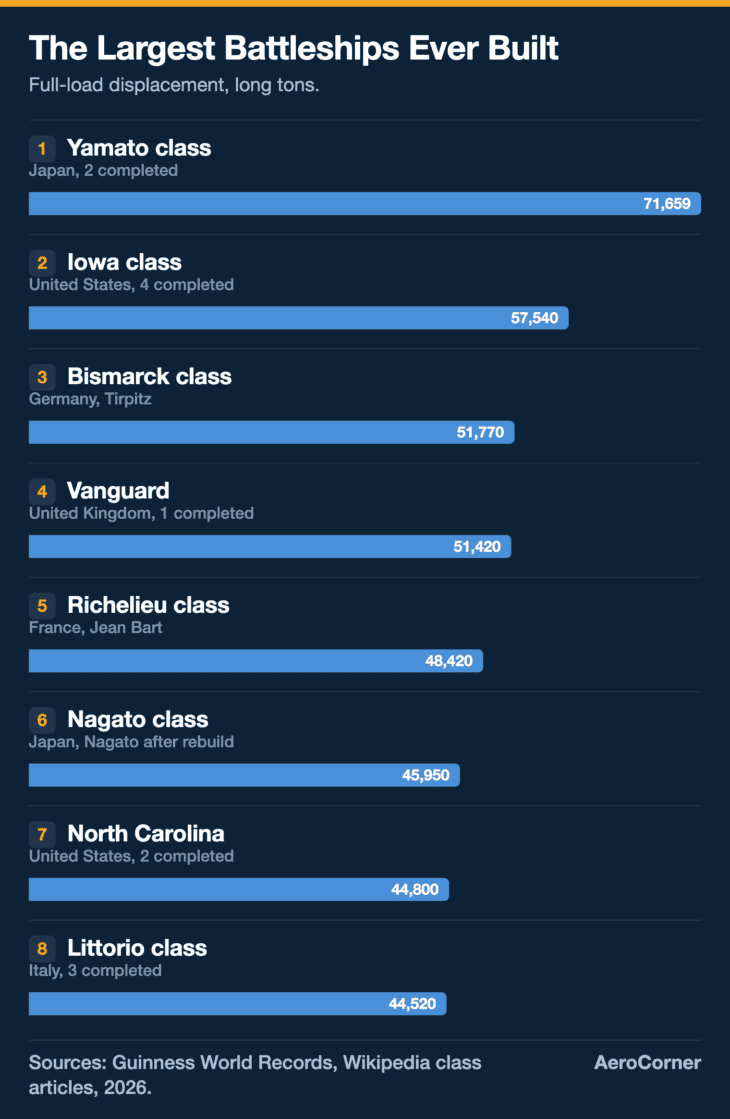
The largest battleships ever built were Japan’s Yamato and Musashi, which displaced 71,659 long tons (72,809 metric tons) fully loaded. No battleship before or since came close: the runner-up, America’s Iowa class, was about 14,000 long tons lighter.
This list ranks every battleship class that was actually completed by its full-load displacement, the weight of the ship ready for battle with fuel, ammunition and crew aboard. Each class is ranked at its heaviest completed ship or configuration.
The order holds up well, with one surprise: the heaviest battleship was not the longest. The Iowa class was 24 feet longer than Yamato. For the largest warships afloat today, mostly aircraft carriers, see our ranking of the largest warships in the world.
| Rank | Class (country) | Full-load displacement | Length overall | Main guns | Completed |
|---|---|---|---|---|---|
| 1 | Yamato (Japan) | 71,659 long tons (72,809 t) | 863 ft (263 m) | 9 × 18.1 in | 2 |
| 2 | Iowa (US) | 57,540 long tons (58,460 t) | 887 ft 3 in (270.4 m) | 9 × 16 in | 4 |
| 3 | Bismarck (Germany) | 51,770 long tons (52,600 t), Tirpitz | 823 ft 6 in (251 m) | 8 × 15 in | 2 |
| 4 | Vanguard (UK) | 51,420 long tons (52,245 t) | 814 ft 4 in (248.2 m) | 8 × 15 in | 1 |
| 5 | Richelieu (France) | 48,420 long tons (49,196 t), Jean Bart | 813 ft 2 in (247.9 m) | 8 × 15 in | 2 |
| 6 | Nagato (Japan) | 45,950 long tons (46,690 t), after rebuild | 738 ft (224.9 m) | 8 × 16.1 in | 2 |
| 7 | North Carolina (US) | 44,800 long tons (45,519 t) | 728 ft 9 in (222.1 m) | 9 × 16 in | 2 |
| 8 | Littorio (Italy) | 44,520 long tons (45,236 t) | 780 ft 1 in (237.8 m) | 9 × 15 in | 3 |
| 9 | South Dakota (US) | 44,519 long tons (45,233 t) | 680 ft (207.3 m) | 9 × 16 in | 4 |
How this ranking works
Ships are ranked by full-load (deep-load) displacement, the standard measure of a warship’s size, in long tons of 2,240 pounds, the unit the US and Royal navies used. Only battleship classes with at least one ship completed count. Battlecruisers, ships converted to other roles and designs that were never finished are covered separately at the end. Where sister ships or refits differ, the class is ranked at its heaviest completed ship or configuration, and the ship is named.
1. Yamato Class (Japan): 71,659 Long Tons
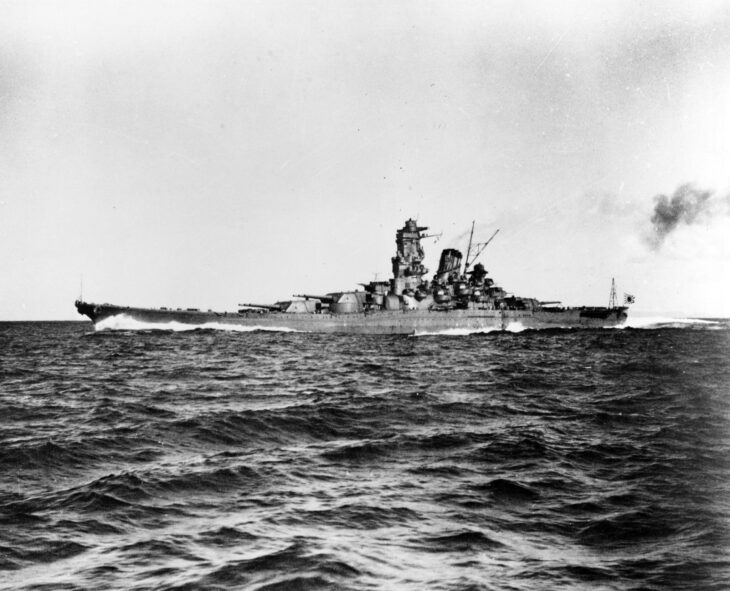

Yamato and Musashi displaced 71,659 long tons (72,809 t) at full load, measured 863 feet (263 m) long and 127 feet 7 inches (38.9 m) wide. Guinness World Records lists the pair as the largest battleships ever built.
They also carried the largest guns ever mounted on a warship: nine 18.1-inch (46 cm) guns in three triple turrets. Each fired a 3,219-pound (1,460 kg) shell up to 26 miles (42 km).
Japan built them in such secrecy that US naval intelligence learned their names only in late 1942. As late as September 1944, Jane’s Fighting Ships listed both at 45,000 tons, short by about a third.
Neither giant was sunk by another battleship. Musashi went down on Oct. 24, 1944, in the Battle of the Sibuyan Sea after 19 torpedo and 17 bomb hits. Yamato followed on April 7, 1945, sunk by 386 American carrier aircraft on her way to Okinawa, with 2,498 of her roughly 2,700 crew lost.
The third Yamato became an aircraft carrier
A third Yamato-class hull was finished as the carrier Shinano, at 64,800 long tons standard displacement the largest carrier built up to that time. The submarine USS Archerfish sank her on Nov. 29, 1944, 10 days after she was completed for trials. She remains the largest ship ever sunk by a submarine.
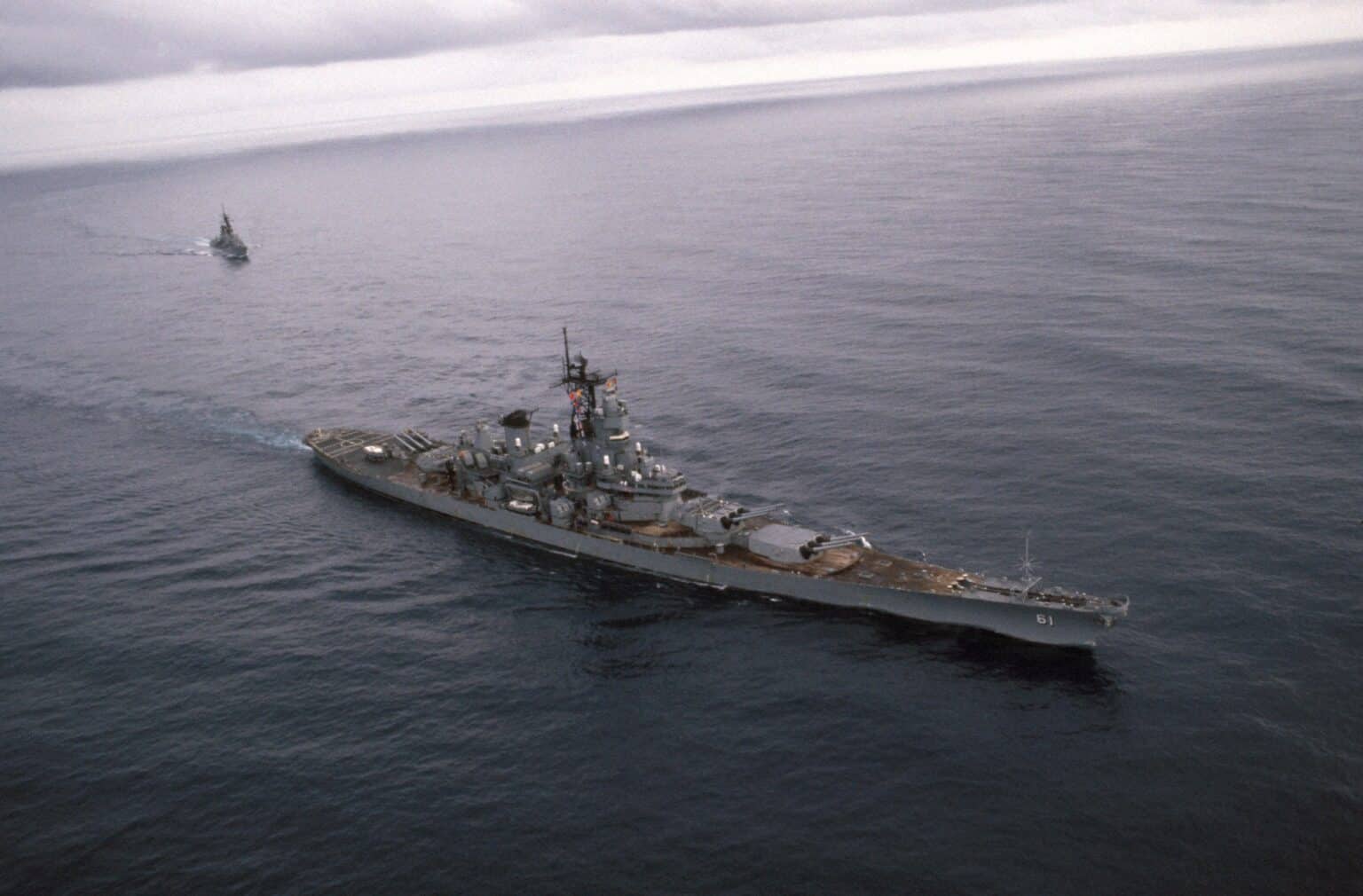
2. Iowa Class (United States): 57,540 Long Tons
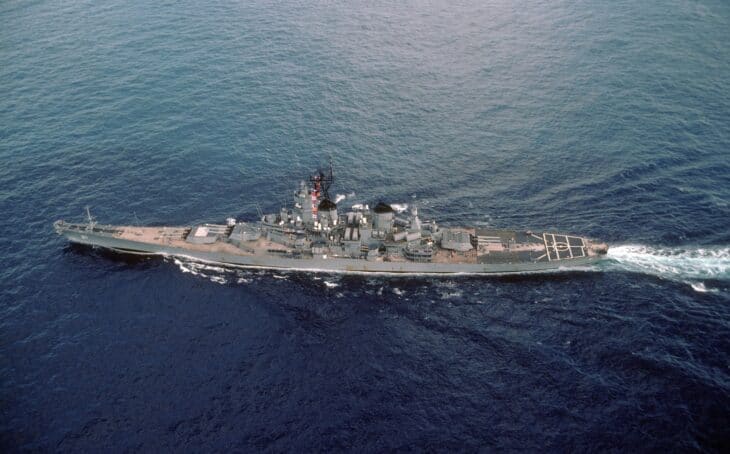

The four Iowas (Iowa, New Jersey, Missouri and Wisconsin) displaced 48,110 long tons standard and 57,540 long tons (58,460 t) at full load in World War II. New Jersey reached about 60,000 long tons at full load by 1968, the heaviest any Iowa got.
At 887 feet 3 inches (270.4 m) overall, they are the longest battleships ever completed. Their beam of 108 feet 2 inches (33 m) was set by the width of the Panama Canal, which is why a longer, narrower hull carried less weight than Yamato’s.
They were built for speed, at 33 knots, and for nine 16-inch guns. They cost about $100 million each.
They also had the longest careers. Japan’s surrender was signed aboard Missouri in Tokyo Bay on Sept. 2, 1945, and Missouri and Wisconsin fired their 16-inch guns and missiles at Iraqi targets in Operation Desert Storm in 1991.
Iowa and Wisconsin were the last battleships on the US Naval Vessel Register, struck off in March 2006. All four are now museum ships.
3. Bismarck Class (Germany): 51,770 Long Tons
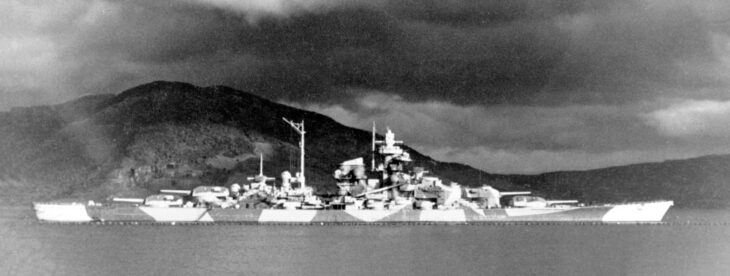

The Bismarck class ranks third through Tirpitz, which displaced 52,600 metric tons (51,770 long tons) at full load. Bismarck herself was lighter, at 50,300 metric tons (49,506 long tons). Both measured 823 feet 6 inches (251 m) and carried eight 15-inch (38 cm) guns.
Bismarck is the most famous battleship on this list for a single week in May 1941. On May 24, in the Battle of the Denmark Strait, the battlecruiser HMS Hood was destroyed by the combined fire of Bismarck and the cruiser Prinz Eugen.
Three days later, on May 27, Bismarck was scuttled in the North Atlantic after a British fleet battered her. Tirpitz spent most of the war in Norway and was sunk by Royal Air Force bombers on Nov. 12, 1944.
4. HMS Vanguard (United Kingdom): 51,420 Long Tons
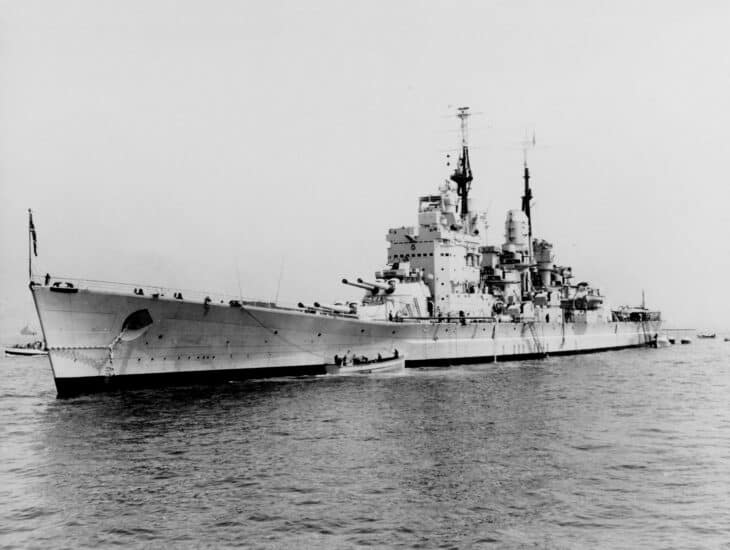

Vanguard displaced 44,500 long tons standard and 51,420 long tons (52,245 t) at deep load, which makes her the largest and fastest battleship the Royal Navy ever had. She was 814 feet 4 inches (248.2 m) long and carried eight 15-inch guns in four twin turrets.
She came too late for the war she was built for. Launched on Nov. 30, 1944, she was commissioned on May 12, 1946, after the war had ended, and was scrapped in 1960.
Vanguard was the only ship of her class and the last battleship ever built. Her deep-load weight puts her within 350 long tons of Tirpitz, close enough that a different loading condition could swap ranks three and four.
5. Richelieu Class (France): 48,420 Long Tons
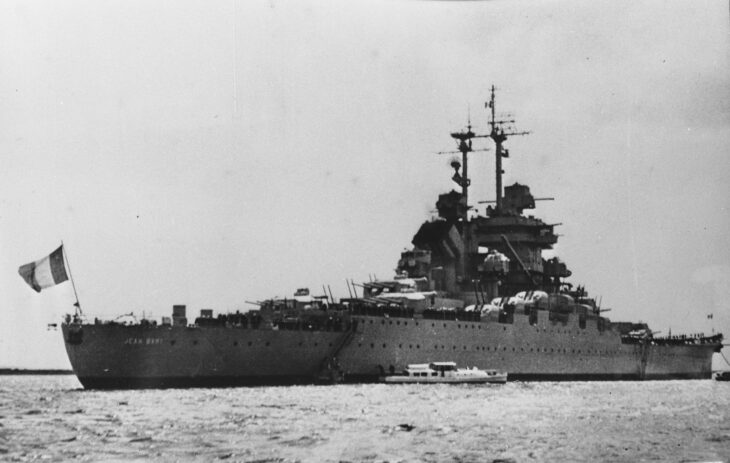

France’s two Richelieus put all eight 15-inch (380 mm) guns in two quadruple turrets on the bow, the same concentrated layout France had used on its smaller Dunkerque class. Each ship measured 813 feet 2 inches (247.9 m).
The class grew heavier with time. Richelieu was designed for 44,698 metric tons at full load and reached 47,728 metric tons after her 1943 refit in the United States. Jean Bart, finished after the war, came out heaviest at 49,196 metric tons (48,420 long tons).
Jean Bart was launched in March 1940, commissioned in January 1949 and only entered full service in 1955. In November 1956 she fired four shells at Port Said during the Suez Crisis, and she was broken up in 1970.
6. Nagato Class (Japan): 45,950 Long Tons
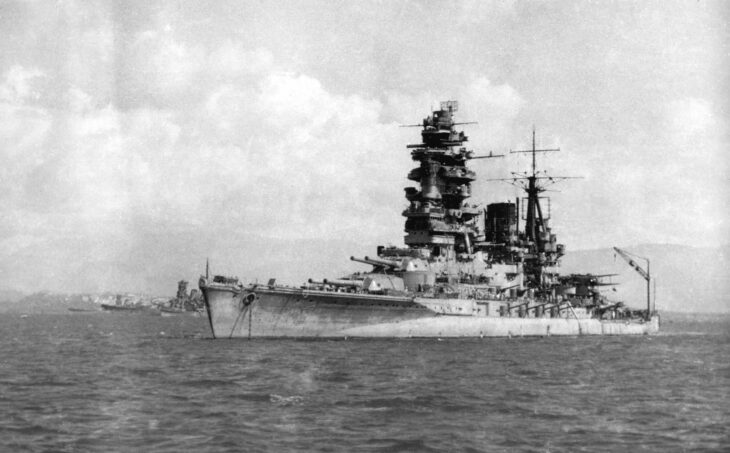

Nagato is the only World War I era battleship on this list. She entered service in 1920 at 39,116 metric tons full load, armed with eight 16.1-inch (41 cm) guns.
A 1934 to 1936 reconstruction added more than 7,000 metric tons, bringing her to 46,690 metric tons (45,950 long tons) at deep load and 738 feet (224.9 m) long. That rebuild is what puts her above the newer American and Italian ships below.
Her sister Mutsu was destroyed by an internal explosion on June 8, 1943, which killed 1,121 people aboard. Nagato survived the war and was sunk as a target in the Operation Crossroads atomic bomb tests at Bikini Atoll in July 1946.
7. North Carolina Class (United States): 44,800 Long Tons
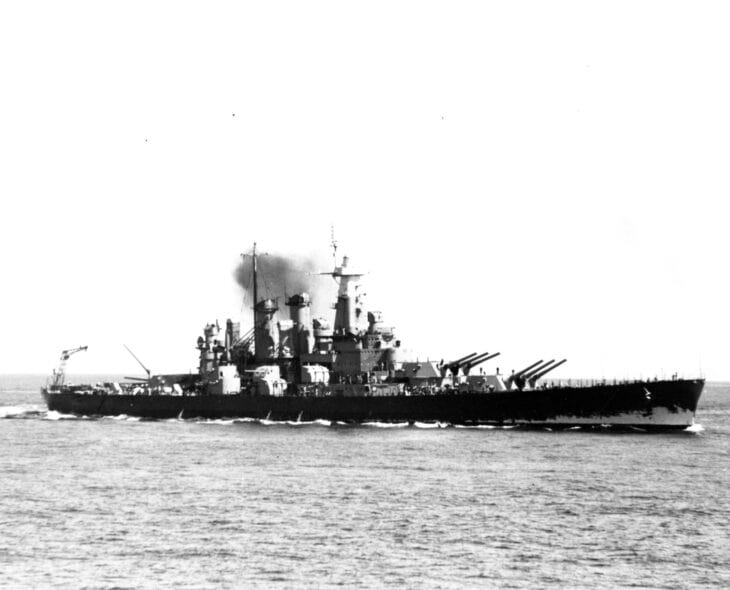

North Carolina and Washington were the first US battleships built after the long treaty pause of the 1920s and 1930s. They displaced 36,600 long tons standard and 44,800 long tons (45,519 t) at full load, with nine 16-inch guns in three triple turrets.
At 728 feet 9 inches (222.1 m), they were 48 feet longer than the South Dakotas that followed, and weighed slightly more. North Carolina has been a museum ship in Wilmington, North Carolina, since 1962.
Like the other US fast battleships, they carried catapult floatplanes such as the Vought OS2U Kingfisher for scouting and spotting the fall of shot.
8. Littorio Class (Italy): 44,520 Long Tons
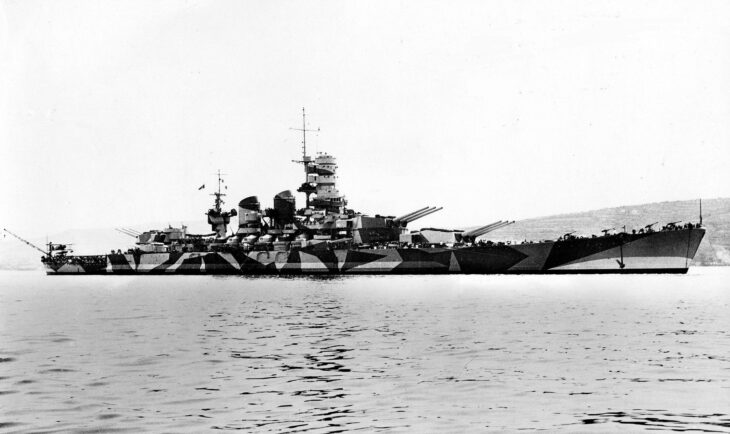

Italy completed three Littorios: Littorio, Vittorio Veneto and Roma. They displaced 40,724 metric tons standard and 45,236 metric tons (44,520 long tons) at full load, carrying nine 15-inch (381 mm) guns.
Littorio and Vittorio Veneto were 780 feet 1 inch (237.8 m) long, and Roma was slightly longer at 789 feet 8 inches (240.7 m). A fourth ship, Impero, was never finished.
Roma was sunk on Sept. 9, 1943, by German radio-guided glide bombs dropped from aircraft, while the fleet sailed to be interned by the Allies after Italy’s armistice.
9. South Dakota Class (United States): 44,519 Long Tons
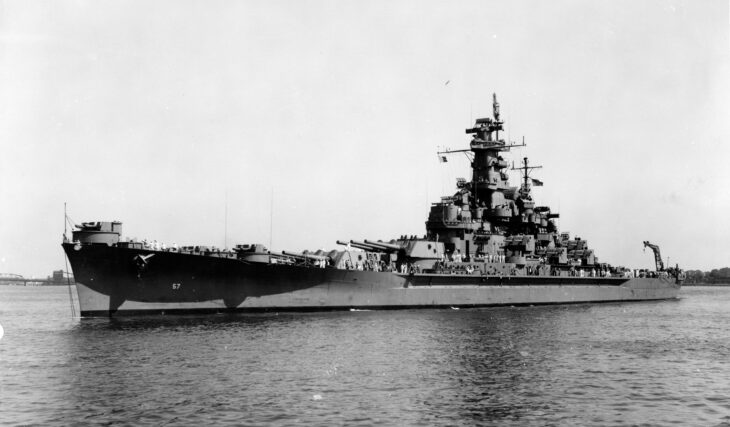

The four South Dakotas (South Dakota, Indiana, Massachusetts and Alabama) displaced 35,412 long tons standard and 44,519 long tons (45,233 t) at full load in 1942. That is three metric tons less than Littorio, a tie in practice.
They are the shortest ships here, at 680 feet (207.3 m), because the Navy fitted the same nine 16-inch guns into a much shorter hull. Massachusetts survives at Battleship Cove in Fall River, Massachusetts, and Alabama in Mobile, Alabama.
What About Hood, Montana and the Unfinished Giants?
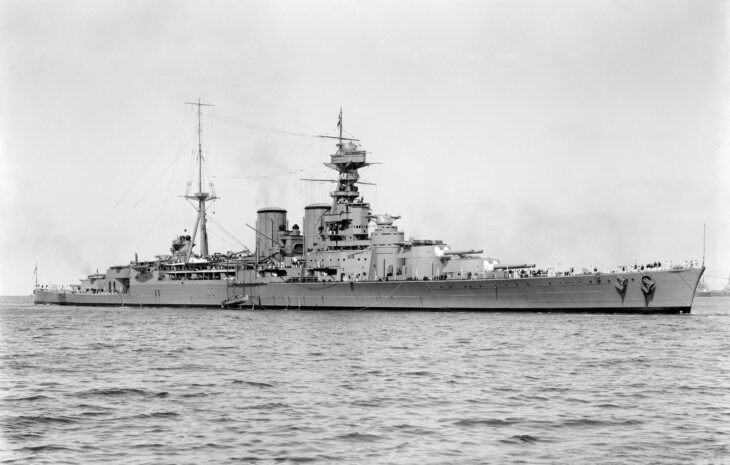

Three kinds of ship show up on other lists of the biggest battleships. Each is left out of the ranking for a stated reason, so here is where each would sit.
HMS Hood was a battlecruiser, not a battleship. At 46,680 long tons (47,429 t) deep load and 860 feet 7 inches (262.3 m) long, she would rank sixth here, and she was the largest warship in the world for 20 years after her 1920 commissioning.
The Montana class would have been America’s answer to Yamato: 70,965 long tons (72,104 t) at full load, 921 feet 3 inches (280.8 m) long and twelve 16-inch guns. All five were cancelled before any was built, in favor of more Essex-class carriers and Iowas.
The Soviet Sovetsky Soyuz class was designed for 65,150 metric tons (64,120 long tons) at full load and nine 16-inch (406 mm) guns. Four were laid down, none was finished, and the surviving hulls were scrapped in the late 1940s.
Is there a bigger battleship today?
No. No navy operates a battleship in 2026; the last two were struck from the US register in 2006. The ships often called battleships today are cruisers or carriers. Russia’s Kirov class, the largest surface combatants in operation other than carriers and amphibious assault ships, displace roughly 28,000 tons at full load, less than half of Yamato. The biggest warships now are nuclear aircraft carriers: the US Gerald R. Ford class is about 1,092 feet long, more than 200 feet longer than any battleship.
Aircraft are why the battleship ended. Both Yamatos were sunk by carrier planes, and the carriers that replaced battleships as the measure of naval power are ranked in our list of the best aircraft carriers in the world.
FAQ
Sources and references used for research and fact-checking.
- Guinness World Records, Largest battleship
- Wikipedia, Yamato-class battleship
- Wikipedia, Japanese aircraft carrier Shinano
- Wikipedia, Iowa-class battleship
- Wikipedia, USS Missouri (BB-63)
- Wikipedia, Bismarck-class battleship
- Wikipedia, German battleship Bismarck
- Wikipedia, German battleship Tirpitz
- Wikipedia, HMS Vanguard (23)
- Wikipedia, Richelieu-class battleship
- Wikipedia, French battleship Jean Bart (1940)
- Wikipedia, Japanese battleship Nagato
- Wikipedia, Japanese battleship Mutsu
- Wikipedia, North Carolina-class battleship
- Wikipedia, Littorio-class battleship
- Wikipedia, South Dakota-class battleship (1939)
- Wikipedia, HMS Hood
- Wikipedia, Montana-class battleship
- Wikipedia, Sovetsky Soyuz-class battleship
- Wikipedia, Kirov-class battlecruiser
- Wikipedia, Gerald R. Ford-class aircraft carrier
- Wikipedia, List of battleships of the United States Navy
Get the Newsletter
The latest aviation news and stories sent to your inbox.
About the Author

Tim is the owner and lead editor of AeroCorner since 2019, overseeing aviation content covering aircraft, airlines, airports, and the broader aviation industry. Through years of researching, writing, editing, and publishing aviation-focused content, he has developed extensive practical knowledge of commercial aviation and air travel. Based in Asia and a frequent traveler himself, Tim also brings firsthand passenger experience to AeroCorner’s coverage. Outside of publishing, he has also explored aviation firsthand through hands-on flight training in New Zealand.