

Table of Contents
The footage looks the same every time. Bright streaks climb out of the dark over an Israeli city, bend toward points of light coming the other way, and burst into small orange flashes high above the rooftops.
What the footage never shows is the rockets nobody shot at. In the same salvo, some of the incoming rockets are tracked, judged harmless, and allowed to come down in fields, dunes and the sea, on purpose.
That deliberate restraint is the heart of how Iron Dome works. Here is the whole chain, from the radar that spots a rocket to the warhead that destroys it, plus what the system was never built to stop.
How Does Iron Dome Work?
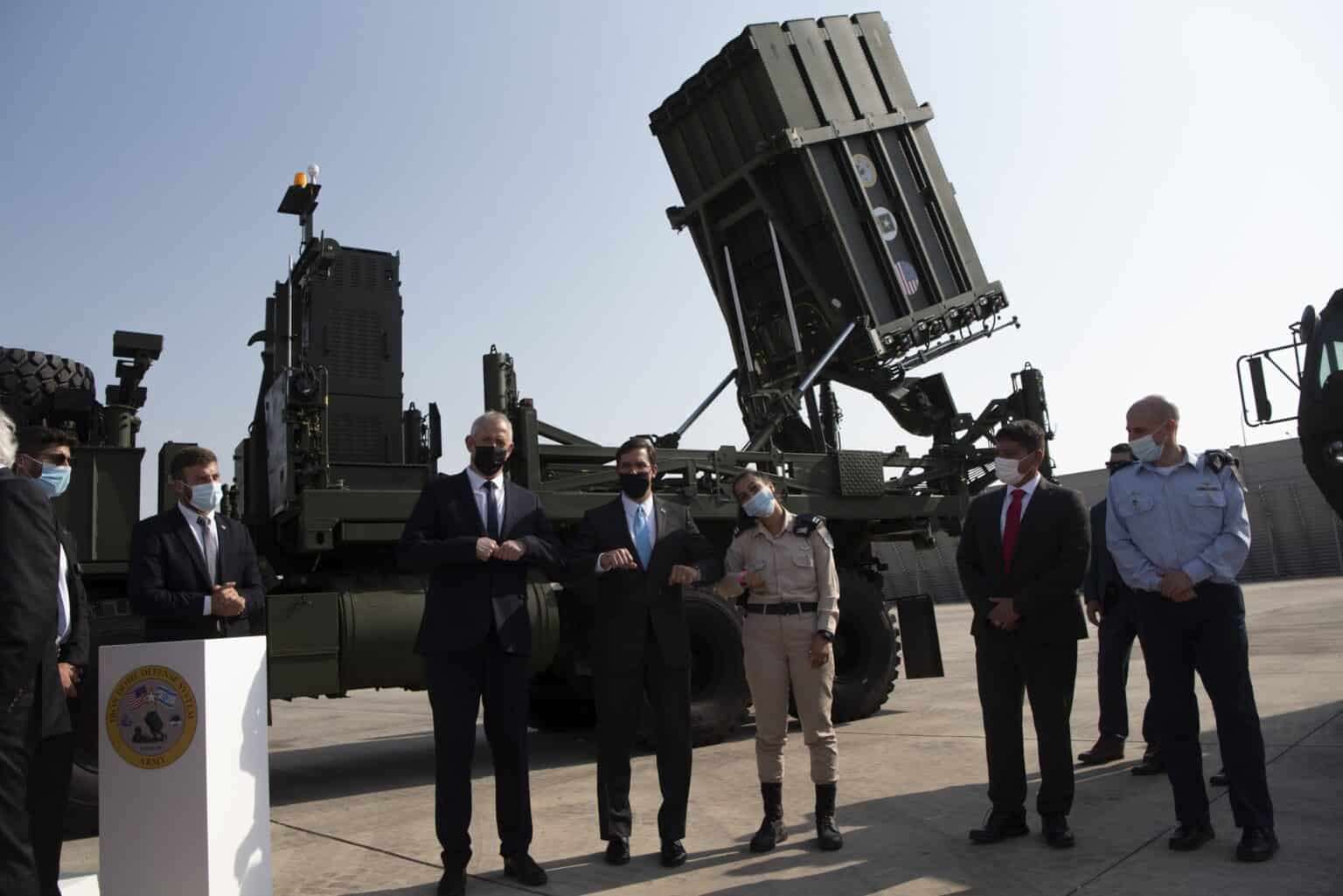
Iron Dome is a short-range air defense system built by Israel’s Rafael Advanced Defense Systems. Each battery has three parts: a radar that detects and tracks incoming threats, a battle management and control center that decides what to do about them, and launchers loaded with Tamir interceptor missiles.
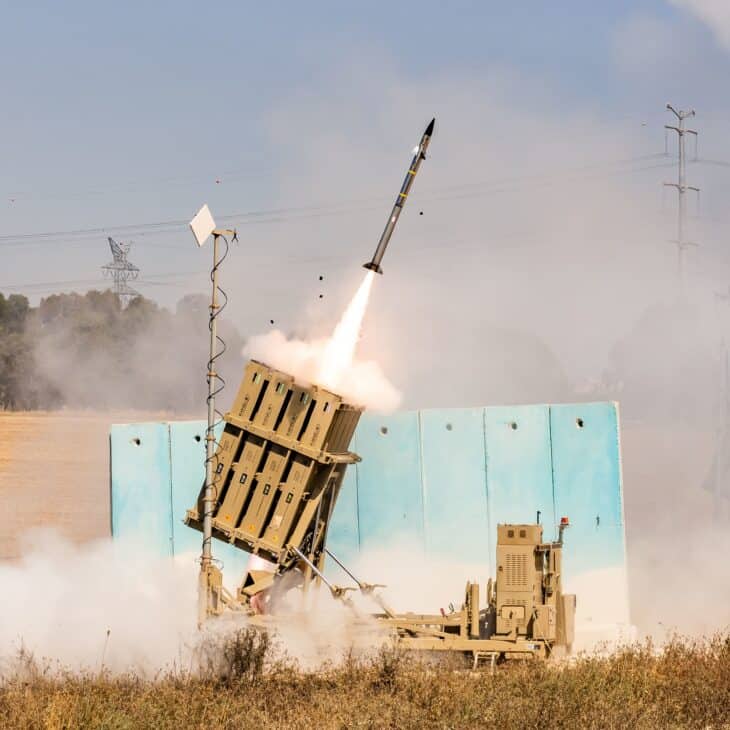

The key step happens in the computer. It predicts where each incoming rocket will land and fires only at the ones headed for a defended area, such as a town or a power station. Anything heading for open ground is left alone, which saves interceptors for the threats that matter.
Iron Dome at a glance
Builder: Rafael Advanced Defense Systems, with an Elta radar and mPrest software. Intercept range: 2.5 to 43 miles (4 to 70 km). Battery: one radar, one control center, three or four launchers with 20 Tamir interceptors each. Targets: rockets, artillery and mortar shells, drones and cruise missiles. In service since 2011.
From Launch to Interception, Step by Step
1. Detection. The battery’s EL/M-2084 radar, built by Elta Systems, a subsidiary of Israel Aerospace Industries, detects the incoming rocket and keeps tracking it through its flight.
2. Prediction. The radar track goes to the battle management and control center, software built for Rafael by the Israeli firm mPrest. From the rocket’s speed and direction, it calculates the full arc of the flight and the point where it will hit the ground.
3. The decision. If that impact point falls inside a defended zone, the system orders a launch. If it falls in an empty field or the sea, no interceptor is fired. The software makes these calls in split seconds, but, as a 2025 Congressional Research Service report notes, human operators oversee the system and reload the launchers.
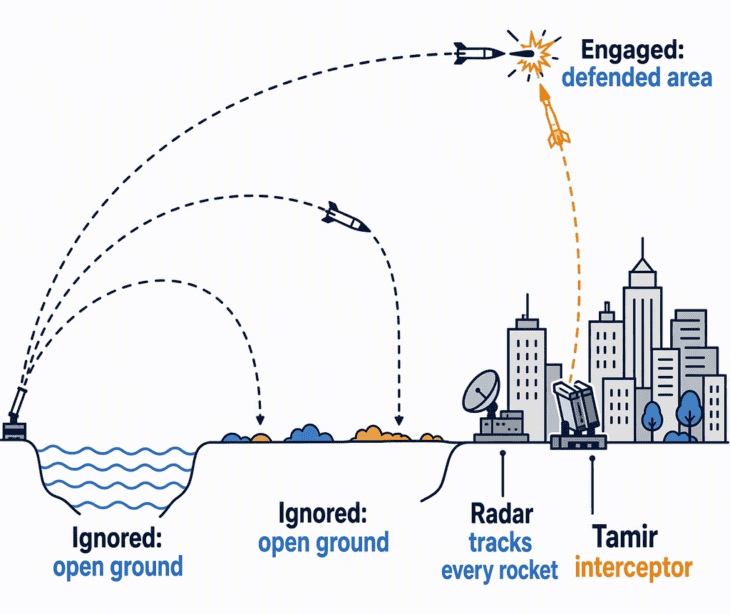
4. The intercept. The Tamir interceptor is about 9.8 feet (3 m) long and weighs around 200 pounds (90 kg). It steers with several small fins and closes on the target using electro-optic sensors.
5. The kill. The Tamir does not need to hit the rocket head-on. A proximity fuze detonates its warhead as it passes close by, and Rafael says that blast is designed to set off the rocket’s own warhead in the air.
The launchers do not have to sit next to the radar. They are scattered around the defended area and fired remotely over a secure wireless link.
Why Iron Dome Lets Rockets Fall
Selective engagement is not a weakness Israel tolerates. It is the design idea that makes the whole system affordable, and Rafael lists it as a core feature: by answering only threats headed for defended areas, it “limits the number of interceptor launches, significantly reducing costs.”
The arithmetic is brutal. Rafael does not publish a price for the Tamir, but published estimates run from about $50,000 to $150,000 per interception. The rockets it faces are mostly simple unguided weapons, and they arrive in salvos.
There is also a hard limit on supply. A launcher holds 20 interceptors, and every one fired at a rocket bound for an empty beach is one that cannot be fired at a rocket bound for an apartment block later in the same salvo.
The first kill
Iron Dome’s first combat interception came on April 7, 2011, when it destroyed a Grad rocket fired from Gaza toward Ashkelon. It was the first time a short-range rocket from Gaza had ever been shot down. The decision to build the system had been taken only in December 2007.
The batteries are also mobile. Israel can move them as threats change, putting interceptors where the rockets are actually being aimed.
What Iron Dome Can and Cannot Stop
Iron Dome was built for short-range rockets, artillery shells and mortar rounds, and its intercept range is 2.5 to 43 miles (4 to 70 km). Rafael now markets it against drones and cruise missiles as well.
The system belongs to the Israeli Air Force, the same service that flies the jets in our guide to Israeli fighter jets, and it has operated Iron Dome since 2011.
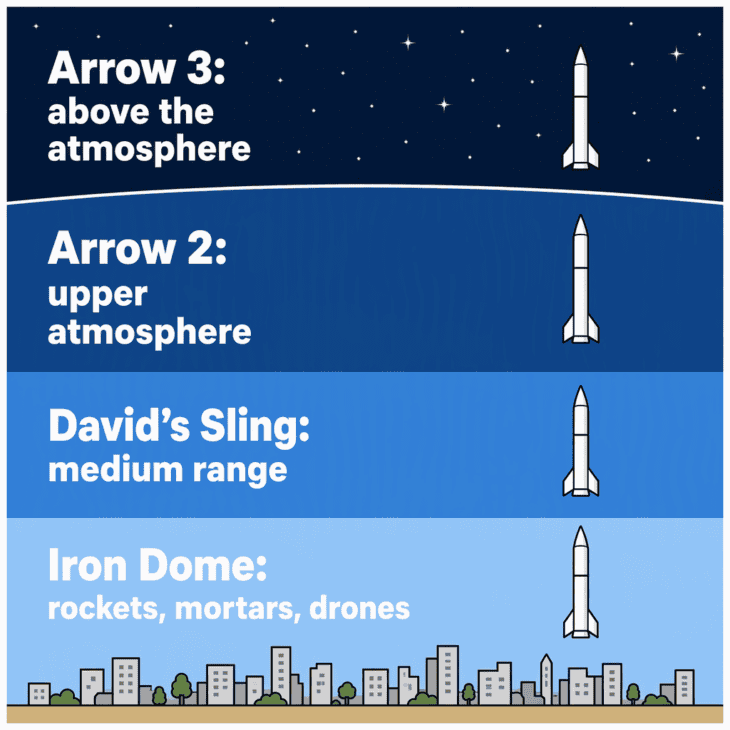
What it was not designed for is a long-range ballistic missile from Iran. Those come in far higher and faster, which is why Israel runs a layered network in which Iron Dome is only the bottom floor.
| Layer | System | Main job |
|---|---|---|
| Short range | Iron Dome | Rockets, artillery, mortars, drones, cruise missiles |
| Low to medium range | David’s Sling | Heavier rockets, cruise missiles, shorter-range ballistic missiles |
| Upper atmosphere | Arrow 2 | Ballistic missiles |
| Above the atmosphere | Arrow 3 | Long-range ballistic missiles, in space |
The 2026 war with Iran tested that structure hard. After the United States and Israel struck Iran on February 28, 2026, Iran fired more than 400 missiles and hundreds of drones at Israel in the first four weeks, according to The Jerusalem Post.
In mid-March, US officials told Semafor that Israel was running critically low on ballistic missile interceptors, a claim Israel’s foreign minister denied. Either way, the shortage being discussed was in the upper layers, not Iron Dome.
The Jerusalem Post reported that Israel began conserving its top-tier interceptors and leaning on upgraded David’s Sling and Iron Dome batteries adapted to engage drones and longer-range projectiles. Direct hits in Dimona and Arad followed interception attempts with those lower-tier systems that failed. A conditional ceasefire took effect on April 8.
The Myths vs. the Reality
Myth: Iron Dome is a dome over Israel
There is no dome. Iron Dome is a set of separate batteries, each defending roughly 58 square miles (150 sq km) of chosen ground. Areas outside a battery’s zone are not covered, and the system is not hermetic: rockets have gotten through since its first year in service.
The success rate is not what most people think. Rafael claims more than 10,000 interceptions and a success rate above 90%. That figure measures the rockets Iron Dome chose to engage, not every rocket fired, because the ones heading for open ground were never targets in the first place.
The rate has also moved over time. Figures published in the system’s first year ranged from 75% to 85%, and the later 90% figures rest largely on IDF and Rafael data rather than independent audits.
“Iron Dome for America” was never Iron Dome. On January 27, 2025, President Trump signed Executive Order 14186, titled “The Iron Dome for America”, calling for a homeland shield against ballistic, hypersonic and cruise missiles. The Pentagon renamed it “Golden Dome for America” on February 24, 2025.
The name was borrowed, but the job is completely different. Experts quoted by Military Times agreed Iron Dome would be ill-suited to defending a territory the size of the continental United States, since it was designed as the lowest layer of defense for a small country.
Who Pays for Iron Dome, and Who Else Uses It
Israel developed Iron Dome alone, but the United States has helped pay for it since 2011. The Congressional Research Service puts the total at more than $6 billion for batteries, interceptors, co-production and maintenance.
That money bought a share of the work. Under a 2014 co-production agreement, RTX (formerly Raytheon) builds Tamir components in Tucson, Arizona, and the US version of the interceptor is called SkyHunter. By 2023, the US workshare had reached 30%.
The system has also served in American hands. Here is how Iron Dome went from a 2007 decision to a weapon fielded by two countries.
December 2007
Israel decides to build it. The go-ahead is given to develop the system.
April 2011
First combat interception. A Grad rocket fired from Gaza at Ashkelon is destroyed.
March 2014
US co-production deal. Components start being built in the United States, and the US Missile Defense Agency gains full access to the technology.
August 2014
Ten batteries. Ten Iron Dome batteries are operational across Israel.
Oct to Nov 2021
Guam. The US Army sends one of its two batteries to Andersen Air Force Base as an interim cruise missile defense experiment.
October 2023
Sent back. After the October 7 attacks, the US transfers its two Army batteries to Israel.
December 2025
Iron Beam. Rafael delivers the first operational Iron Beam laser to the IDF as a complement to Iron Dome.
June 2026
Upgrade tests. Israel completes a test series of an upgraded Iron Dome with lessons from the war, including Iron Beam working inside the Iron Dome command system.
July 2026
US Marines in Japan. Marines in Japan receive the Iron Dome-based Medium-Range Intercept Capability, with three batteries planned by 2028.
The Marine Corps version, the Medium-Range Intercept Capability, mounts Tamir-family interceptors on trailers and is aimed at cruise missiles and drones in the Western Pacific. Drones are now a growing share of what air defenses face, and our ranking of the best military drones in the world shows how capable the larger ones have become.
The laser is meant to ease the cost problem. Iron Beam targets smaller threats at a marginal cost per shot, but it works poorly in heavy cloud, so it supplements Iron Dome rather than replacing it.
Next time you see those streaks climbing over a city at night, count the incoming lights that get no answer. Those unanswered rockets are not the system failing. They are Iron Dome doing the math it was built to do, and keeping its last interceptors for the rockets headed for people.
Sources and references used for research and fact-checking.
- Rafael Advanced Defense Systems, Iron Dome Family: Short-to-Medium Range Multi-Mission Air Defense Systems
- Congressional Research Service, U.S. Foreign Aid to Israel: Overview and Developments since October 7, 2023 (RL33222, updated May 28, 2025)
- Wikipedia, Iron Dome
- Defense News, Iron Dome heads to missile defense experiment in Guam
- Military Times, Iron Dome for America gets a golden makeover
- The Jerusalem Post, Israel scales back top missile defenses as Iranian attacks keep coming
- Semafor, Israel is running critically low on interceptors, US officials say
- Wikipedia, 2026 Iranian strikes on Israel
- Israel Ministry of Defense, Iron Dome Receives Additional Upgrade: Israel MOD and Rafael Successfully Complete Comprehensive Test Series
- EDR Magazine, Rafael Delivers 1st Operational High-Power Laser System Iron Beam to the IDF
- The Times of Israel, Laser-based Iron Beam interception system declared operational
- Defence Industry Europe, U.S. Marine Corps fields Iron Dome-based air defense systems in Japan
Get the Newsletter
The latest aviation news and stories sent to your inbox.
About the Author

Tim is the owner and lead editor of AeroCorner since 2019, overseeing aviation content covering aircraft, airlines, airports, and the broader aviation industry. Through years of researching, writing, editing, and publishing aviation-focused content, he has developed extensive practical knowledge of commercial aviation and air travel. Based in Asia and a frequent traveler himself, Tim also brings firsthand passenger experience to AeroCorner’s coverage. Outside of publishing, he has also explored aviation firsthand through hands-on flight training in New Zealand.