

Table of Contents
The most powerful part of the Israeli Navy is its submarine fleet, led by the three German-built Dolphin 2 boats. The newest, INS Drakon, reached Haifa on September 24, 2026, and gave Israel six submarines for the first time.
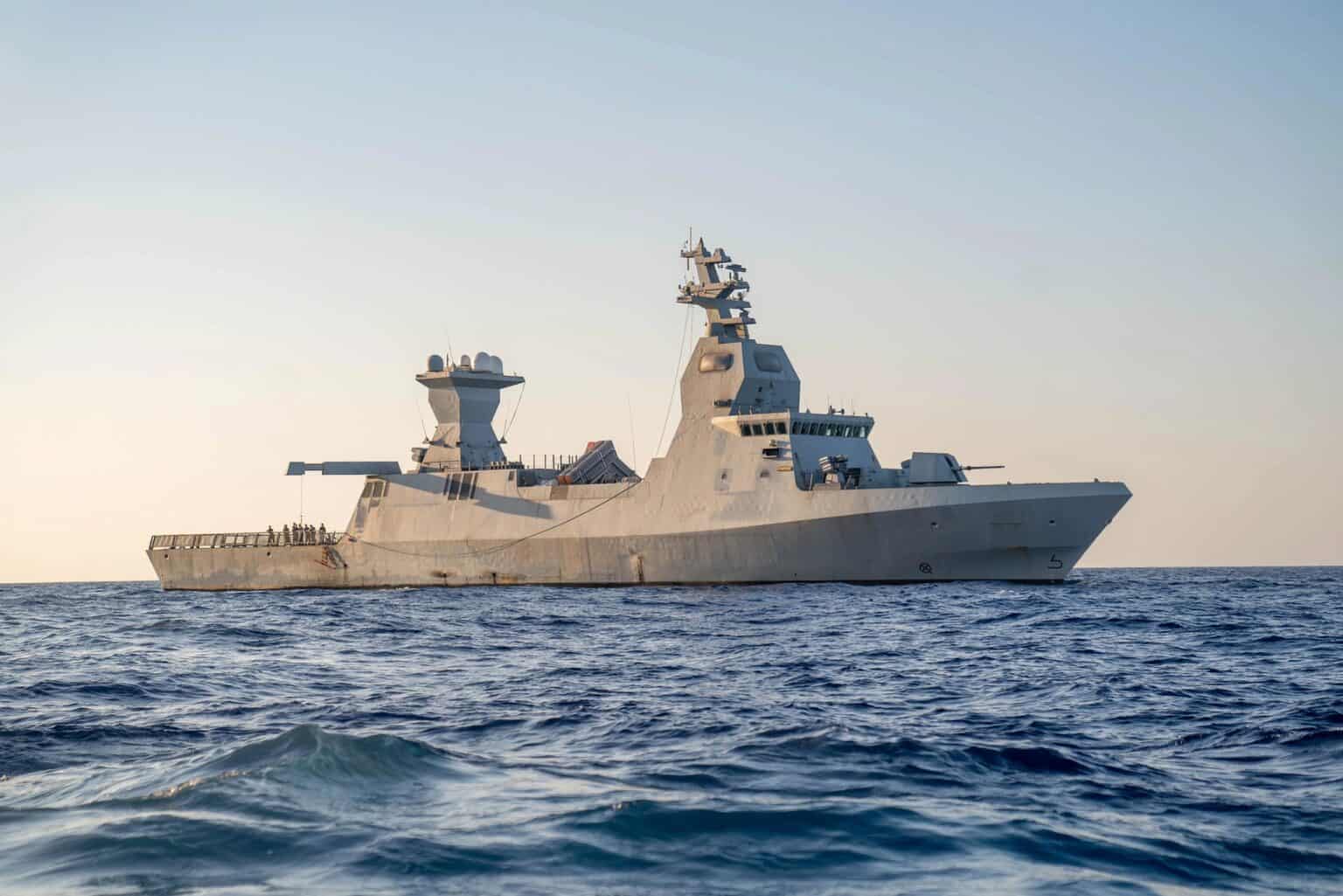
On the surface, the backbone is four Sa’ar 6 corvettes, which have shot down drones from Iran and Yemen and fired the navy’s first missiles at a Houthi port. Behind them come three Sa’ar 5 corvettes, eight Sa’ar 4.5 missile boats, two US-built landing ships and dozens of patrol boats.
It is a small navy, with about 9,500 active sailors in the IISS count. This list ranks every class by what it adds to Israel’s fighting power as of November 2026, then covers the navy’s aircraft, its bases and the ships on order.
| Rank | Class | Type | In service | Length |
|---|---|---|---|---|
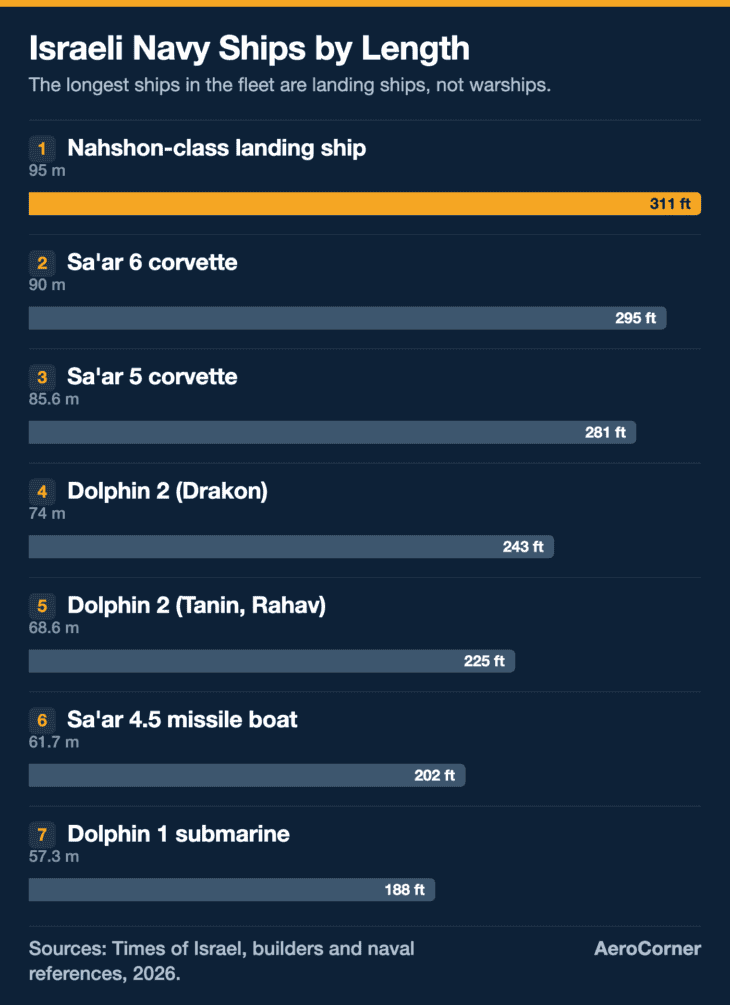
| 1 | Dolphin 2 | AIP attack submarine | 3 (Tanin, Rahav, Drakon) | 225 ft (68.6 m); Drakon 243 ft (74 m) |
| 2 | Sa’ar 6 | Missile corvette | 4 | 295 ft (90 m) |
| 3 | Dolphin 1 | Diesel-electric submarine | 3 | 188 ft (57.3 m) |
| 4 | Sa’ar 5 | Missile corvette | 3 | 281 ft (85.6 m) |
| 5 | Sa’ar 4.5 (Hetz) | Missile boat | 8, oldest retiring | 202 ft (61.7 m) |
| 6 | Nahshon class | Landing ship | 2 | 311 ft (95 m) |
| 7 | Dvora, Super Dvora, Shaldag and others | Patrol boat | About 45 | Small craft |
How this ranking works
Classes are ranked by what they add to Israel’s fighting power in November 2026: firepower, survivability, reach and how new they are. Submarines and missile ships come first because they carry the navy’s strike and air defense weapons. Landing ships and patrol boats follow, and ships on order are covered separately. Israel publishes little about its fleet, so counts come from the navy’s own announcements, builders and naval references, and the text says which.
1. Dolphin 2 Class: The Air-Independent Submarines
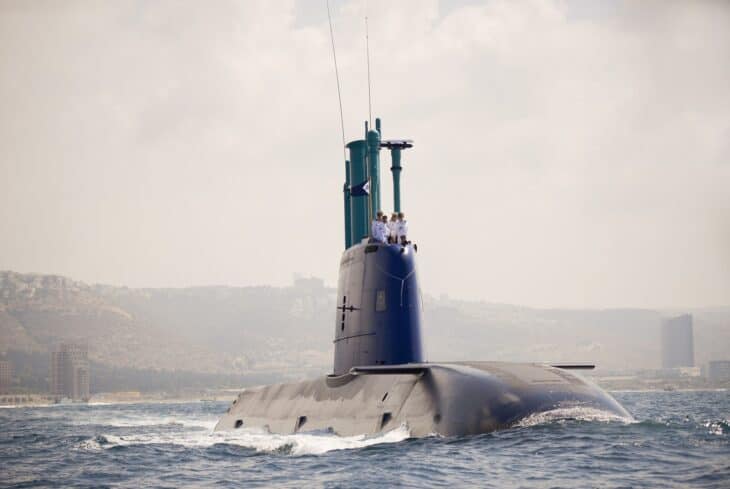

The Dolphin 2 boats are the most capable and most expensive ships Israel owns. INS Tanin entered service in 2014 and INS Rahav in 2016, both built by Thyssenkrupp Marine Systems (TKMS) in Kiel, Germany.
What sets them apart is air-independent propulsion. A fuel-cell system lets them stay submerged for weeks instead of surfacing to run their diesels, which is when a submarine is easiest to find. Each displaces about 2,050 tons surfaced and 2,400 tons submerged, and is rated at more than 25 knots.
The third boat, INS Drakon, is bigger still: about 243 feet (74 m) long and 2,600 tons, the largest submarine Israel has operated. It sailed about 3,792 nautical miles from Kiel and arrived at Haifa on September 24, 2026, after Denmark and Norway refused TKMS the use of their deep waters for tests.
The Algemeiner puts Drakon’s cost at around €550 million ($634 million). Israeli systems take two to three months to fit, so the navy expected several more months before declaring it operational.
The submarine that was almost named Dakar
Drakon was meant to be called Dakar, after the Israeli submarine lost with all hands in 1968. The families of its crew objected, so the boat became Drakon, Hebrew for dragon, and the name Dakar went to the next class of submarines instead.
All six Dolphin boats carry six 533 mm torpedo tubes and four larger 650 mm tubes, and can load up to 16 torpedoes and Popeye Turbo cruise missiles between them. Jane’s has assessed that Drakon could take vertical tubes for missiles, which Israel and Germany have not confirmed.
2. Sa’ar 6 Class: The Gas-Field Guardians
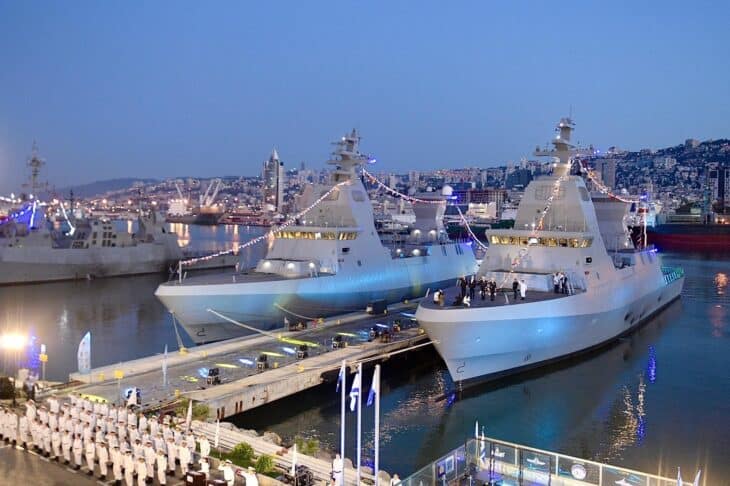

The four Sa’ar 6 corvettes are the most heavily armed surface ships in the fleet. INS Magen, Oz, Atzmaut and Nitzachon were built in Germany and entered service between 2020 and December 2023, at a total cost Globes put at about €450 million.
Each is 295 feet (90 m) long and displaces about 1,900 tons at full load, with a crew of about 70. They were designed to protect Israel’s offshore gas platforms, so they are built around air defense more than anti-ship firepower.
The weapon fit is dense for the size: 40 cells for C-Dome, the naval version of the Iron Dome rocket interceptor, 16 cells for Barak MX (called Barak Magen in Israeli service), Gabriel V anti-ship missiles, a 76 mm gun and an MF-STAR radar. The hangar takes a medium helicopter.
The class has been in combat since 2024. A Sa’ar 6 made C-Dome’s first operational interception, a drone near Eilat, on April 8, 2024, and the ships shot down Iranian drones with Barak Magen for the first time in June 2025. Globes reported 25 drones downed by the missile ships early in that war, most of them by C-Dome.
The navy's first missile strike on Yemen
On June 10, 2025, Sa’ar 6 corvettes in the northern Red Sea fired two long-range precision missiles at the Houthi-held port of Hodeidah. It was the navy’s first attack on the Houthis: until then Israel had relied on the air force, whose jets needed roughly three hours each way to get there.
3. Dolphin 1 Class: The First Three Submarines
INS Dolphin and INS Leviathan entered service in 1999 and INS Tekuma in 2000. Germany paid for the first two outright and half of the third, a gift that started the long German role in Israel’s submarine force.
They are smaller, at 188 feet (57.3 m) and about 1,900 tons submerged, and they have no air-independent propulsion. That means they must snorkel more often, which is why they rank below the Dolphin 2 boats despite carrying the same ten torpedo tubes.
All three are now more than 25 years old. Three Dakar-class boats will replace them, with the first due in 2031, which keeps Israel at six submarines through the 2030s unless it orders more.
Six is small next to Israel’s neighbors. The Algemeiner reports Turkey’s submarine force growing from 12 boats to 18 as its Reis-class boats arrive, and Israel’s defense establishment has reportedly recommended going to eight. Our ranking of the best attack submarines in the world shows where the Dolphin design sits against the big navies.
4. Sa’ar 5 Class: The American-Built Corvettes
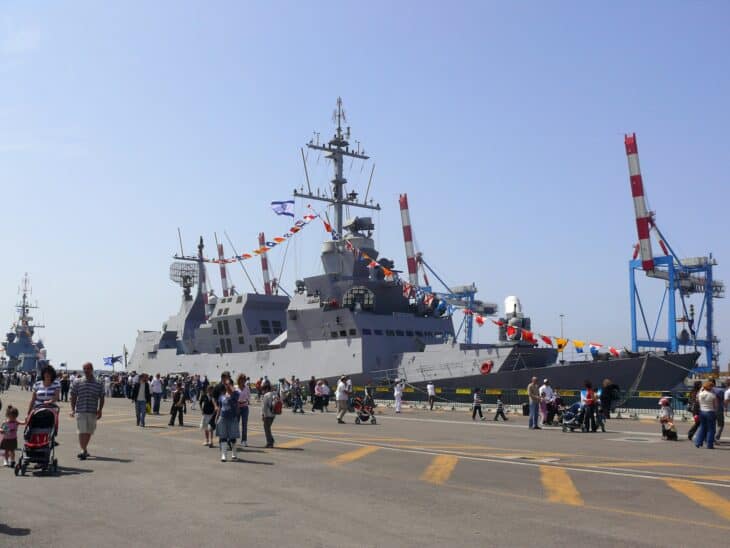

INS Eilat, Lahav and Hanit were built by Ingalls Shipbuilding in Pascagoula, Mississippi, and launched in 1993 and 1994. For a quarter of a century they were Israel’s largest surface warships.
Each is 281 feet (85.6 m) long and displaces about 1,275 tons at full load. A gas turbine pushes them to 33 knots, and they carry Harpoon anti-ship missiles, a 32-cell Barak launcher, a Phalanx close-in gun and a deck for one helicopter.
All three have been modernized with Israeli AESA radars, Lahav with the same MF-STAR that the Sa’ar 6 carries. They now work alongside the newer corvettes rather than leading the fleet.
The day a Sa'ar 5 forgot to defend itself
On July 14, 2006, a Hezbollah C-802 anti-ship missile hit INS Hanit about 8.5 nautical miles off Beirut, killing four sailors. The ship’s missile defenses had been switched off about an hour earlier without the captain being told. Hanit sailed home under its own power, and the attack reshaped how the navy thinks about shore-launched missiles.
5. Sa’ar 4.5 Class: The Veteran Missile Boats
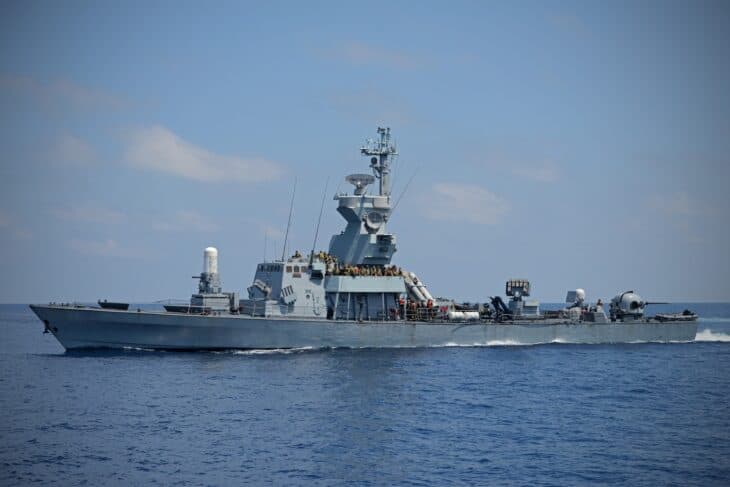

The eight Hetz-subclass Sa’ar 4.5 boats are the workhorses of the navy’s missile flotilla, Shayetet 3. They are 202 feet (61.7 m) long, displace about 488 tons at full load and carry a crew of 53.
For their size they hit hard: Harpoon and Gabriel anti-ship missiles, Barak 1 air defense missiles, a 76 mm gun and a Phalanx. Some hulls are much older than their service dates suggest, because Kidon, Tarshish and Yaffo began life as 1970s Sa’ar 4 boats and were rebuilt in the 1990s.
The oldest two, Romach and Keshet, date from 1981 and 1982 and are being retired after four decades. Keshet was listed to leave service in October 2026.
6. Nahshon Class: The Landing Ships
INS Nahshon arrived in 2023 and INS Komemiyut reached Haifa on June 16, 2024, both built in Pascagoula and paid for with US military aid. Each is about 311 feet (95 m) long and 2,500 tons, which makes them the longest ships in the navy.
They give Israel something it had not had for years: the ability to move troops, vehicles and supplies by sea and put them ashore. They serve in Shayetet 11, a landing craft flotilla the navy revived in 2022 to operate them.
7. Patrol Boats: The Coastal Fleet
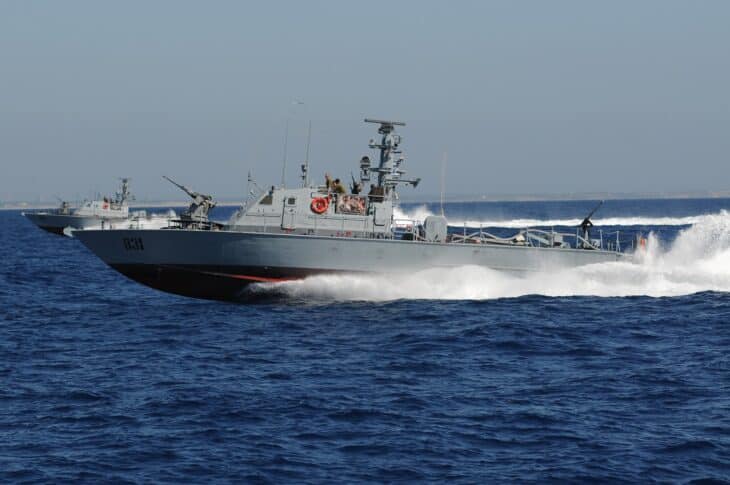

Most of the navy’s hulls are small, fast patrol boats, nearly all designed in Israel. Reference counts put the fleet at about 45 boats across the Dvora, Super Dvora, Shaldag and Defender classes, with the Super Dvora Mk III the most numerous.
They patrol off Gaza and Lebanon, guard the ports and work out of Haifa, Ashdod and Eilat. Israel also fields uncrewed surface vessels such as Rafael’s Protector.
What the Israeli Navy Did in the 2026 War
Most of the attention in the 2026 war with Iran went to the air force, but the navy says it carried out or guided 154 strikes in 48 days of fighting, 42 of them launched from the sea. By its count, 95 targeted Iran-linked assets, 53 hit Hezbollah and 6 hit Hamas.
The navy also directed strikes on Iranian vessels in the Caspian Sea, which Ynet described as a first for Israel. More than 1,000 personnel spent about 26,000 hours at sea and handled about 40 air defense incidents.
Those are the navy’s own figures, released as Vice Adm. David Saar Salama handed command to Vice Adm. Eyal Harel. They follow two earlier strikes the navy counts as successes: most of Hezbollah’s shore-to-sea missiles destroyed in October 2024, and, the military says, 15 of Syria’s 21 naval vessels after the fall of Assad in December 2024.
The record is not all strikes. On October 7, 2023, Hamas gunmen landed by sea near Zikim and killed 17 people before they were stopped, and a military review called the navy’s own investigation of that day inadequate. For the other side of the war at sea, see our guide to the Iranian navy.
The Aircraft of the Israeli Navy
The navy owns no fixed-wing combat aircraft and no aircraft carrier. Its helicopters are Eurocopter AS565 Panthers of 193 Squadron, which the IISS counted at seven in 2017, flown and maintained by air force crews.
Long-range strike from the air belongs to the air force, whose jets struck Hodeidah before the navy ever did. Our guide to Israeli fighter jets covers that side of the fight.
Bases, People and Shayetet 13
Haifa is the main base, home to the missile boats of Shayetet 3 and the submarines of Shayetet 7. Ashdod covers the south coast, Eilat covers the Red Sea, and Atlit, south of Haifa, is home to Shayetet 13, the navy’s commando unit.
Shayetet 13 is to Israel roughly what the SEALs are to the US Navy: raids from the sea, boarding ships, hostage rescue and sabotage.
The IISS put the navy at 9,500 active personnel and 10,000 reservists in its 2023 Military Balance. That is a fraction of the size of the fleets on our list of the largest navies in the world.
The Ships on Order
Two programs will reshape the fleet by the mid-2030s. The first is three Dakar-class submarines from TKMS, ordered in January 2022 for about €3 billion, roughly €1 billion a boat.
Each Dakar will be about 276 feet (84 m) long and 3,800 tons, far bigger than any Dolphin. TKMS says production began in November 2024, and the first boat is due in 2031.
The second is the Reshef class, Israeli-designed corvettes to replace the Sa’ar 4.5. Israel Shipyards won a NIS 2.8 billion ($780 million) contract for five ships on December 12, 2024, with an option for more, and cut steel for the first one in Haifa in February 2025.
The Times of Israel expected the first Reshef within three to four years as of September 2026. They will carry C-Dome like the Sa’ar 6, which means even the smallest missile ships will be able to shoot down drones.
Does Israel have an aircraft carrier?
No, and it has no plans for one. The Israeli Navy is built for the eastern Mediterranean and the Red Sea, where Israeli airbases are within reach, so the air force does the flying and the navy spends its money on submarines and missile ships. Its longest ships are the two Nahshon-class landing ships, at about 311 feet.
How Strong Is the Israeli Navy?
By numbers, it is modest: six submarines, seven corvettes and eight missile boats. By what those ships have done since 2023, it punches far above that, with drone kills over Eilat, missiles on Yemen and strikes reaching the Caspian Sea.
Its weak spots are size and age. Three of its six submarines and most of its missile boats are decades old, and the replacements do not arrive until the late 2020s and early 2030s. For a broader picture of what a modern fleet looks like, our guide to types of navy ships explains each class.
FAQ
Sources and references used for research and fact-checking.
- Wikipedia, Israeli Navy
- Wikipedia, Sa'ar 6-class corvette
- Wikipedia, Sa'ar 5-class corvette
- Wikipedia, Sa'ar 4.5-class missile boat
- Wikipedia, Dolphin-class submarine
- The Times of Israel, Israel's 6th submarine to arrive as Navy plans major fleet expansion
- The Algemeiner, Israel's Navy Only Has Six Submarines; That's a Problem
- The Times of Israel, In first, IDF says ship-mounted Iron Dome downs suspicious target over Eilat
- Globes, Israel Navy's new Barak Magen shoots down UAVs
- Ynet, Israeli Navy strike on Yemen port marks new phase in campaign against Houthis
- Ynet, From targeted killings to offshore defense: Israeli Navy's growing role in Iran war
- Ynet, Israeli Navy chief steps down with Lebanon, Syria gains, Oct. 7 failures and Iran 'debut'
- The Times of Israel, Israeli Navy receives second of new US-built landing craft
- Shephard Media, Israel Shipyards begins steel-cutting on new Reshef-class corvettes
Get the Newsletter
The latest aviation news and stories sent to your inbox.
About the Author

Tim is the owner and lead editor of AeroCorner since 2019, overseeing aviation content covering aircraft, airlines, airports, and the broader aviation industry. Through years of researching, writing, editing, and publishing aviation-focused content, he has developed extensive practical knowledge of commercial aviation and air travel. Based in Asia and a frequent traveler himself, Tim also brings firsthand passenger experience to AeroCorner’s coverage. Outside of publishing, he has also explored aviation firsthand through hands-on flight training in New Zealand.