

Table of Contents
The most valuable ships in the German Navy are its three Sachsen-class frigates, the only German warships built to defend a whole task group against aircraft and missiles. Right behind them come six Type 212A submarines, which run silently on hydrogen fuel cells.
Counting every commissioned hull, tugs and trials ships included, the Deutsche Marine has about 65 ships and had 15,531 personnel in August 2024. The fighting core is much smaller: 11 frigates, 5 corvettes in full service and 6 submarines.
This list ranks every major class by fighting value as of November 2026, then covers the aircraft, the ships on order, and the June 2026 decision to cancel the six F126 frigates that were meant to be the navy’s future.
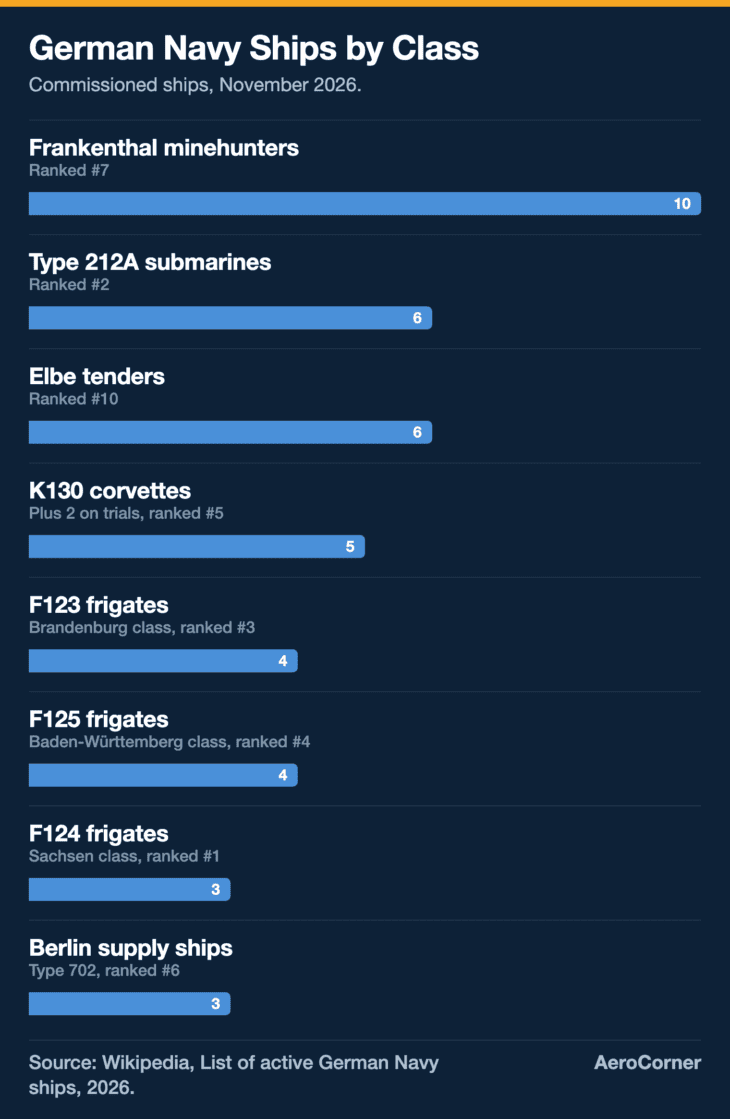
| Rank | Class | Type | Ships | In service since |
|---|---|---|---|---|
| 1 | Sachsen (F124) | Air defense frigate | 3 | 2004 |
| 2 | Type 212A | Fuel-cell attack submarine | 6 | 2005 |
| 3 | Brandenburg (F123) | Anti-submarine frigate | 4 | 1994 |
| 4 | Baden-Württemberg (F125) | Long-endurance frigate | 4 | 2019 |
| 5 | Braunschweig (K130) | Missile corvette | 5, plus 2 on trials | 2008 |
| 6 | Berlin (Type 702) | Replenishment ship | 3 | 2001 |
| 7 | Frankenthal and Ensdorf | Minehunter and minesweeper | 10 and 2 | 1990 |
| 8 | Oste (Type 423) | Signals intelligence ship | 3 | 1988 |
| 9 | Rhön (Type 704) | Fleet tanker | 2 | 1977 |
| 10 | Elbe (Type 404) | Squadron tender | 6 | 1993 |
| 11 | Gorch Fock | Sail training ship | 1 | 1958 |
How this ranking works
Each class is ranked by the fighting value it adds in November 2026: what it can do in a war, how hard it would be to replace, and how many Germany has. Counts are commissioned ships. Corvettes still on builder’s trials are noted but not counted, and the navy’s tugs, trials boats and research ship sit outside the ranking. Germany operates no aircraft carriers, destroyers or amphibious ships.
1. Sachsen Class (F124): The Air Defense Frigates
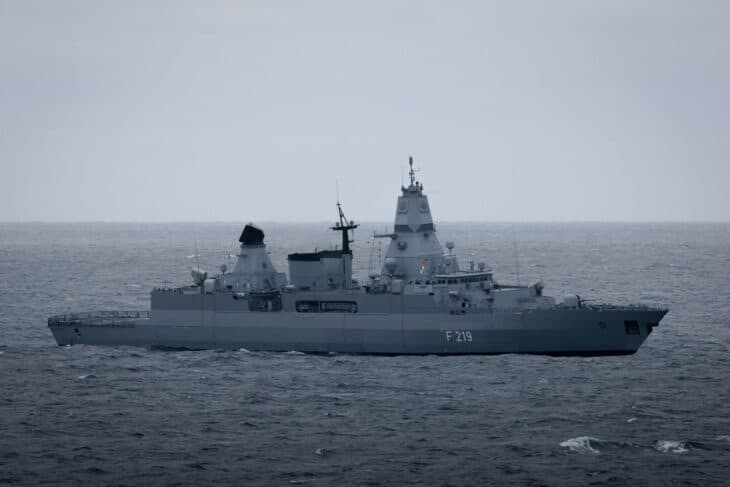

Sachsen, Hamburg and Hessen were commissioned between 2004 and 2006 to protect a naval group from air attack. Each is 469 feet (143 m) long, displaces about 5,800 metric tons fully loaded, and can make 29 knots.
Their 32-cell Mk 41 vertical launcher holds 24 SM-2 Block IIIA and 32 Evolved Sea Sparrow missiles, guided by the Dutch APAR radar and backed by a long-range SMART-L search radar. No other German ship can engage aircraft at that range.
They rank first because they are the umbrella every other ship sails under. Their replacement, the F127, is still unbuilt: the US approved the sale of eight Aegis combat systems for up to $11.9 billion in April 2026, but as of early November 2026 no construction order had reached parliament.
Hessen's first Red Sea fight
On January 28, 2024, the frigate Hessen fired two missiles at a drone it believed was hostile in the Red Sea. Both missed and fell into the sea, and the drone turned out to be an American MQ-9 Reaper. The next day Hessen shot down two Houthi drones with its 76 mm gun and RAM missiles.
2. Type 212A: Six Submarines That Run on Hydrogen
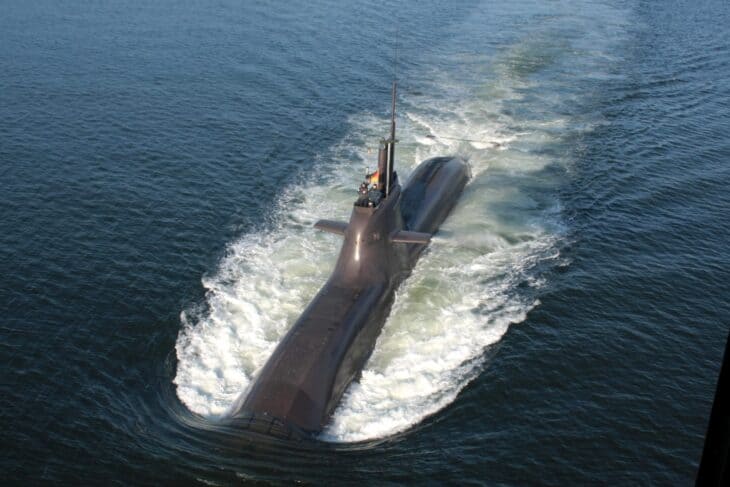

Germany’s six submarines, U-31 to U-36, were commissioned between 2005 and 2016. Each is about 184 feet (56 m) long, displaces 1,830 metric tons submerged, carries a crew of 28, and fires heavyweight torpedoes from six tubes.
Their edge is air-independent propulsion. Siemens fuel cells, fed by stored hydrogen, let a boat stay under for about three weeks without snorkeling, and in 2013 U-32 spent 18 days submerged without snorkeling on its way to exercises in US waters.
They rank second only because six boats is a thin force. NATO’s goals call for at least five German submarines ready for operations from 2031, and in June 2025 TKMS won a 10-year, €800 million contract to modernize the command, navigation and weapons systems of the four oldest. How they compare with nuclear boats is in our ranking of the largest submarines in the world.
3. Brandenburg Class (F123): The Submarine Hunters
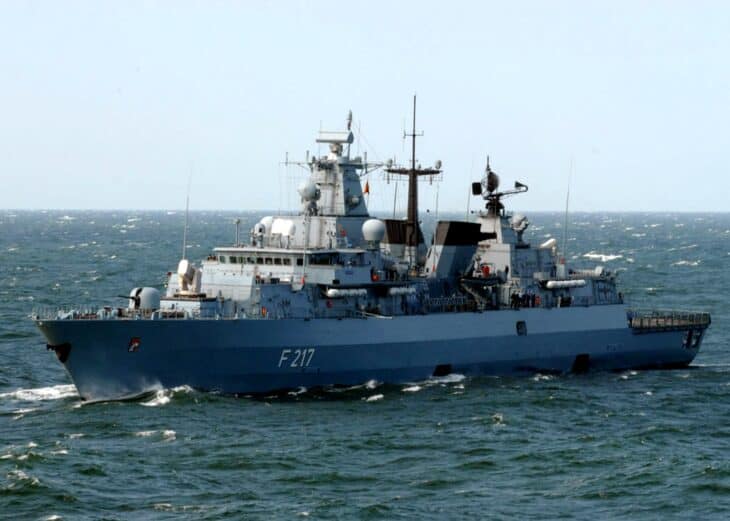

Brandenburg, Schleswig-Holstein, Bayern and Mecklenburg-Vorpommern were commissioned between 1994 and 1996 and are based in Wilhelmshaven. Each is 455 feet (138.85 m) long, displaces 4,490 metric tons fully loaded and can exceed 29 knots.
Their main job is anti-submarine warfare, with torpedo tubes, eight Harpoon anti-ship missiles, RAM point defense and two Sea Lynx helicopters. They also carry a 16-cell Mk 41 launcher for Sea Sparrow missiles.
They are now the gap-fillers for the cancelled F126. On July 30, 2026, Neue Jadewerft won a contract to modernize Bayern’s combat system, radar, anti-submarine equipment and propulsion through 2029, meant to keep the class in service to at least 2035.
4. Baden-Württemberg Class (F125): The World’s Heaviest Frigates
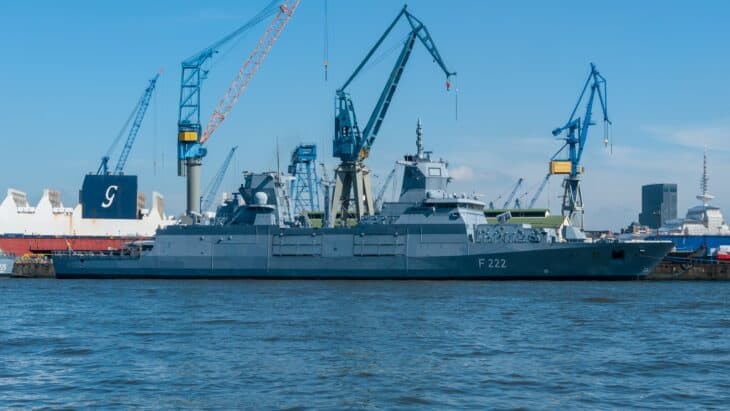

At 7,200 metric tons and 490 feet (149.5 m), the four F125s are the heaviest frigate class in the world. Baden-Württemberg, Nordrhein-Westfalen, Sachsen-Anhalt and Rheinland-Pfalz entered service between 2019 and 2022.
They were built for long stabilization missions, designed to stay deployed for up to two years away from home with a standard crew of 110. The armament is light for their size: a 127 mm gun, two RAM launchers and eight Harpoons fitted as an interim solution.
The lead ship was refused by the procurement agency and handed back to its builder with a persistent 1.3-degree list and serious weight problems, a first for the German Navy, and was not commissioned until June 2019. In September 2026 Sachsen-Anhalt test-fired Israeli LORA ballistic missiles in the North Atlantic, and parliament’s budget committee approved adapting the IRIS-T SLM air defense missile for all four.
5. Braunschweig Class (K130): The Missile Corvettes
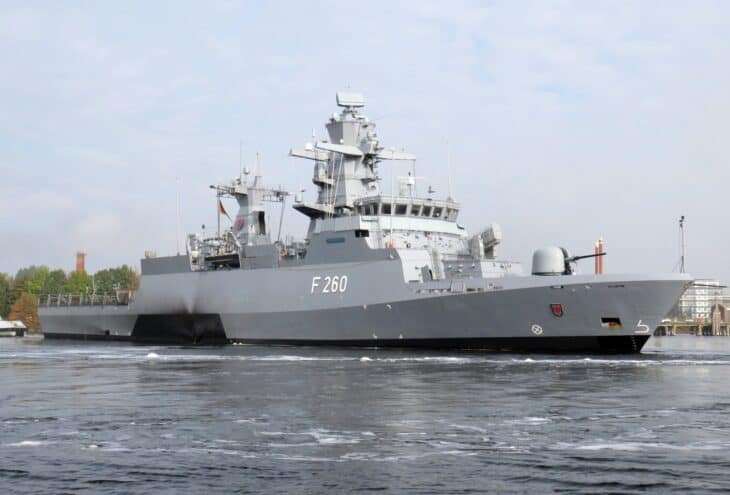

The K130 corvettes are the navy’s Baltic fighters. Each is 292 feet (89 m) long, displaces 1,840 metric tons, makes 26 knots and carries four RBS-15 Mk3 anti-ship missiles, two RAM launchers and a 76 mm gun with a crew of 65.
Five Batch 1 ships, Braunschweig, Magdeburg, Erfurt, Oldenburg and Ludwigshafen am Rhein, were commissioned between 2008 and 2013 after gearbox problems delayed the class. A second batch of five is following: Emden and then Köln, on September 19, 2025, raised the navy’s flag for trials, and Lübeck, the last, was christened in April 2026.
Rheinmetall expected to formally deliver Köln and Emden during 2026. Emden’s start was delayed in February 2025, when metal shavings were found in its main gear in what police and military counterintelligence investigated as suspected sabotage.
6. Berlin Class (Type 702): The Largest Ships in the Fleet
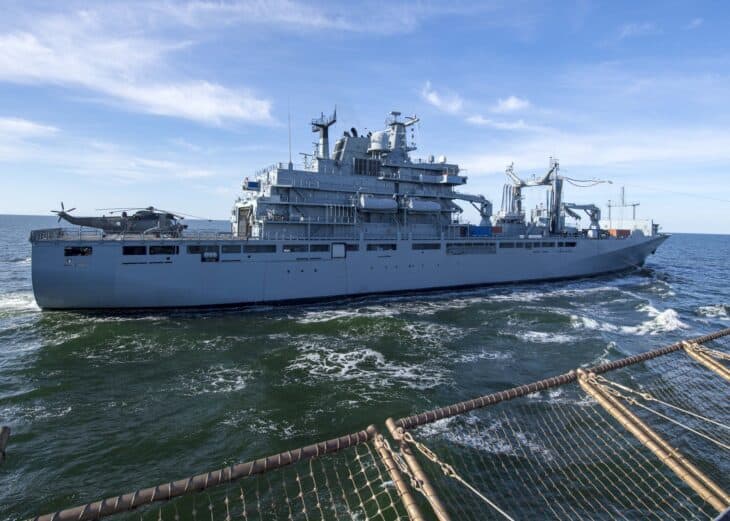

Berlin, Frankfurt am Main and Bonn are the biggest ships the German Navy operates, at 570 feet (173.7 m) and 20,243 metric tons fully loaded. They carry fuel, ammunition, food and spare parts to the fleet at sea.
Each can also embark a modular rescue center with room for 50 patients, including emergency surgery and intensive care. All three are based in Wilhelmshaven.
They rank sixth because without them the frigates cannot deploy far from home. Germany has no aircraft carrier to protect, so these supply ships are what give the fleet its reach. How that compares with navies that do operate carriers is in our ranking of the best aircraft carriers in the world.
7. Frankenthal and Ensdorf Classes: The Mine Countermeasures Force
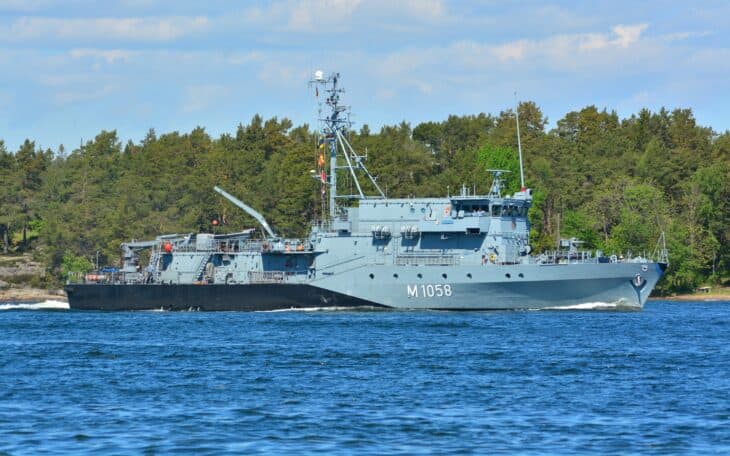

Ten Frankenthal-class minehunters make up the navy’s largest single class. Each is 178 feet (54.4 m) long, displaces 650 metric tons and is built of non-magnetic steel so it does not set off the mines it hunts.
All ten are based in Kiel, alongside two older Ensdorf-class minesweepers, Pegnitz and Siegburg. In a Baltic war, clearing mines from German harbors and shipping lanes would be among the first jobs.
8. Oste Class (Type 423): The Spy Ships
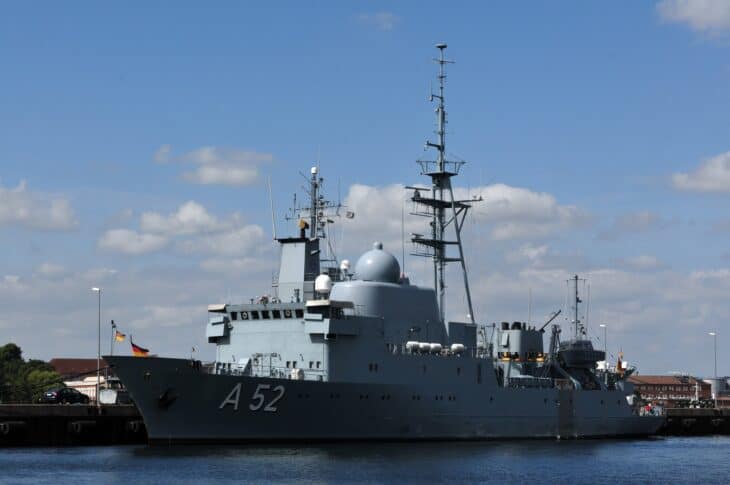

Oste, Oker and Alster are signals intelligence ships, commissioned in 1988 and 1989. Each displaces about 3,200 metric tons.
Three Type 424 replacements were ordered in July 2023 for €3.26 billion, with deliveries planned from 2029 to 2031. That price, more than a billion euros a ship, shows how much the navy values the work.
9. Rhön Class (Type 704): Two Tankers From 1977
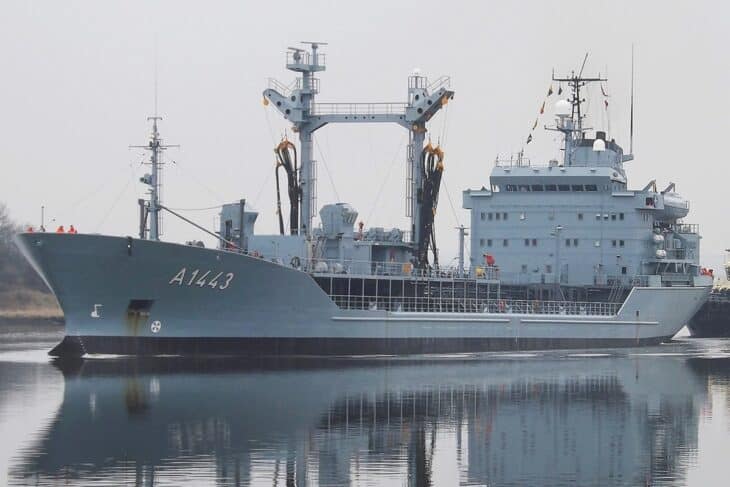

Rhön and Spessart have refueled the fleet since 1977, older than any other ship in the navy except Gorch Fock. Each displaces 14,169 metric tons.
Two Type 707 tankers are being built by NVL with Meyer Werft to replace them. At 567 feet (173 m) and more than 20,000 metric tons, they will rival the Berlin class in size, but both were still in production in 2026.
10. Elbe Class (Type 404): The Squadron Tenders
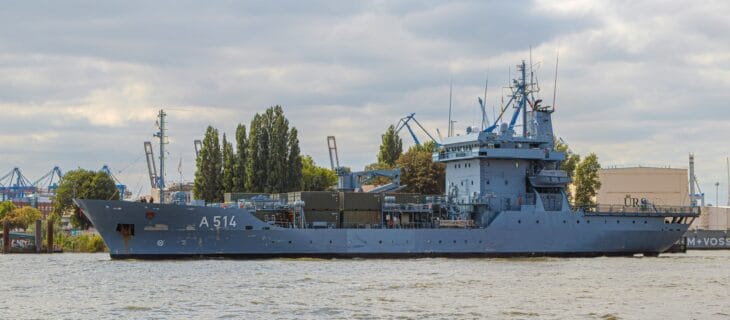

Six Elbe-class tenders, commissioned in 1993 and 1994, support the corvette, submarine and mine warfare squadrons. Each is 330 feet (100.55 m) long and displaces 3,586 metric tons.
They take care of waste disposal and minor repairs for the small ships they serve. Main supports the submarines at Eckernförde, and Donau the corvettes at Warnemünde.
11. Gorch Fock: The €135 Million Sailing Ship
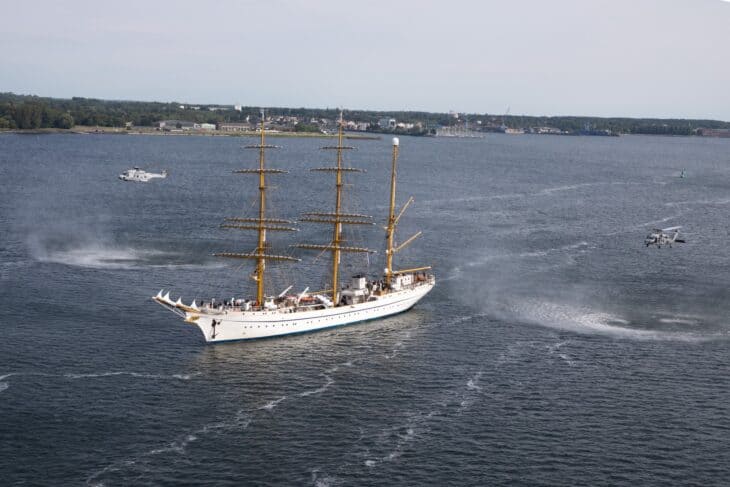

Gorch Fock, a three-masted sail training ship commissioned in 1958, has trained more than 14,500 cadets for the Naval Academy at Flensburg-Mürwik. Her steel hull is 266 feet (81.2 m) long without the bowsprit.
Her last refit ran wildly over budget. It began in November 2015 with a first estimate of €9.6 million, rose to an estimated €135 million by 2017, and she did not return to the navy until September 30, 2021.
Does Germany really have 65 warships?
No. About 65 ships are in commission, but that count includes tugs, trials boats, a research ship, tenders and tankers. The ships that can fight are 11 frigates, 5 corvettes in full service and 6 submarines, plus 12 mine warfare ships. Germany has no aircraft carriers, no destroyers and no amphibious ships; its marines, the Seebataillon, sail on Dutch amphibious ships instead.
German Navy Aircraft and Helicopters
The Marineflieger, the navy’s air arm, flies from Nordholz near Cuxhaven. Its biggest change in decades came in November 2025: the first P-8A Poseidon landed there on November 7, and the eight ex-Dutch P-3C Orions retired on November 20 after just under 28,500 German flying hours.
Germany bought eight P-8As for €3.1 billion. Three were at Nordholz by June 2026, and the other five are due by 2029.
The helicopter fleet is changing too. The first of 31 NH90 Sea Tiger submarine hunters was delivered on December 16, 2025, with the fleet due by 2030 to replace the Sea Lynx, in service since 1981. Eighteen NH90 Sea Lion helicopters handle search and rescue and transport. Two Dornier 228s fly pollution patrols, and how these types compare is in our guide to types of navy helicopters.
Why Germany Cancelled the F126 Frigates
The F126 was meant to be the navy’s biggest new warship program: six large frigates from the Dutch shipbuilder Damen, contracted in 2020 and projected to cost about €10 billion. On June 24, 2026, the Defense Ministry cancelled it.
Damen could not meet the schedule or budget. The first ship, originally due by mid-2028, had slipped to around 2032, and the total cost had risen above €18 billion.
Germany turned instead to TKMS’s MEKO A-200, now designated F128. Four were contracted on July 14, 2026, for about €6.3 billion, parliament’s budget committee approved four more on October 8, and the first is due at the end of 2029. Damen has since claimed about €4.68 billion from the government, which says it will pursue its own claims.
German Navy Ships on Order
Beyond the eight F128 frigates, Germany has six Type 212CD submarines on order from TKMS, in a program shared with Norway, with the first two due in the early 2030s. Three Type 424 intelligence ships and two Type 707 tankers are also under contract.
The F127 air defense frigate, to replace the Sachsen class, has no contract. Der Spiegel reported in August 2026 a cost estimate above €40 billion for eight ships, against about €26 billion budgeted.
Even with those ships, the German Navy stays a mid-sized European fleet. Where it sits against the world’s biggest is in our ranking of the largest navies in the world, and its sister service is covered in our guide to the German Air Force.
Where the German Navy Is Based
The navy splits between two seas. Einsatzflottille 2, with the frigates and supply ships, is in Wilhelmshaven on the North Sea.
Einsatzflottille 1 is headquartered in Kiel on the Baltic, home of the minehunters. Its submarines and the Seebataillon are at Eckernförde, and the corvettes at Warnemünde.
Navy Command sits in Rostock, the aircraft fly from Nordholz, and officers train at the Naval Academy in Flensburg-Mürwik.
FAQ
Sources and references used for research and fact-checking.
- Wikipedia, List of active German Navy ships
- Wikipedia, German Navy
- Naval News, Germany is cancelling the F126 frigate project and procuring eight MEKO frigates
- Grosswald, German frigate programmes tracker: F123, F126 to MEKO A-200, F127
- Wikipedia, Sachsen-class frigate
- Wikipedia, Type 212 submarine
- Naval Technology, TKMS wins €800m contract to modernise German submarines
- Naval News, Germany approves budget for additional four Type 212CD submarines
- Wikipedia, Brandenburg-class frigate
- Wikipedia, Baden-Württemberg-class frigate
- Wikipedia, Braunschweig-class corvette
- MILMAG, Köln missile corvette enters German service
- The Defense Post, German Navy christens final Braunschweig corvette
- Wikipedia, Berlin-class replenishment ship
- Wikipedia, Frankenthal-class minehunter
- Wikipedia, Ensdorf-class minesweeper
- Wikipedia, Type 707 tanker
- Wikipedia, Elbe-class replenishment ship
- Wikipedia, Gorch Fock (1958)
- Wikipedia, Marineflieger
- Janes, ILA 2026: German Navy stands up Poseidon MMA capability
- Migflug, Nordholz Naval Air Base
- NHIndustries, First NH90 Sea Tiger delivered to the German Navy
Get the Newsletter
The latest aviation news and stories sent to your inbox.
About the Author

Tim is the owner and lead editor of AeroCorner since 2019, overseeing aviation content covering aircraft, airlines, airports, and the broader aviation industry. Through years of researching, writing, editing, and publishing aviation-focused content, he has developed extensive practical knowledge of commercial aviation and air travel. Based in Asia and a frequent traveler himself, Tim also brings firsthand passenger experience to AeroCorner’s coverage. Outside of publishing, he has also explored aviation firsthand through hands-on flight training in New Zealand.