

Military Aircraft
Boeing B-17 Flying Fortress
ICAO: B17
A 737 airliner rebuilt to find and sink submarines.
Updated: by Tim de Vries
The latest aviation news and stories sent to your inbox.
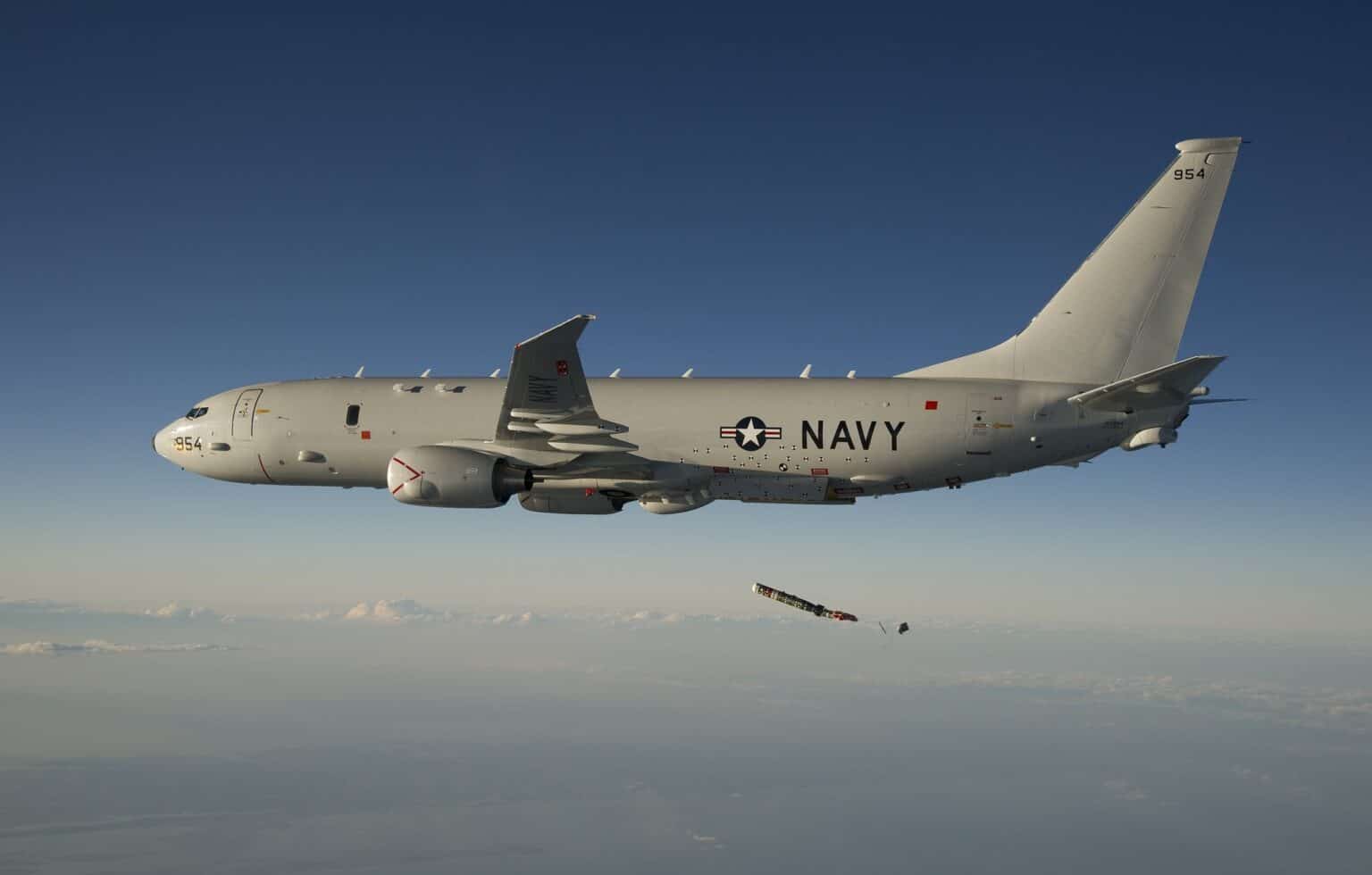
The Boeing P-8 Poseidon is the US Navy’s submarine hunter: a Boeing 737-800 rebuilt with a weapons bay, sonobuoy launchers, 737-900 wings and a strengthened airframe for low-level flying over the sea. It replaced the P-3 Orion from 2013 and now flies with navies and air forces on four continents, from Australia and India to Norway and the UK.
Live Fleet Activity (P8)
Fetching live data…


The Boeing P-8 Poseidon is the US Navy’s maritime patrol aircraft: a jet built to find submarines, track surface ships and, when ordered, sink them. It also flies intelligence, surveillance and reconnaissance missions and search-and-rescue sorties far out over open water.
Underneath the gray paint it is a Boeing 737. The Navy describes it as the 737-800 airframe with the wings of the 737-900, a weapons bay and pylons, with the military equipment added after the airliner leaves the commercial assembly line.
The P-8A replaced the four-engine turboprop Lockheed P-3 Orion, which had hunted submarines for the Navy since 1962. It reached initial operational capability in November 2013 and now flies with the navies and air forces of eight countries, with Canada next in line.
The search for a P-3 replacement started in the 1980s, as the Orions grew heavier and ran into airframe fatigue limits. Lockheed won a contract to develop a successor, the P-7, in 1989, but it was canceled the following year.
A second competition opened in 2000. Lockheed Martin offered the Orion 21, a new-build P-3, and BAE Systems offered a version of the Nimrod MRA4 before withdrawing in October 2002 for lack of an American production partner.
Boeing’s bid was based on the 737-800, and on May 14, 2004 it won the Multimission Maritime Aircraft program. The development contract followed on June 14, 2004, and the aircraft received the P-8A designation on March 30, 2005.
The logic was cost. The Navy’s fact file says the P-8 is built on an efficient commercial assembly line, with the military changes made after final assembly, and that sharing parts and training with the worldwide 737 fleet reduces cost.
The first P-8 flew on April 25, 2009. Low-rate production was approved in August 2010, and the first sonobuoys were dropped in flight testing on October 15, 2010.
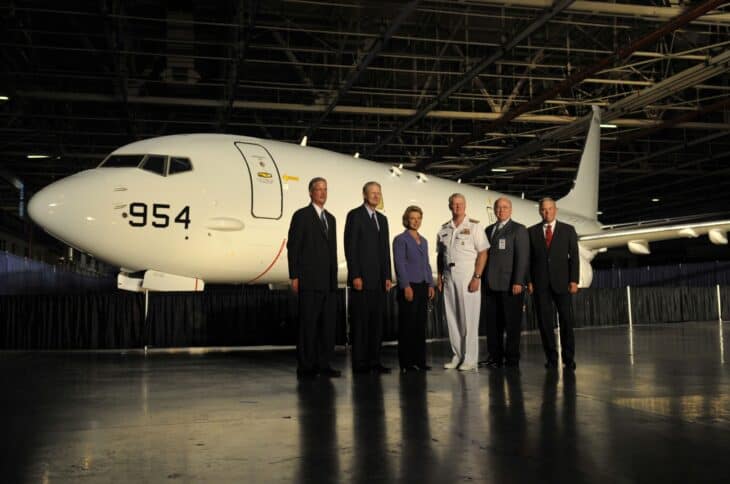
The first production aircraft went to the Navy on March 4, 2012, joining the training squadron VP-30 at Naval Air Station Jacksonville, Florida. On November 29, 2013, squadron VP-16 left Jacksonville with six aircraft for Kadena Air Base in Okinawa, the type’s first operational deployment.
Almost everything that matters is below the paint. Spirit AeroSystems, which builds 737 fuselages, strengthened the structure for low-level flying and more aggressive maneuvering, and cut a short weapons bay into the belly behind the wing.
The Royal Australian Air Force says the strengthening allows low-level operations down to 200 feet (61 m) above the sea. It adds that the P-8’s fuel load lets it fly low-level anti-submarine missions more than 1,240 miles (2,000 km) from base.
The P-8 uses raked wingtips instead of the blended winglets available on 737 Next Generation airliners, and it de-ices the wingtips and tail surfaces with an electro-mechanical expulsion system. Each engine carries a 180 kVA generator in place of the airliner’s 90 kVA unit, which forced a redesign of the nacelles to power the mission electronics.
In the cockpit, Boeing allowed steeper bank angles, made the autothrottle more responsive and removed audible warnings that would otherwise sound during low-altitude operations. Flight International’s 2010 cutaway judged that airline 737 pilots would be quite comfortable on the flight deck, apart from a few oddities on the panel such as a bank angle boost selector and aerial refueling controls.
The cabin is a workplace, not a passenger compartment. Five operator consoles sit in a sideways row along the left side, and only two observer stations in the forward cabin have large windows.
For endurance, the P-8 carries six auxiliary fuel tanks, and the RAAF puts its internal fuel at almost 34 tonnes.
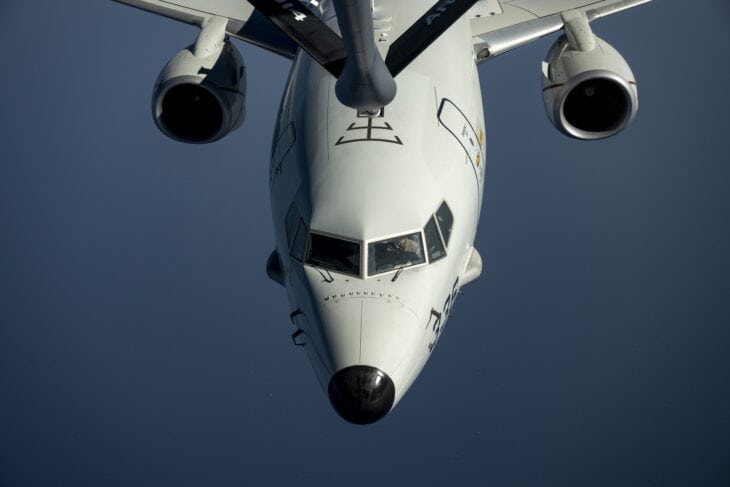
It refuels in flight through a boom receptacle on top of the forward fuselage, so it cannot use the Navy’s usual probe-and-drogue method and depends on Air Force boom tankers such as the KC-135 and KC-46. Our guide to how airplanes refuel in the air explains the difference.
A submarine hunt starts with sound. The P-8 drops sonobuoys, small floating sensors that listen underwater and radio what they hear back to the aircraft, where acoustic operators process the signals.
Boeing lists stowage for 129 A-size sonobuoys, launched from a rotary, reloadable launcher. Laying a pattern of buoys lets the crew search an area, fix a contact and then follow it as it moves.
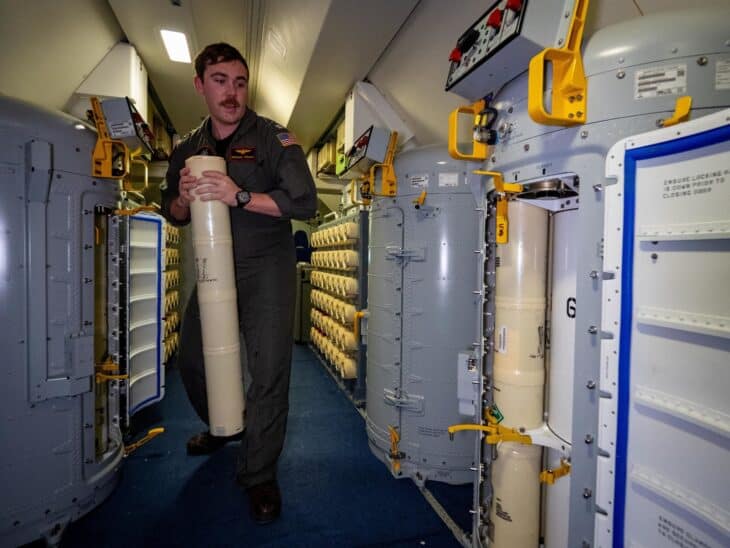
Above the water, the Raytheon AN/APY-10 multi-mission radar searches the sea surface. NAVAIR adds synthetic aperture radar and an electro-optical and infrared sensor turret, and Boeing lists an electronic support measures suite that picks up other ships’ and aircraft’s emissions. A hydrocarbon sensor can detect fuel vapor from diesel-powered submarines and ships.
One sensor the P-3 carried is missing. The Navy deleted the requirement for a magnetic anomaly detector (MAD) to save weight and improve endurance. The Indian Navy’s P-8I is the exception, because India asked for one.
NAVAIR lists a higher operating altitude among the P-8’s advantages over the P-3, alongside a smaller crew, greater reach and more payload. Some of its equipment, such as the high-altitude torpedo kit below, is built around that.
The early results were mixed. The Pentagon’s test office found the first-increment aircraft effective for small-area and cued searches, but short of the P-3C’s broad-area acoustic search capability, and it judged the Mk 54 torpedo of limited use against evasive targets.
Capability was added in increments. On April 24, 2026, the Navy declared initial operational capability for Increment 3 Block 2, which NAVAIR says brings a new combat systems suite, wideband satellite communications, an anti-submarine signals intelligence capability and new radome, antennas and sensors.
Yes. Once a submarine is located, the P-8 attacks it with lightweight torpedoes such as the Mk 54, carried in the internal weapons bay. The Indian Navy’s first P-8I completed weapons trials that included a torpedo drop and a Harpoon missile firing.
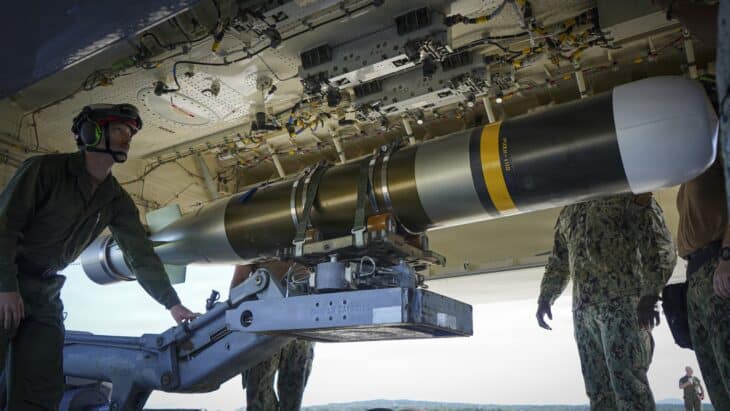
The P-8 is also to be equipped with the High Altitude Anti-Submarine Warfare Weapon Capability (HAAWC), an air launch kit that turns a Mk 54 into a glide weapon. It is designed to let the aircraft release a torpedo from as high as 30,000 feet (9,100 m).
The Naval Academy’s description of the aircraft lists a five-station internal weapons bay, four wing pylons and two centerline pylons. Beyond torpedoes, the P-8 carries AGM-84 Harpoon anti-ship missiles, and it fired a live Harpoon for the first time on June 24, 2013, scoring a direct hit on a target.
The Royal Air Force chose the British Sting Ray torpedo for its fleet in 2023. Mines and depth charges also appear in the published weapon list.
The Navy lists a crew of nine. The Naval Academy breaks that down as two pilots, five mission crew, a relief pilot and an in-flight technician.
The five mission consoles are worked by two naval flight officers and three enlisted aircrew. The RAAF names the roles on its aircraft as pilot, co-pilot, tactical coordinator, co-tactical coordinator, acoustic warfare analysts and electronic warfare analysts.
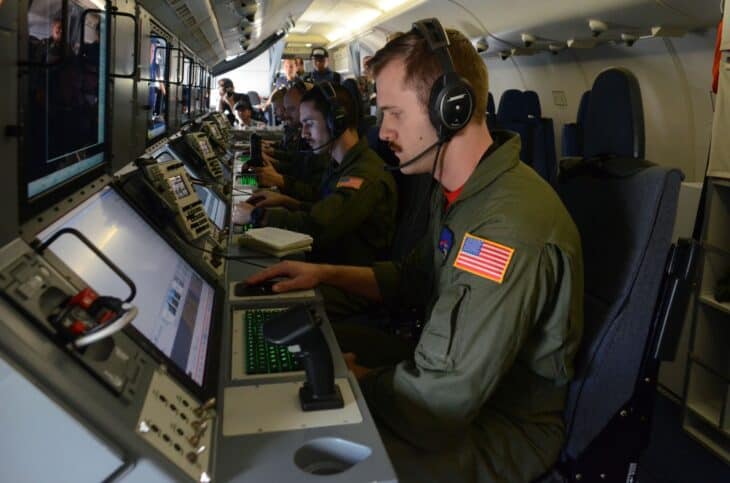
The Navy says crews find the jet a steadier platform than the P-3, with less turbulence and fewer fumes, which helps them concentrate through a long patrol.
The full specification table for the aircraft is on this page. Three of its figures need context, because they are regularly quoted against each other.
The number Boeing publishes is a mission, not a range: the P-8 can fly 1,200 nautical miles (2,225 km) out from base, spend four hours hunting on station and fly home. Search results often present that radius as the aircraft’s total range, which understates it.
The range in the panel is the RAAF’s published figure, a distance with no time spent on station. It is more than three times the patrol radius, and in-flight refueling extends either figure.
The top speed and ceiling in the panel are airliner-class numbers, well above the turboprop P-3’s. The P-8 reaches a search area faster than the Orion it replaced and can patrol higher.
Boeing designed each P-8 for 25 years and 25,000 flight hours in maritime service, and says the worldwide fleet has flown more than 700,000 hours in total.
The Navy’s fiscal 2025 budget justification, published in March 2024, puts the P-8A’s flyaway unit cost at $171.4 million, averaged across the aircraft already bought. Flyaway cost covers the aircraft itself.
The same document gives a gross weapon system unit cost of $201.2 million, which adds trainers, support equipment and other procurement costs. The gap between the two is one reason published “unit cost” figures for the P-8 vary so widely.
Export deals run higher still, because they bundle weapons, simulators and infrastructure. Canada budgeted C$10.4 billion for 14 aircraft and everything needed to operate them. The P-8 sits alongside the other entries in our list of the most expensive military aircraft.
The Navy’s budget documents count 128 P-8As bought with procurement funds through fiscal 2024. One of those has since been lost.
On November 20, 2023, a VP-4 aircraft overran the runway while landing in the rain at Marine Corps Air Station Kaneohe Bay, Hawaii, and came to rest in the water. All nine crew were uninjured, but after about two weeks in saltwater the Navy judged a repair cost prohibitive and scrapped the jet.
Purchases paused in fiscal 2025 and 2026. The Navy’s fiscal 2027 budget request, reported by Breaking Defense in May 2026, asks for 12 more P-8As for just over $4.2 billion, calls 2027 the last planned production year and expects the final delivery in the first quarter of fiscal 2032.
That is a budget request, not an appropriation, and Congress decides the final number.
P-8A Poseidon. The production aircraft for the US Navy, also bought by every export customer except India.
P-8I Neptune. India’s export version adds a magnetic anomaly detector and a Telephonics APS-143 aft-facing radar, and uses an export version of the APY-10. It also carries Indian systems, including a Bharat Electronics data link and IFF interrogator.
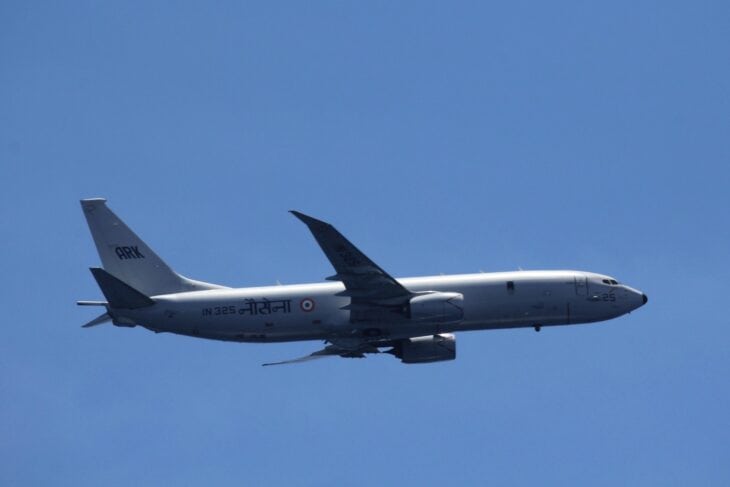
Poseidon MRA1. The Royal Air Force’s service name for its P-8As.
P-8 AGS. A ground-surveillance version with a belly-mounted radar pod, proposed to the US Air Force in 2010 as a replacement for the E-8 Joint STARS.
Boeing lists seven P-8A operators in delivery order: the US Navy, the Royal Australian Air Force, the Royal Air Force, the Royal Norwegian Air Force, the Royal New Zealand Air Force, the Republic of Korea Navy and the German Navy. India’s P-8I makes eight, and Canada is on contract to become the ninth.
India was the first export customer. It signed for eight P-8Is on January 1, 2009 to replace its Tupolev Tu-142M turboprops, then added four more in a deal signed on July 27, 2016. A further six were approved in principle in February 2026 but had not been contracted by the newest source consulted here.
Australia operates 14 P-8As in No. 92 Wing, flown by No. 11, No. 12 and No. 292 Squadrons at RAAF Base Edinburgh. The RAAF accepted its first aircraft on September 27, 2016.
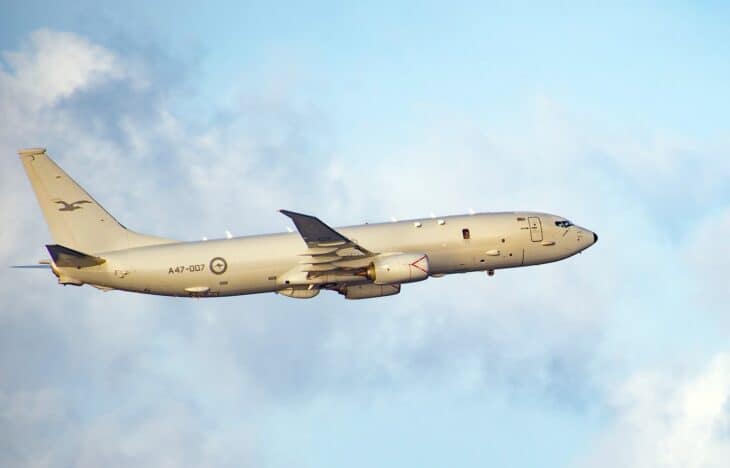
The United Kingdom bought nine to fill the gap left by the canceled Nimrod MRA4. They fly with No. 120 and No. 201 Squadrons from RAF Lossiemouth in Scotland, and the last arrived in January 2022.
Norway took five aircraft for 333 Squadron at Evenes, all operational since June 30, 2023. New Zealand ordered four, with the first delivered in December 2022.
South Korea ordered six, delivered in 2024. Germany bought five in 2021 and approved three more in November 2023 to replace its P-3C Orions.
Canada is buying 14 aircraft, with options for two more, to replace its CP-140 Auroras. National Defence expects the first delivery in 2026 and full operational capability by 2033, with bases at 14 Wing Greenwood in Nova Scotia and 19 Wing Comox in British Columbia.
Singapore confirmed an order in September 2025, and Denmark’s Ministry of Defence confirmed plans to buy two in July 2026. Counting every customer, Boeing had built 187 P-8s by January 31, 2026.
Much of the P-8’s work is routine patrolling that never makes the news. Some of it does, often because another country’s fighters came too close.
On August 19, 2014, a Chinese J-11 fighter passed within about 30 feet (9 m) of a Navy P-8A east of Hainan Island, then flew a barrel roll at close range. In November 2016, a Russian Su-30 came within about 5 feet (1.5 m) of a P-8 over the Black Sea, pushing it through the fighter’s jet wash.
Search and rescue is the other public face of the fleet. US and Indian P-8s searched for Malaysia Airlines Flight 370 in 2014, and on February 20, 2018 a VP-8 crew dropped a survival kit to three fishermen who had been adrift in the South Pacific for eight days, the first operational use of the kit from a P-8.
On April 17, 2024, a Navy P-8A flew through the Taiwan Strait to assert navigational rights. In US service the P-8 is paired with the MQ-4C Triton drone, which provides continuous surveillance.
For the wider picture of what the Navy flies and why, see our overview of the types of Navy planes.
The P-3 Orion is a four-engine turboprop that served the Navy for half a century before the P-8 arrived. The P-8 swapped it for a twin-engine jet with, in NAVAIR’s words, a smaller crew, greater reach, more payload and a higher operating altitude.
The Navy gave up the Orion’s magnetic anomaly detector in the process, and its own testers found the first P-8s short of the P-3C’s broad-area acoustic search. Increment 2 added multi-static active coherent acoustics, and Increment 3 Block 2 added further acoustic systems.
Japan went the other way. The Kawasaki P-1 is a purpose-built maritime patrol jet with no civil counterpart, designed from the start for the role that the P-8 adapts an airliner to perform.
The 737 connection also runs through the rest of the Navy fleet. The C-40A Clipper transport is a 737-700 derivative, and the civil Boeing 737-800 is the P-8’s direct ancestor.
The P-8 Poseidon hunts and attacks submarines, tracks and attacks surface ships, and flies intelligence, surveillance and reconnaissance and search-and-rescue missions. It is the US Navy’s replacement for the P-3 Orion.
Yes. It finds submarines with sonobuoys, radar and other sensors, then attacks them with lightweight torpedoes such as the Mk 54, carried in its internal weapons bay. A glide kit, HAAWC, is designed to let it release torpedoes from high altitude.
The Navy’s budget documents count 128 P-8As bought through fiscal 2024, and one was scrapped after a 2023 runway overrun in Hawaii. The fiscal 2027 budget request asks for 12 more, which Congress has yet to approve.
The Navy puts the flyaway unit cost at $171.4 million, averaged across the aircraft bought so far. Including support, spares and training systems, the gross weapon system unit cost is $201.2 million.
Yes. It combines the 737-800 fuselage with the stronger 737-900 wing, then adds a weapons bay, pylons, sonobuoy launchers, a strengthened structure, a refueling receptacle and a military mission system.
Boeing’s mission figure is four hours on station at 1,200 nautical miles from base. In-flight refueling from Air Force boom tankers extends that.
NAVAIR deleted the requirement as a weight-saving measure that improves endurance. India’s P-8I carries one at the Indian Navy’s request.
Sources and references used for research and fact-checking.

.jpg)
.jpg)
.jpg)
.jpg)
.JPG)
.JPG)