Military Aircraft
The Boeing demonstrator that lost the Joint Strike Fighter contest to the X-35 in 2001.
Updated: by Tim de Vries
The latest aviation news and stories sent to your inbox.
The Boeing X-32 was one of two concept demonstrators Boeing built for the Joint Strike Fighter competition, flown against Lockheed Martin’s X-35. It proved a direct-lift hover system and a carrier-approach airframe, but it lost the October 2001 downselect and the X-35 became the F-35. Both aircraft survive in museums.
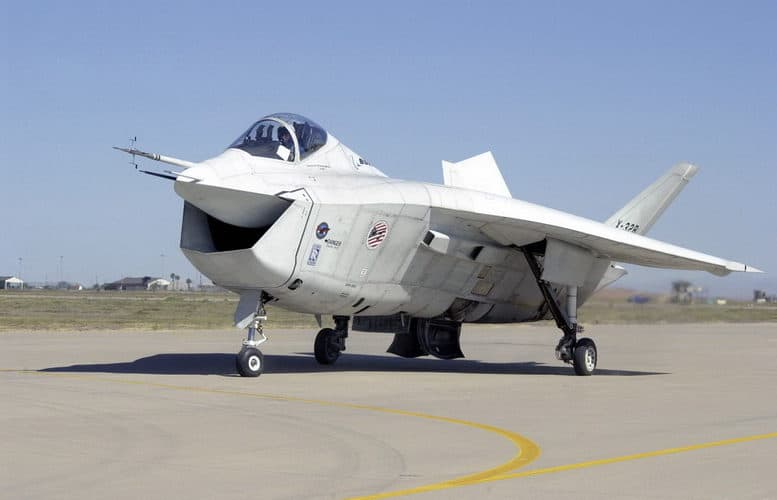
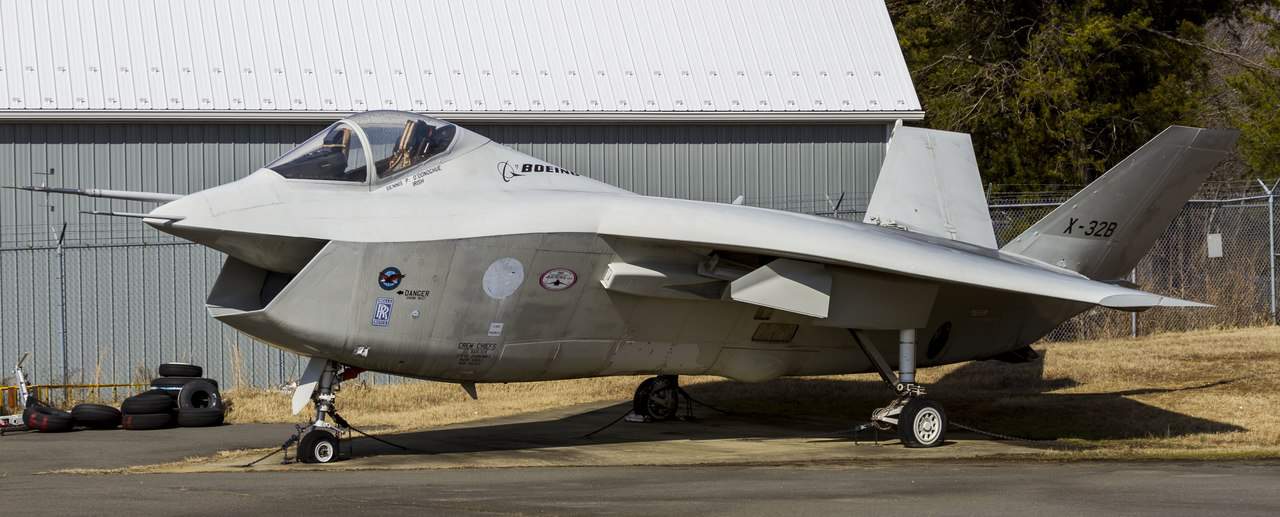
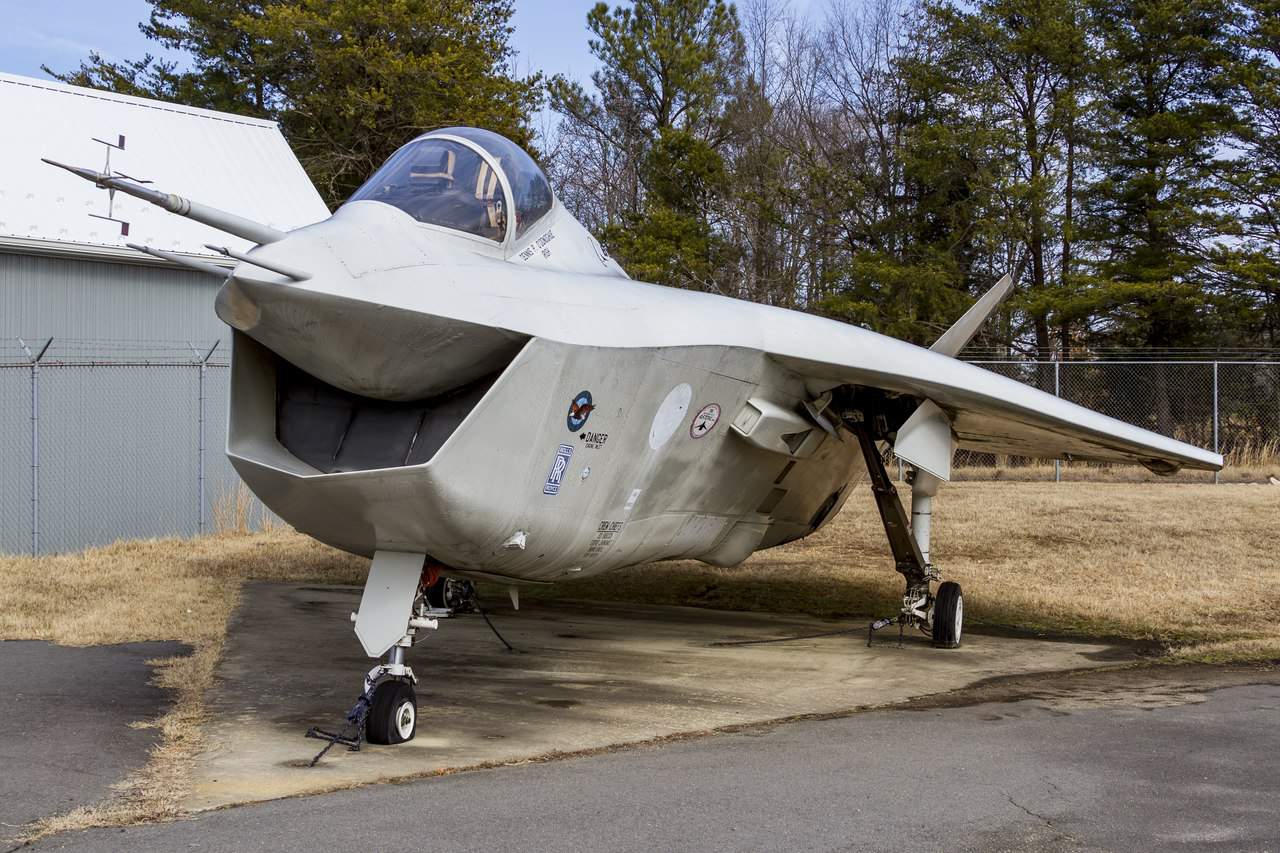
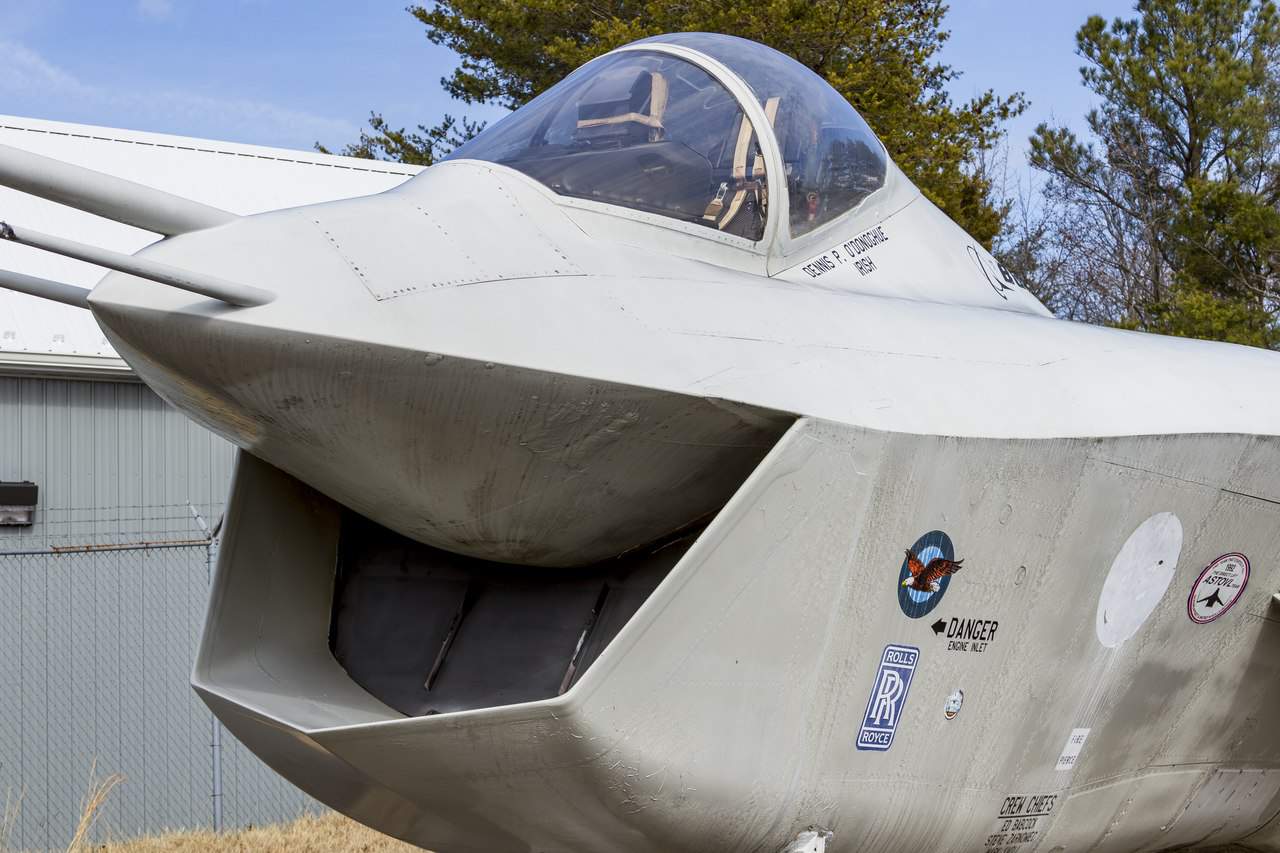
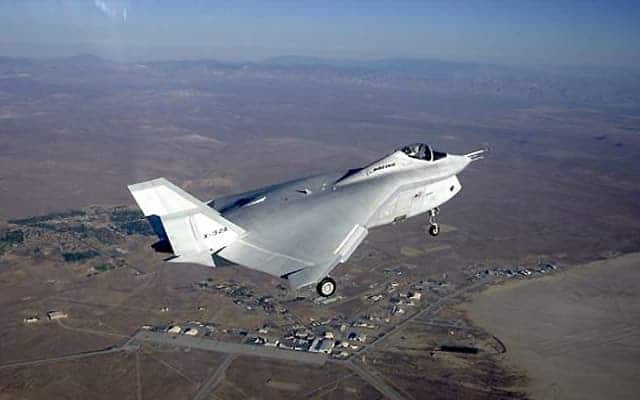
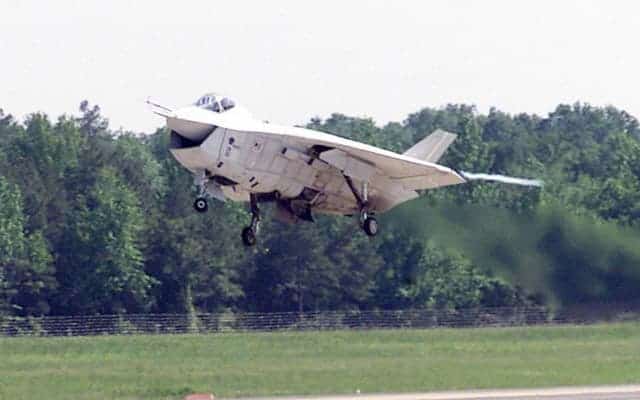
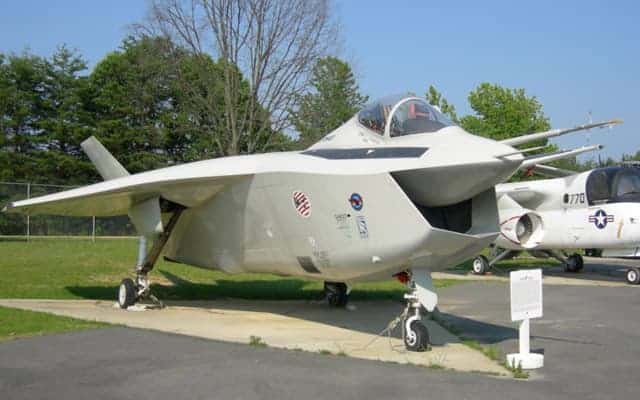
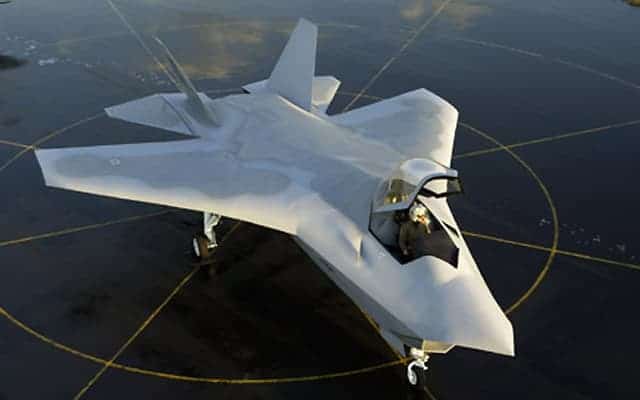
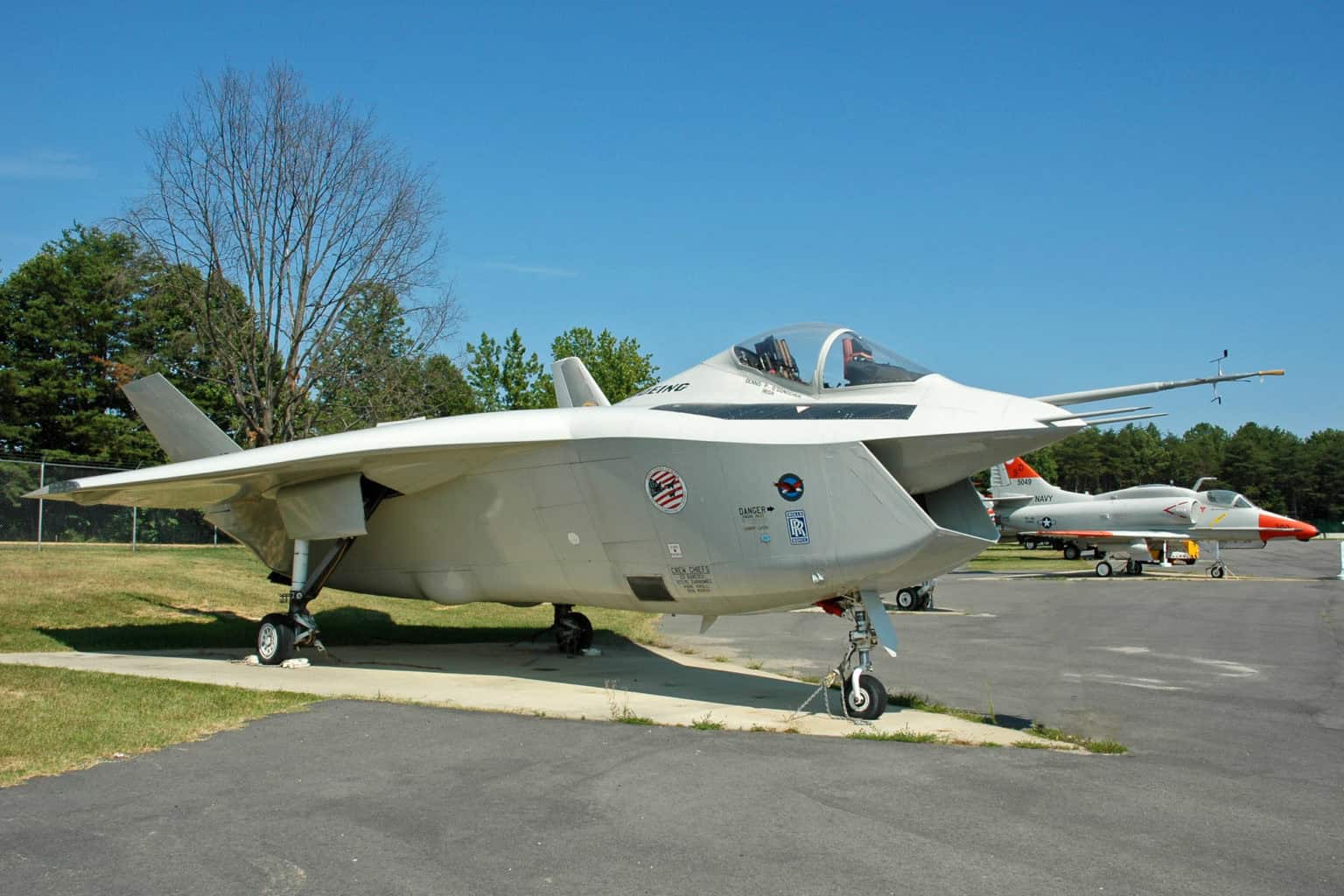
The Boeing X-32 was a concept demonstrator built for the Joint Strike Fighter (JSF) competition. It lost to the Lockheed Martin X-35, which became the F-35 Lightning II.
On November 16, 1996, Boeing and Lockheed Martin were each awarded a contract to build two demonstrators. Each company received $750 million and was barred from adding its own money, which pushed both toward low-cost construction.
The X-32 first flew on September 18, 2000. On October 26, 2001, the Department of Defense announced that the X-35 had won.
The X-32 is a demonstrator, not a prototype. It was built to prove that Boeing’s design concepts would work, and the X designation says so.
Boeing built two aircraft, the X-32A and the X-32B. Between them they covered conventional takeoff and landing, carrier approach and short takeoff and vertical landing (STOVL).
The X-32A handled the conventional and carrier-approach work. NASA’s X-vehicle inventory notes that, unlike the X-35, no airframe changes were needed to demonstrate carrier approach, so the X-32A performed both roles.
The X-32B was the STOVL aircraft. NASA says its fuselage was slightly shorter and its wing narrower to save weight, and it had a moving intake cowl that slid forward during hover to let more air into the engine.

Boeing rolled out both aircraft together at Palmdale, California, on December 14, 1999. Wikipedia notes that the X-32B’s appearance was a surprise, because its construction had begun about three months after the X-32A’s.
Boeing’s strategy was to win on cost. It wanted the three versions to be as alike as possible, so it built the X-32 around a single carbon fiber composite delta wing.
That wing had a 55-degree leading-edge sweep and could hold up to 20,000 pounds (9,000 kg) of fuel, according to Wikipedia. The sweep let Boeing use a thick wing without a large transonic drag penalty.
The wingspan is 36 ft 0 in (10.97 m). That figure is the X-32A’s. Aerospaceweb lists the X-32B’s narrower wing at 9.15 m.
The unusual shape came from the vertical-landing system. Boeing chose direct lift, the same idea as the AV-8B Harrier, which sends the engine’s own thrust downward through nozzles.
For a hover to stay level, those nozzles have to sit at the aircraft’s center of gravity. NASA explains that this put the engine in the front of the fuselage, with the nozzles right behind it and a long exhaust duct running back to the tail nozzle. The result was a very short nose.

The direct-lift layout also explains the large chin intake. Wikipedia says it was needed to feed enough air to the engine during the zero-speed phase of a hover.
That intake had a cost. The same article notes that it could leave the compressor blades directly visible to radar, and that possible fixes included variable baffles to block radar waves.
Boeing test pilot Fred Knox flew the X-32A on its first flight on September 18, 2000, from Palmdale to Edwards Air Force Base. A minor hydraulic leak cut the flight to about 20 minutes, and the aircraft reached 10,000 feet, according to Wikipedia.
Knox called the aircraft “a pleasure to fly” and said it showed the handling qualities Boeing expected from hundreds of hours of simulator work.
The X-32A flew 66 times and 50.4 hours, according to Boeing. The museum says those flights demonstrated handling in aerial refueling, weapons-bay operation and supersonic flight.
The X-32B made its first flight on March 29, 2001. Boeing says it made its first vertical landings on June 27, flew supersonic on July 17, and finished testing on July 28 after 78 flights.
Its longest sustained hover lasted two minutes and 42 seconds. Boeing’s test pilots included U.S. Marine Corps Maj. Jeff Karnes and Royal Navy Lt. Cdr. Paul Stone.
Karnes later told NAVAIR that flying the X-32B was “amazing.” He had flown the Harrier, and said the digital flight controls reduced his workload and let him land vertically with more accuracy than ever.
No single flaw sank the X-32. NAVAIR says the demonstrators from both teams showed that their JSF designs were viable. The loss came down to how the X-32 did it, and to what Boeing would have to change.
The first problem was the delta wing. Wikipedia reports that about eight months into construction, the Navy refined the JSF’s maneuverability and payload requirements, and the delta wing fell short of the new targets.
Boeing redesigned the production aircraft with a conventional tail, but it was too late to change the demonstrators. NASA says the planned production version gained a horizontal stabilizer and a stubby swept wing, so the X-32 did not look like the aircraft Boeing was proposing to build.
NASA lists that as one of the things that worked against Boeing: the X-32 design was not representative of the proposed production aircraft.
The second problem was how the X-32 demonstrated its abilities. Wikipedia says Boeing showed STOVL and supersonic flight in separate configurations, with some parts removed for hover.
The X-35 did them together. On July 20, 2001, the X-35B took off in under 500 feet, went supersonic and landed vertically in a single mission.
That contrast came down to the lift system. Lockheed used a shaft-driven lift fan, where Boeing used the Harrier-style direct lift, which was simpler and more conventional.
The X-32’s looks did not help its reputation either. NASA’s inventory records that the general consensus was that it was the ugliest design from an American manufacturer in decades. Karnes called it “not the most beautiful thing,” but “a wonderful beast” for the people who worked on it.
The X-32 was never an F-35 competitor in a production sense. It was a demonstrator competing against another demonstrator.
The X-35 was then developed into the F-35. No production version of the X-32 was built, and the proposed X-32C never flew.
It is a fair question whether the X-32 would have been the better fighter. The honest answer is that it was never tested as one, so nobody knows. What the flights showed is that the concept worked, and that the contest was decided on the approach and the risk.
Boeing did not walk away empty-handed. Wikipedia reports that the company treats the X-32 work as a strategic investment that fed technology into the F/A-18E/F Super Hornet and other studies.
Boeing’s later fighter story ended differently. For the follow-on, read our piece on how Boeing lost the F-35 race and then won both of America’s next fighter contracts.
The full specification table for the aircraft is on this page. These notes cover the figures that need context, because published X-32 numbers disagree more than most.
Start with the X-32A and X-32B. They were different airframes, with different lengths, wingspans and intakes, so any single table of “X-32 specs” is blending two aircraft.
Weights are the biggest argument. Published maximum takeoff weights for the demonstrator disagree by thousands of pounds, and the heaviest figure often quoted online belongs to the proposed production X-32C, not to the aircraft in the museum.
Speed needs the most care. The Air Force museum lists a maximum speed of Mach 1.2, which is the 688 kt (792 mph, 1,274 km/h) in the panel. Some references print 1,200 mph, which would be about Mach 1.6 and contradicts the Mach 1.2 printed next to it.
NASA’s inventory estimates that the fastest X-32 flight exceeded Mach 1.5, and that its highest flight passed 40,000 feet. Those are test points the aircraft reached, not ratings.
The engine was a Pratt & Whitney JSF119-614, a derivative of the F-22’s F119. The museum puts its afterburning thrust at about 50,000 lbf (222 kN), and the word “approximately” matters: other references give lower numbers for the same engine.
The X-32B used a modified version of the engine with direct-lift hardware. Boeing says it shifted thrust to the lift nozzles in one to three seconds in more than 500 test-stand transitions.
The panel’s range of 850 nm is the Air Force mission profile. The Navy and Marine Corps profiles were shorter.
Neither aircraft was lost. Both were retired after testing and transferred to museums in 2005.
The X-32A went to the National Museum of the United States Air Force near Dayton, Ohio. The museum says it went on display in May 2024 after restoration, and Wikipedia reports that it sits close to the YF-23 in the research and development gallery.

The X-32B went to the Patuxent River Naval Air Museum in Maryland. When it arrived, NAVAIR noted that the museum was the only place where visitors could see both JSF contenders, because the Lockheed X-35C was already there.
Wikipedia describes the X-32B as being in a deteriorated state on display as of 2023. Anyone planning a visit to either aircraft should check the museum’s current display status first.
For more on the other experimental aircraft of the era, see our ranking of the X-planes that changed flight.
The Department of Defense announced the X-35 as the Joint Strike Fighter winner on October 26, 2001. Several things worked against the X-32. The delta wing fell short of the Navy’s refined maneuverability targets, the demonstrator was not representative of Boeing’s proposed production aircraft, and Boeing showed STOVL and supersonic flight in separate configurations. The X-35B did both in one flight.
Nobody can say, because the X-32 was never tested as a fighter. It was a concept demonstrator, and the F-35 is a production fighter developed from the winning X-35. What can be said is that the X-32 proved Boeing’s concept and still lost the contest.
Boeing built two, the X-32A and the X-32B. Both survive. The X-32A is at the National Museum of the United States Air Force in Ohio, and the X-32B is at the Patuxent River Naval Air Museum in Maryland.
No. Neither aircraft was lost. The X-32A completed 66 flights and the X-32B completed 78, and both survive in museums.
The Air Force museum lists a maximum speed of Mach 1.2. NASA’s inventory estimates that the fastest test flight went beyond Mach 1.5, and Boeing says the X-32B flew supersonic on July 17, 2001.
The X-32 was never sold, so it has no unit price. Boeing and Lockheed Martin each received $750 million to build two demonstrators, including avionics, software and hardware.
The Joint Strike Fighter grew out of a DARPA effort to build a stealth-enabled design, but we found no published radar cross-section figure for the X-32. Its large chin intake raised concerns that radar could see the compressor blades, and variable baffles were one possible fix.
The X-32 used one Pratt & Whitney JSF119-614 afterburning turbofan, a derivative of the F-22’s F119. The X-32B version had direct-lift hardware that could divert thrust to lift nozzles for hovering.
Sources and references used for research and fact-checking.