


Table of Contents
Airplanes refuel in the air through one of two systems: a rigid flying boom that a tanker crew member steers into a receptacle on the receiving aircraft, or a probe-and-drogue hose that the receiving pilot flies into. Both move jet fuel between two aircraft holding formation at cruising speed.
The boom is faster. Boeing rates the KC-46A’s boom at 1,200 gallons per minute, against 400 gallons per minute through its hose-and-drogue systems.
Almost every aircraft that does this is military. No airliner in service is built to take fuel in flight, which is why you will never see it from seat 14A.
| System | How it connects | Transfer rate | Who uses it |
|---|---|---|---|
| Flying boom | A boom operator flies a rigid telescoping tube into a receptacle on the receiver | Up to 1,200 gallons per minute (KC-46A) | US Air Force and boom-equipped allies |
| Probe and drogue | The receiving pilot flies a probe into a basket trailing on a flexible hose | Roughly 220 to 400 gallons per minute | US Navy, Marine Corps, most European air forces |
One thing both systems share
Tankers pump jet fuel, not the aviation gasoline used by piston aircraft. Modern receivers take JP-8 or Jet A-1. The SR-71 was the exception, burning a specialized high-flash-point fuel called JP-7 that its tankers had to carry separately.
The flying boom
The boom is a rigid telescoping tube mounted under the tail of the tanker. It has small control surfaces near its tip, so it can genuinely be flown rather than simply dangled.
A dedicated crew member called the boom operator lies or sits at a station in the back of the tanker and steers the boom into a receptacle on the spine of the receiving aircraft. The receiving pilot’s job is simply to hold position.

That division of labor is why the boom suits big aircraft. A bomber or a transport only has to fly straight and level while somebody else does the delicate part, and the same logic applies to the F-16 Fighting Falcon and every other boom-equipped receiver.
The tradeoff is that a tanker carries only one boom, so it refuels one aircraft at a time.
Probe and drogue
The probe-and-drogue system reverses the workload. The tanker unspools a flexible hose from a wing pod or the centerline, with a basket on the end that looks like a badminton shuttlecock.
The receiving pilot then flies a rigid probe into that basket. There is no operator to help, so the skill sits entirely with the receiver.

Push in too hard and the hose whips into a wave that can throw the basket off the probe. Pilots describe the approach as a slow, deliberate closure rather than a stab.
What the system loses in speed it gains in numbers. A tanker can carry several drogues, so two or three aircraft can take fuel simultaneously, which matters when a whole formation of fighters needs topping off.
They are closer than you think
During boom refueling the two aircraft sit roughly 35 feet apart. Hose-and-drogue refueling gives a little more room, at about 80 feet. Both are formation distances, held for minutes at a time, several miles above the ground.
Why the US services use different systems
The US Air Force standardized on the boom. The Navy and Marine Corps use probe and drogue, as do most European air forces and many other operators.
That split is a practical problem when those aircraft fly together, so tankers bridge it. A KC-135 can carry a shuttlecock-shaped drogue adapter fitted to the end of its boom, and many carry Mk32B wing pods under the designation Multi-point Refueling System.

The KC-46A goes further and carries a boom, a centerline drogue and wing pods on the same airframe.
The tankers that do the work
The backbone of the US fleet is still the KC-135 Stratotanker, an aircraft first deployed in August 1956. The Air Force fact sheet lists 396 of them across active duty, the Air National Guard and the Air Force Reserve, while Wikipedia’s 2026 figure is 375, so the fleet sits somewhere around 380 to 400.
A KC-135 can pass up to 200,000 pounds (90,719 kg) of transfer fuel and cruises at 530 mph at 30,000 feet. It is one of the oldest airframe designs still in front-line service, which is the whole reason a replacement program exists. It sits alongside the other types of military planes that have been in service for decades.
| Tanker | Main operator | Refueling system | Status as of 2026 |
|---|---|---|---|
| KC-135 Stratotanker | US Air Force | Boom, plus drogue adapter and wing pods | In service since August 1956 |
| KC-46A Pegasus | US Air Force | Boom, centerline drogue and wing pods | 113 delivered as of August 2026 |
| KC-10 Extender | US Air Force | Boom and drogue | Retired 26 September 2024 |
| A330 MRTT | Australia, UK, NATO and others | Boom and drogue | In service |
| Il-78 | Russia, India and others | Drogue | In service |
The KC-10 Extender left the fleet on 26 September 2024 after 44 years, with the last aircraft flown to storage at Davis-Monthan Air Force Base in Arizona. The Airbus A330 MRTT fills a similar role for a growing list of air forces.
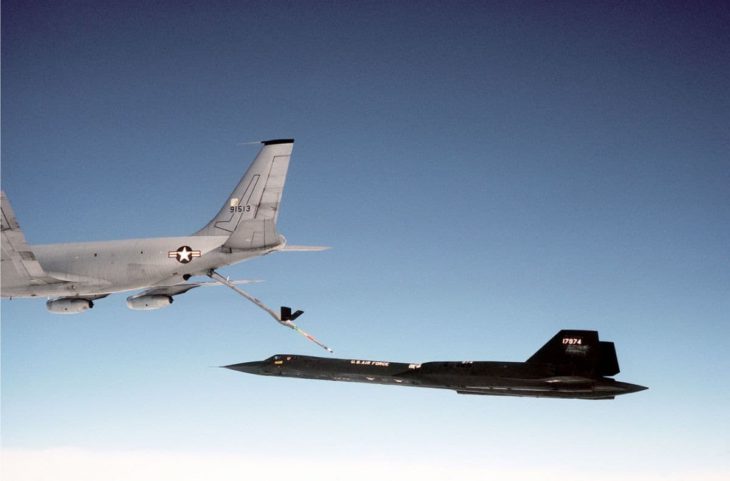
That KC-135Q variant existed purely to serve the SR-71 Blackbird, which burned a fuel no other aircraft used. Refueling was not a convenience for the Blackbird, it was structural: the aircraft took off light and topped up almost immediately.
What actually happens during a refueling
Tanker and receiver meet at a prearranged point, altitude and speed. Both have to sit inside a window where the tanker is slow enough for its own comfort and the receiver is fast enough to stay controllable.
The receiver closes from behind and below, into the tanker’s wake. That air is turbulent, and the tanker’s own downwash pushes back, so holding position is constant small corrections rather than one settled trim.
Once the connection seals, fuel flows and the receiver gets steadily heavier while the tanker gets lighter. Both aircraft trim continuously through the transfer.
A fighter topping off is usually done in a few minutes. A large aircraft taking a full load can sit on the boom far longer, which is exactly why the boom’s higher flow rate matters for bombers and transports. You can see the scale of the problem in how much fuel aircraft use on a long sortie.
How aerial refueling started
The first transfer of fuel between two aircraft was a stunt. On 12 November 1921 a wing walker named Wesley May climbed from a Lincoln Standard onto a Curtiss JN-4 with a can of gasoline strapped to his back and poured it into the tank.
The first practical refueling came less than two years later, and it is the one the Air Force counts as the beginning.

12 November 1921
A can of gas and a wing walk. Wesley May carries fuel by hand from a Lincoln Standard to a Curtiss JN-4. The Air Force calls it the first actual mid-air transfer of fuel, and says it was meant as nothing more than a stunt.
27 June 1923
The first real refueling. Two DH-4B biplanes connect over Rockwell Field in San Diego with a 50-foot hose. Lieutenants Virgil Hine and Frank Seifert crew the tanker, Lowell Smith and John Richter the receiver, and 75 gallons of gasoline pass between them.
27 to 28 August 1923
Proof it changes endurance. Smith and Richter stay airborne 37 hours and 25 minutes across 14 midair contacts, setting a world endurance record.
1929
The Question Mark. A Fokker C-2A led by Major Carl Spaatz remains aloft for more than 150 hours, turning the technique into a demonstration of air power.
1939
Airlines try it. Four Short Empire flying boats are fitted for in-flight refueling by Handley Page Harrow tankers to carry transatlantic airmail. The Second World War ends the trials.
26 February to 3 March 1949
Around the world without landing. The B-50 Lucky Lady II circles the globe non-stop in 94 hours and 1 minute, refueled four times by pairs of KB-29M tankers.

Lucky Lady II is the clearest early statement of what the technique was for. A bomber that never has to land is a bomber whose range is set by crew endurance and engine wear, not by fuel, and that idea shaped decades of bomber design.
Refueling helicopters
Helicopters refuel using probe and drogue, and the hard part is speed. A tanker has to fly slowly enough for the helicopter while staying above its own stall speed.

That overlap exists, but it is narrow. It is why the tankers used for this job are mostly propeller-driven Hercules variants rather than jets, since a C-130 Super Hercules is comfortable at speeds a jet tanker would struggle to hold.
The probe on a helicopter is also deliberately long, to keep the basket clear of the rotor disc. Aircraft such as the Sikorsky CH-53E Super Stallion and the HH-60G Pave Hawk carry them, and the payoff is a genuine extension of how far helicopters can fly.
Can Air Force One refuel in the air?
Yes. The VC-25A used as Air Force One is fitted for in-flight refueling, which in principle gives it unlimited range and lets it stay airborne as a command post for as long as the crew can manage.
In practice it is rarely used. Crews of the 89th Airlift Wing practice the maneuver to stay current, but it is not part of a normal presidential trip, and you can read more about who pilots Air Force One.
The replacement tells you how little it was valued. Air & Space Forces Magazine reports that the incoming VC-25B will not be capable of refueling in flight at all, dropped as a cost-saving measure.
Why airliners cannot refuel in flight
No airliner flying today is equipped to receive fuel in the air. There is no receptacle, no probe, and no certification basis for it.
The reason is economics rather than physics. Refueling needs a second aircraft, a second crew and a fuel-carrying tanker orbiting near the route, which costs far more than simply landing to refuel or building an aircraft with the range to avoid the stop.
Airlines actually tried this
In 1939 four Short Empire flying boats were fitted for in-flight refueling by converted Handley Page Harrow tankers, so they could take off light and top up for a transatlantic airmail run. The trials worked. The Second World War ended them, and no airline has seriously returned to the idea since.
Airliners manage fuel in the other direction instead. They carry reserves, plan alternates, and in an emergency some can jettison fuel to get down to a safe landing weight, which is a separate question from whether airplanes dump fuel.
What if a plane runs out of fuel anyway?
It becomes a glider, and that is survivable. In 1983 an Air Canada 767 ran dry at altitude after a fuel conversion error and landed at Gimli. In 2001 Air Transat Flight 236 lost both engines to a fuel leak over the Atlantic and glided to the Azores with 306 people aboard. Both landed without fatalities.
What comes next for the tanker fleet
The KC-46A Pegasus is the aircraft meant to replace the KC-135. It carries 212,299 pounds (96,297 kg) of fuel, has a maximum takeoff weight of 415,000 pounds (188,240 kg), and can also move 65,000 pounds (29,484 kg) of cargo or 58 passengers.
Its introduction has been difficult. The Remote Vision System, the camera setup that replaced the boom operator’s window, produced distorted depth perception, and the corrected RVS 2.0 is not expected to reach the fleet as a retrofit until 2027.
A separate problem was a boom too stiff for light aircraft to push against, which kept the KC-46 from refueling the A-10 and required an actuator redesign. The Air Force accepted its 100th KC-46A in December 2025 and had 113 by August 2026.
Beyond that the picture is unsettled. The Air Force has shifted money from its Next Generation Air-refueling System toward a new Advanced Tanker Systems effort in the fiscal 2027 request, aimed at mission systems such as connectivity, electronic warfare and defensive capability rather than at a new airframe.
Major General Frank Verdugo framed it as looking to offer more options than a single program, so that future tankers can operate in contested airspace. The tankers themselves are large, slow and impossible to hide, and that vulnerability is now the central design question.
FAQ
Sources and references used for research and fact-checking.
- U.S. Air Force, KC-135 Stratotanker Fact Sheet
- U.S. Air Force, KC-46A Pegasus Fact Sheet
- Boeing, KC-46 Pegasus Tanker
- AIAA, Aerospace Micro-Lesson 37: Aerial Refueling
- DVIDS, U.S. Air Force, Air refueling turns 100 years old
- This Day in Aviation, 27 June 1923
- U.S. Air Force, Refuelers extend 'gas can' tradition
- Wikipedia, Aerial refueling
- Wikipedia, Boeing KC-135 Stratotanker
- Wikipedia, Boeing KC-46 Pegasus
- Air & Space Forces Magazine, VC-25 Air Force One
- U.S. Air Force, Travis AFB, Travis AFB bids farewell to last KC-10
- DefenseScoop, Air Force shifts sixth-gen tanker strategy to prioritize mission systems over new aircraft
Get the Newsletter
The latest aviation news and stories sent to your inbox.
About the Author

Tim is the owner and lead editor of AeroCorner since 2019, overseeing aviation content covering aircraft, airlines, airports, and the broader aviation industry. Through years of researching, writing, editing, and publishing aviation-focused content, he has developed extensive practical knowledge of commercial aviation and air travel. Based in Asia and a frequent traveler himself, Tim also brings firsthand passenger experience to AeroCorner’s coverage. Outside of publishing, he has also explored aviation firsthand through hands-on flight training in New Zealand.