

Table of Contents
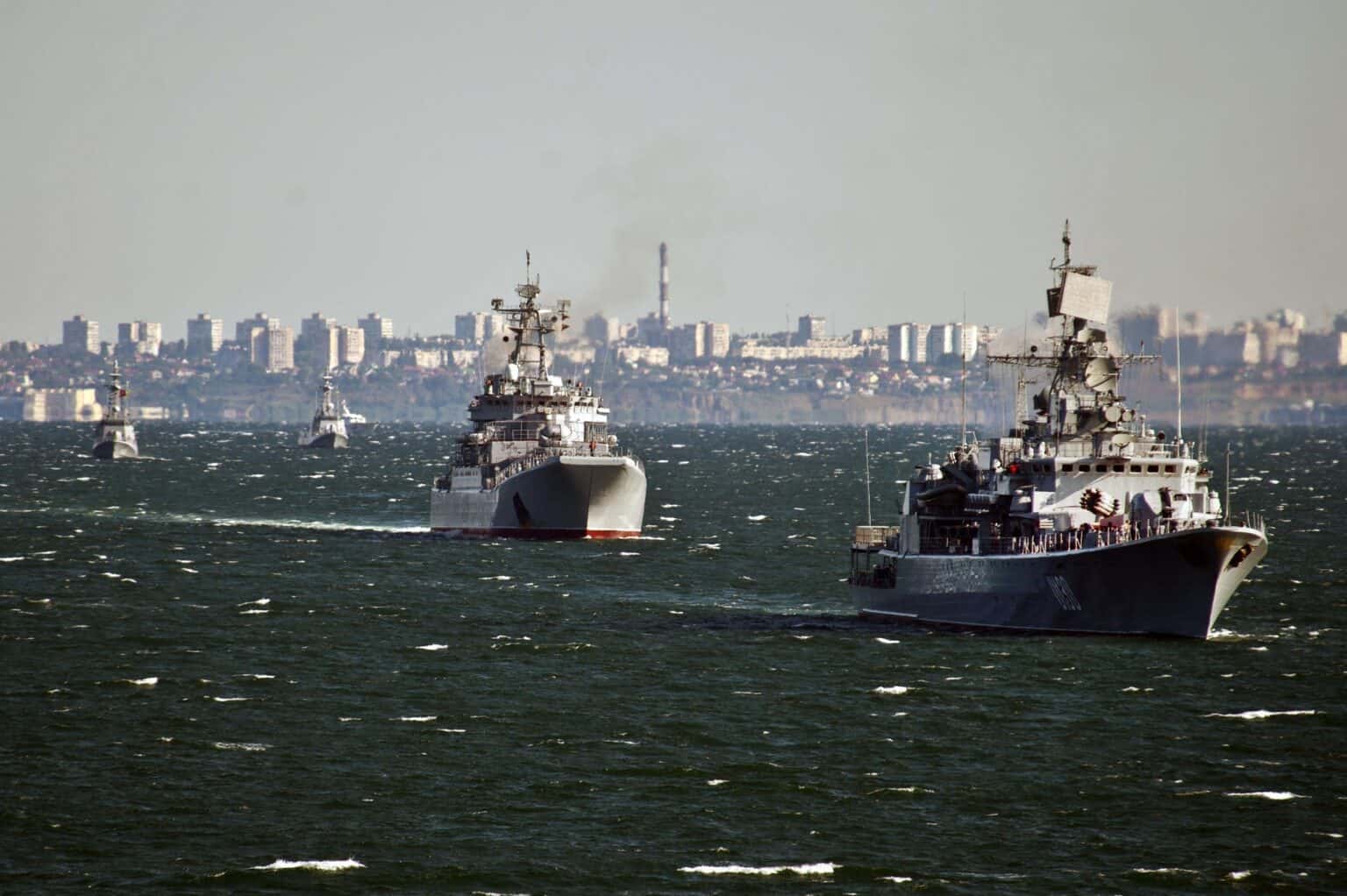
The Ukrainian Navy has no frigates, no corvettes and no submarines in service in November 2026. Its sharpest weapons are sea drones and the Neptune anti-ship missile, which Ukraine says sank the Russian cruiser Moskva in April 2022.
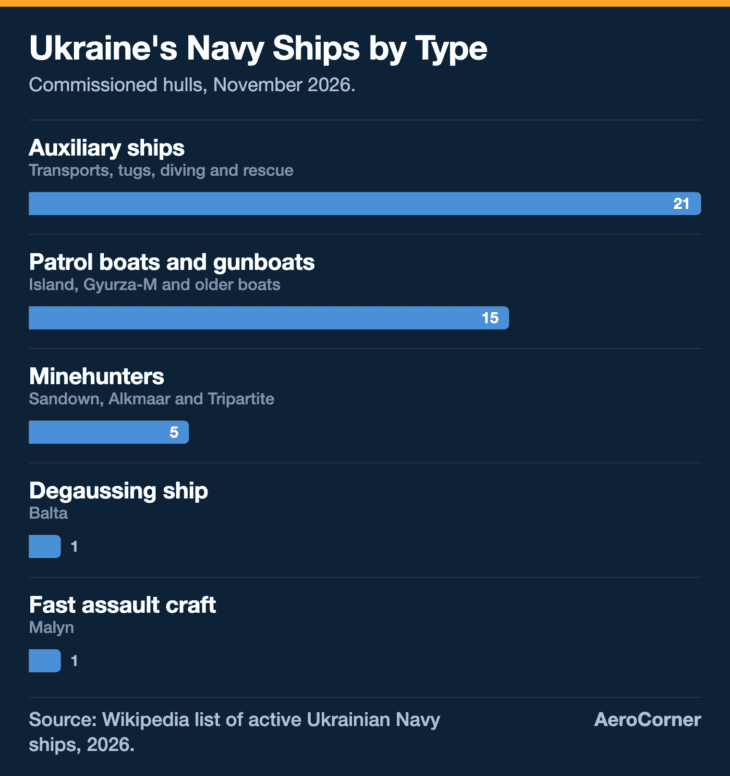
Its most capable commissioned warships are five Western minehunters, two of which are still based in Britain. The rest of the fleet includes 15 patrol boats and gunboats, 21 auxiliaries and more than 100 small combat boats, with two Turkish-built corvettes still waiting to come home.
This guide ranks every class the Ukrainian Navy operates by fighting value as of November 2026, with hull counts, what each one has actually done in the war, and the ships still on order.
| Rank | Class | Type | In service | Status, November 2026 |
|---|---|---|---|---|
| 1 | Sargan-3000 and other sea drones | Unmanned surface vessel | Not published | Sank FSB patrol ship Izumrud, July 2026 |
| 2 | Neptune and Harpoon batteries | Coastal anti-ship missiles | Not published | Neptune in service since 2021 |
| 3 | Alkmaar and Tripartite | Minehunter | 3 | Henichesk joined June 2026 |
| 4 | Sandown | Minehunter | 2 | Based in the UK |
| 5 | Island | Patrol boat (ex-US Coast Guard) | 3 | Active |
| 6 | Gyurza-M | Armored gunboat | 2 | Both captured in 2018, returned 2019 |
| 7 | Older and ex-Estonian boats | Patrol boat, gunboat | 10 | Some status unknown |
| 8 | CB90, Dauntless, Metal Shark and RIBs | Small combat craft (not commissioned) | 100+ | Active |
| 9 | Balta and Malyn | Degaussing ship, assault craft | 2 | Active |
| 10 | 10th Naval Aviation Brigade | Helicopters, transports, drones | 2 Sea Kings, 2 An-26s, plus Mi-8s and TB2s | Active |
How this ranking works
Classes are ranked by fighting value in November 2026: what each one has done in the war and how much it changes what Ukraine can do at sea. A drone that sinks a warship ranks above a dozen patrol boats. Hull counts come from open-source lists checked against 2025 and 2026 transfer reports. Auxiliaries such as tugs, transports and diving boats are counted in the chart but left out of the ranking, and the corvettes still in Turkey are covered separately because they are not in service.
1. Sea Drones: The Weapon That Replaced a Fleet
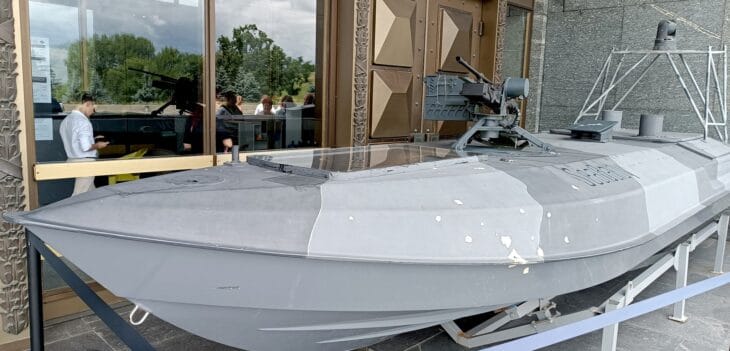

Ukraine’s most effective naval weapon is a boat with nobody on board. Uncrewed surface vessels, fast explosive-laden drone boats, have hit Russian warships at anchor, at sea and inside their own harbors.
The Navy’s own drone is the Sargan-3000. On July 14, 2026, the Navy said one sank the Izumrud, a Russian FSB border patrol ship, near Novorossiysk, and released satellite imagery of the wreck alongside a quay. The Navy said the Izumrud took part in the 2018 Kerch Strait attack on Ukrainian boats.
The best-known drones belong to other agencies, though. The Magura V5 is flown by the military intelligence agency HUR, whose Group 13 claimed in August 2024 to have struck 18 Russian vessels, nine of them beyond repair, including the corvette Ivanovets, the landing ship Caesar Kunikov and the patrol ship Sergey Kotov. The Sea Baby belongs to the SBU security service.
Group 13 gives the Magura a range of more than 500 miles (800 km), a speed of about 50 mph (80 km/h) and a 550-pound (250 kg) warhead. For the airborne side of the same drone war, see our ranking of the best military drones in the world.
2. Neptune and Harpoon: The Missiles That Sank the Moskva
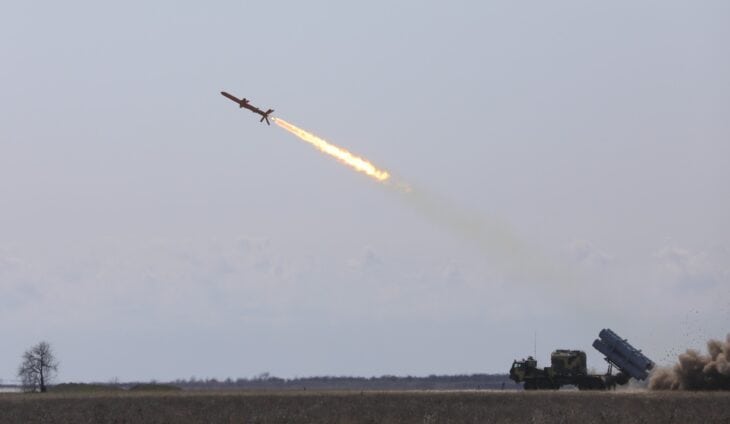

The R-360 Neptune is a subsonic anti-ship missile developed by the Luch Design Bureau in Kyiv. The first training battalion was handed to the Navy in March 2021, less than a year before the full-scale invasion.
It flies more than 174 miles (280 km) with a warhead of about 330 pounds (150 kg). A longer-range version, the Long Neptune, carries a 570-pound (260 kg) warhead to a claimed 620 miles (1,000 km), and President Zelensky said in March 2025 that it had been used.
Two missiles, one flagship
On April 13, 2022, Ukraine and the US say two Neptune missiles hit the cruiser Moskva, flagship of Russia’s Black Sea Fleet, near Snake Island. It sank the next day while under tow. Russia’s Defense Ministry blamed a fire that set off ammunition.
Denmark sent truck-mounted Harpoon launchers in June 2022, with missiles from Britain and the Netherlands, and the US announced two more systems that month. Ukraine does not publish how many coastal batteries it has.
3. Alkmaar and Tripartite Class: The Minehunters From the Low Countries
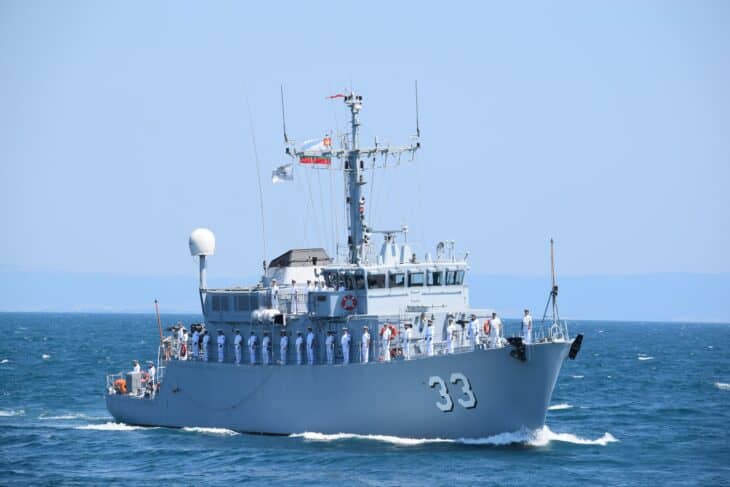

Mines will be the Black Sea’s problem long after the shooting stops, which is why Ukraine’s newest warships are minehunters. Three are Tripartite designs, known in Dutch service as the Alkmaar class, built for Belgium, France and the Netherlands.
Melitopol, the former Dutch Vlaardingen, and Mariupol, the former Belgian Narcis, were handed over together at the Belgian naval base in Zeebrugge in June 2025. Henichesk, the former Dutch Makkum, followed on June 15, 2026, named after a Ukrainian minesweeper lost in 2022.
According to Ukraine’s Ministry of Defense, each is 169 feet (51.5 m) long, displaces 543 tonnes, makes up to 13 knots and carries a crew of 28 to 38. Commander of the Navy Vice Admiral Oleksiy Neizhpapa said Henichesk would add to Ukraine’s ability to find and neutralize mines.
4. Sandown Class: Two Minehunters That Have Never Sailed Home
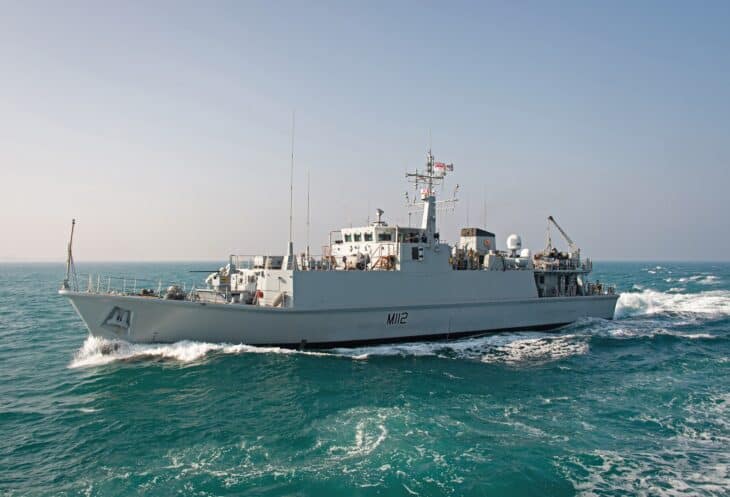

Britain agreed in June 2021 to give Ukraine two Sandown-class minehunters, and both were commissioned into the Ukrainian Navy in July 2023. Chernihiv is the former HMS Grimsby, and Cherkasy is the former HMS Shoreham.
Each fiberglass hull is 172 feet (52.5 m) long, displaces about 600 tonnes and makes 13 knots. Neither has reached Ukraine: Wikipedia’s active ship list records them as based in the UK under a Babcock maintenance contract, because of the Montreux Convention, the treaty that governs warship passage through the Turkish straits.
5. Island Class: The Ex-US Coast Guard Cutters
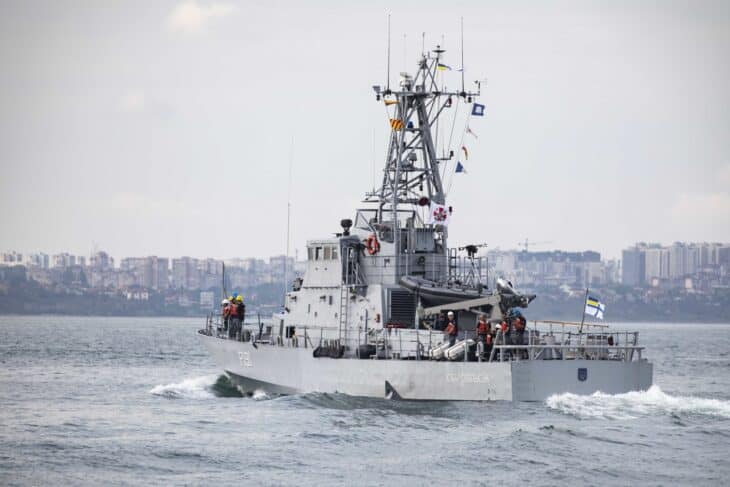

Ukraine received five former US Coast Guard Island-class cutters. Each is 110 feet (34 m) long, about 163 tons fully loaded and capable of nearly 30 knots.
Sloviansk, the former Cushing, was sunk by Russian aircraft on March 3, 2022. Three remain in service, Starobilsk, Sumy and Fastiv, and Wikipedia’s list notes that one unnamed Island-class boat was damaged by a Lancet drone in March 2024. A fifth boat, Viacheslav Kubrak, is still waiting in the US.
6. Gyurza-M Class: The Gunboats Russia Captured and Gave Back
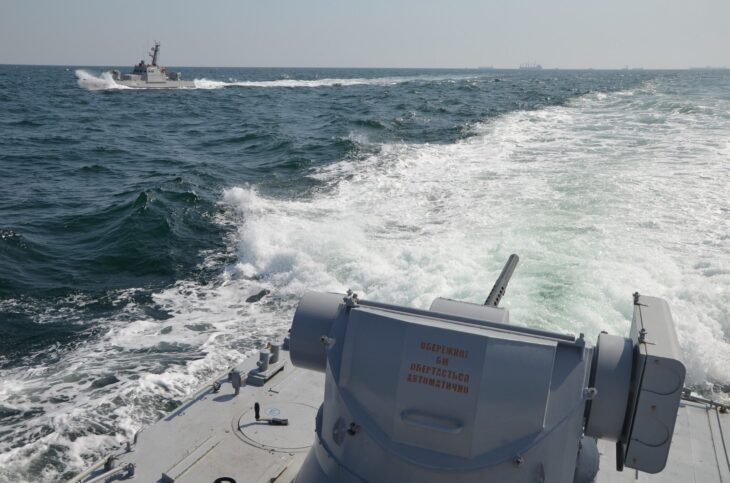

The Gyurza-M is a small Ukrainian-built armored gunboat, 75 feet (23 m) long, 54 tons and good for 25 knots, with two remote weapon stations and a crew of five. Eight were completed.
Two, Berdyansk and Nikopol, were seized by Russia in the Kerch Strait on November 25, 2018, and returned in November 2019. Russia captured four more in 2022 at Berdiansk and Mariupol, and Nikopol was hit by a Lancet drone that November before returning to service in June 2023.
7. The Older and Ex-Estonian Patrol Boats
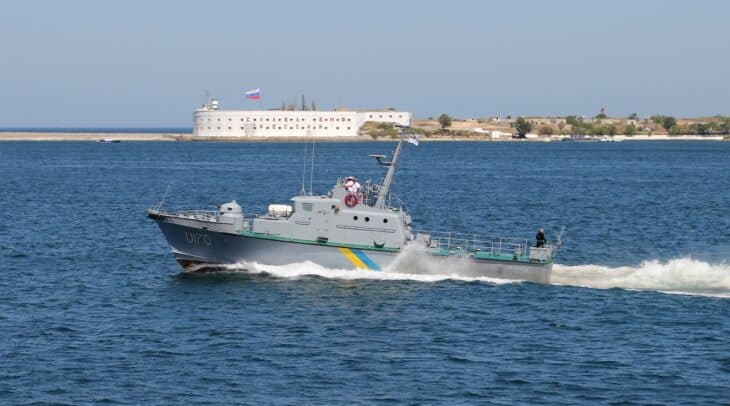

Ten more commissioned patrol boats and gunboats make up the rest of the patrol force. They include the Soviet-era Pryluky, a Matka-class boat whose anti-ship missile launchers have been removed, three PO-2 gunboats from the 1970s, the artillery boat Kostopil and the harbor patrol boat Hola Prystan.
Newer arrivals Bucha, Irpin and Reni joined from 2023, Irpin and Reni from Estonia. Wikipedia’s list marks the status of several of these boats as unknown, a reminder that not every loss is announced.
8. CB90, Dauntless and Metal Shark: The Mosquito Fleet
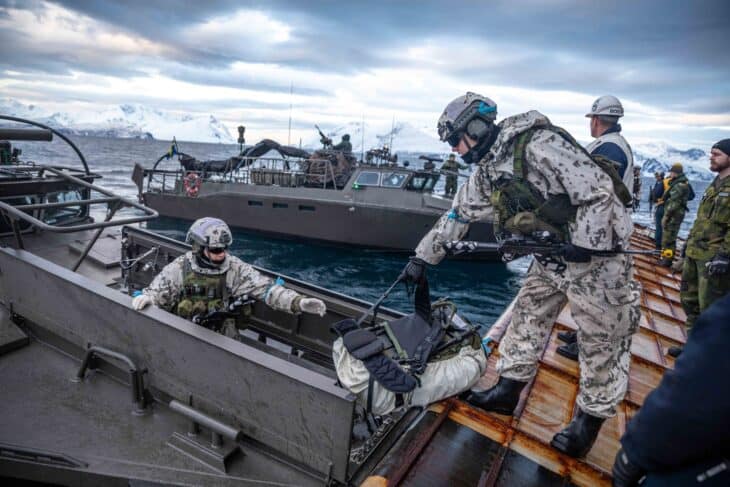

Below the commissioned list sits a far bigger force of uncommissioned small craft. The active ship list counts three Swedish CB90 assault boats, ten Sea Ark Dauntless and ten Metal Shark patrol boats, six 40 PB boats, three Finnish Uisko landing craft and 74 Wing rigid inflatable boats, among others.
This is the “mosquito fleet” Ukraine’s naval strategy now favors: many fast, cheap boats and unmanned systems instead of a few big hulls. It is also why GlobalFirepower’s 2026 index counts 169 Ukrainian naval assets while the commissioned list holds 43.
Two more US patrol boats, the Mark VI class, are under construction, and up to 16 may eventually be acquired.
9. Balta and Malyn: The Degaussing Ship and the Assault Craft
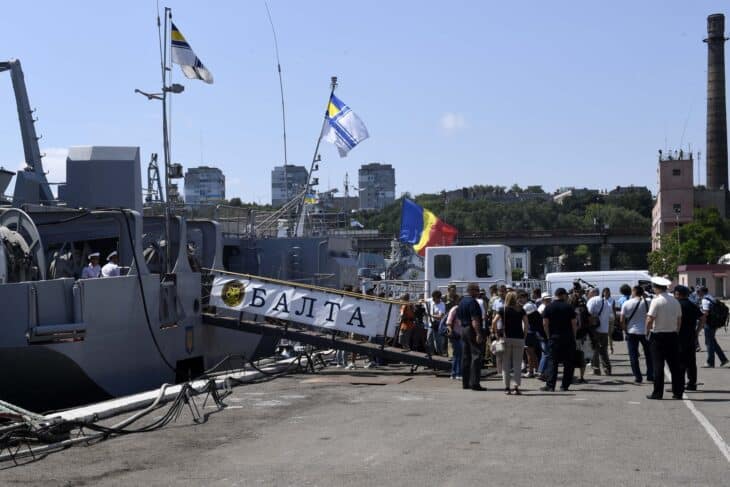

Balta is a Soviet Bereza-class degaussing ship from 1987, which demagnetizes other ships’ hulls so they are less likely to set off magnetic mines. At 2,096 tonnes it is the heaviest ship on the combat list, and it came back from Crimea in 2014.
Malyn is a 47-tonne Kentavr-class fast assault craft based at Ochakiv. It failed its state tests in February 2022 and was pressed into emergency service two months later.
10. The 10th Naval Aviation Brigade
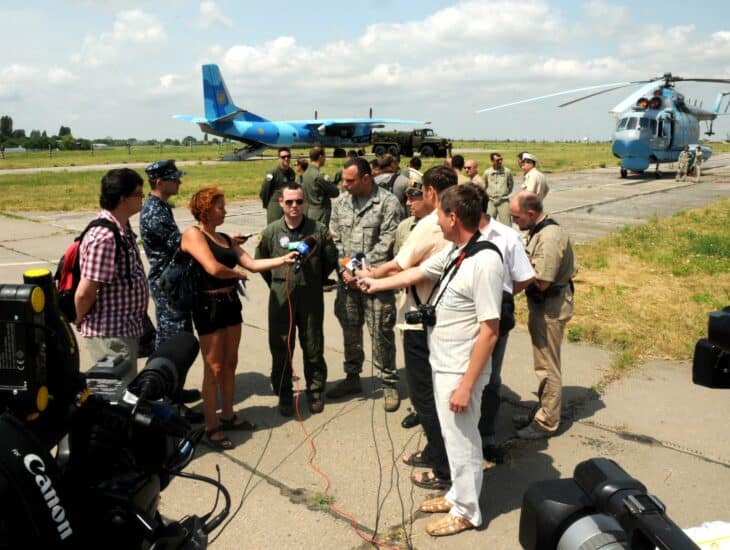

The Navy’s aircraft fly from Kulbakino, near Mykolaiv. Wikipedia’s 2026 inventory lists two ex-Royal Navy Westland Sea King helicopters, two Antonov An-26 transports, an unpublished number of Mi-8 helicopters and Bayraktar TB2 drones, the first of which arrived in 2021.
The Soviet-era Ka-27 anti-submarine helicopters are listed as former types. With the frigate Hetman Sahaidachny gone, no Ukrainian warship can operate a helicopter, which leaves the brigade flying from shore. Ukraine’s land-based fighters are covered in our guide to the Ukrainian Air Force.
Does Ukraine even have a navy?
It is a fair question. GlobalFirepower’s 2026 index gives Ukraine zero frigates, corvettes, destroyers and submarines. But a navy is measured by what it can do, not only by its hull list. Ukraine’s Defense Ministry says roughly 30% of Russia’s Black Sea Fleet had been destroyed or seriously damaged by early 2026, an estimate that has not been independently verified, and much of it was done by missiles and drones rather than ships.
How Ukraine Lost Its Navy Twice
Ukraine’s modern navy dates from 1992, after the breakup of the Soviet Union. Most of it was lost in March 2014, when Russia seized at least 12 of the 17 Ukrainian ships at Sevastopol and Ukraine lost all its missile boats. The headquarters moved to Odesa.
The second loss came in 2022. The frigate Hetman Sahaidachny, the flagship, was scuttled at Mykolaiv in late February or early March so Russia could not take it, and several boats were captured at Berdiansk and Mariupol. Compare that with the Russian Navy it is fighting, which still sails cruisers, frigates and submarines.
Coming Next: Two Ada-Class Corvettes Still in Turkey
Ukraine signed for two Ada-class corvettes in December 2020, the same Turkish design described in our guide to the Turkish Navy. Hetman Ivan Mazepa was launched in Istanbul on October 2, 2022, began sea trials in May 2024 and test-fired its guns that November.
It is 327 feet (99.56 m) long, displaces 2,300 tonnes and reaches 29 knots, armed with a 76 mm gun, eight Harpoon anti-ship missiles, eight VL MICA air defense missiles and torpedoes. Its sister, Hetman Ivan Vyhovskyi, was launched on August 1, 2024, and builder STM schedules its handover for 2027.
Neither ship has been reported commissioned as of mid-November 2026. When Mazepa arrives it will be the first major warship Ukraine has had since 2022, and it is slated to become the flagship. For how that compares with the world’s big fleets, see the largest navies in the world.
FAQ
Sources and references used for research and fact-checking.
- Wikipedia, List of active Ukrainian Navy ships
- Wikipedia, Ukrainian Navy
- GlobalFirepower, Ukraine Military Strength 2026
- Ukrainska Pravda, Ukraine receives another mine-hunting vessel from the Netherlands
- Ukrainska Pravda, Ukrainian drone sinks Russian border patrol vessel near Novorossiysk
- UNITED24 Media, From Moskva to Novorossiysk: How Ukraine Humiliated Russia's Fleet in Its Own Waters
- The Kyiv Independent, Ukraine's Magura naval drones
- Wikipedia, R-360 Neptune
- Militarnyi, Turkey to complete construction of Hetman Ivan Vyhovskyi corvette for Ukrainian Navy
- Wikipedia, Ukrainian corvette Hetman Ivan Mazepa
- Wikipedia, Sandown-class minehunter
- Wikipedia, Island-class patrol boat
- UNITED24 Media, Belgium and Netherlands transfer first minehunters to Ukraine's Navy
- Wikipedia, Gyurza-M-class gunboat
Get the Newsletter
The latest aviation news and stories sent to your inbox.
About the Author

Tim is the owner and lead editor of AeroCorner since 2019, overseeing aviation content covering aircraft, airlines, airports, and the broader aviation industry. Through years of researching, writing, editing, and publishing aviation-focused content, he has developed extensive practical knowledge of commercial aviation and air travel. Based in Asia and a frequent traveler himself, Tim also brings firsthand passenger experience to AeroCorner’s coverage. Outside of publishing, he has also explored aviation firsthand through hands-on flight training in New Zealand.