

Table of Contents
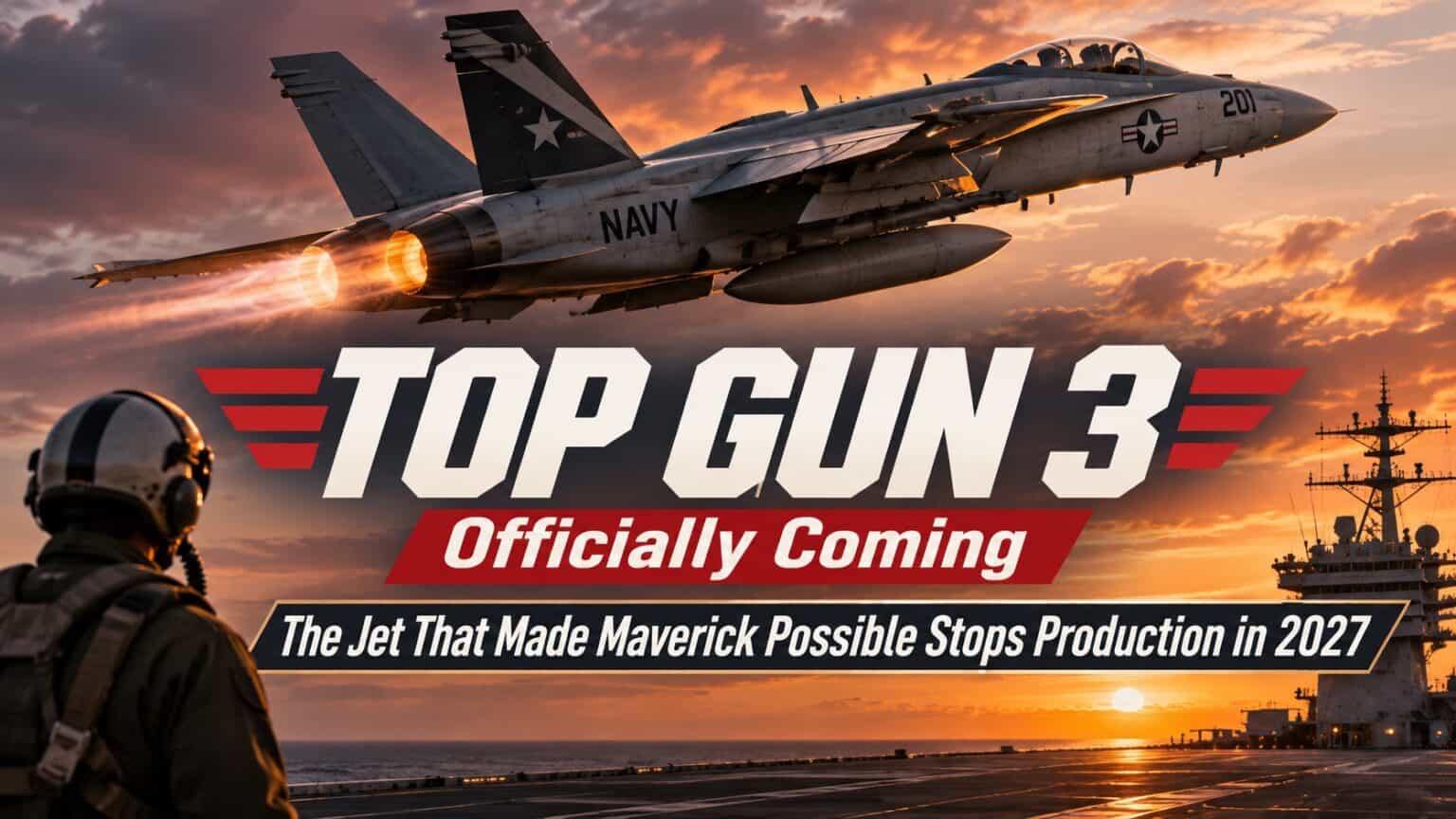
On April 16, 2026, Paramount told a Las Vegas ballroom full of theater owners that Maverick is coming back. Top Gun 3 is real, Tom Cruise is attached, and almost nothing else about it has been announced.
For aviation fans, the cast is the less interesting unknown. Top Gun: Maverick earned about $1.5 billion because the flying was real, and the next film has to solve the same problem with a different Navy.
Here is what has actually been confirmed, and what the real aircraft situation means for what Top Gun 3 can put on screen.
What Do We Know About Top Gun 3 So Far?
Paramount confirmed the film at CinemaCon on April 16, 2026. Jerry Bruckheimer is producing again, and Ehren Kruger, one of the writers of Top Gun: Maverick, is returning to write it, according to the Motion Picture Association’s report from the event.
That is the official list. No director, no release date, no plot and no cast beyond Cruise had been announced as of mid-November 2026.
Top Gun 3 at a glance (November 2026)
Confirmed: Tom Cruise returns as Maverick, Jerry Bruckheimer produces, Ehren Kruger writes. Not announced: director, release date, plot, the rest of the cast, and which aircraft the film will use. Status: early development.
The story itself has been settled for a while. In May 2025, Christopher McQuarrie, who co-wrote Maverick, said the story for a third film was “already in the bag” after Kruger pitched an idea.
The latest word came from Miles Teller on Jimmy Kimmel Live in early November 2026. He said “everybody’s really excited” but confirmed nothing about his own role, and he named Cruise’s next project as a return to Days of Thunder, which puts Top Gun 3 behind it in the queue.
Joseph Kosinski, who directed Maverick, has not been named. Reports about whether he will return have conflicted since 2025, so treat any director name you see as unconfirmed until Paramount says it.
May 1986
Top Gun opens. Navy F-14A Tomcats from Carrier Air Wing Fifteen fly the real aerial footage.
Sept. 2006
The Navy retires the F-14. The ceremony is held at NAS Oceana on Sept. 22.
May 2022
Top Gun: Maverick opens. Navy F/A-18E/F Super Hornets carry the flying, and the film grosses about $1.5 billion.
May 2025
Christopher McQuarrie says the story is set. He calls the third film “already in the bag.”
April 16, 2026
Paramount confirms Top Gun 3 at CinemaCon. Cruise returns, Bruckheimer produces, Kruger writes.
April 28, 2026
The Senate passes the Maverick Act. It would let one of the last three U.S. F-14Ds be made flyable.
Sept. 29, 2026
Boeing wins F/A-XX. The Navy picks the sixth-generation fighter that will replace the Super Hornet.
2027
Super Hornet production is due to end. A final batch of 17 Navy jets extended the line from 2025.
Why the Aircraft Matter More Than the Cast
Both Top Gun films were built on borrowed Navy jets. In 1986 Paramount paid as much as $7,800 an hour to fly F-14A Tomcats, with Northrop F-5s painted up as the fictional “MiG-28.”
For Maverick, the producers paid the Navy $11,374 per flight hour for F/A-18E/F Super Hornets and the pilots who flew them. Single-seat E models filmed the exterior shots, and two-seat F models carried the actors.
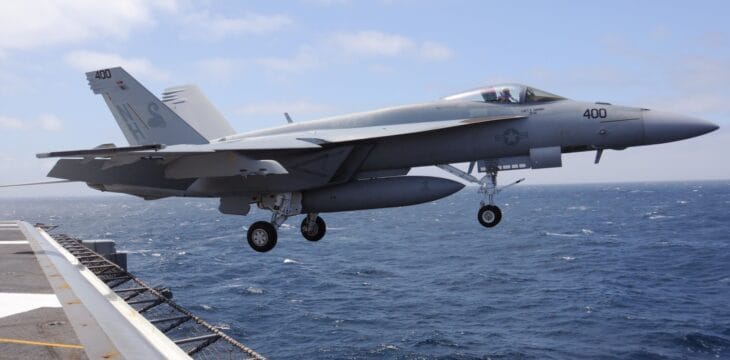

Each cockpit held six IMAX-certified Sony Venice cameras, four pointed at the actor and two looking out. The crew shot more than 800 hours of aerial footage, and NAVAIR engineers tested the camera mounts so they would survive g-loads and carrier landings and stay safe in an ejection.
| Role on screen | Top Gun (1986) | Top Gun: Maverick (2022) |
|---|---|---|
| Hero jet | F-14A Tomcat (real, flying) | F/A-18E/F Super Hornet (real, flying) |
| Enemy jet | Northrop F-5 as the fictional “MiG-28” (real, flying) | Su-57-style fighter (CGI) |
| The Tomcat | Front-line Navy fighter | Engineless F-14A from a museum, plus CGI in flight |
| Experimental jet | None | Darkstar (full-scale mockup and CGI) |
| Vintage aircraft | None | P-51 Mustang, flown by Cruise |
| Navy rate per flight hour | Up to $7,800 | $11,374 |
The table shows the pattern. Whatever the Navy is flying at the time becomes the hero jet, and anything the Navy cannot lend is faked with a mockup or a computer.
The Two-Seat Problem: Why the F-35 Is Not the Obvious Star
When Maverick started filming in 2018, many fans expected Cruise to fly the F-35C. Navy Times noted that the jet in his first-day photo looked like an F/A-18F Super Hornet “rather than the newer F-35C that many predicted would star in the film.”
The reason is simple. Every version of the F-35 Lightning II is a single-seat jet, so there is no back seat for an actor and no way to film a real face under real g-forces.
That still holds for Top Gun 3. The F-35C has been in Navy service since February 2019 and is now a normal sight on carrier decks, but a film that wants real flying with real actors still needs a two-seat jet with a Navy pilot up front.
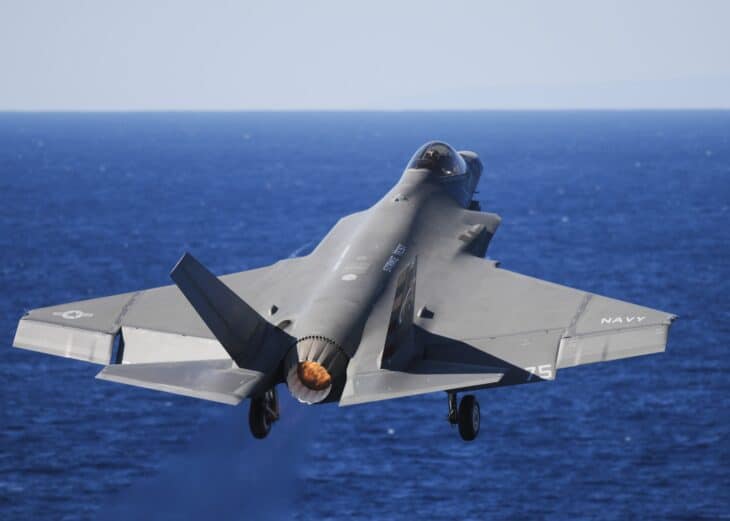

F-35s can still appear. They can fly exterior shots the way single-seat Super Hornets did in Maverick. They just cannot carry a cast member.
The Super Hornet Line Closes, but the Jet Stays
Boeing planned to stop building Super Hornets in 2025. An order for 17 more Navy jets pushed the end of production to 2027.
The end of production is not the end of the airplane. The Navy plans to replace the Super Hornet with the F/A-XX starting in the 2030s, so the two-seat F model that carried Maverick’s cast will still be flying from carriers for any shooting schedule Top Gun 3 is likely to have.
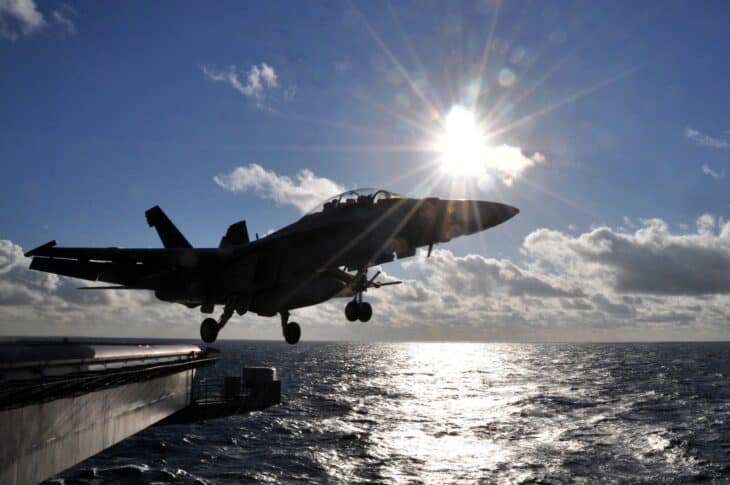

The replacement was picked this fall
On Sept. 29, 2026, the Navy selected Boeing to design, build and deliver the F/A-XX, its sixth-generation carrier fighter. Boeing says the program’s technical details remain classified. It is Boeing’s second sixth-generation fighter win, after the Air Force’s F-47 in 2025.
That raises the question every fan will ask: could Maverick fly the F/A-XX? Not a real one. Boeing has not shown what it looks like, and the Navy is not going to put a classified prototype in a movie. The full story of the award is in our piece on how Boeing won both of America’s next fighters.
Maverick already showed how the franchise handles a secret airplane. Darkstar, the hypersonic jet in the opening scene, was designed with engineers from Lockheed Martin’s Skunk Works and built as a full-scale mockup, which the crew filmed at China Lake.
Lockheed denied any link to its SR-72 concept. A sixth-generation “Navy fighter of the future” built the same way, as a mockup with CGI in flight, is the precedent, though nothing about Top Gun 3’s aircraft has been announced.
Could a Real F-14 Fly in Top Gun 3?
It is the one aircraft question with a live answer in Congress. The Navy retired the F-14 Tomcat on Sept. 22, 2006, and in 2007 announced it would shred the retired jets so Iran, the only foreign operator, could not get parts.
The Maverick Act (S. 4161) would hand the last three surplus F-14Ds to the U.S. Space and Rocket Center in Huntsville, Alabama. It lets the Navy supply spare parts from existing stock so that one of the three can be made flyable or prepared for static display, for airshows and commemorative events.
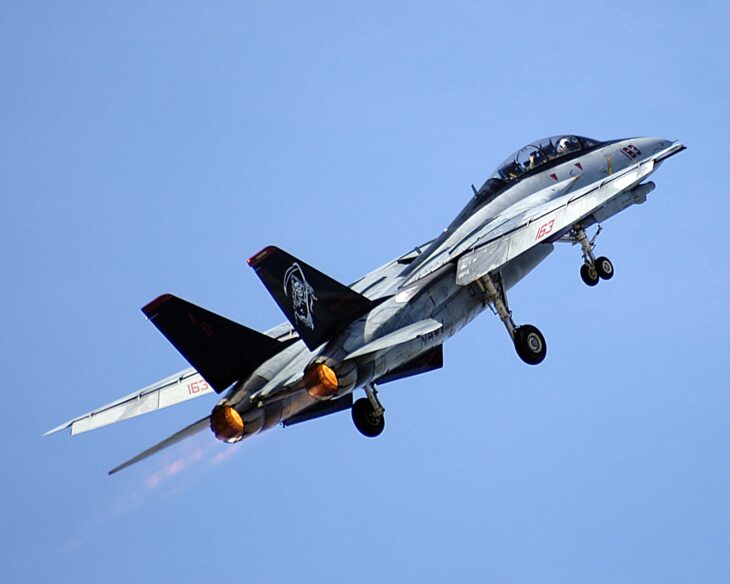

The Senate passed it by unanimous consent on April 28, 2026. The House version, H.R. 8331, was referred to the House Armed Services Committee, and the newest reporting found for this article shows no House vote and no signature, so it is not law.
Myth: Maverick flew a real F-14
It did not. No flying F-14 was available in the United States, and Iran’s fleet was off-limits under sanctions. The production used one engineless F-14A from the San Diego Air & Space Museum on the ground, and every Tomcat shot in the air was CGI.
So the honest answer is maybe, a long way off. A single restored Tomcat flying airshows would be the first F-14 in U.S. skies since 2006, but the bill has to pass the House first, and a restoration of that scale is measured in years.
What Cruise Can and Cannot Fly
The most repeated Top Gun myth is that Cruise flew the Super Hornet. He did not. “The Navy wouldn’t let [Tom] fly an F-18,” Bruckheimer told Empire in 2020, as reported by Task & Purpose.
Navy pilots flew every Super Hornet shot, with the actors in the back seat. What Cruise did fly, Bruckheimer said, was a P-51 Mustang in the movie, plus helicopters.
That split will almost certainly carry over. Cruise is a civilian pilot who owns his own aircraft, which we cover in Tom Cruise’s private jets and warbird, but no civilian gets the controls of a Navy fighter for a movie.

When the first Top Gun 3 trailer drops, look at the back seat first. If there is an actor’s face in a real cockpit, it is a two-seat Super Hornet, and the stars of the third film will be the same jets as the second.
Anything newer, a sixth-generation Navy jet or a flying Tomcat, will be a mockup, CGI or a Congressional vote away. For the real front line the next Maverick would join, see the best carrier-based fighter jets in the world.
Sources and references used for research and fact-checking.
- Motion Picture Association, CinemaCon 2026: Top Gun 3 Cleared for Takeoff With Tom Cruise Returning as Maverick
- Collider, Miles Teller Officially Confirms Potential Top Gun 3 Return
- Wikipedia, Top Gun: Maverick
- Wikipedia, Top Gun (film)
- Boeing, U.S. Navy Selects Boeing for F/A-XX Program
- Wikipedia, Boeing F/A-18E/F Super Hornet
- Wikipedia, Lockheed Martin F-35 Lightning II
- Wikipedia, Grumman F-14 Tomcat
- Navy Times, Maverick Act saves last 3 F-14 Tomcats from destruction
- U.S. Congress, S. 4161, Maverick Act (bill text)
- Navy Times, Maverick is back, and flying a Super Hornet?
- Task & Purpose, The Navy refused to let Tom Cruise fly an F/A-18 Super Hornet in Top Gun: Maverick
Get the Newsletter
The latest aviation news and stories sent to your inbox.
About the Author

Tim is the owner and lead editor of AeroCorner since 2019, overseeing aviation content covering aircraft, airlines, airports, and the broader aviation industry. Through years of researching, writing, editing, and publishing aviation-focused content, he has developed extensive practical knowledge of commercial aviation and air travel. Based in Asia and a frequent traveler himself, Tim also brings firsthand passenger experience to AeroCorner’s coverage. Outside of publishing, he has also explored aviation firsthand through hands-on flight training in New Zealand.