

Table of Contents
The best carrier-based fighter jet in the world in 2026 is the Lockheed Martin F-35C Lightning II. It is the only stealth fighter flying from a catapult deck with a combat record, a mature air wing around it, and a published combat radius of more than 600 nautical miles on internal fuel.
That is a different question from which fighter is best overall. A carrier fighter has to survive a catapult shot, come back aboard a moving deck at night, and do it again tomorrow, which rules out most of the aircraft that top a general ranking.
This list ranks the eight fixed-wing fighters actually flying from ships’ decks as of August 2026, measured by combat capability from a deck rather than by raw speed or airframe count.
| Rank | Aircraft | Main operators | Launch method | Combat radius |
|---|---|---|---|---|
| 1 | F-35C Lightning II | US Navy, US Marine Corps | Catapult | 600+ nm (internal fuel) |
| 2 | Dassault Rafale M | France, India from 2029 | Catapult | ~540 nm with drop tanks |
| 3 | F-35B Lightning II | US Marine Corps, UK, Italy, Japan | Ski-jump or flat deck (STOVL) | ~450 nm (internal fuel) |
| 4 | F/A-18E/F Super Hornet | US Navy | Catapult | ~390 nm (strike profile) |
| 5 | Shenyang J-35 | China | Catapult and ski-jump | Not published |
| 6 | Shenyang J-15T | China | Catapult and ski-jump | Not published |
| 7 | MiG-29K / KUB | India | Ski-jump | ~460 nm (internal fuel) |
| 8 | Sukhoi Su-33 | Russia (no deck) | Ski-jump | ~540 nm nominal |
How this ranking works
Four things decide the order: survivability and sensors against a modern air-defence network, unrefuelled combat radius, what the launch method costs in fuel and weapons, and whether the jet has proven it can sustain deck operations day after day. Only fixed-wing fighters that flew from a ship in 2026, or are cleared to, are ranked. Helicopters, trainers, electronic-attack and early-warning aircraft, land-based fighters, and aircraft still in development are excluded.
1. Lockheed Martin F-35C Lightning II
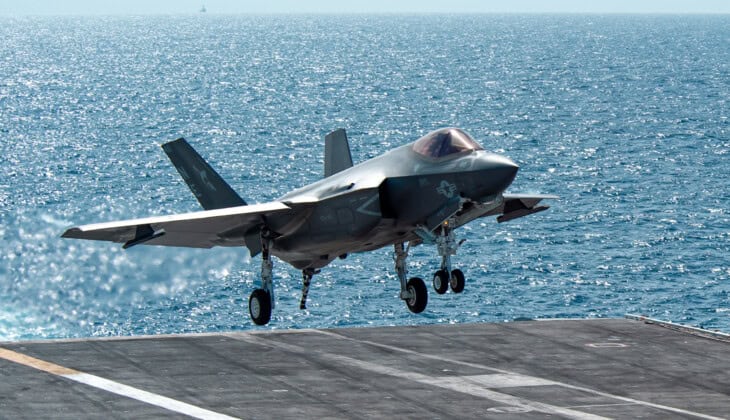
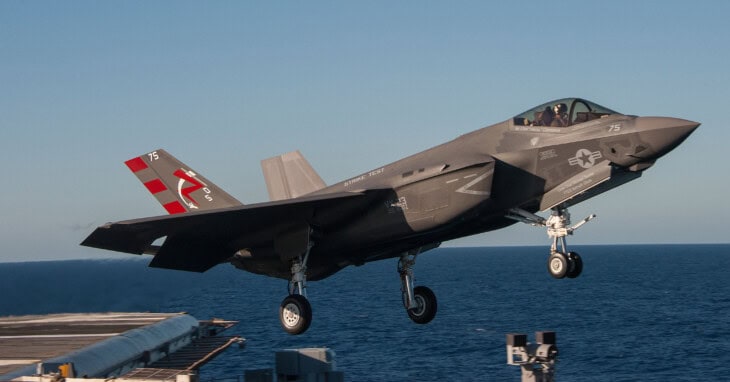
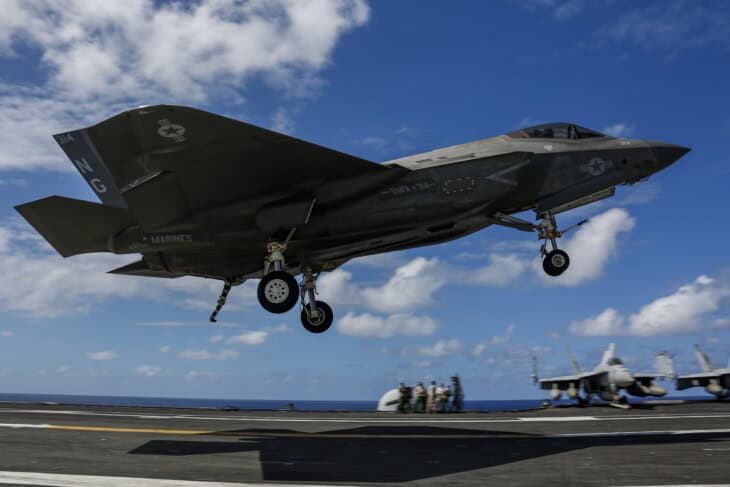
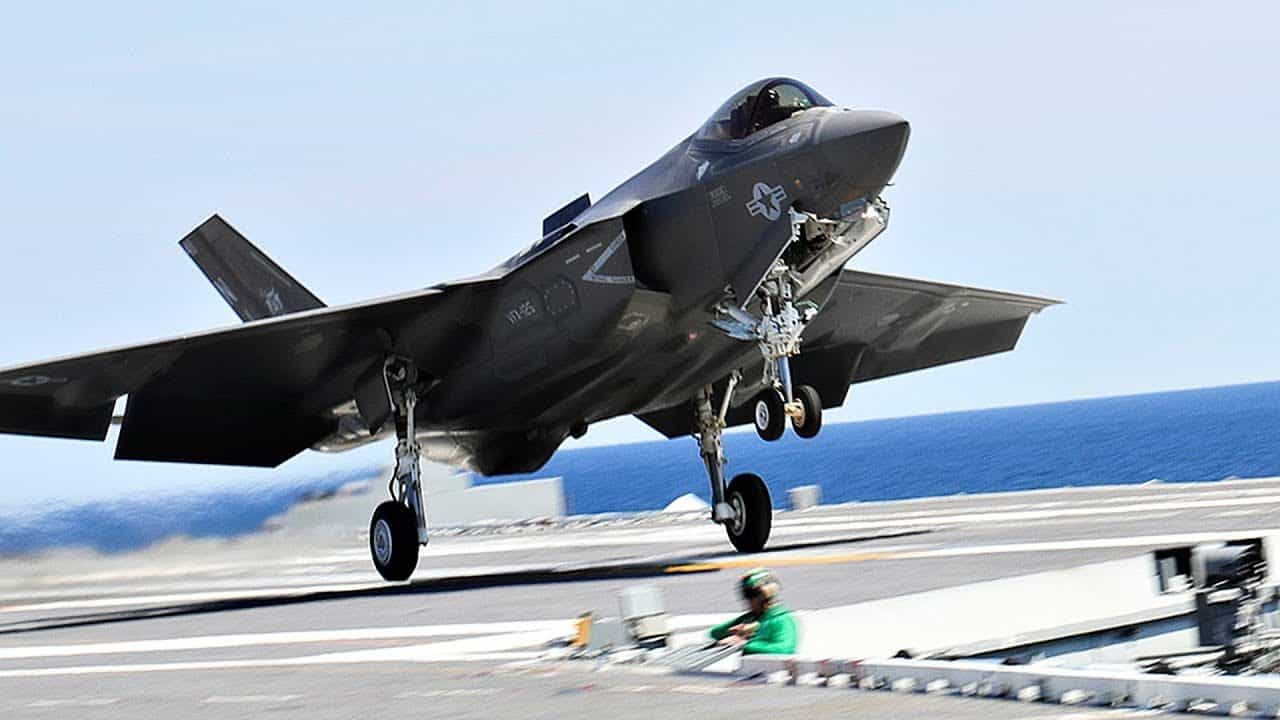
The F-35C is the carrier variant of the F-35, with a 43-foot (13.1 m) wingspan, 668 square feet of wing area, and folding wingtips. That oversized wing is what makes it work at sea: it lowers approach speed, improves low-speed handling behind the ship, and carries the fuel that gives the jet its range.
Lockheed Martin lists a combat radius above 600 nautical miles on internal fuel and a top speed of Mach 1.6. No other carrier fighter combines that reach with a stealth airframe and sensor fusion.
It has also been at sea long enough to count. The type made its first operational deployment on 3 August 2021, when VFA-147 “Argonauts” sailed aboard USS Carl Vinson, and it has since flown combat missions from the Red Sea and the Middle East.
The gap over the Rafale M at number two is survivability. In 2026 the Navy completed the first flight tests of the AGM-158C long-range anti-ship missile on the F-35C, which turns a stealth fighter into a ship-killer that can shoot from outside a defended zone.
America's biggest carrier still cannot launch its best fighter
USS Gerald R. Ford, the largest and newest carrier in the US fleet, has never deployed with an F-35C. It was delivered without the modifications the jet needs, and its 2026 deployment with Carrier Air Wing 8 flew Super Hornets and Growlers only. USS John F. Kennedy, which left Newport News for acceptance trials on 12 August 2026, will be the first carrier handed over ready to operate the F-35C from day one.
2. Dassault Rafale M
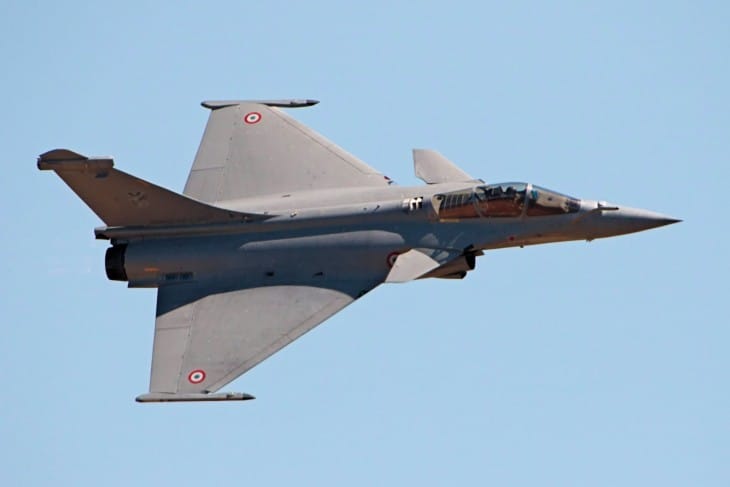
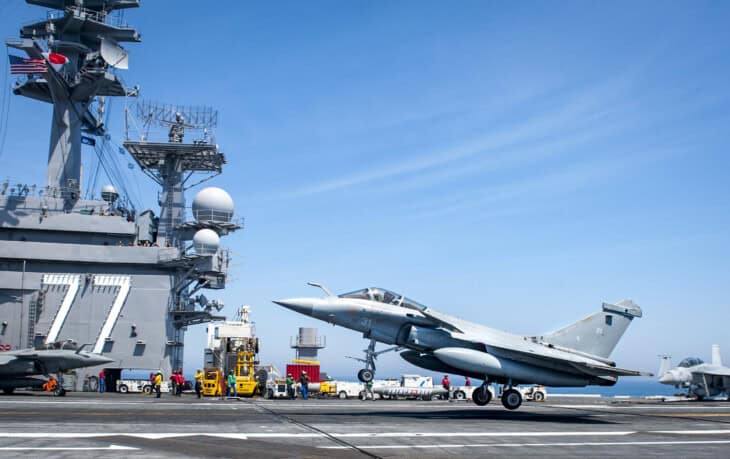
The Rafale M is the most capable non-stealth fighter operating from any deck, and the only carrier fighter in the world that can deliver a nuclear weapon. France flies it from Charles de Gaulle with Flottilles 11F, 12F and 17F, based at Landivisiau.
Two Safran M88-2 engines give it Mach 1.8 and a penetration-mission radius of roughly 540 nautical miles (1,000 km) with drop tanks and a full strike load. In the current F4 standard it carries an AESA radar, the Meteor long-range missile, and networked targeting.
It ranks above the F-35B because a catapult launch lets it leave the deck with everything it can carry, while a short take-off costs the F-35B fuel, weapons, or both. It ranks below the F-35C because it is not stealthy, and against a modern integrated air defence that is the difference that matters.
India signed for 26 Rafale Marine aircraft in April 2025 for around 7.4 billion euros, with deliveries running from 2029 to 2031 and INS Vikrant as the intended home deck. That order came after the jet proved it could get airborne from a ski-jump, not just a catapult.
The only foreign jet cleared to fly off a US carrier
Dassault states plainly that the Rafale M is the only non-US type of fighter cleared to operate from the decks of US carriers. French Rafales qualified aboard American ships in 2007 and 2008 with catapult launches and arrested landings, because both navies use the same CATOBAR system. No Eurofighter, Gripen, or Su-33 can make that claim.
3. Lockheed Martin F-35B Lightning II
.jpg)
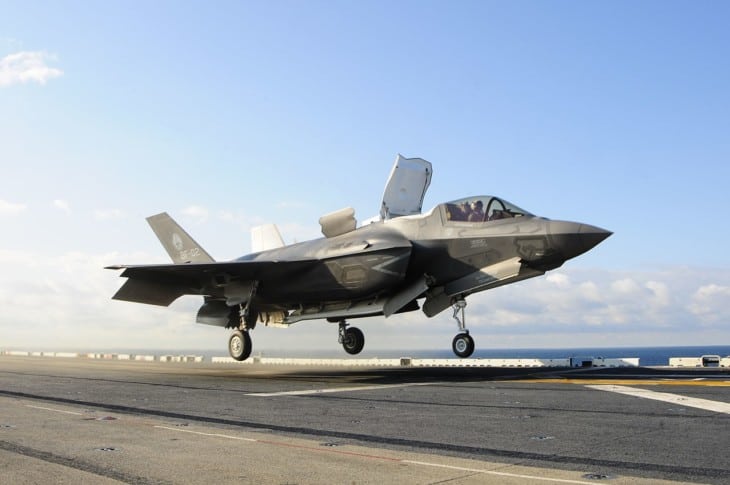
The F-35B is the short take-off and vertical landing variant, and it is the most strategically consequential aircraft on this list. It gave stealth carrier aviation to every navy that owns a flat deck but could never afford catapults.
Britain flies it from the Queen Elizabeth class, which can embark up to 36 in a surge air wing. Italy operates it from Cavour, Japan from the converted Izumo class, and the US Marine Corps from amphibious assault ships as well as full-size carriers.
The price of that flexibility is paid in fuel and weight. The lift fan eats internal volume, and combat radius drops to around 450 nautical miles, roughly a quarter less than the F-35C.
There is a second penalty that rarely gets mentioned: bring-back weight. A vertical landing limits how much unexpended fuel and ordnance the jet can recover with, so a mission that aborts can mean jettisoning expensive weapons into the sea.
4. Boeing F/A-18E/F Super Hornet Block III

The Super Hornet is not the most advanced fighter here, but it is still the one doing most of the work. More than 470 are in US Navy service, and a 2026 Gerald R. Ford deployment was flown almost entirely on Super Hornets.
Block III adds an APG-79 AESA radar, infrared search and track, a large-format cockpit display, networked targeting, and a 10,000-hour airframe life. It is a genuine capability jump, and it is what keeps the type relevant into the 2030s.
Its weakness is reach. Combat radius on a typical strike profile is around 390 nautical miles, the shortest of any modern catapult fighter, which is why carrier air wings burn so many sorties on buddy tanking.
The Navy tried to fix that with conformal fuel tanks and failed. It issued a stop-work order to Boeing on 6 January 2021 after structural and sustainment problems appeared in carrier testing, and no Block III jet has been delivered to the Navy with them.
Production is now ending. Northrop Grumman finished the last structural components in January 2026, and the final 17 aircraft are due to be delivered by spring 2027.
5. Shenyang J-35

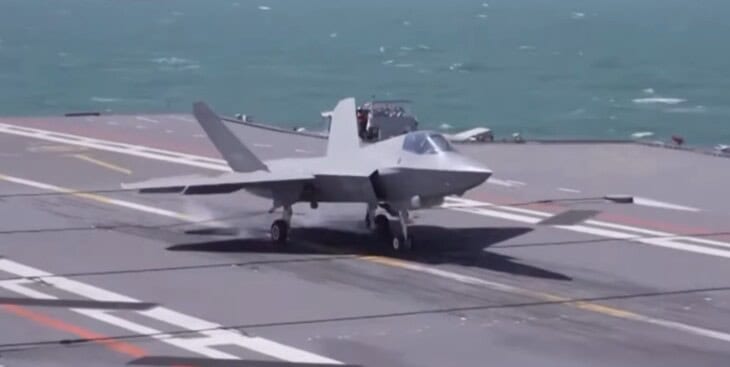
The J-35 is the only stealth carrier fighter in the world outside the F-35 family, and its arrival makes China the second nation able to launch a stealth aircraft from a catapult at sea.
It flies from Fujian, China’s first electromagnetic-catapult carrier, commissioned on 5 November 2025 at Yulin naval base in Hainan. Chinese state media reported the J-35, J-15T and KJ-600 completing catapult launches and arrested landings aboard the ship in September 2025.
Defence reporting through mid-2026 says the type has since operated from the older ski-jump carriers Liaoning and Shandong as well. If accurate, all three Chinese carriers now embark a fifth-generation fighter.
It ranks fifth rather than higher for one honest reason: almost nothing about it is verified. China publishes no combat radius, no radar-cross-section data, and no availability figures, and the jet has never flown a combat mission. Our comparison of the US and Chinese carrier fleets covers the ships behind it.
6. Shenyang J-15T
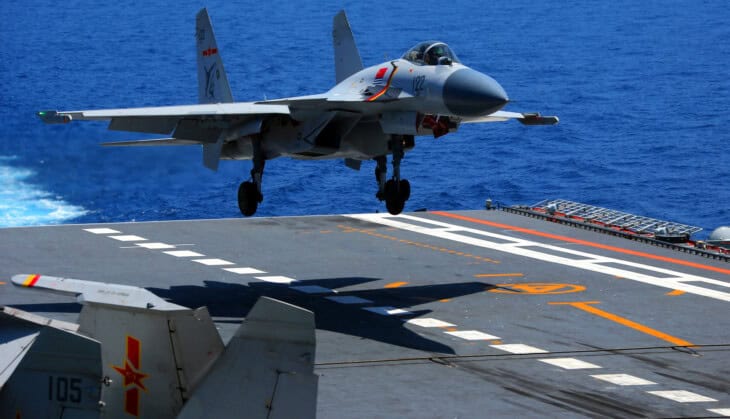
The J-15 is China’s heavyweight carrier fighter, derived from the Su-33 airframe, and the T variant is the version that finally made it a catapult aircraft. It gained a strengthened twin-wheel nose leg with a launch bar, Chinese WS-10 series engines, and a new radome believed to house an AESA radar.
That matters more than it sounds. From a ski-jump, a heavy fighter has to trade fuel or weapons to get airborne, so the catapult effectively unlocks the payload the airframe always had. The Shenyang J-15 page covers the baseline aircraft in detail.
China has also fielded the J-15D, a two-seat electronic-attack variant broadly equivalent to the EA-18G Growler, which has deployed aboard Shandong. Very few navies have carrier-borne electronic warfare at all.
7. Mikoyan MiG-29K / KUB
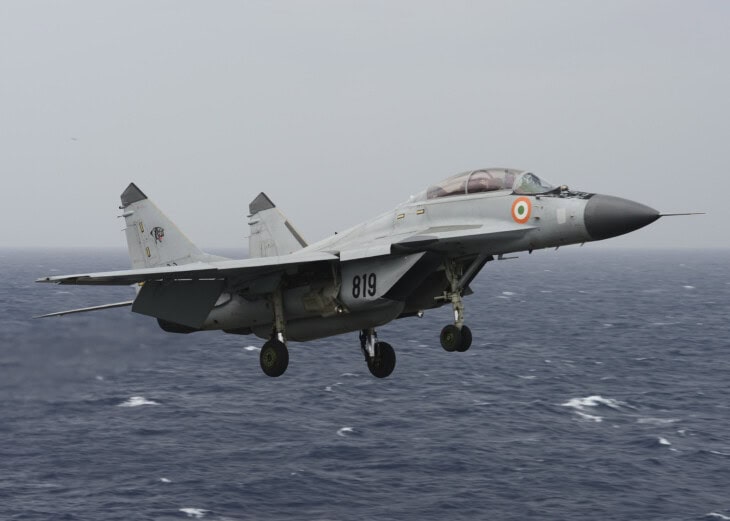
The MiG-29K is a capable aircraft on paper, with a combat radius near 460 nautical miles on internal fuel and a multirole weapons fit. Its problem has never been the design.
India bought 37 MiG-29K and 8 two-seat MiG-29KUB aircraft between 2004 and 2010 for about 2.29 billion dollars, and roughly 40 remain after several losses. Serviceability has been criticised repeatedly by India’s own auditors.
India has now extended the fleet to 2040 as a bridge until the indigenous Twin Engine Deck Based Fighter arrives, which is a decision about having something to fly rather than about the jet being good enough.
8. Sukhoi Su-33
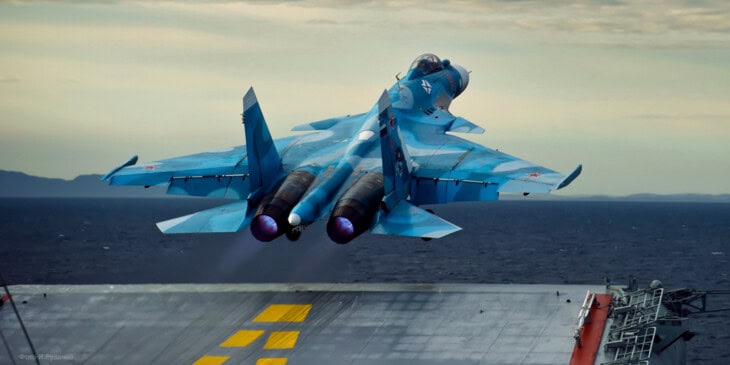
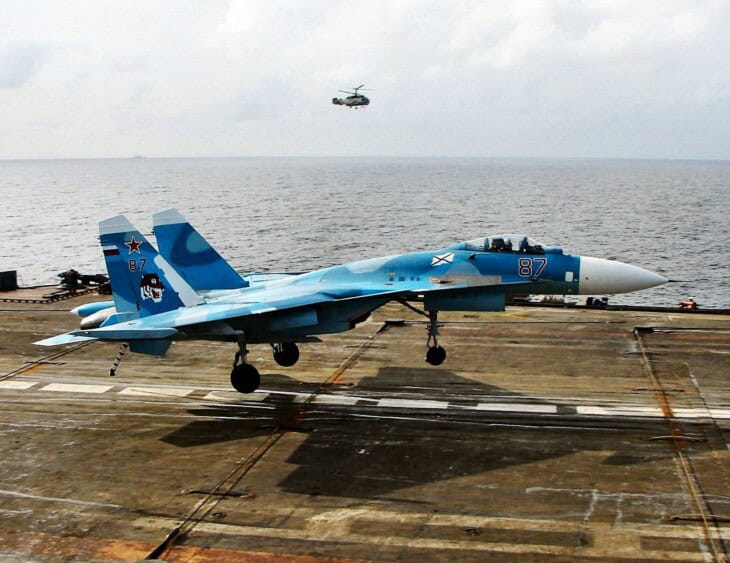
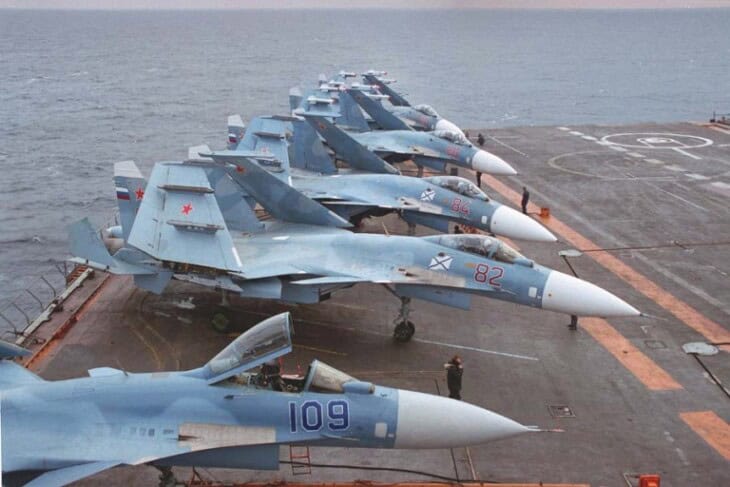
The Su-33 is the largest fighter ever to operate from a carrier deck and, on paper, one of the most impressive. In practice it now has nowhere to land.
Only around 24 were built. Its only ship, Admiral Kuznetsov, has not deployed since the 2016 to 2017 Syria mission and has been stuck in an overhaul plagued by a drydock collapse in 2018 and a major fire in 2019.
In July 2025 the chairman of Russia’s state shipbuilding corporation said the carrier would most likely be sold or scrapped. The Su-33 is ranked last because a carrier fighter without a carrier is a land-based fighter with a heavy tailhook.
The jet that just left the deck: AV-8B Harrier II


.jpg)
The Harrier II was the aircraft that proved a fighter did not need a runway, and it left US service this year. VMA-223 “Bulldogs” flew the final Marine Corps deployment aboard USS Iwo Jima, and the last flight took place at Cherry Point on 3 June 2026.
It is not quite finished. Spain still operates around a dozen AV-8B aircraft from Juan Carlos I and has committed to flying them into the 2030s, which makes it the last navy in the world going to sea with a Harrier.
What replaces them: the next generation of carrier fighters
The US Navy’s F/A-XX is the programme to watch. It is a sixth-generation fighter intended to replace the Super Hornet fleet in the 2030s, with Boeing and Northrop Grumman the finalists after Lockheed Martin was eliminated in early 2025.
The Navy has said it will name the winner and award the engineering and manufacturing development contract in August 2026, backed by roughly 1.69 billion dollars in fiscal 2026 funding.
India’s Twin Engine Deck Based Fighter is targeted at service entry around 2038, and China has been seen flight-testing tailless designs that appear oriented toward carrier use. None of them are ranked here because none of them have flown from a deck.
What about the F-22, the F-15, or the WW2 carrier fighters?
The F-22 Raptor and F-15 Eagle top plenty of fighter rankings and neither can land on a ship. Both lack the reinforced structure, the tailhook, the folding wings, and the low approach speed a deck demands, and no version of either was ever carrier-qualified. Being the best fighter and being the best carrier fighter are different competitions. The Second World War answer is also different: the Grumman F6F Hellcat and Vought F4U Corsair dominated carrier air combat in the Pacific, but they are propeller aircraft and belong to a separate question.
The verdict
Only two navies in the world can launch a stealth fighter from a catapult, and only one of them has done it in combat. That is the real state of carrier aviation in 2026, and it is why the F-35C takes the top spot despite flying from ships that are still being modified to accept it.
The ranking will move. Fujian working up to full capability, the Kennedy arriving F-35C-ready, and the F/A-XX award all land inside the next 18 months. For the wider picture beyond the deck, see our ranking of the best fighter jets in the world.
FAQ
Sources and references used for research and fact-checking.
- Lockheed Martin, F-35C Lightning II product card and variant specifications
- Dassault Aviation, The Rafale in the French Air and Space Force and the French Navy
- USNI News, First F-35C Fighters, CMV-22B Deploy with Carl Vinson Carrier Strike Group
- USNI News, Carrier John F. Kennedy Leaves Newport News for Acceptance Trials
- The War Zone, Navy Halts Plans To Give Its Super Hornets Conformal Fuel Tanks
- FlightGlobal, US Marine Corps to retire AV-8B Harrier II in 2026
Get the Newsletter
The latest aviation news and stories sent to your inbox.
About the Author

Tim is the owner and lead editor of AeroCorner since 2019, overseeing aviation content covering aircraft, airlines, airports, and the broader aviation industry. Through years of researching, writing, editing, and publishing aviation-focused content, he has developed extensive practical knowledge of commercial aviation and air travel. Based in Asia and a frequent traveler himself, Tim also brings firsthand passenger experience to AeroCorner’s coverage. Outside of publishing, he has also explored aviation firsthand through hands-on flight training in New Zealand.