

Table of Contents
The United States wins this comparison in 2026, and not by the margin most articles quote. The usual scoreboard is 11 American carriers against China’s 3, but hull count is the least useful number in the entire matchup.
A carrier is not a ship. It is a machine for putting armed aircraft over a target and getting them back, so this comparison ranks the two fleets on what that machine actually produces: launch and recovery technology, air wing composition, sortie generation rate, and how many hulls are genuinely available on a given morning.
On that measure the American lead is far wider than 11 to 3 suggests. On one of the four, availability, it is far narrower.
| Measure | United States | China |
|---|---|---|
| Carriers in commission | 11 | 3 |
| Nuclear powered | 11 | 0 |
| Catapult carriers | 11 (44 catapults) | 1 (3 catapults) |
| Combined full-load displacement | ~1,100,000 tons | ~211,000 tons |
| Embarked aircraft per carrier | 65 to 75 | 40 to 50 |
| Carrier air wings | 9 | Approximately 3 |
| Fixed-wing AEW aircraft | E-2D, every carrier | KJ-600, Fujian only |
| Carrier-based tanker | MQ-25 entering service | None |
| Typically deployed at once | 3 to 4 | 1 to 2 |
| Carriers in combat since 1945 | Continuous | None |
How this comparison works
Carriers are ranked on four things, in order: launch and recovery technology, which decides how heavy an aircraft can leave the deck; air wing composition, which decides what those aircraft can do; sortie generation rate, which decides how often; and availability, which decides whether the ship is there at all. Displacement and hull count are inputs to those four, not measures in themselves. Amphibious assault ships that operate F-35Bs, such as the US America class and China’s Type 076 Sichuan, are excluded: they are useful, but they are not fleet carriers and counting them muddies every comparison they appear in.
Every carrier in both fleets
Fourteen hulls are in commission between the two navies as of August 2026. Here is all of it in one place.
| Carrier | Navy | Displacement | Launch system | Aircraft |
|---|---|---|---|---|
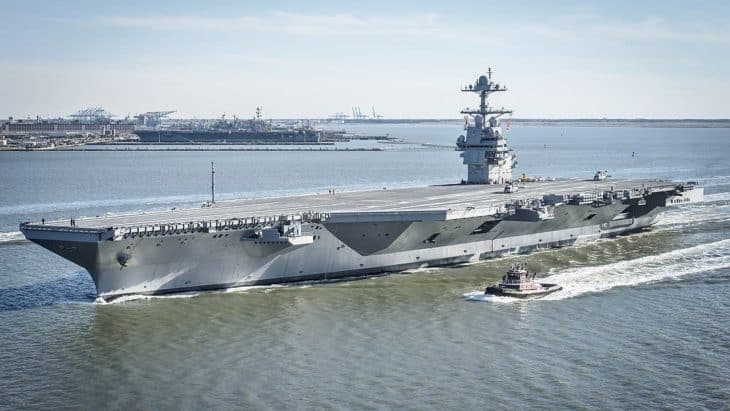
| USS Gerald R. Ford (CVN-78) | US | ~100,000 tons | 4 x EMALS | 75+ |
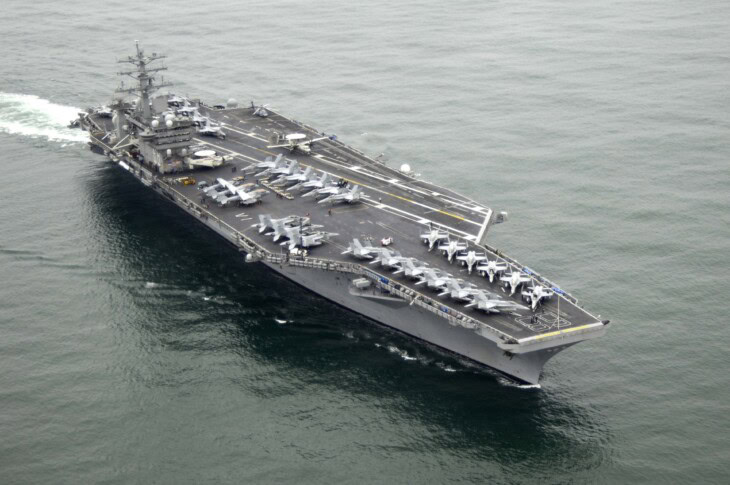
| USS Nimitz (CVN-68) | US | ~100,000 tons | 4 x steam | 60 to 70 |
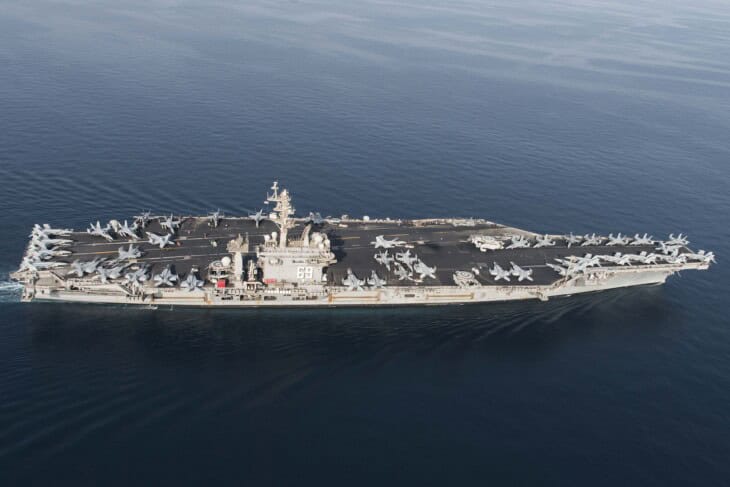
| USS Dwight D. Eisenhower (CVN-69) | US | ~100,000 tons | 4 x steam | 60 to 70 |
| USS Carl Vinson (CVN-70) | US | ~100,000 tons | 4 x steam | 60 to 70 |
| USS Theodore Roosevelt (CVN-71) | US | ~100,000 tons | 4 x steam | 60 to 70 |
| USS Abraham Lincoln (CVN-72) | US | ~100,000 tons | 4 x steam | 60 to 70 |
| USS George Washington (CVN-73) | US | ~100,000 tons | 4 x steam | 60 to 70 |
| USS John C. Stennis (CVN-74) | US | ~100,000 tons | 4 x steam | In overhaul |
| USS Harry S. Truman (CVN-75) | US | ~100,000 tons | 4 x steam | 60 to 70 |
| USS Ronald Reagan (CVN-76) | US | ~100,000 tons | 4 x steam | 60 to 70 |
| USS George H.W. Bush (CVN-77) | US | ~100,000 tons | 4 x steam | 60 to 70 |
| Fujian (CV-18) | China | ~80,000 to 85,000 tons | 3 x electromagnetic | 50+ |
| Shandong (CV-17) | China | ~66,000 to 70,000 tons | Ski jump | ~40 |
| Liaoning (CV-16) | China | ~60,900 tons | Ski jump | ~40 |
1. Launch technology: the gap that decides everything else
How an aircraft leaves the deck sets the ceiling on everything it can do afterwards. This is the single most important line in the comparison and the one most reporting skips.
All 11 American carriers are catapult ships with four catapults each, giving the US Navy 44 catapult tracks at sea. A catapult throws a fighter off the bow at full fuel and full weapons load, so the aircraft’s published combat radius is the radius it actually gets.
Two of China’s three carriers have no catapults at all. Liaoning and Shandong use a ski jump, which means the aircraft launches under its own power up a ramp, and to get airborne it has to be light.

In practice that means less fuel, fewer weapons, or both. The Shenyang J-15 is a large, heavy fighter, and off a ramp it typically goes to sea with a partial fuel load and a handful of missiles rather than a full strike loadout.
Two of China's three carriers cannot launch a fully loaded fighter
This is the most consequential fact in the entire comparison and it almost never appears in the hull-count headlines. A ski jump carrier does not have a slightly worse version of catapult capability, it has a different capability: its fighters trade fuel for weapons on every single launch. Fujian is the first Chinese ship that escapes the trade, and it has been in commission for less than a year.
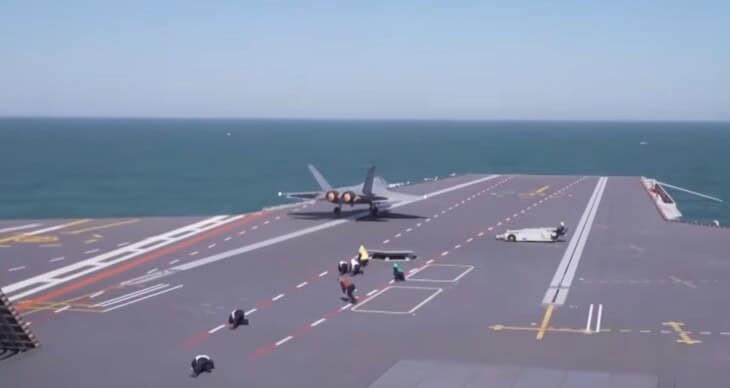
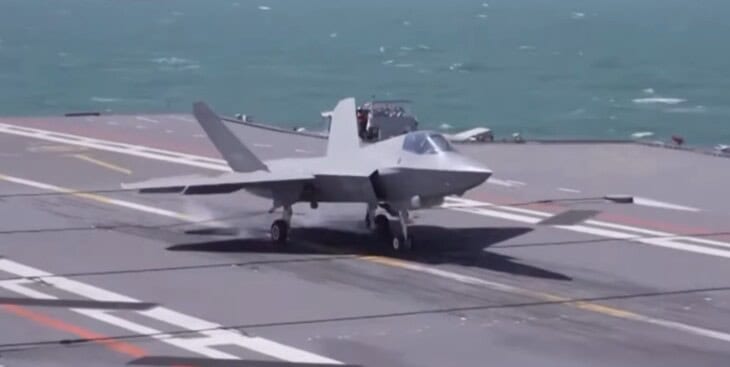
Fujian changes that. It carries three medium-voltage direct-current electromagnetic catapults, making China the second country ever to put an electromagnetic launch system to sea after the USS Gerald R. Ford.
The Ford’s four EMALS catapults can each accelerate a 100,000-pound aircraft to 130 knots and recharge within 45 seconds of a launch, faster than a steam catapult can cycle. Electromagnetic catapults also apply force more gently and more precisely, which matters for both heavy aircraft and light drones.
The honest caveat runs the other way too. EMALS reliability on Ford lagged its requirement for years, and the Navy’s own testing office did not expect the system to hit its reliability goals until the 2030s.
2. The air wing: what actually flies off the deck
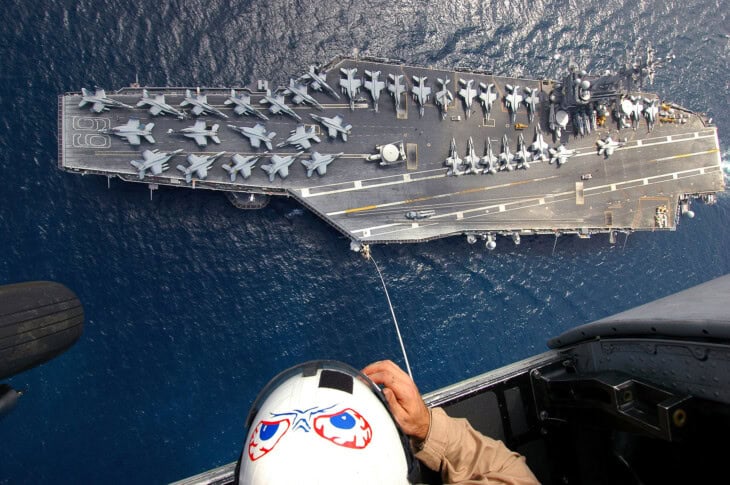
An American carrier deploys with a carrier air wing of roughly 65 to 70 aircraft, and the US Navy maintains nine of them. The composition is the point, not the count.
A current wing fields around 44 strike fighters, moving from roughly 10 F-35C and 34 F/A-18E/F Super Hornets today toward 16 F-35C and 28 Super Hornets. Around that sit five to seven EA-18G Growler electronic attack aircraft, five E-2D Advanced Hawkeye radar aircraft, six to ten MH-60 helicopters and three CMV-22B Ospreys.
China’s carrier air wing is smaller and thinner. Liaoning embarks about 24 J-15 fighters plus helicopters; Shandong carries around 36 J-15s; Fujian is expected to operate 50-plus aircraft including the J-15T, the J-15DT electronic attack variant, the stealthy J-35 and the KJ-600.

The category China lacks entirely on two of three ships is airborne early warning. Liaoning and Shandong rely on the Z-18J helicopter, which carries a capable radar but flies low and slow compared with a fixed-wing aircraft.
The KJ-600 matters more than the J-35
Radar horizon is a function of altitude, so where you put the antenna decides how far the fleet can see. An E-2D orbiting above 25,000 feet sees vastly further than a helicopter radar at a few thousand feet, and that difference sets how early a carrier group detects an incoming missile or aircraft. China’s KJ-600 is the first non-American carrier-based fixed-wing radar aircraft ever fielded, and it, not the stealth fighter, is what turns Fujian into a real carrier strike group.
There is also no Chinese carrier-based tanker. The US Navy is fielding the MQ-25 Stingray for exactly that job, on top of Super Hornets that can carry buddy refueling stores.
That matters because carrier fighters are short-legged. The F-35C has a combat radius of about 670 nm on internal fuel with a real weapons load, which is why organic tanking, not raw fighter numbers, is the constraint the US Navy spends most of its money solving.
For the aircraft-by-aircraft matchup behind these wings, we compare the two air forces in detail in US vs China: Fighter Jets Compared, and rank the world’s fighters against each other in the best fighter jets in the world.
3. Sortie generation: the number that decides a fight
Sortie generation rate is how many aircraft a carrier can launch, recover, refuel, rearm and relaunch in a day. It is the closest thing to a single measure of carrier combat power.
The Nimitz class is credited with roughly 120 sorties a day sustained. The Ford class was designed for 160 a day sustained over 30-plus days with a surge capability of 270, a target of about 25 percent more than a Nimitz.
Those Ford figures are design targets rather than combat-demonstrated records, and worth treating as such. What is demonstrated is endurance: Ford came home in 2026 from a deployment exceeding 300 days spanning operations connected to both Venezuela and Iran, one of the longest combat-related carrier deployments in modern US Navy history.
China publishes no sortie rate for any of its carriers, and anyone quoting one is guessing. What can be said from the hardware is that Fujian has three catapults to a Ford’s four, a smaller flight deck, a smaller hangar and a smaller air wing.
Deck cycle efficiency is also learned, not bought. The choreography that lets a US flight deck turn aircraft at that rate took the Navy decades of continuous operations to develop, and China has been running fixed-wing carrier aviation since 2012.
4. Availability: 11 carriers on paper is not 11 carriers at sea
This is the measure where the American advantage collapses, and it is the strongest argument China has.
US carriers run a cycle of deployment, maintenance and training that leaves roughly a third of the fleet available at any moment. In late July 2026 three US carriers were deployed, three were training or in port at varying readiness, four were in maintenance and one was primarily a training ship.
The maintenance picture is worse than the cycle alone implies. A Government Accountability Office review found that 75 percent of carrier and submarine maintenance periods finish late.
USS John C. Stennis is the extreme case. It entered a refueling and complex overhaul in May 2021 on a four-year plan and is now projected back with the fleet around late 2026, with sea trials and deployment readiness running into 2027.
China’s three carriers face the same physics but a much shorter commute. Fujian is homeported at Yulin Naval Base on Hainan, which puts it in the South China Sea rather than 6,000 miles away from it.
The comparison that actually matters
The relevant question is not 11 against 3 globally. It is how many carriers each navy can concentrate in the Western Pacific in a given week, and how fast. In that framing an American advantage of roughly four to one on paper narrows considerably, because China’s carriers start where the fight would be and America’s mostly do not.
The Fujian question
Fujian was commissioned on 5 November 2025 at Yulin Naval Base in Sanya, Hainan, giving China a three-carrier fleet. It is the largest carrier ever built outside the United States.
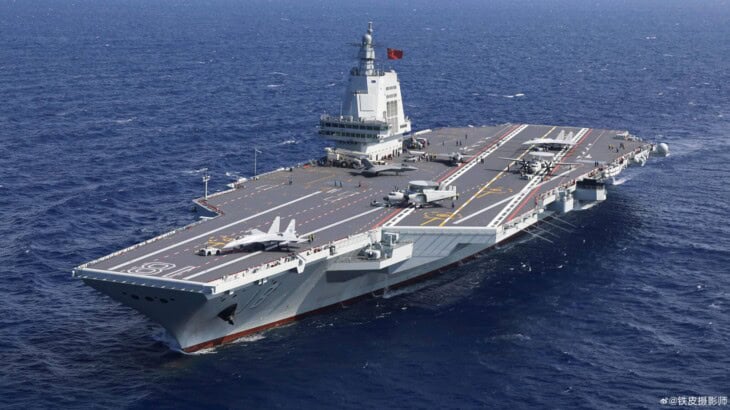
Footage released in January 2026 showed J-35, J-15T and KJ-600 aircraft making electromagnetic catapult launches and arrested recoveries, with launches smooth enough to suggest the system had moved beyond experimental use. During the ship’s first post-commissioning training mission all four types operated from the deck together.
That is a genuinely significant milestone and it deserves to be reported as one. China went from an ex-Soviet training hull to a working electromagnetic-catapult carrier flying a stealth fighter and a fixed-wing radar aircraft in 13 years.
The qualifier is that Fujian is conventionally powered, using steam turbines rather than reactors. That caps its endurance and ties it to oilers in a way no American carrier is tied, which is exactly the constraint that limits how far from home it can usefully operate.
A full operational capability declaration is not expected before late 2026 or early 2027 on current trial pacing. One combat-capable carrier does not close a gap; it opens a door.
What is coming next for both fleets
Both navies have their next carrier in the water, and the two ships tell you where each program is heading.
Huntington Ingalls announced on 12 August 2026 that the future USS John F. Kennedy had left Newport News to begin acceptance trials, the last sea test before the Navy formally accepts the ship.
Delivery is scheduled for March 2027, roughly two years later than originally planned. The delays came from problems with the Advanced Arresting Gear and the Advanced Weapons Elevators.
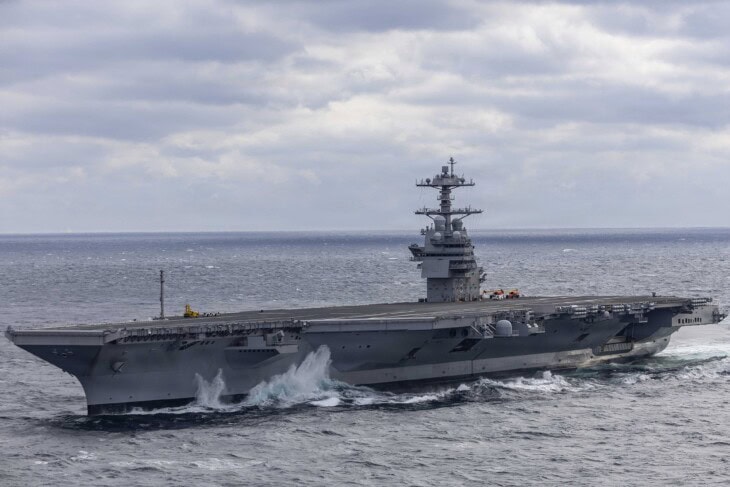
Even after delivery, CVN-79 is unlikely to begin operational duties before 2028 once post-delivery testing, shakedown and air wing integration are done. USS Nimitz, meanwhile, has finished its last deployment and its decommissioning has slipped to 2027, partly because federal law requires the Navy to keep 11 carriers.
China’s answer is the Type 004, under construction at Dalian and the more consequential of the two ships. Satellite imagery from May 2026 showed a hull roughly 938 feet (286 m) long and 151 feet (46 m) wide, with armored compartments consistent with two nuclear reactors.
Estimates put it at 110,000 to 120,000 tons with capacity for 100-plus aircraft, which would make it larger than a Ford. Chinese statements put the hull as complete and overall program progress past 25 percent, with service entry generally expected around 2030.
The Pentagon’s December 2025 report on Chinese military power states that the PLA Navy aims to produce six more carriers by 2035, for a total of nine.
2012
Liaoning commissioned. A rebuilt ex-Soviet hull enters service in September as China’s first carrier, initially as a training ship.
2017
USS Gerald R. Ford delivered. The first carrier anywhere with electromagnetic catapults joins the US fleet.
2019
Shandong commissioned. China’s first domestically built carrier enters service in December, still with a ski jump.
November 2025
Fujian commissioned. China’s first catapult carrier enters service at Yulin, giving the PLA Navy three carriers.
January 2026
Full air wing flies from Fujian. J-35, J-15T and KJ-600 aircraft conduct electromagnetic catapult launches and arrested recoveries.
May 2026
Type 004 hull revealed. Satellite imagery at Dalian shows a 938-foot nuclear-powered hull with reactor compartments.
August 2026
USS John F. Kennedy begins acceptance trials. The second Ford-class carrier goes to sea for its final test before Navy acceptance.
2027
Kennedy delivered, Nimitz retires. CVN-79 is due in March; the oldest US supercarrier stands down after 52 years.
But could China’s navy beat the US Navy?
This is the question the search results are really asking, and carriers are a misleading way to answer it.
China has the world’s largest navy by number of hulls. It does not follow that China would fight a Pacific war with carriers, because in the waters that matter most to Beijing it does not need them.
Taiwan sits about 110 miles (177 km) off the Chinese coast, well inside the range of land-based fighters, land-based radar aircraft and anti-ship ballistic missiles. A carrier is a way of bringing an airbase to a place you do not have one, and near its own coast China already has plenty.
The number that misleads everyone
Almost every version of this comparison leads with 11 against 3, and that figure is simultaneously too flattering to the United States and too flattering to China. Too flattering to the US because only three or four of those 11 are deployed at any moment and one has been in a shipyard since 2021. Too flattering to China because two of its three carriers cannot launch a fully armed fighter, and none of the three has a fixed-wing radar aircraft except Fujian. Count decks if you like, but count what leaves them.
Chinese carriers are best understood as instruments for everything that is not a Taiwan contingency: presence in the Indian Ocean, protection of sea lanes, and the ordinary business of being a global naval power. That is exactly what American carriers have done for 80 years.
So who actually wins?
The United States, decisively, in 2026. It is not close on three of the four measures and it will not be close for at least a decade.
The US puts nine air wings of 65 to 70 aircraft to sea from 11 nuclear-powered catapult ships, every one of them carrying fixed-wing radar aircraft and dedicated electronic attack aircraft.
China puts roughly 130 aircraft to sea from three conventionally powered hulls, two of which launch fighters at reduced load. Behind the American figure sit 80 years of unbroken carrier operations.
The honest concessions cut the other way. American availability is genuinely poor, the maintenance system is under strain, and China’s trajectory since 2012 has been faster than almost anyone predicted.
The date to watch is not 2026 but around 2030, when Type 004 is expected in service. A nuclear-powered, 120,000-ton Chinese carrier flying stealth fighters and fixed-wing radar aircraft would be the first ship outside the US Navy in living memory to match an American carrier on the measures that count.
Until then, the answer to how many aircraft each side can put over a target is not 11 to 3. It is closer to 600 to 130, and that is the number worth remembering. Our guide to how many planes an aircraft carrier holds breaks down where those air wing figures come from.
FAQ
Sources and references used for research and fact-checking.
- Center for Strategic and International Studies, Tracking China's Fourth Aircraft Carrier
- USNI News, China Wants Nine Aircraft Carriers by 2035, Says New Pentagon Report
- The Aviationist, The Future USS John F. Kennedy Begins Acceptance Trials
- FlightGlobal, Chinese naval airpower enters new era with Fujian electromagnetic launch system tests
- USNI News, USS Nimitz Begins Last Cruise Ahead of Decommissioning
- Seapower Magazine, Navy's Future Carrier Air Wing Configuration Coming into Focus
Get the Newsletter
The latest aviation news and stories sent to your inbox.
About the Author

Tim is the owner and lead editor of AeroCorner since 2019, overseeing aviation content covering aircraft, airlines, airports, and the broader aviation industry. Through years of researching, writing, editing, and publishing aviation-focused content, he has developed extensive practical knowledge of commercial aviation and air travel. Based in Asia and a frequent traveler himself, Tim also brings firsthand passenger experience to AeroCorner’s coverage. Outside of publishing, he has also explored aviation firsthand through hands-on flight training in New Zealand.