

Table of Contents
The United States still fields the stronger fighter force in 2026. It flies roughly 2,700 fighters against China’s estimated 1,900 to 2,100 combat aircraft, it has about a thousand stealth fighters to China’s few hundred, and it owns the supporting fleet of tankers that turns those fighters into a force that can reach across an ocean.
China leads in two places that matter, and both are new. Its sixth-generation prototypes flew almost four years before America’s will, and its longest-range air-to-air missile has outranged the standard US one in actual combat.
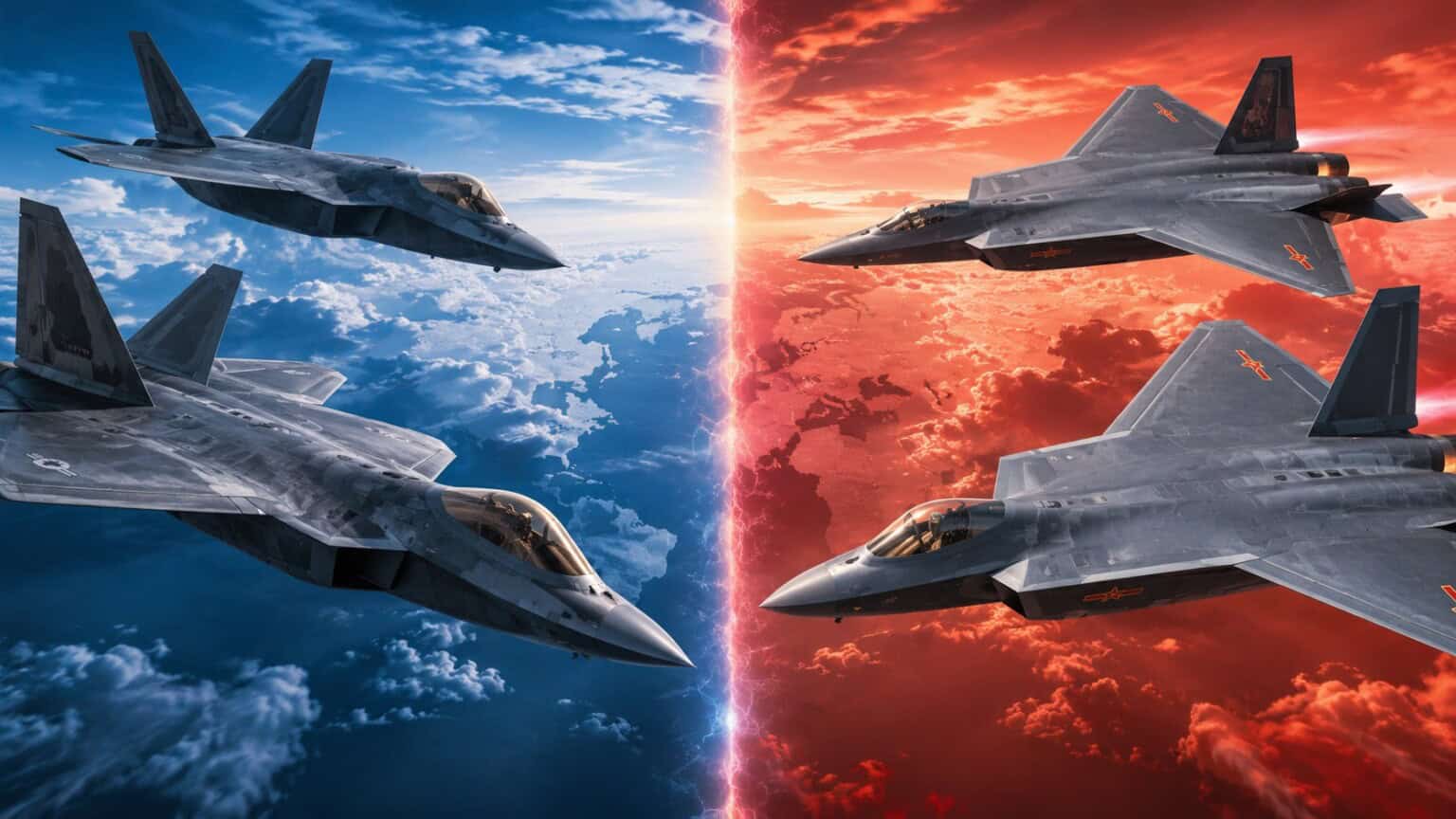
This is a head-to-head comparison of the two fleets as of 2026, matchup by matchup, measured on generation, numbers fielded, and demonstrated capability. It is not a global ranking. For that, see our list of the best fighter jets in the world.
| Measure | United States | China | Edge |
|---|---|---|---|
| Total fighters in service | ~2,700 (Air Force, Navy, Marines) | ~1,900 to 2,100 combat aircraft | US |
| Stealth fighters fielded | ~1,000 (F-22, F-35A/B/C) | ~300 to 500 (J-20, J-35A) | US |
| Fifth-gen types in service | 2 (F-22, F-35) | 2 (J-20, J-35A) | Even |
| Sixth-gen first flight | F-47, targeted 2028 | J-36 and J-50, flew Dec 2024 | China |
| Stealth fighter output per year | ~190 F-35s of all variants, all customers | ~100 to 120 J-20s | US |
| Longest-range missile in service | AIM-120D, ~100 miles (160 km) | PL-15, ~125 miles (200 km) | China |
| Aerial refueling tankers | ~475 | ~35 | US |
| Modern air combat experience | Continuous since 1991 | None since the 1950s | US |
How this comparison works
Every US number here is an official inventory count. Every Chinese number is an estimate, because Beijing publishes nothing. That asymmetry is the single biggest reason published comparisons disagree with each other, so ranges are given where the sources genuinely disagree. US fighter totals count all three services, not just the Air Force. Bombers, drones, trainers and attack aircraft such as the A-10 are excluded.
1. F-22 Raptor vs Chengdu J-20
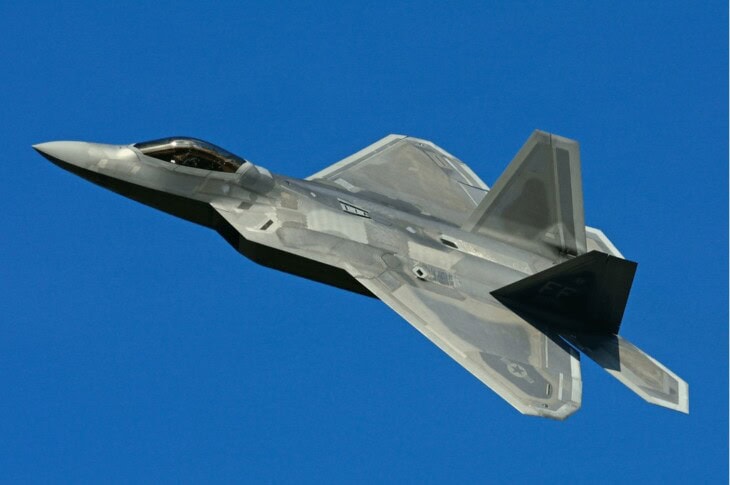
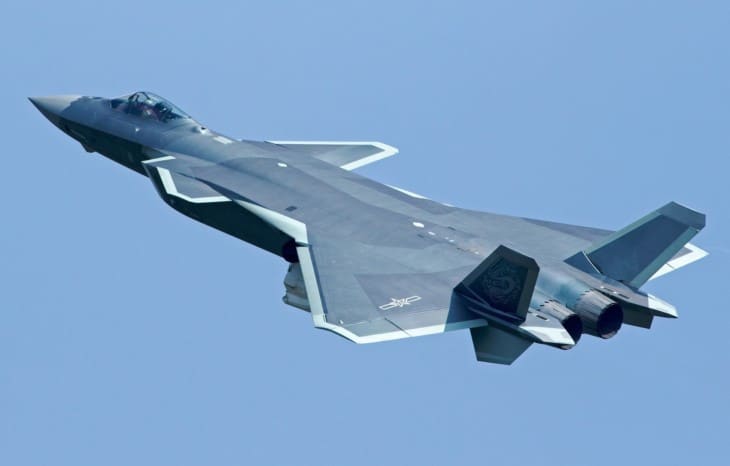
This is the marquee matchup, and it is closer than it was five years ago, mostly because one side stopped building and the other did not.
The F-22 remains the better air-to-air fighter. It supercruises above Mach 1.5 without afterburner, carries thrust-vectoring nozzles no Chinese fighter matches, and has the smallest radar signature of any fighter in service.
The problem is arithmetic. Production ended in 2011 at 187 airframes, 183 of which survive, and only about 152 of those are combat-capable Block 30 and 35 jets. The Air Force asked to retire the 32 oldest training jets; Congress refused and, in July 2026, moved to bar any F-22 retirement until 2032.
The J-20 went the other way. Western estimates put the fleet at around 300 aircraft at the end of 2025, and some mid-2026 assessments put it near 500, with Chengdu turning out roughly 100 to 120 airframes a year.
Even the conservative estimate means China now flies more J-20s than the US flies F-22s. The J-20 is a bigger aircraft at about 70 feet (21.3 m) long, built for long-range interception with a combat radius over 680 miles (1,100 km), which suits the distances of the Pacific better than the Raptor’s shorter legs do.
Where the J-20 still trails is the engine. Most in-service aircraft use the WS-10C, not the more powerful WS-15 that would give it true supercruise, so the Raptor keeps its kinematic edge. We break the two down side by side in our F-22 vs J-20 comparison.
China builds a stealth fighter faster than America builds its best one, ever
Chengdu delivers an estimated 100 to 120 J-20s a year. The entire F-22 program, from first delivery in 2003 to the last in 2012, produced 187 aircraft. China now builds more stealth fighters in two years than the United States built Raptors in a decade.
2. F-35 vs Shenyang J-35A


This matchup is not close, and it is the clearest US advantage on the board.
Lockheed Martin had delivered 1,325 F-35s by March 2026, including 948 F-35As, and shipped a record 191 aircraft in 2025 alone. The US Air Force alone counted 500 F-35As on its ramp at the end of fiscal 2025.
The J-35A, China’s answer, was formally inducted into the PLA Air Force in late 2025. Open-source serial tracking suggested only about 30 production airframes existed by mid-2026, and full initial operating capability is expected around the end of the year.
So the comparison in 2026 is a mature fleet of roughly a thousand aircraft against a squadron’s worth. The J-35A is a real fifth-generation fighter and China is doubling its production lines, but it is roughly where the F-35 was in 2014.
The deeper F-35 advantage is the sensor fusion and datalink software, refined over two decades and hundreds of thousands of flight hours. That is the part of a fifth-generation fighter that cannot be reverse-engineered from photographs, and it is where the F-35 and J-20 differ most.
One thing China has that the US does not: an export fifth-generation fighter. The J-35AE was pitched openly at the 2026 Singapore Airshow, and Pakistan is close to becoming the first foreign operator. Washington restricts F-35 sales tightly and never exported the F-22 at all.
3. The workhorses: F-15EX and F-16 vs J-16 and J-10C
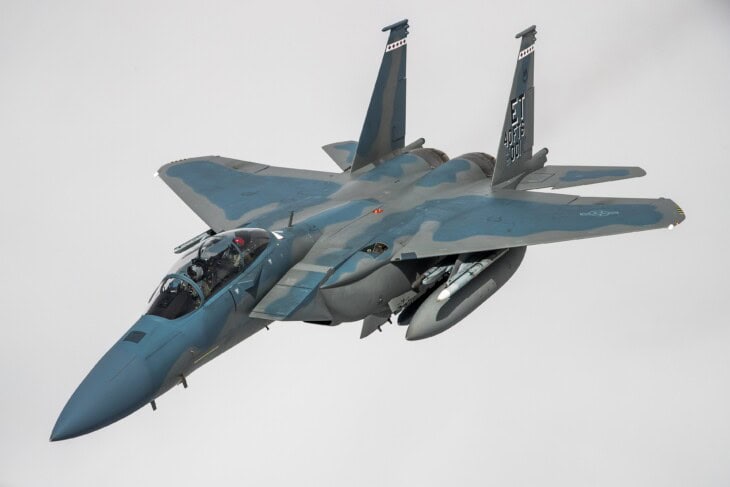
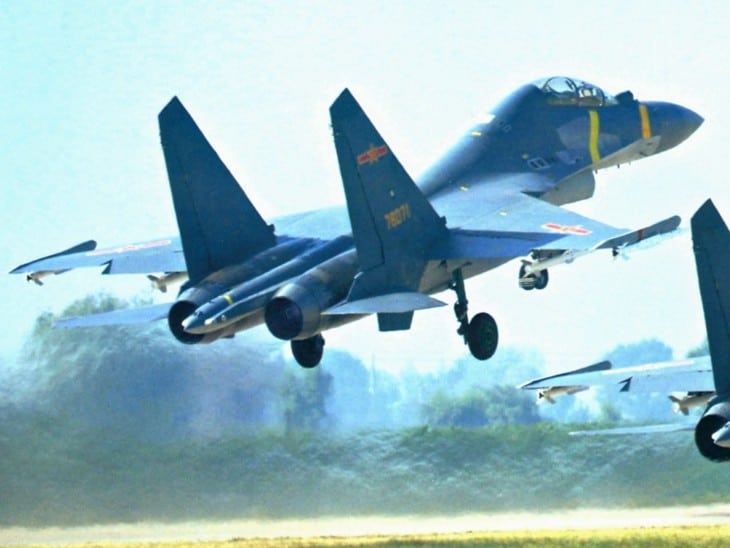
Most of both air forces is not stealthy, and this is where the raw numbers live.
The US Air Force still counted 826 F-16s, 217 F-15Es and 75 F-15C/Ds as of September 2025. The F-15EX Eagle II is replacing the oldest of them, with 13 delivered so far and a planned fleet of 111 by 2030.
China’s equivalents are the twin-seat J-16 strike fighter and the single-engine J-10C, both modern, both fitted with active electronically scanned array radars, and both produced in volume. The PLA Air Force and Naval Aviation together operate an estimated 1,200 or more fourth-generation and later fighters.
The important shift is qualitative. A decade ago China’s mass was made up of obsolete J-7s and J-8s; today the old airframes are being retired faster than new ones arrive, which is why the total combat aircraft count has fallen while capability has risen sharply.
Our roundup of the best Chinese fighter jets covers each type in detail, and the best American fighter jets list does the same on the US side.
4. Carrier aviation: F/A-18E/F and F-35C vs J-15T and J-35
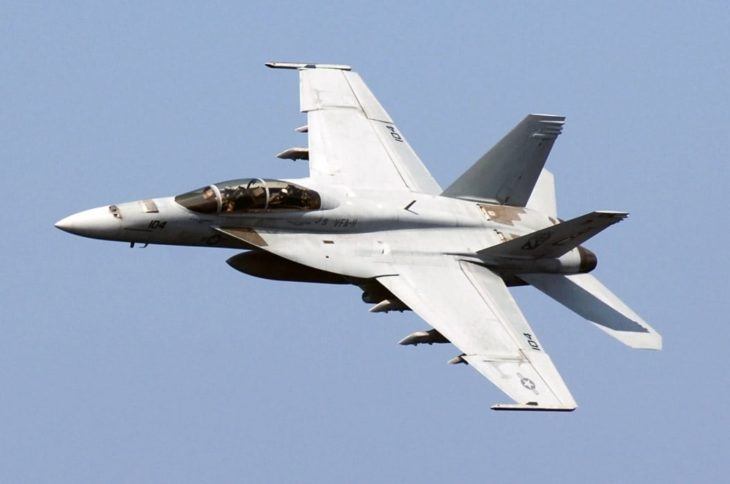

At sea the gap is wider than it is over land, and it is a gap of experience as much as hardware.
The US Navy operates around 560 F/A-18E/F Super Hornets plus a growing F-35C force, and the Marine Corps expects 261 F-35B and F-35C aircraft by the end of 2026. All of it flies from eleven nuclear carriers with catapults and decades of institutional practice.
China’s carrier air wing is built around the J-15 and the improved J-15T, with the carrier-configured J-35 now joining it. The Fujian, China’s first catapult carrier, ran successful electromagnetic launch trials in September 2025, which is the milestone that makes a heavy, fully fueled stealth fighter viable at sea.
That is genuine progress, but three carriers against eleven is not a contest yet. The relevant question is not whether China can match US carrier aviation, it is whether China needs to when its fighters can fly from the mainland.
5. The sixth generation: F-47 vs J-36 and J-50
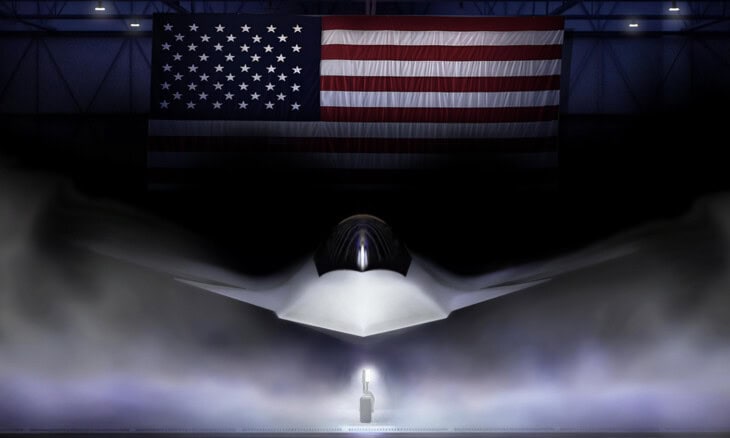
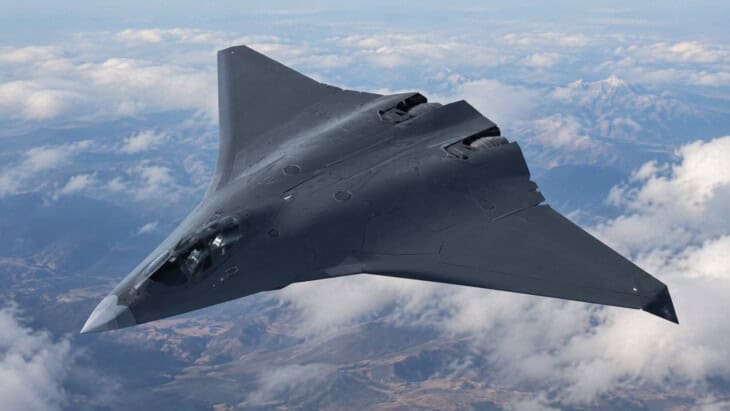
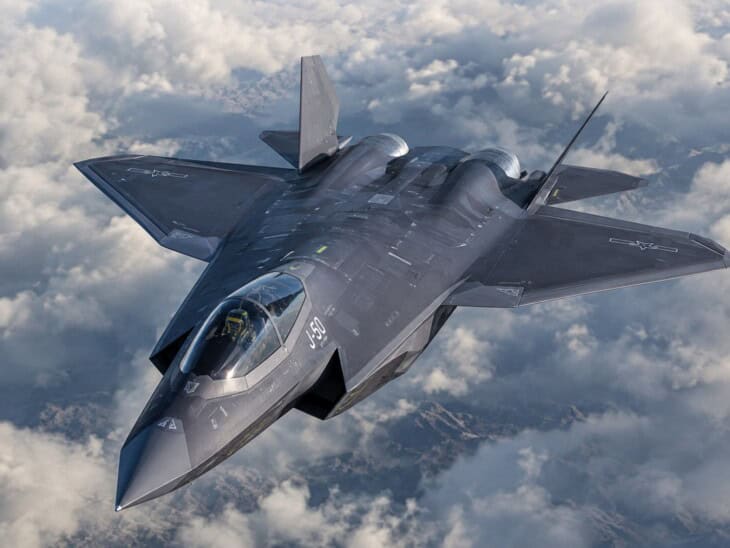
This is the one category where China is unambiguously ahead on the calendar, and it is the reason this comparison is being argued about in 2026 at all.
China flew two sixth-generation prototypes on the same day, 26 December 2024: Chengdu’s large three-engine tailless J-36, and Shenyang’s twin-engine J-50. The Pentagon’s December 2025 report to Congress confirmed both had begun initial flight testing.
Testing has moved fast since. By July 2026 imagery suggested a fifth J-36 airframe and a third major configuration, with changes to the intakes, exhausts and landing gear.
America’s F-47, awarded to Boeing in March 2025, is in early manufacturing in St. Louis. In July 2026 the Air Force confirmed its first flight remains targeted for 2028, with a fleet goal of 185 or more aircraft to replace the F-22.
That is close to four years behind China’s first flights, and the F-47’s first sorties will use an interim engine because its adaptive-cycle powerplant is not expected until around 2030.
Be careful with that headline, though. A first flight is a prototype leaving the ground, not a weapon system. The Pentagon projects both Chinese aircraft reaching operational capability in the mid-2030s, which is roughly when the F-47 is expected to be fielded in numbers, and the US has decades more experience turning a flying prototype into a squadron that works.
6. The missile gap almost nobody mentions
Modern air combat is usually decided before the aircraft see each other, which makes the missile more important than the airframe carrying it.
For thirty years the US held the range advantage with the AIM-120 AMRAAM, whose latest AIM-120D reaches roughly 100 miles (160 km). China’s PL-15 is credited with about 125 miles (200 km).
That stopped being theoretical in May 2025. Pakistani J-10Cs firing PL-15s engaged Indian fighters, and Reuters reported US officials confirming at least one French-built Rafale was shot down at a range Indian planners had not expected.
Pakistan claims five kills; India has not confirmed the full total, and verifiable detail remains thin. What is not in dispute is that a Chinese missile fired from a Chinese fighter beat a top-tier Western fighter in combat.
The US answer is the AIM-260 Joint Advanced Tactical Missile, in final testing and initial fielding on the F-22. Funding jumps from $894 million in fiscal 2026 to $2.9 billion in 2027, which tells you how seriously the range gap is being taken.
7. The tanker gap that decides the Pacific
Fighters have short legs. In a theater as large as the Western Pacific, the aircraft that decides whether fighters matter is the one carrying the fuel.
The US Air Force operates roughly 370 KC-135s and 105 KC-46s, about 475 tankers in total, and plans to buy 263 KC-46s in the end.
China’s entire aerial refueling force is around 35 aircraft: three secondhand Il-78s, a handful of converted H-6 bombers, and a slowly growing number of YY-20 tankers. Analysts expect roughly 100 by 2035.
The most lopsided number in the entire comparison
The United States operates about thirteen aerial refueling tankers for every one China has. This is the least discussed statistic in every US versus China fighter comparison online, and arguably the most decisive: it is what lets American fighters operate thousands of miles from home while Chinese fighters are still largely tied to mainland bases.
This cuts both ways. Fighting near its own coast, China does not need tankers, and its fighters can generate more sorties than US aircraft flying from Guam or Japan. Fighting anywhere else, the shortage is crippling.
8. Combat experience: the category China cannot buy
The US has flown fighters in combat continuously since 1991, across Iraq, the Balkans, Afghanistan, Libya, Syria and Yemen. Its pilots, maintainers, tanker crews and controllers have all done the real thing.
The PLA Air Force has not fought an air war since the 1950s. No serving Chinese pilot has shot at anyone.
The caveat is that experience decays and doctrine changes. Most recent US combat has been against opponents with no meaningful air force, which is not preparation for a peer fight, and China has spent twenty years studying exactly how the US fights.
China also now has a proxy data point. The May 2025 engagements gave Chinese hardware and tactics their first real test, even though the pilots were Pakistani.
9. Production rate: where China is genuinely winning
If you want one trend line that explains why this comparison keeps getting closer, it is the rate at which each side adds airframes.
The US Air Force’s total fighter fleet is projected to shrink from 1,271 combat-coded aircraft in fiscal 2026 to a low of 1,215 in 2028, before recovering to 1,304 by 2030. It requested just 24 F-35As in the 2026 budget.
China’s stealth fleet is growing by an estimated 100 to 120 J-20s a year, with J-35A production ramping alongside it, and satellite imagery has shown roughly 8 million square feet of new factory floor at Chinese fighter plants.
Lockheed Martin’s 191 F-35 deliveries in 2025 comfortably out-produce that, but those aircraft are split among a dozen air forces. Count only what reaches the US Air Force and China is currently adding stealth fighters to its own inventory faster than America is.
So who actually wins?
In 2026 the United States still has the better fighter force, and it is not particularly close on the measures that decide a campaign rather than a duel: more stealth aircraft, far better sensor and datalink integration, thirteen times the tanker capacity, and the only air arm on earth with modern combat experience.
China has closed the gap faster than anyone predicted a decade ago, and it now leads on two specific things: the missile that decides beyond-visual-range engagements, and the calendar for sixth-generation flight testing.
The honest answer is that the gap is narrowing and geography matters more than either fleet total. In a fight 100 miles off the Chinese coast, China’s numbers, missiles and basing largely cancel the American advantage. In a fight anywhere else, they do not come close.
But doesn't China have more fighter jets than the US?
No, and this is the single most repeated error in this comparison. The confusion comes from counting methods: US totals are sometimes quoted as combat-coded aircraft (about 1,271 Air Force fighters in 2026) and sometimes as total inventory (about 1,815 Air Force fighters), and many comparisons then forget the Navy and Marine Corps entirely, which is another 900 or so. Counted the same way on both sides, the United States fields roughly 2,700 fighters to China’s estimated 1,900 to 2,100 combat aircraft. Where China does lead is stealth fighter production rate, not fleet size.
One more caveat worth keeping in mind: every Chinese figure on this page is an outside estimate, and the credible ones disagree with each other by hundreds of airframes. The J-20 fleet is put at 300 by one respected assessment and 500 by another for the same rough period.
Anyone quoting a precise Chinese number without a range is guessing. For the stealth-specific picture across both countries and everyone else, see our ranking of the best stealth aircraft in the world.
FAQ
Sources and references used for research and fact-checking.
- Air & Space Forces Magazine, 2026 USAF & USSF Almanac: Total Aircraft Inventory (TAI)
- Air & Space Forces Magazine, Air Force Fighter Roadmap Projects Slow Growth for F-35 Fleet
- US Department of Defense, Annual Report to Congress: Military and Security Developments Involving the People's Republic of China 2025
- The War Zone, How Many J-20 Mighty Dragon Fighters Does China Actually Have?
- Lockheed Martin, F-35 Breaks Delivery Record, Continues Combat Success in 2025
- The War Zone, F-47 Program's Accelerated Pace Made Possible By NGAD X-Plane Efforts
Get the Newsletter
The latest aviation news and stories sent to your inbox.
About the Author

Tim is the owner and lead editor of AeroCorner since 2019, overseeing aviation content covering aircraft, airlines, airports, and the broader aviation industry. Through years of researching, writing, editing, and publishing aviation-focused content, he has developed extensive practical knowledge of commercial aviation and air travel. Based in Asia and a frequent traveler himself, Tim also brings firsthand passenger experience to AeroCorner’s coverage. Outside of publishing, he has also explored aviation firsthand through hands-on flight training in New Zealand.