


Table of Contents
| Measure | F-35A Lightning II | Chengdu J-20 |
|---|---|---|
| Built to | Strike first, fight air-to-air second | Air superiority at long range |
| Stealth | Reported around 0.001 sq m head-on | Strongest head-on, weaker from the rear |
| Sensor fusion | Mature, in combat use since 2018 | Similar layout, real performance unknown |
| Internal air-to-air load | 4 AIM-120s (6 with Sidekick, Block 4) | 4 PL-15s plus 2 PL-10s |
| Internal gun | 25 mm GAU-22/A, 180 rounds | None |
| Combat range, internal fuel | 669 nm (interdiction) | About 1,080 nm |
| Built so far | 1,355+ (all variants, Sept 2026) | About 500 (mid-2026) |
| Unit cost | $92.0 million (Lots 18-19) | Not published; estimates $30M to $120M |
| Operators | 20+ countries | China only |
| Combat use | Yes, since 2018 | None publicly reported |
How to read this comparison
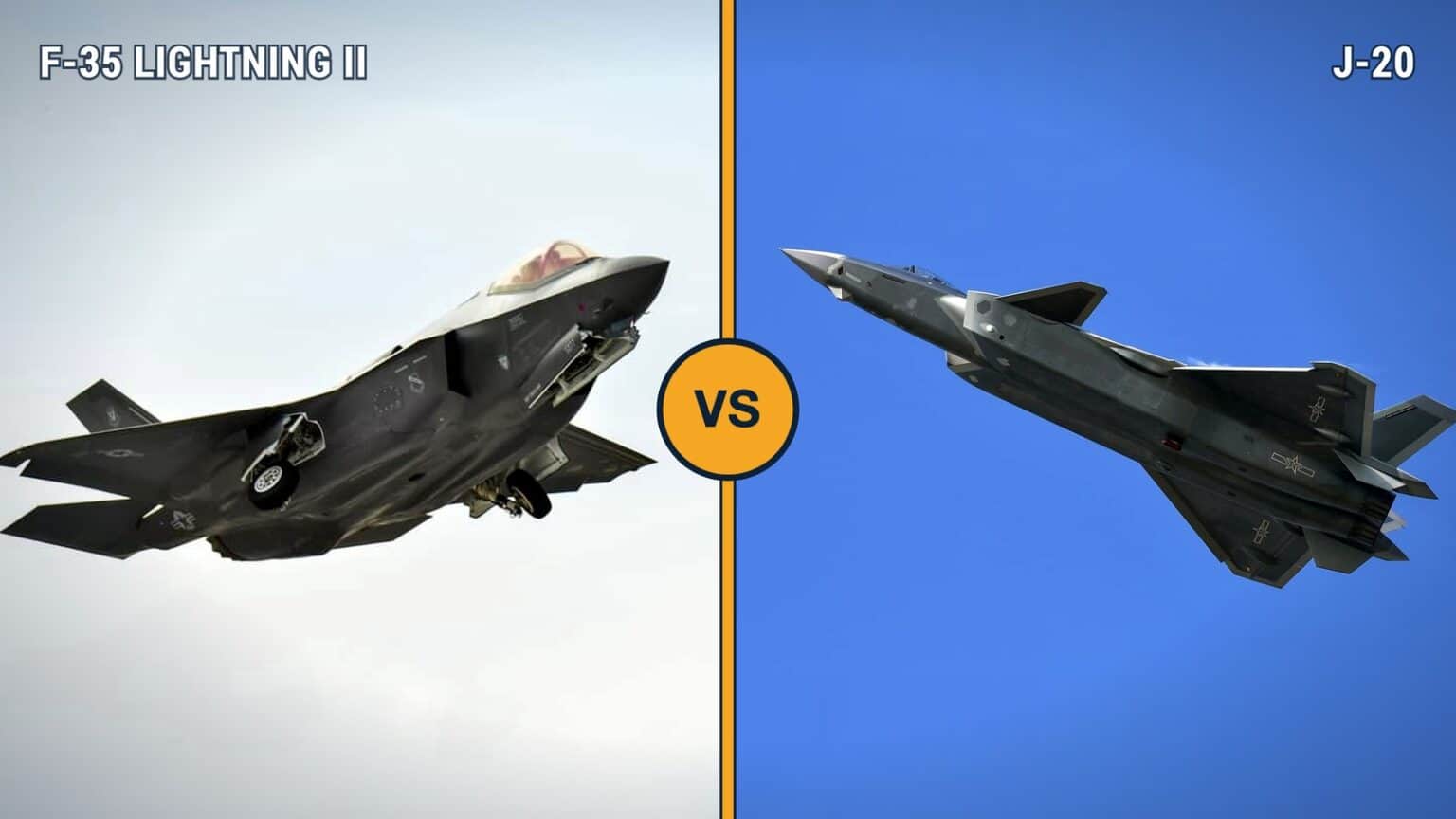
Neither aircraft has fought the other, and both governments classify the numbers that would settle it: radar cross-section, radar range and electronic warfare performance. The F-35 figures here are official. Almost every J-20 figure is an analyst estimate built from photographs, because China publishes very little. The spec panel above compares the F-35A, the Air Force version.
Two different jobs
The F-35 Lightning II is a single-engine multirole fighter. It was designed to replace the F-16, A-10, Harrier and older Hornets, so its first job is getting weapons onto defended targets and coming home.
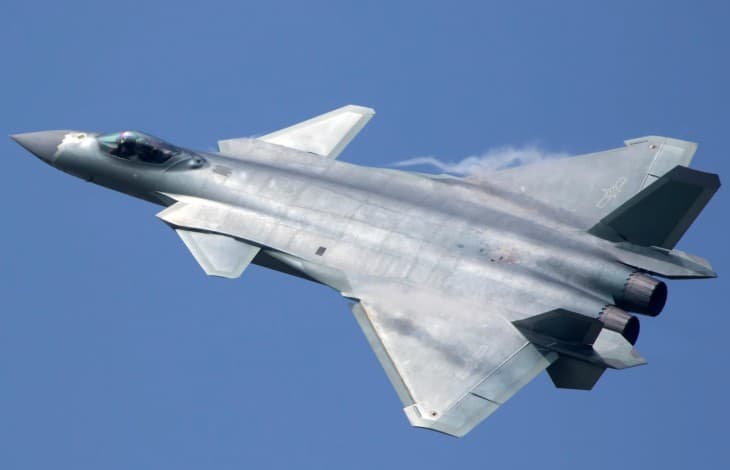
The Chengdu J-20 is a large twin-engine fighter built around range and long-range missiles. Aviation journalist Piotr Butowski summed up the design as putting speed and range ahead of maneuverability.
So the question “which is better” has two answers. Better in a one-on-one fight, and better at the job China actually built its jet to do, are not the same thing.
Stealth: the F-35’s clearest lead
Aviation Week has reported the F-35’s radar cross-section at about -30 dBsm, or 0.001 square meters, roughly the return of a golf ball. The F-35 is also believed to be stealthier than the F-22 from the front, though less uniform around the rest of the aircraft.
The J-20 is taken seriously but rated lower. Retired Lt. Gen. David Deptula described it as having significant low-observable features on the front end, “but not all aspects.” Analyst Andreas Rupprecht wrote that it is most likely no match for the F-22 and F-35, while being far stealthier than most other aircraft in the region.
The weak spot was the rear. Early J-20s had round engine nozzles, and the WS-10C engines fitted from 2019 brought serrated nozzles to reduce that return. Our guide to stealth fighter jets explains how those features work.
Writing in USNI Proceedings, Mark Schneider estimated that the gap could be one to two orders of magnitude in the F-35’s favor. In practice, that means the F-35 would probably see the J-20 first and get the first shot.
Edge: F-35.
Sensors and networking
The J-20’s sensor layout looks deliberately like the F-35’s. It has an AESA radar, a chin-mounted electro-optical targeting sensor, an infrared search and track system, and six passive windows for all-round coverage.
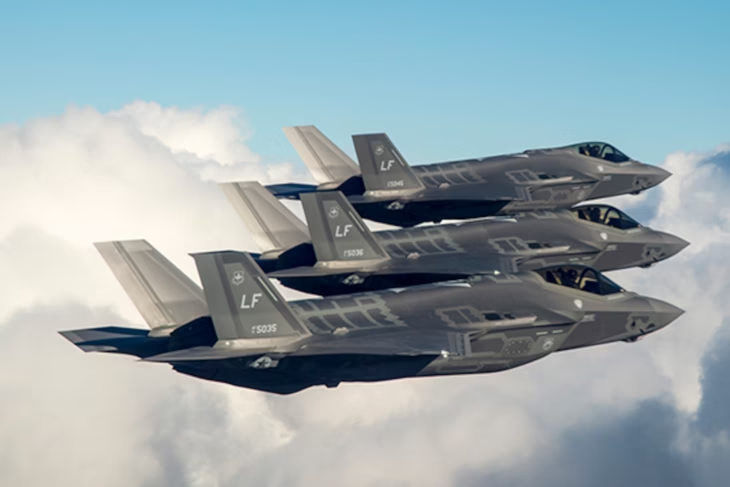
Looking the same is not the same as working the same. The F-35’s APG-81 radar was built to operate in low-probability-of-intercept modes, and its sensors feed one fused picture to the pilot and to every other F-35 in the flight.
China has never published the J-20’s radar. Analysts believe it is an early Chinese AESA, and matching the F-35’s software, sensor fusion and networking is a harder problem than matching its hardware.
There is one caveat that favors the J-20. Infrared search and track ignores radar-absorbent coatings, which is how one stealth fighter would expect to find another.
Edge: F-35, on what can be verified. The J-20’s real sensor performance is unknown outside China.
Speed, fuel and range: where the J-20 wins
The J-20 is the faster jet. Chinese state media give it Mach 2.0, while the Air Force lists the F-35A at Mach 1.6, about 1,200 mph.

It also carries much more fuel. CSIS puts the J-20’s internal fuel at about 26,500 lb (12,000 kg), against 18,498 lb (8,390 kg) for the F-35A. That is roughly 40 percent more.
Range follows fuel. The Mitchell Institute gives the J-20 a combat range of 1,080 nm, while the F-35A’s published combat range is 669 nm on internal fuel for a strike mission. The J-20’s mission profile is not published, so the comparison is approximate, but the gap is large.
Reach is the point of the design. Schneider called the J-20 a clear threat to AWACS, tanker aircraft and fourth-generation fighters, which are the assets the F-35 relies on to operate over the western Pacific.
Edge: J-20, and this is the advantage that matters most in the war it was built for.
Weapons: what fits inside
Missiles carried inside keep a jet stealthy, so the internal load is the one that counts. The J-20 carries four PL-15 long-range missiles in its main bay and one short-range PL-10 in each of its two side bays, six in total.
The F-35A has four internal stations. In an air-to-air setup that usually means four AIM-120s, and the Sidekick rack offered with Block 4 raises it to six.
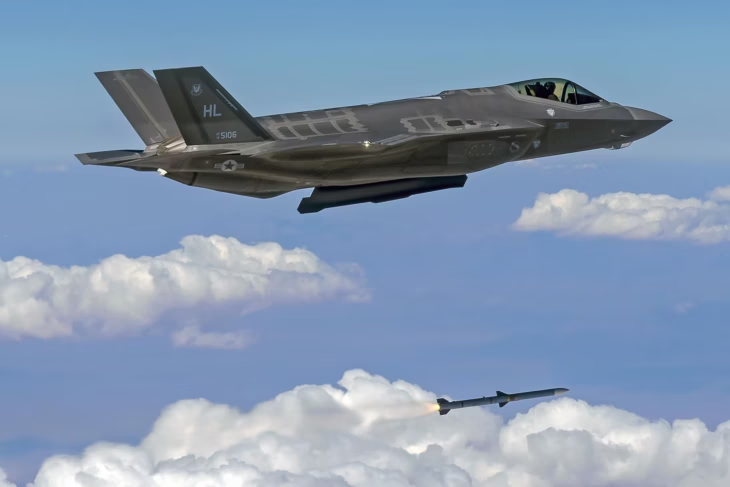
Both jets can carry more under the wings, and both lose their stealth when they do. A J-20 filmed with eight PL-15s on external pylons can carry 14 missiles in total, but it is no longer a stealth fighter at that point.
The gun is the other difference. The F-35A has a 25 mm GAU-22/A cannon with 180 rounds. The J-20 has no gun at all, which shows it was never meant to fight at close range.
Edge: J-20 on missiles in the bays today, closing to level once Sidekick is fitted.
J-20 vs F-35 dogfight: who would win?
Close in, it is closer than the stealth numbers suggest. Rupprecht rates the J-20’s maneuverability as at least comparable to the J-11B, a Flanker derivative, and Schneider notes the F-35 was not designed to out-turn an F-16 or F-18.
The F-35A is cleared to 9 g, and its thrust-to-weight ratio climbs from 0.87 at gross weight to 1.07 at half fuel. Its single F135 makes 43,000 lb of thrust, while each of the J-20’s WS-10Cs is rated at 142 to 147 kN, about 31,900 to 33,000 lb.
But a real fight between them would almost certainly be decided before visual range. The side that detects the other first and fires first usually wins, and that points back to the F-35’s lead in stealth and sensors.
Myth: the J-20 is the stealthier jet
You will still find claims online that the J-20 is stealthier than the F-35, or that the F-35 is not a stealth aircraft at all. Neither is supported. Every published Western assessment rates the F-35 as the lower-observable design, and the J-20’s main weakness is its rear aspect. What the J-20 does have is more speed, more fuel and a longer reach.
Numbers and cost
Lockheed Martin had delivered more than 1,355 F-35s across all three variants by September 2026, to the United States and a long list of partner nations. The F-35A now costs $92.0 million per aircraft in Lots 18 and 19.

The J-20 fleet is smaller but growing fast. Rupprecht estimated about 208 built by late 2022 and put the 500th airframe at mid-2026, and none has been exported.
China has never published a price. CSIS cites estimates from $30 million to $120 million per aircraft, too wide to settle a cost comparison.
What matters is where the jets are. The F-35 fleet is spread around the world, while the J-20s are concentrated in one region. As Schneider put it, the J-20 does not need parity with the F-35 to change the military balance in the Far East.
Edge: F-35 worldwide. J-20 in the Western Pacific.
Have the F-35 and J-20 met?
Yes, though not in combat. In March 2022, Pacific Air Forces commander Gen. Kenneth Wilsbach confirmed a “relatively close encounter” between USAF F-35s and J-20s. He said he was “relatively impressed” with how the Chinese jets were controlled.
Wilsbach also said the Air Force’s E-3 Sentry radar aircraft could not detect the J-20 in a timely way, and he used that to argue for replacing the E-3 with the E-7.
Each side trains against its own version of the other
In June 2022 the US Air Force reactivated the 65th Aggressor Squadron with F-35As to play fifth-generation enemy fighters in training. In March 2023, Chinese state media reported that the PLAAF was using J-20s to simulate the F-35 in strike missions during its own opposing-force training. Each air force’s best stand-in for the other’s stealth fighter is its own.
F-35 vs J-20 vs F-22
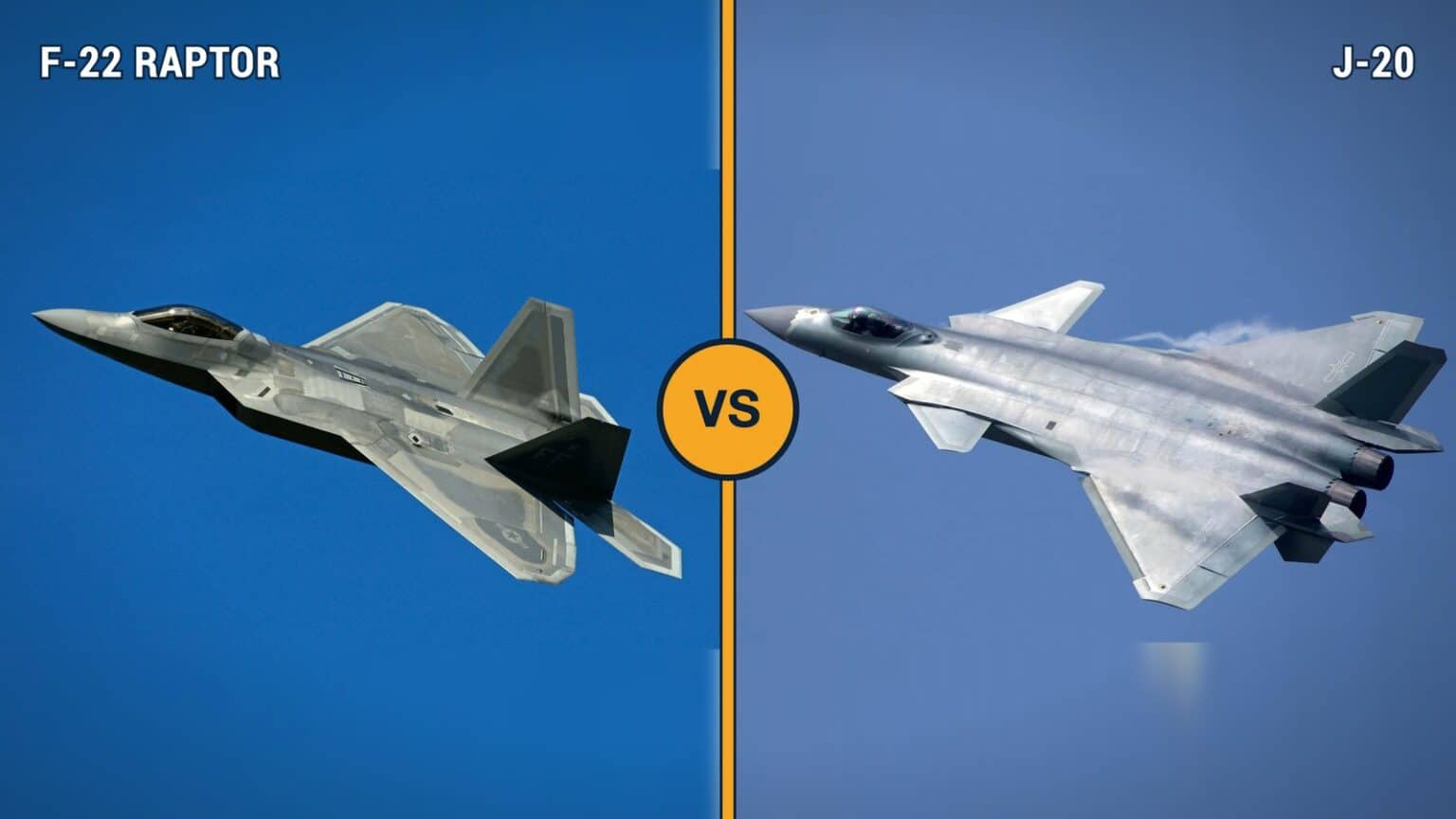
The F-22 Raptor is the closer match to the J-20, because both were designed first for air superiority. The Raptor is faster at Mach 2.25 and has thrust vectoring, but only 187 operational aircraft were built. Our F-22 vs J-20 comparison covers that matchup in detail.
For the wider picture, see our US vs China fighter jets comparison and the F-35 vs Su-57 matchup against Russia’s stealth fighter.
The verdict
In a one-on-one fight where both jets are stealthy and flying at medium range, the F-35 should win. It is harder to see, its sensors and data links are more mature, and it is likely to fire first.
That is not the fight the J-20 was built for. It goes faster and further with more missiles inside, and its targets are the tankers and radar aircraft that let the F-35 operate over the Pacific at all.
Both jets appear in our ranking of the best fighter jets in the world, and the J-20 features in our list of the best Chinese fighter jets.
FAQ
Sources and references used for research and fact-checking.
- U.S. Air Force, F-35A Lightning II fact sheet
- Wikipedia, Lockheed Martin F-35 Lightning II
- Lockheed Martin, F-35 Fast Facts
- Air & Space Forces Magazine, What Each F-35 Variant Really Costs Right Now
- Wikipedia, Chengdu J-20
- Mitchell Institute China Airpower Tracker, J-20
- CSIS China Power Project, Does China's J-20 Rival Other Stealth Fighters?
- U.S. Naval Institute Proceedings, Professional Notes: The U.S. F-35 versus the PRC J-20
- 19FortyFive, A Chinese Chengdu J-20 Stealth Fighter Was Filmed Carrying 8 PL-15 Missiles on External Hardpoints
- Wikipedia, Lockheed Martin F-22 Raptor
About the Author

Tim is the owner and lead editor of AeroCorner since 2019, overseeing aviation content covering aircraft, airlines, airports, and the broader aviation industry. Through years of researching, writing, editing, and publishing aviation-focused content, he has developed extensive practical knowledge of commercial aviation and air travel. Based in Asia and a frequent traveler himself, Tim also brings firsthand passenger experience to AeroCorner’s coverage. Outside of publishing, he has also explored aviation firsthand through hands-on flight training in New Zealand.