


Table of Contents
| Measure | F-35 (F-35C at sea) | F/A-18 Hornet and Super Hornet |
|---|---|---|
| Generation | Fifth | Fourth (Hornet), fourth-plus (Super Hornet Block III) |
| What it is for today | First-day strike into defended airspace, plus sensor and networking node for the air wing | Everyday strike, fleet defense, buddy tanking, the workhorse that flies the most sorties |
| Main radar | AN/APG-81 AESA, with the AAQ-40 targeting system and the AAQ-37 distributed aperture system | AN/APG-73 on the legacy Hornet, AN/APG-79 AESA on Super Hornet Block II and III |
| Radar signature | Shaped and coated for low observability, weapons carried internally | Conventional airframe, no low-observable shaping, everything hangs outside |
| Weapons carriage | Internal bays when stealth matters, external pylons when it does not | External only, across up to 11 stations |
| Cost per flight hour (FY2026 DoD rate) | F-35C $17,602 | F/A-18E $22,407, F/A-18F $24,603, F/A-18C $25,277 |
| US status, September 2026 | Growing, in both Navy and Marine squadrons | Super Hornet frontline into the 2040s, legacy Hornet out of US service by 2030 |
| Still in production | Yes | New-build Super Hornets end in 2027 |
First, which F-18 do you mean?
Almost every argument about the F-35 and the F-18 falls apart on this question. “F-18” covers two aircraft that share a name, a mission and almost nothing else.
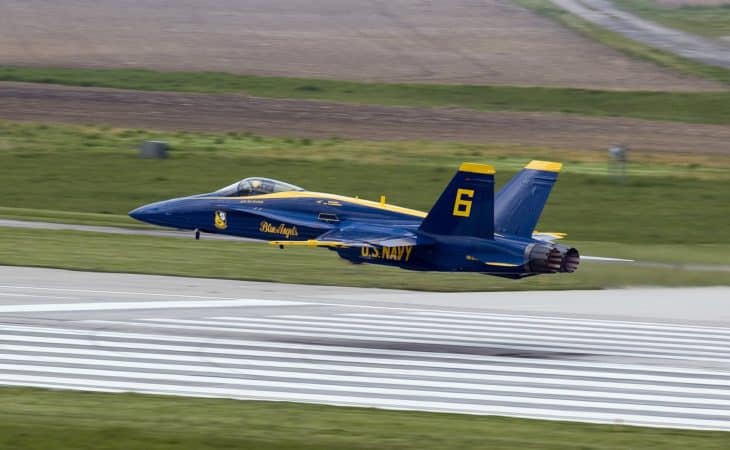
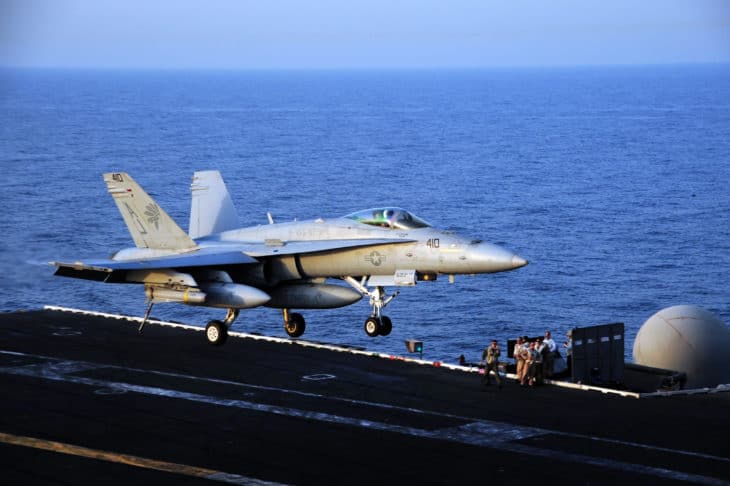
The legacy F/A-18 Hornet is the original. The Navy first deployed it in November 1978 and declared the A and B models operational in October 1983, with the C and D following in September 1987.
The F/A-18E/F Super Hornet is a different, larger aircraft that first flew in November 1995 and reached initial operational capability in September 2001. It carries a maximum takeoff weight of 66,000 pounds (29,900 kg) against the Hornet’s 51,900 pounds (23,500 kg), on more thrust from a different engine family.
That difference decides the comparison. The database panel above this article covers the legacy Hornet, the jet that is nearly finished in American service. The jet people actually mean when they argue about the F-35 is the Super Hornet.

The three comparisons people actually mean
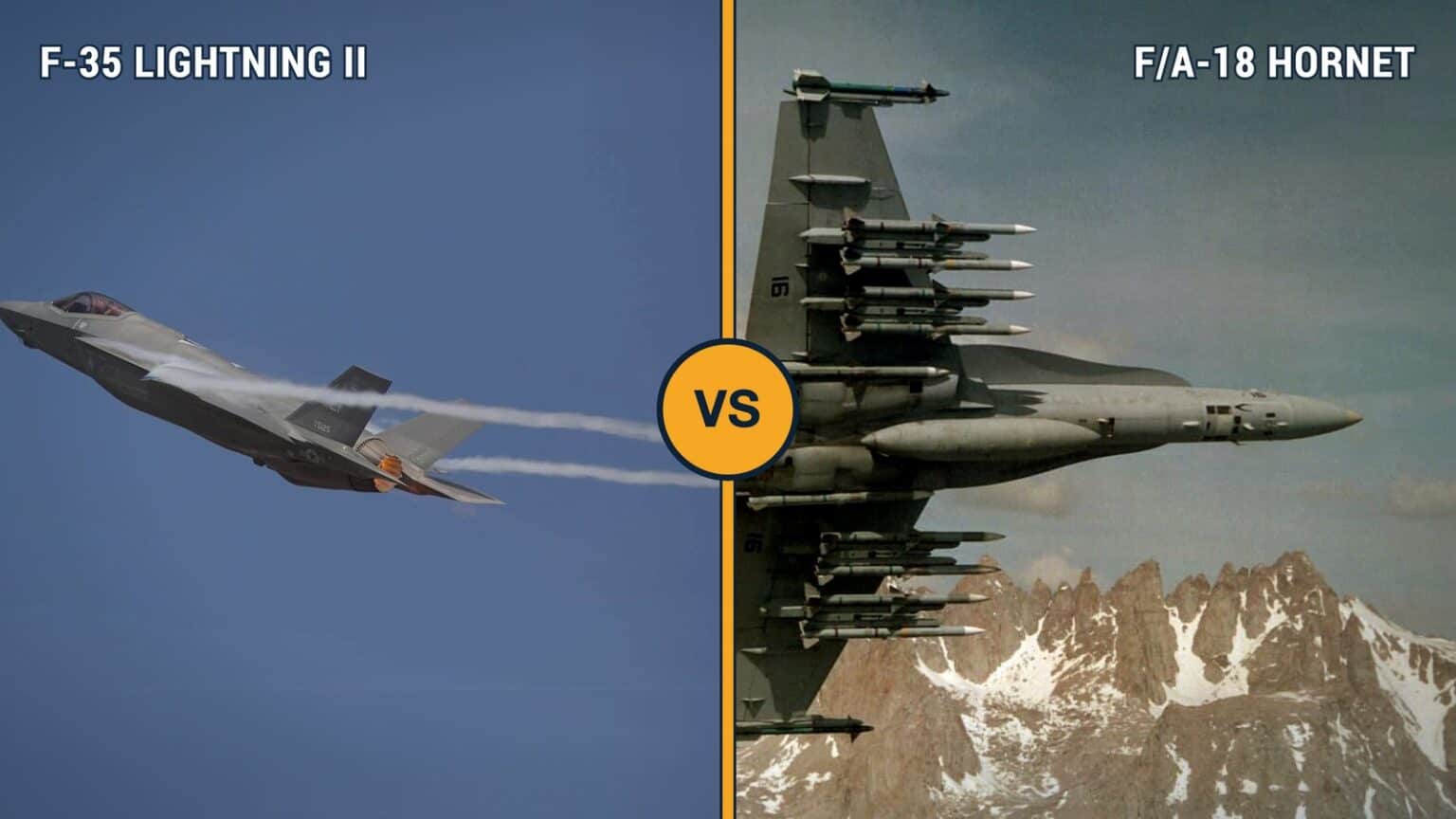
F-35A against the legacy Hornet is a mismatch across thirty years of design. F-35C against the Super Hornet is the live question inside the US Navy. F-35A against an export Hornet is what Finland, Switzerland and Canada each decided when they replaced their fleets. This article answers all three, but the second one is the real argument.
And which F-35?
The F-35 comes in three versions that are not interchangeable. The F-35A is the conventional runway version flown by the Air Force and most export customers.
The F-35B is the short takeoff and vertical landing version for the Marine Corps and for small-deck ships. It is the only one that can land vertically, which is the source of a common error about the family.
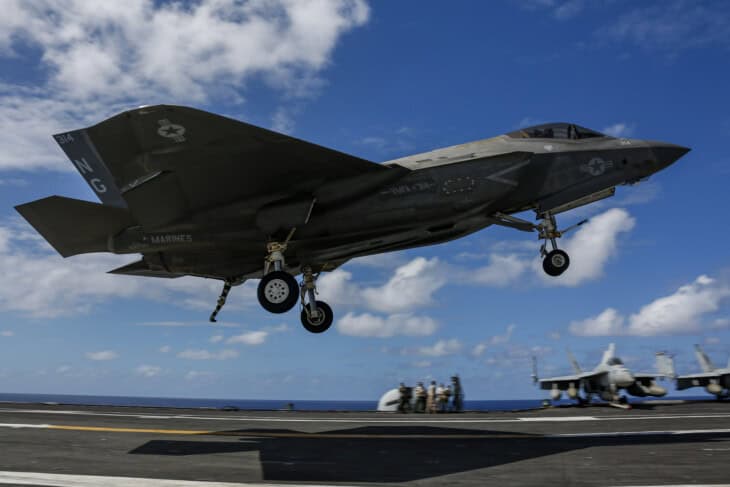
The F-35C is the carrier version, and it is the one that belongs in any serious comparison with the F-18. It has a bigger wing, folding wingtips, stronger landing gear and a tailhook built for arrested landings.
A correction worth making
The F-35 does not take off and land vertically as a family. Only the F-35B does, and it is a short takeoff aircraft rather than a true vertical takeoff one in operational use. The F-35A and the F-35C both need a runway or a catapult, exactly like an F-18.
F-18 vs F-35 speed: the Hornet family is faster
This one surprises people who assume the newer jet must be quicker. It is not.
The US Navy lists the Super Hornet at Mach 1.8 or better and the legacy Hornet at Mach 1.7 or better. The F-35C is published at Mach 1.6.
The gap is real but it is also close to meaningless in combat. Top speed is a clean-configuration number measured at altitude, and a strike fighter carrying weapons and fuel tanks will not see anything near it.
What matters more is how far the jet reaches. The F-35C is published with a combat radius on internal fuel of more than 600 nautical miles, and a range on internal fuel of more than 1,200 nautical miles, carrying 19,200 pounds (8,700 kg) of fuel inside the airframe.
Be careful comparing that to the Hornet numbers, because they are not the same measure. The Navy’s figure of 1,275 nautical miles for the Super Hornet is a combat range, clean plus two AIM-9s, not a radius, and a radius is roughly the distance out and back.
Read on the same basis, the F-35C goes noticeably further on its own fuel than a Super Hornet does, which is why the Navy values it for reaching targets without leaning on tankers. For an airframe-by-airframe look at outright speed, see our ranking of the fastest fighter jets ever built.
F-18 vs F-35 size: the Hornets are longer, the F-35 is heavier
The Super Hornet is the biggest of the three at 60.3 feet (18.4 m) long with a 44.9-foot (13.7 m) wingspan. The legacy Hornet is 56 feet (17.1 m) long with a 40-foot 5-inch (12.3 m) span.
The F-35C is the shortest at 51.5 feet (15.7 m), but its wing is wide for the length at 43 feet (13.1 m), and it folds so the jet fits a carrier deck. That wing is what separates the C from the land-based A.
Length is a poor guide to capability here. The F-35 packs a single large engine, internal weapons bays and a great deal of fuel into a shorter airframe, which is why it is dense rather than long.
The number almost everyone gets backwards: cost per flight hour
The standard line is that the F-18 is the cheap jet and the F-35 is the expensive one. On the Pentagon’s own published billing rates, that is no longer true.
Every year the DoD Comptroller publishes reimbursable rates: what one part of the Department bills another for an hour of a given aircraft. The FY2026 table puts the Navy’s F-35C below every Hornet variant on the list.
| Aircraft | FY2026 rate per flying hour |
|---|---|
| F-35C (Navy) | $17,602 |
| F-35C (Marine Corps) | $17,925 |
| F-35A | $18,600 |
| EA-18G Growler | $19,296 |
| F/A-18E Super Hornet | $22,407 |
| F-35B | $23,155 |
| F/A-18F Super Hornet | $24,603 |
| F/A-18C Hornet | $25,277 |
| F/A-18D Hornet | $48,137 |
Two honest caveats come with those numbers. A reimbursable rate is a billing rate, not the full cost of owning and sustaining a fleet, so it is not the same measure as a program-level cost per flight hour.
The same table also produces odd results for small fleets, where a handful of aircraft carry a large fixed cost. The two-seat F/A-18D at $48,137 is the clearest example, and the F-35C and Super Hornet lines are more meaningful precisely because both fleets are large.
The cheap hour is not the whole story
A low rate per hour does not mean the F-35 is a solved problem. The GAO reported in June 2026 that F-35 mission capable rates fell from 67 percent in FY2021 to 44 percent in FY2025, with full mission capable rates down from 38 percent to 25 percent, and projected that the services will face a gap of more than $1 billion a year between F-35 sustainment costs and their affordability goals by the mid-2030s. A cheaper hour is worth less when fewer jets are ready to fly it.
Stealth against payload: the tradeoff that decides missions
The F-35’s advantage is not speed or agility. It is being harder to see, and seeing more.
Its shaping, coatings and internal weapons bays are designed so an opposing radar gets a usable return much later than it would against a Hornet. The AN/APG-81 radar, the electro-optical targeting system and the distributed aperture system then feed one fused picture rather than several separate displays.
The Super Hornet’s advantage is what it can carry and how often. Up to 11 external stations let it haul a heavy and varied load, which makes it the aircraft of choice when nobody is shooting back and the job is to deliver weapons.
The F-35C can also carry weapons externally when stealth is not needed, with a published weapons payload of 18,000 pounds (8,200 kg). Doing so gives up the low-observable advantage, which is exactly the point: the jet is configured for the threat, not for a brochure.
F-35 vs F-18 dogfight: the wrong question, asked honestly
The dogfight question dominates forums and it is worth answering plainly rather than dodging.
The F-35C is rated to 7.5 g and it is not built to out-turn a dedicated air superiority fighter. On raw agility numbers it is in the same class as the Super Hornet rather than a clear step above it.
But the F-35 is not designed to arrive in a turning fight. It is designed to detect, identify and shoot first, from a range at which the other aircraft still has no firing solution.
Put a Super Hornet and an F-35C in a merged, guns-only, both-aircraft-aware setup and you have built the one scenario the F-35 exists to avoid. The answer to “can the F-18 beat the F-35 in a dogfight” is that a dogfight already means something went wrong for the stealth jet.
Who flies what in September 2026
The legacy Hornet is almost gone from American service. The Marine Corps, its last US operator, will complete the switch to the F-35 by 2030.
The published schedule retires the type at Marine Corps Air Station Beaufort by August 1, 2028, at Miramar by August 1, 2029, and at Naval Air Station Joint Reserve Base Fort Worth by August 1, 2030. Marine Hornet pilot training already ended in 2018.
The Super Hornet is a different story. It remains the numerical backbone of the carrier air wing, and a typical deployed wing in 2026 mixes Super Hornet squadrons with one or two F-35C squadrons rather than choosing between them.
Abroad, the legacy Hornet still flies with operators including Canada, Finland, Kuwait, Spain and Switzerland. Several of those air forces have already picked their replacement, and they picked the same aircraft.
Switzerland selected the F-35A to replace its Hornet fleet and is buying 36 of them. Finland followed in December 2021, choosing 64 F-35As over the Super Hornet, the Rafale, the Eurofighter Typhoon and the Gripen, with deliveries running from 2026 to 2030.
That is the clearest verdict on offer. Given a free choice, a real budget and the Super Hornet on the table as an option, governments replacing Hornets have been picking F-35s.

Is the F-35 replacing the F-18?
For the legacy Hornet, yes, and the date is set. For the Super Hornet, no, and the Navy has spent real money making that clear.
New-build Super Hornet production does end. Northrop Grumman delivered its final lot of structural components on January 27, 2026, and Boeing expects to hand over the last new aircraft by 2027 under a final Navy order for 17 jets.
Ending production is not the same as ending service. Under the Service Life Modification program the Navy is extending Super Hornet airframes from 6,000 to 10,000 flight hours, with a contract awarded in December 2025 covering up to 60 aircraft and work running to November 2028.
The reason is the gap. The Super Hornet’s eventual replacement is the F/A-XX, the Navy’s sixth-generation carrier fighter, and as of September 2026 the contract has still not been awarded, with Boeing and Northrop Grumman the remaining competitors after Lockheed Martin was eliminated in 2025.
Until that aircraft exists, the Super Hornet has to keep flying, which is why the Navy is rebuilding rather than retiring it. Our guide to sixth-generation fighter jets covers where that program sits.
1978
The Hornet arrives. The F/A-18 is first deployed in November, becoming operational in the A and B models in October 1983.
1995
A bigger jet, the same name. The F/A-18E/F Super Hornet flies in November, reaching initial operational capability in September 2001.
2019
The F-35C goes operational. The Navy declares initial operational capability for the carrier variant on February 28.
2021
First carrier deployment. VFA-147 takes the F-35C to sea aboard USS Carl Vinson, integrated into the air wing alongside Super Hornets.
January 2026
The production line winds down. Northrop Grumman delivers the final lot of Super Hornet structural components on January 27.
May 2026
The Marines set a date. The Corps confirms the legacy Hornet leaves its last bases on a schedule ending August 1, 2030.
2027
The last new Super Hornet. Boeing expects to deliver the final new-build aircraft, closing a line that opened in the 1990s.
The verdict
Against the legacy F/A-18 Hornet, the F-35 wins on every measure that decides a modern fight, and the world’s air forces have voted with their budgets. The Hornet’s remaining advantage is that it is paid for.
Against the F/A-18E/F Super Hornet, there is no single winner, and the US Navy’s own behavior is the evidence. It is buying F-35Cs and rebuilding Super Hornets at the same time.
Pick the F-35C when the airspace is defended, when reach on internal fuel matters, and when the jet needs to survive being seen. Pick the Super Hornet when the job is carrying a lot of weapons a moderate distance, repeatedly, to a place nobody is defending.
The Navy’s answer, in other words, is both. If you want the wider field, see our rankings of the best carrier-based fighter jets and the best fighter jets in the world.
FAQ
Sources and references used for research and fact-checking.
- U.S. Navy, F/A-18A-D Hornet and F/A-18E/F Super Hornet Strike Fighter
- U.S. Naval Academy, F-35C Lightning II
- Office of the Under Secretary of Defense (Comptroller), Fiscal Year 2026 Department of Defense Fixed Wing and Helicopter Reimbursable Rates
- U.S. Government Accountability Office, F-35 Sustainment: Actions Needed to Ensure Updated Strategy Improves Persistent Readiness Challenges
- Stars and Stripes, Marines to phase out F/A-18 Hornet, maintenance jobs tied to the plane by 2030
- The War Zone, Last New F/A-18 Aft Fuselages Built As Super Hornet Production End Approaches
- FlightGlobal, Boeing extends Super Hornet production to 2027 with final new-build order from USA
- The Aviationist, Boeing Awarded $931 Million Super Hornet Service Life Modification Contract
- USNI News, Navy Declares Initial Operational Capability for F-35C Joint Strike Fighter
- Naval News, First Operational Deployment for US Navy's CMV-22B and F-35C
- Military Times, US Navy's next-generation fighter decision to be unveiled soon, sources say
- Defense One, Finland Chooses F-35 Over Super Hornet, 3 European Fighters
- Aerospace Global News, Switzerland reaches first production milestone for its F-35A fleet
- Simple Flying, The Little-Known Reason The US Navy Still Chooses The F/A-18 Super Hornet Over The F-35C On Certain Missions
About the Author

Tim is the owner and lead editor of AeroCorner since 2019, overseeing aviation content covering aircraft, airlines, airports, and the broader aviation industry. Through years of researching, writing, editing, and publishing aviation-focused content, he has developed extensive practical knowledge of commercial aviation and air travel. Based in Asia and a frequent traveler himself, Tim also brings firsthand passenger experience to AeroCorner’s coverage. Outside of publishing, he has also explored aviation firsthand through hands-on flight training in New Zealand.