


Table of Contents
| Judgment call | F-16 Fighting Falcon | F/A-18 Hornet |
|---|---|---|
| Built for | Land bases. A lightweight day fighter that grew into a multirole workhorse | Carrier decks. A fighter and attack aircraft in one airframe |
| Radar lineage | AN/APG-66, then AN/APG-68, with AESA sets on later blocks | AN/APG-65, then AN/APG-73 on the C and D |
| Wing loading | 88.3 lb/sq ft | 93 lb/sq ft |
| Thrust-to-weight | 1.095 | 0.96 |
| Maximum external load | 17,000 lb | 13,700 lb |
| Still in production | Yes, restarted in 2019 | No, the legacy line closed in 2000 |
| Export reach | 25 operators beyond the U.S. Air Force | Canada, Australia, Spain, Switzerland, Finland and Kuwait |
The one requirement that explains everything else
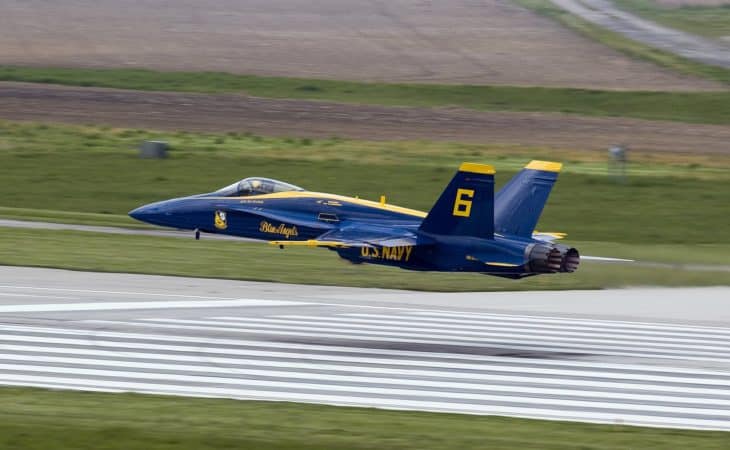
The F/A-18 Hornet had to land on a ship. That sounds like a detail. It is actually the reason the two aircraft look and fly the way they do.
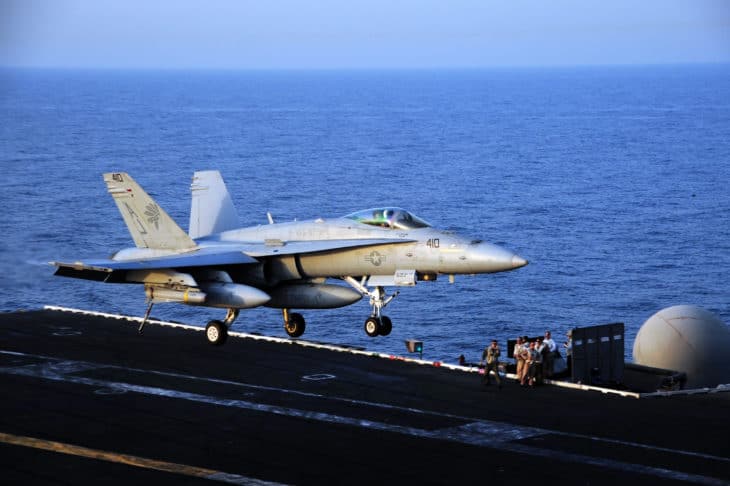
A carrier landing is a controlled collision. The airframe needs a reinforced structure, a tailhook, heavier landing gear and wings that fold to fit the deck. All of that is weight the F-16 never had to carry.
The Hornet also needed to fly slowly and predictably on approach, with the nose high and the engines responsive. The F-16 was optimized for the opposite: accelerate hard, turn hard, get home.
_87_lands_on_the_flight_deck_of_the_aircraft_carrier_USS_George_H.W._Bush_(CVN_77).jpg)
Two different customers, not two rivals
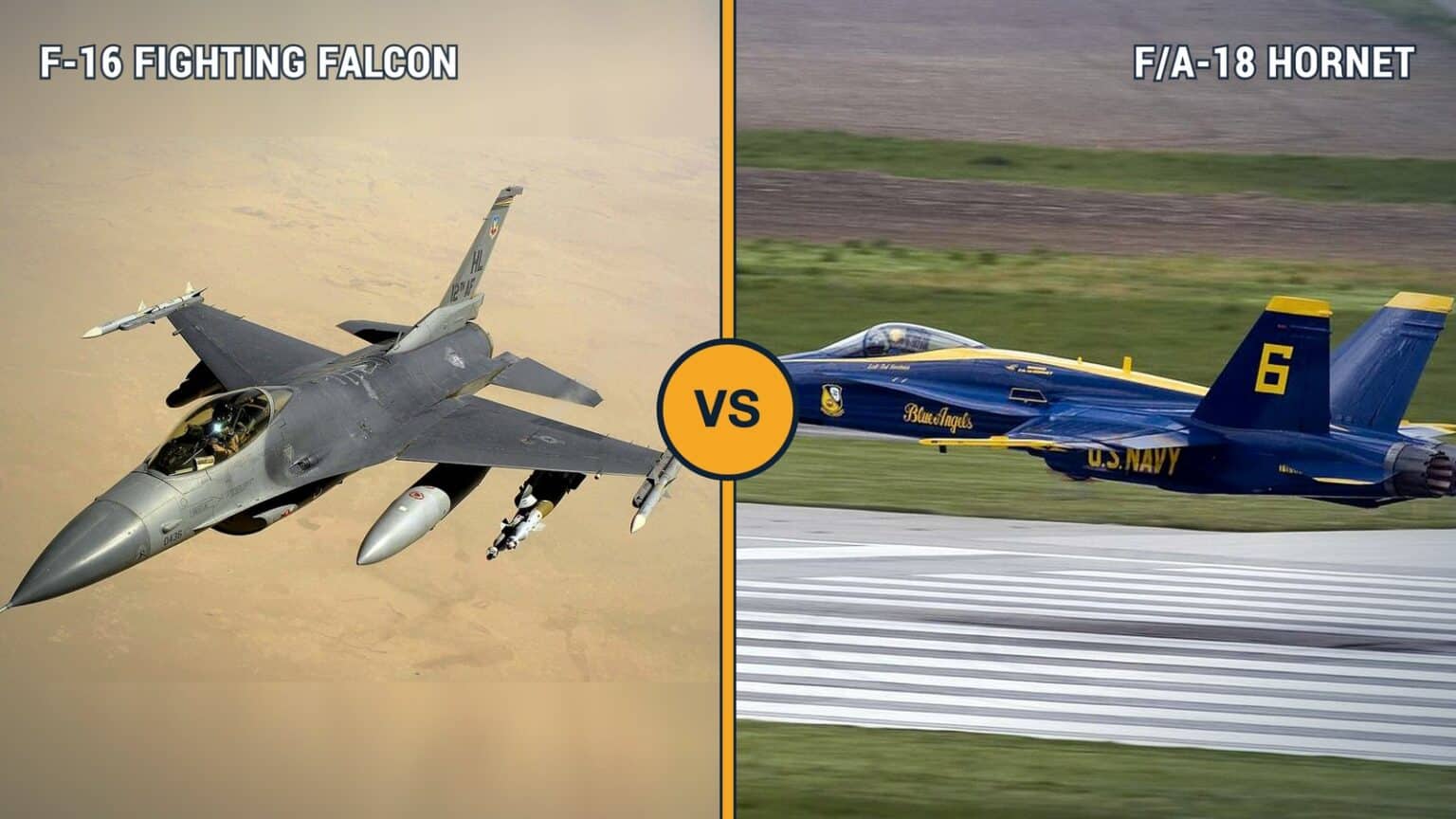
The F-16 and the F/A-18 were never in competition for the same job. The Air Force flies from runways it controls. The Navy flies from a 1,000-foot deck that is moving. The two services wrote different requirements and got different aircraft.
Size: the F-18 is bigger, and not by a little
This is the comparison most people get wrong, so here are the real numbers. The F-16 is 49 feet 5 inches long (15.1 m) with a wingspan of 32 feet 8 inches (10.0 m). The Hornet is 56 feet long (17.1 m) with a span of 40 feet 5 inches (12.3 m).
The wing tells the clearer story. The F-16 has 300 square feet of wing area. The Hornet has roughly 409 square feet, about a third more.
Empty, the F-16 weighs 18,900 pounds against the Hornet’s 23,000 pounds. Fold the Hornet’s wings and it narrows to 27 feet 7 inches (8.4 m), which is the only dimension where the bigger aircraft wins.
Despite the larger wing, the Hornet still carries more weight per square foot: 93 lb/sq ft against the F-16’s 88.3. The extra wing does not fully offset the extra structure.
One engine or two
The F-16 has a single engine, either a General Electric F110 or a Pratt & Whitney F100 depending on the block. The Air Force fact sheet lists 27,000 pounds of thrust for the F-16C/D.
The Hornet has two General Electric F404 engines, each rated at 17,750 pounds with afterburner. That is more total thrust, but it is pushing a much heavier aircraft.
The published thrust-to-weight ratios settle it: 1.095 for the F-16 against 0.96 for the Hornet. The F-16 is the only one of the two that can accelerate vertically at normal loaded weight.
The second engine is not there for performance. It is there because the Navy flies hundreds of miles over open water, where losing the only engine means losing the aircraft.

Speed and altitude
The F-16 is faster, and the margin is real. It reaches Mach 2.05, about 1,176 knots, at 40,000 feet. The Hornet tops out at Mach 1.8, about 1,034 knots, at the same altitude.
Down low the gap holds. The F-16 is quoted at Mach 1.2 and 800 knots at sea level, the Hornet at Mach 1.06 and 700 knots.
Ceiling is where the myth needs correcting. Both aircraft are published at 50,000 feet. The Hornet does not fly higher than the F-16, and neither aircraft can supercruise, which means neither can hold supersonic speed without afterburner.
Three claims about these jets that are simply wrong
The F/A-18 is a McDonnell Douglas design, now Boeing, not a Lockheed Martin one. The Hornet cannot supercruise and does not carry torpedoes. And the F-16 has no armor plating; that is the A-10 Thunderbolt II. All three errors are repeated constantly in F-16 versus F-18 comparisons.
Range and payload
Ferry range is the only range figure the two publish in a comparable way. With external tanks, the F-16 is listed at 2,277 nautical miles and the Hornet at 1,800.
Official figures run lower than the encyclopedia ones. The Air Force publishes “more than 2,002 miles ferry range (1,740 nautical miles)” for the F-16, and NAVAIR gives 1,546 nautical miles for the Hornet. The ranking does not change, but the numbers move depending on who is publishing them.
Combat radius figures are not comparable at all, and anyone who lines them up side by side is comparing different missions. The F-16’s 295 nautical miles is a hi-lo-hi profile carrying four 1,000-pound bombs. The Hornet’s 400 nautical miles is an air-to-air mission with no bombs at all.
On payload the F-16 wins on paper, rated to 17,000 pounds of external stores against the Hornet’s 13,700. In practice the Hornet’s larger airframe and heavier maximum takeoff weight make it the more comfortable carrier of a full strike load.
Who would win in a dogfight?
On the numbers, the F-16. It has the better thrust-to-weight ratio, the lower wing loading, a +9 g limit and a published roll rate of 324 degrees per second. In an energy fight, where both aircraft are fast and turning, that combination is hard to beat.
The Hornet’s advantage shows up when the fight slows down. It was built to stay controllable at very high angles of attack, because that is what a carrier approach demands, and it can point its nose at an opponent in situations where other fighters run out of control authority.
That is a real but narrow edge. Getting slow to use it also burns the energy you need to escape, which is why it is a last resort rather than a tactic.
In any case, modern air combat is usually decided before the merge, by radar, missiles and whoever saw the other first. If you want the wider field, our guide to the best fighter jets in the world puts both aircraft in context.
Who still flies them
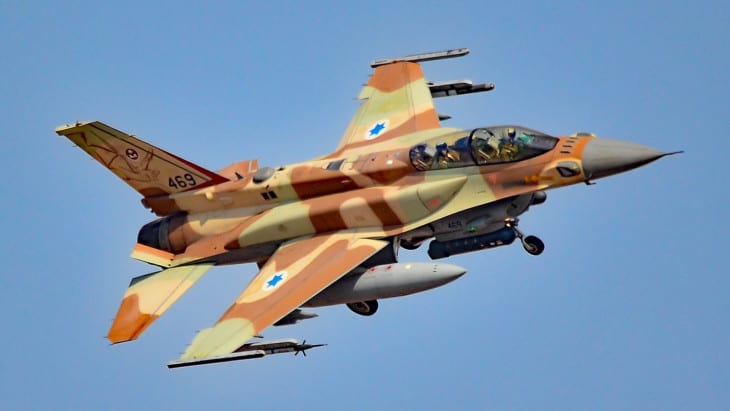
The F-16 is the more successful program by a wide margin. 4,604 have been built, it serves with 25 operators beyond the U.S. Air Force, and production restarted in 2019 after a two-year pause.
The legacy Hornet is in its final chapter. Production ended in 2000, and the U.S. Navy retired its last legacy Hornets in 2019.
The type still flies with the U.S. Marine Corps and with Finland, Spain, Switzerland and Kuwait. Canada and Australia were also major operators.

One point worth making on cost, because it gets misused: the Air Force lists the F-16C/D at $18.8 million in fiscal 1998 dollars, and NAVAIR lists the Hornet at $29 million. Those are different years on different accounting bases, so they are not a like-for-like price comparison.
So which one is better?
If the question is which aircraft is the better pure fighter, the F-16. It is faster, lighter, climbs harder, turns tighter and costs less to buy and run.
If the question is which aircraft is more useful to a navy, the F/A-18, by default. The F-16 cannot operate from a carrier, so for that mission the comparison ends before it starts.
The honest answer is that the Hornet accepted a performance penalty to do a job the F-16 cannot do at all. That is not a flaw in the design. It is the design.
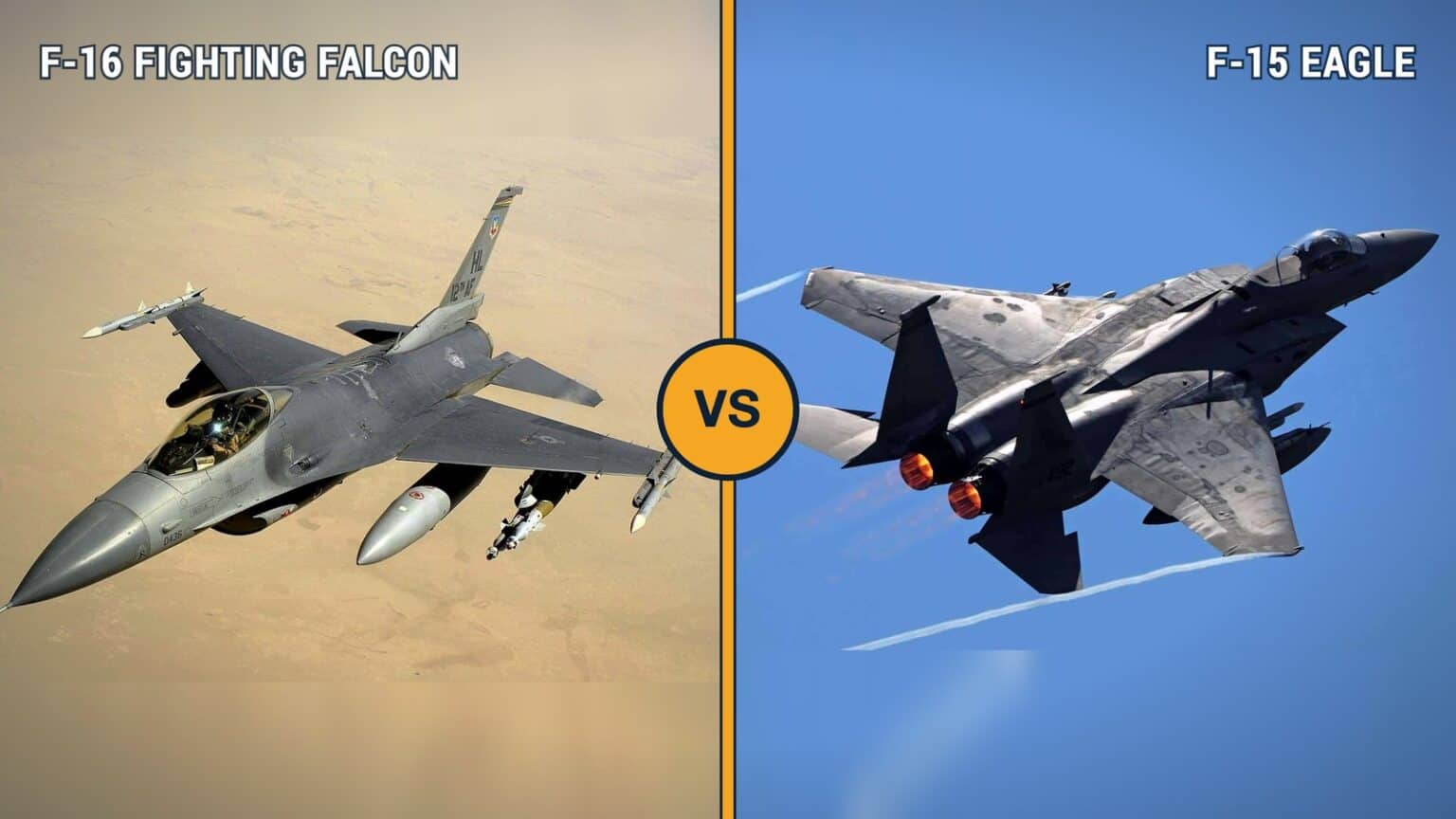
For a closer matchup on the Air Force side, see how the F-16 compares against the larger, twin-engine F-15 Eagle.
FAQ
Sources and references used for research and fact-checking.
About the Author

Tim is the owner and lead editor of AeroCorner since 2019, overseeing aviation content covering aircraft, airlines, airports, and the broader aviation industry. Through years of researching, writing, editing, and publishing aviation-focused content, he has developed extensive practical knowledge of commercial aviation and air travel. Based in Asia and a frequent traveler himself, Tim also brings firsthand passenger experience to AeroCorner’s coverage. Outside of publishing, he has also explored aviation firsthand through hands-on flight training in New Zealand.