


Table of Contents
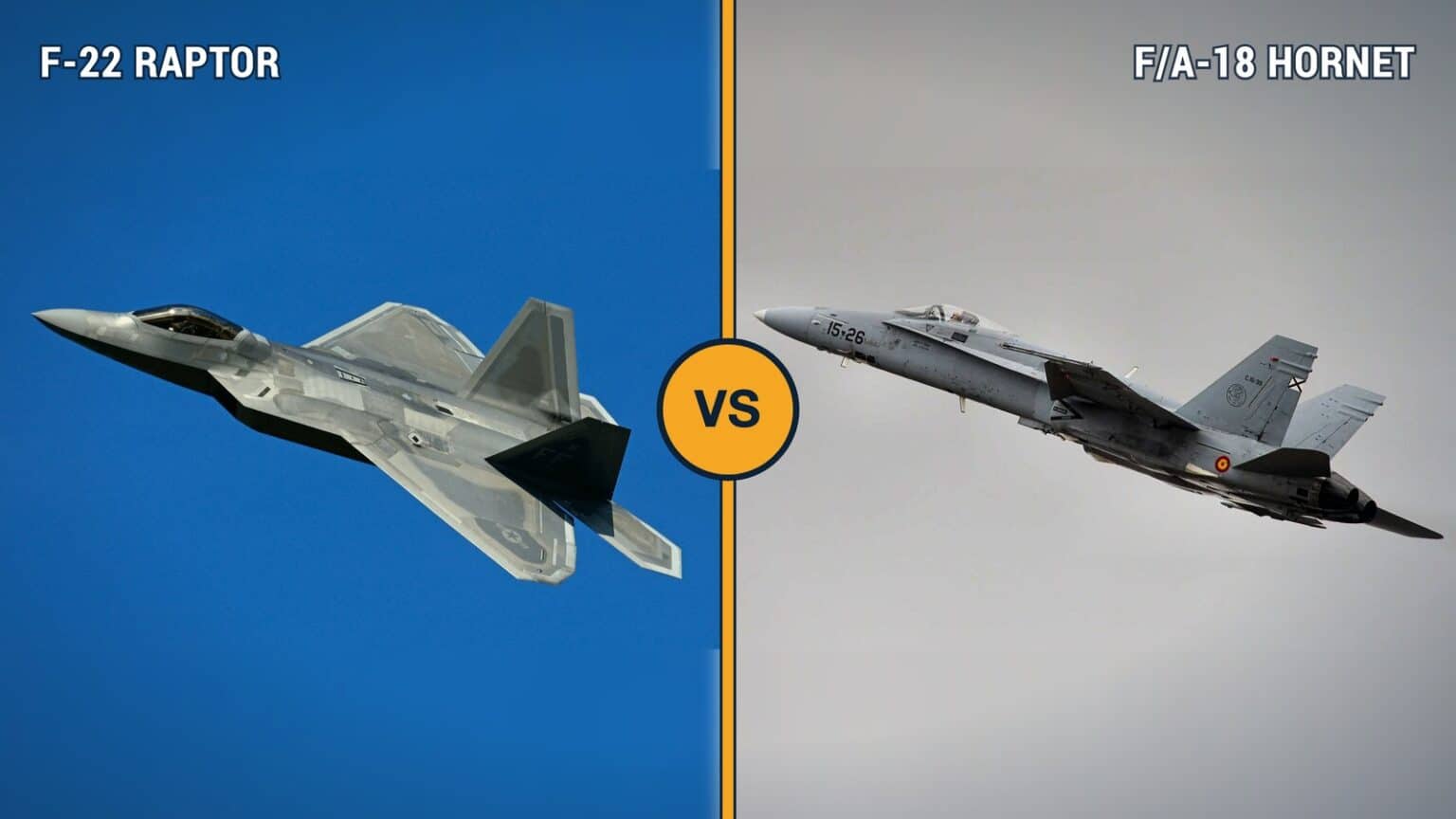
| Judgment call | F-22 Raptor | F/A-18 Hornet |
|---|---|---|
| Built for | Air dominance from land bases | Fighter and attack missions from a carrier deck |
| Generation | Fifth | Fourth |
| Stealth | All-aspect, designed in from the start | None |
| Supercruise | Yes, roughly Mach 1.8 without afterburner | No |
| Weapons carriage | Internal bays, six AIM-120 and two AIM-9 | Nine external hardpoints |
| Radar | AN/APG-77 AESA | AN/APG-65, then AN/APG-73 |
| Carrier capable | No | Yes, the entire point of the design |
| Crew | One, no two-seat version was ever built | One in the A and C, two in the B and D |
| Production | Closed in 2011, 187 production aircraft | Closed in 2000, about 1,480 built |
| Export | Banned by US law, no foreign operator | Canada, Australia, Spain, Switzerland, Finland, Kuwait |
| Combat debut | Syria, 2014 | Gulf War, 1991 |
The one difference that explains all the others
These aircraft answered two different questions, 20 years apart. The F/A-18 Hornet first flew in November 1978. The F-22 Raptor first flew in September 1997.
The Navy wanted one airframe that could fly the fighter mission and the attack mission in the same sortie, and land on a moving ship afterward. That is where the F/A designation comes from.
The Air Force wanted something narrower and far more extreme: an aircraft that could enter defended airspace without being seen and kill anything that came near it. Everything expensive about the Raptor follows from that one sentence.
Size: the Raptor is much bigger
This is the question most people actually arrive with, so here are the real numbers. The F-22 is 62 feet 1 inch long (18.9 m) with a wingspan of 44 feet 6 inches (13.6 m). The Hornet is 56 feet long (17.1 m) with a span of 40 feet 5 inches (12.3 m).
So the Raptor is about 6 feet longer and 4 feet wider. On paper that sounds modest, and it badly undersells the difference.
Weight tells the honest story. The F-22 weighs 43,340 pounds empty (19,700 kg) against the Hornet’s 23,000 pounds (10,400 kg). The Raptor is very close to twice the aircraft before either one loads a weapon.
The Hornet’s maximum takeoff weight is 51,900 pounds (23,500 kg), which is only a little more than what an empty Raptor weighs plus its internal fuel. These are not aircraft in the same weight class.
Stealth is the whole argument
Every other difference here is a matter of degree. This one is a matter of kind.
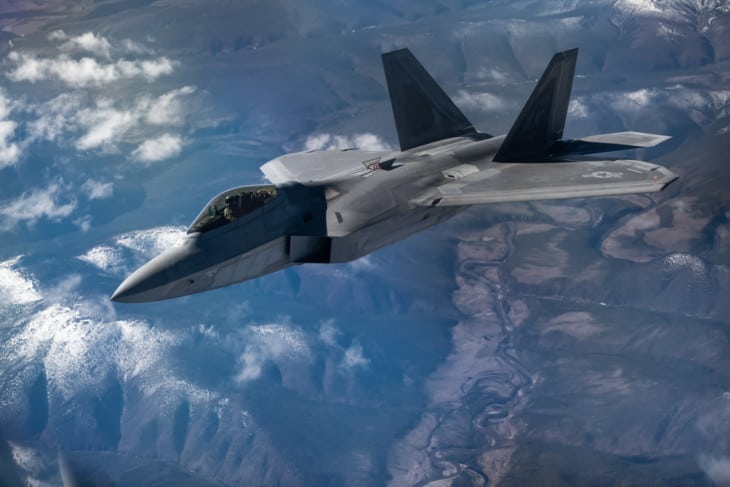
The F-22’s radar cross section is classified, but Lockheed Martin has described it as roughly 0.0001 square meters from certain angles, about the return of a steel marble. The shaping, the serpentine engine inlets, the radar-absorbent materials and the internal weapons bays all exist to produce that number.
The Hornet has no stealth features at all. It was designed in the 1970s, and it hangs its missiles, bombs and fuel tanks in the open air, where each one reflects radar energy.
That is why a straight capability comparison flatters the Raptor so heavily. If one aircraft can see the other first and shoot first, the rest of the specification sheet rarely gets a vote. Our guide to the best stealth aircraft in the world covers how far that advantage extends.
Weapons, and where they are carried
The F-22 carries six AIM-120 radar-guided missiles in its main bay and two AIM-9 heat-seeking missiles in side bays, plus an M61A2 20mm cannon with 480 rounds. All of it is inside the aircraft.
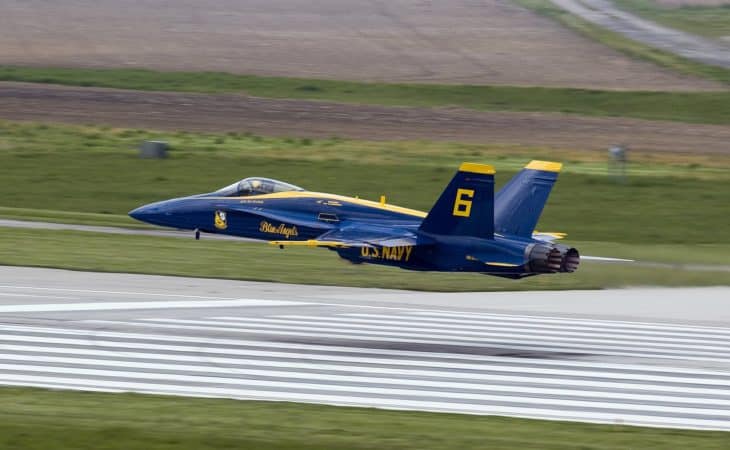
The Hornet has nine hardpoints and is rated to about 13,700 pounds of external stores, a far wider and heavier weapons load than the Raptor can carry internally. It carries one M61 Vulcan cannon in the nose.
That is a genuine Hornet advantage and it is usually stated backwards. The Hornet can carry more, and a greater variety, including Harpoon, HARM, Maverick, JSOW and JDAM. It just cannot do so without lighting up on radar.


Speed, thrust and supercruise
The Air Force describes the F-22 as “Mach two class with supercruise capability”. The Hornet is published at Mach 1.7 and above, or about Mach 1.8 at 40,000 feet.
Top speed is the least interesting half of that sentence. Supercruise is the part that matters: the Raptor can hold roughly Mach 1.8 without afterburner, and the Hornet cannot sustain supersonic speed without one.
Afterburner drinks fuel at an enormous rate, so a Hornet going supersonic is on a short clock. The F-22 can cross a threat area at supersonic speed and still have fuel to fight when it arrives.
The thrust figures explain how. Each of the F-22’s two F119 engines is in the 35,000-pound class. Each of the Hornet’s two F404 engines produces 17,700 pounds. A single Raptor engine is roughly the equal of both Hornet engines combined.
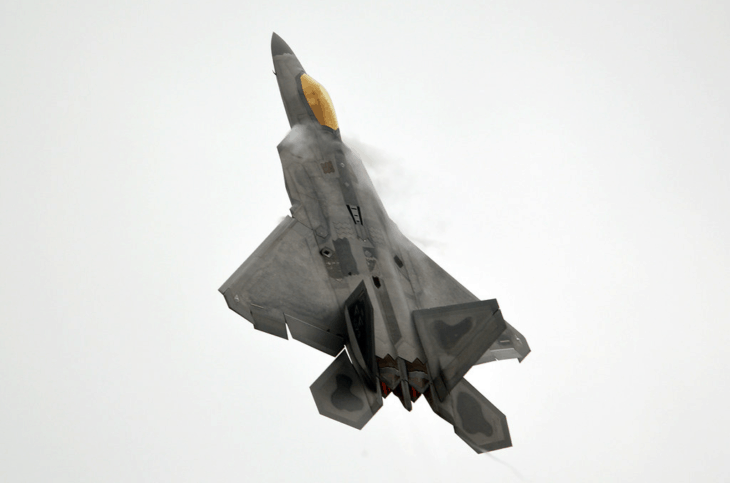
The Raptor's only air-to-air kill was a balloon
On 4 February 2023 an F-22 from the 1st Fighter Wing fired a single AIM-9X into the Chinese surveillance balloon off the South Carolina coast. It was the first known air-to-air takedown in the type’s history. The Raptor shot from 58,000 feet at a target drifting between 60,000 and 65,000 feet, and the two jets used the callsigns FRANK01 and FRANK02, in tribute to Frank Luke Jr., the World War I pilot nicknamed the Arizona Balloon Buster.
The one thing the Hornet does that the Raptor cannot
The F-22 has never landed on an aircraft carrier and never will. It has no tailhook for arrested landings, no folding wings, and no carrier-strength landing gear, because none of that was in the requirement.
Carrier capability cannot be retrofitted. It dictates the structure, the gear, the approach handling and the wing from the first drawing, which is why the Navy has never bought a land-based fighter and adapted it.
So for the Navy’s mission the comparison ends before it begins. If you want the aircraft that actually competes with the Hornet on that ground, see our ranking of the best carrier-based fighter jets.
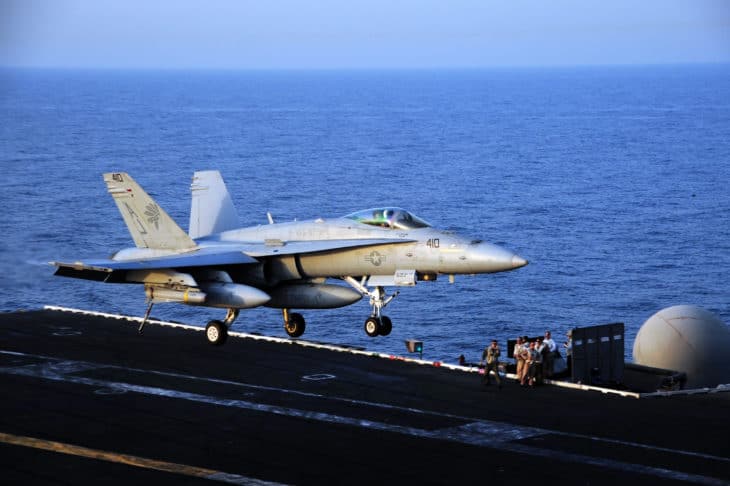
_87_lands_on_the_flight_deck_of_the_aircraft_carrier_USS_George_H.W._Bush_(CVN_77).jpg)
Who would win in a fight?
The F-22, and it is not close. The honest reason is duller than a dogfight: the Raptor almost certainly detects the Hornet first, fires first, and is never detected in return.
Its AN/APG-77 AESA radar looks further than the Hornet’s APG-73, its radar cross section denies the Hornet a lock at comparable range, and supercruise lets it choose the range at which the fight happens. Modern air combat is decided by who sees whom first.
Inside visual range the gap narrows, though it does not close. The Hornet is genuinely excellent at high angles of attack, but the F-22 has thrust vectoring, far more thrust, and can trim at over 60 degrees angle of attack while keeping roll control.
Treat the lopsided exercise scorelines you see quoted with care. The widely repeated ratios from Northern Edge and similar exercises vary from source to source, none has an official figure behind it, and every one of them reflects scripted rules of engagement rather than a real war.
Four claims about these jets that keep getting repeated
The F-22 is a Lockheed Martin aircraft with Boeing as a major partner, not a Boeing design. No foreign air force flies it: US law has barred its export since 1998, so Japan and Israel bought the F-35 instead. The F-22 is single-seat and no two-seat version was ever built. And the Hornet carries one 20mm cannon, not two.
Who still flies them in 2026
The F-22 is flown by the United States Air Force and nobody else. Congress banned its export in 1998 and has never lifted the ban, which is why Japan, Israel and Australia all ended up with the F-35 instead.
Production closed in 2011 after 187 production aircraft. As of September 2026, US law bars the Air Force from retiring any Raptor or dropping the fleet below 184 aircraft before 30 September 2027.
Thirty-two of those are older Block 20 jets used for training rather than combat. A contractor estimate reviewed by the Government Accountability Office put the cost of bringing them up to combat standard at a minimum of $3.3 billion over roughly 15 years.
The legacy Hornet is further along the same road. The US Navy retired its last F/A-18C from operational service in 2019, and the Marine Corps is now working through a dated run-out: Beaufort by 1 August 2028, Miramar by 1 August 2029, and Fort Worth by 1 August 2030.
Abroad the type is also winding down. Finland began handing over to the F-35A in 2026, Spain is retiring its oldest airframes as Eurofighters arrive, and Canada, still the largest operator outside the United States, is replacing its CF-188 fleet with 88 F-35As.
On price, the Air Force lists the F-22 at $143 million and NAVAIR lists the Hornet at $29 million. Those are different years on different accounting bases, so treat the roughly five-to-one ratio as a rough order of magnitude and not a like-for-like quote.
Hornet or Super Hornet? They are not the same aircraft
A lot of F-22 versus F-18 comparisons quietly switch aircraft halfway through, so it is worth being explicit. This page is about the legacy Hornet, the F/A-18A, B, C and D.
The F/A-18E/F Super Hornet is a substantially larger and later aircraft that shares a name and a general shape rather than a design. It is longer, heavier, carries more fuel and weapons, and it is the jet the US Navy actually flies today.
Against the Raptor the Super Hornet closes some of the gap on range and payload. It closes none of the gap on stealth or supercruise, so the shape of the verdict does not change.
So which one is better?
As a pure air superiority fighter, the F-22, decisively. It is the more capable aircraft in almost every dimension that decides an air-to-air engagement, and it was designed two decades later to do exactly that job.
As a useful aircraft for a navy, the Hornet, because the Raptor cannot fly the mission at all. A fighter that cannot reach the fight is not an option, whatever its radar cross section.
The fairer framing is that the Hornet has been doing real work for over 40 years across a dozen air forces, while 187 Raptors were built and never sold to anyone. Both of those are consequences of the same design choices.
For a closer matchup, the F-22 against the F-35 is the comparison that actually troubles the Raptor, and the F-16 against the F-18 puts the Hornet up against a true contemporary. The Hornet also appears in our ranking of the best fighter jets in the world.
FAQ
Sources and references used for research and fact-checking.
- U.S. Air Force, F-22 Raptor fact sheet
- Naval Air Systems Command, F/A-18 A-D Hornet
- Wikipedia, Lockheed Martin F-22 Raptor
- Wikipedia, McDonnell Douglas F/A-18 Hornet
- Air & Space Forces Magazine, Chinese Surveillance Balloon Shot Down By F-22
- Stars and Stripes, Marines to phase out F/A-18 Hornet by 2030
- 19FortyFive, The Air Force Wants to Retire 32 F-22 Raptor Fighters
About the Author

Tim is the owner and lead editor of AeroCorner since 2019, overseeing aviation content covering aircraft, airlines, airports, and the broader aviation industry. Through years of researching, writing, editing, and publishing aviation-focused content, he has developed extensive practical knowledge of commercial aviation and air travel. Based in Asia and a frequent traveler himself, Tim also brings firsthand passenger experience to AeroCorner’s coverage. Outside of publishing, he has also explored aviation firsthand through hands-on flight training in New Zealand.