


Table of Contents
F/A-18 Hornet vs Super Hornet at a glance
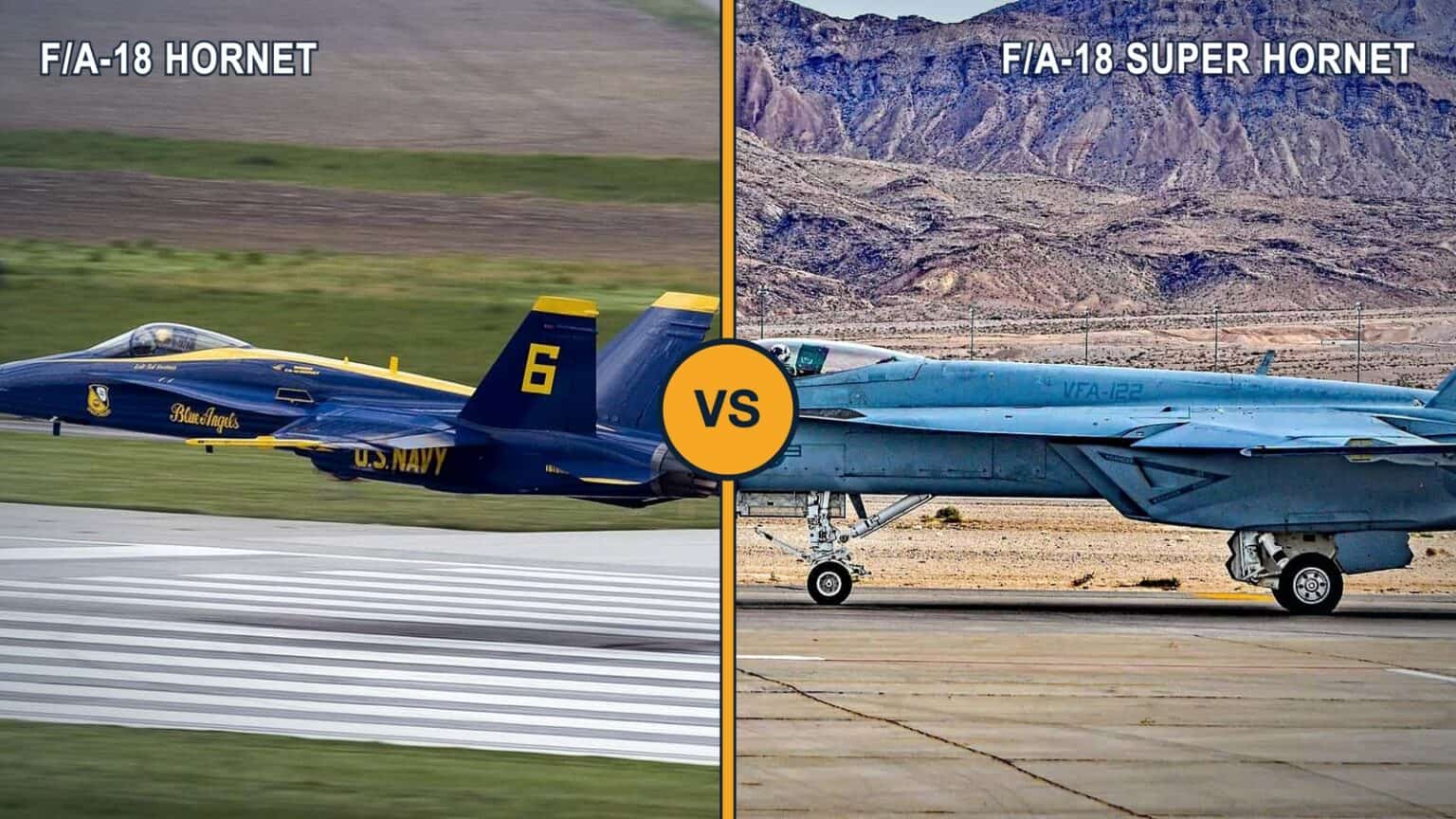
The Super Hornet is a bigger, longer-ranged and more capable jet than the original Hornet, built on the same idea. The Navy kept the F/A-18 name to sell it to Congress as a low-risk upgrade, but the two aircraft share little beyond the forward fuselage.
This page compares the F/A-18C/D Hornet with the F/A-18E/F Super Hornet. The spec widget above sets the numbers side by side. This table covers what it does not.
| F/A-18C/D Hornet | F/A-18E/F Super Hornet | |
|---|---|---|
| First flight | November 18, 1978 (F/A-18A) | November 29, 1995 |
| Entered U.S. Navy service | 1983 | 1999 |
| Radar | Raytheon AN/APG-73 | AN/APG-79 AESA radar (Block II and later) |
| Engine lineage | General Electric F404 | General Electric F414, developed from the F404 |
| Air intakes | Rounded | Larger rectangular caret inlets |
| Status in the U.S. Navy | Retired from active service on February 1, 2019 | Front-line carrier fighter, planned to be replaced by the F/A-XX from the 2030s |
| Operators | U.S. Marine Corps, Canada, Finland, Kuwait, Malaysia, Spain, Switzerland and others | U.S. Navy, Australia, Kuwait |
Size, fuel and range: where the Super Hornet wins
The Super Hornet is about 20% larger than the Hornet. Its fuselage was stretched by 34 inches (86 cm) and its wing area grew by 25%.
The spec widget shows the result. The Super Hornet is 60 ft 1 in (18.31 m) long against 56 ft 1 in (17.10 m), with a wingspan of 44 ft 8 in (13.62 m) against 40 ft 4 in (12.30 m).
It is also far heavier. Empty weight is 32,081 lb (14,552 kg) against 23,000 lb (10,433 kg), and maximum takeoff weight is 66,000 lb (29,900 kg) against 52,000 lb (23,500 kg).
Most of that weight is fuel. The Super Hornet carries 33% more internal fuel, which extends mission range by 41% and endurance by 50% over the legacy Hornet. The widget puts range at 1,470 mi (2,360 km) against 1,250 mi (2,020 km).
Range was the legacy Hornet’s best-known weakness, so this was the point of the redesign. The Super Hornet can also carry an external refueling pack, which let it take over the tanker role the Navy lost when the KA-6D and S-3B retired.
Power rises too. The F414 engine is rated at 22,000 lbf (98 kN) in afterburner, against 17,750 lbf (79 kN) for the Hornet’s F404, and gives about 35% more thrust over most of the flight envelope.

Where the original Hornet holds its own
The Hornet is the lighter jet, and it shows in a few places. The widget lists its rate of climb at 50,000 ft/min (254 m/s) against 44,882 ft/min (228 m/s) for the Super Hornet.
Top speed is a draw for practical purposes, at 1,190 mph (1,915 km/h) for the Hornet and 1,185 mph (1,908 km/h) for the Super Hornet. Both reach a ceiling of 50,000 ft (15,200 m).
Cost is the clearest gap. The widget gives $29 million (2006) for the Hornet and $67.4 million (2021) for the Super Hornet, but the two figures are from different years and are not a like-for-like comparison.
The legacy Hornet is also the proven combat veteran. It first saw action in the 1986 bombing of Libya and flew in the 1991 Gulf War, where Navy Hornets were credited with two MiG-21 kills.

Radar, cockpit and stealth: what changed inside
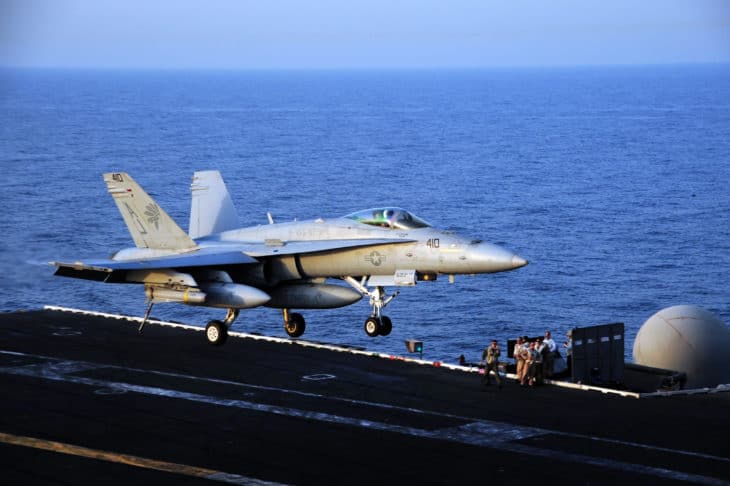
The Super Hornet’s avionics started with about 90% commonality with the C/D fleet, but later blocks pulled away. The Block II added an AESA radar, larger displays and a helmet-mounted cueing system.
Block III aircraft, first delivered in 2021, replaced the displays with one large touchscreen and added an open mission systems architecture. The Super Hornet can also carry an IRST21 infrared search and track sensor in a modified centerline fuel tank.
Its shape helps as well. The caret inlets and the alignment of their leading edges reduce radar cross-section from the front and rear, and the enlarged leading edge extensions give better handling at high angles of attack. The Super Hornet is not a stealth fighter, but it is harder to see than the Hornet.
It also has two more wing hardpoints, for a total of 11, and can bring back more unspent fuel and munitions to the carrier, more than 9,000 lb (4,100 kg).
How to tell a Hornet from a Super Hornet
The quickest tell is the intake. The Hornet has rounded inlets, while the Super Hornet has larger, squared-off caret inlets.
The Super Hornet also looks bigger overall, with enlarged leading edge extensions. Navy crews call it the “Rhino”, partly to avoid radio confusion with earlier Hornets and partly because of the IFF antenna protruding on top of the nose.

Same name, different jet
The Navy kept the F/A-18 designation for the Super Hornet to present it to Congress as a low-risk derivative. In practice the forward fuselage is the main part carried over, and the jet is about 20% larger, with a new engine and a redesigned wing and tail.
Who flew each one
The Hornet was derived from the Northrop YF-17, which lost the Air Force lightweight fighter competition to the YF-16. The Navy and Marine Corps adopted it, and Canada was its first export customer.
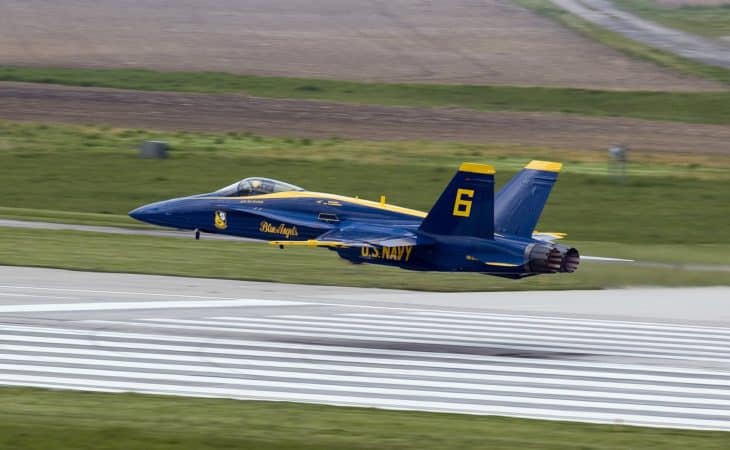
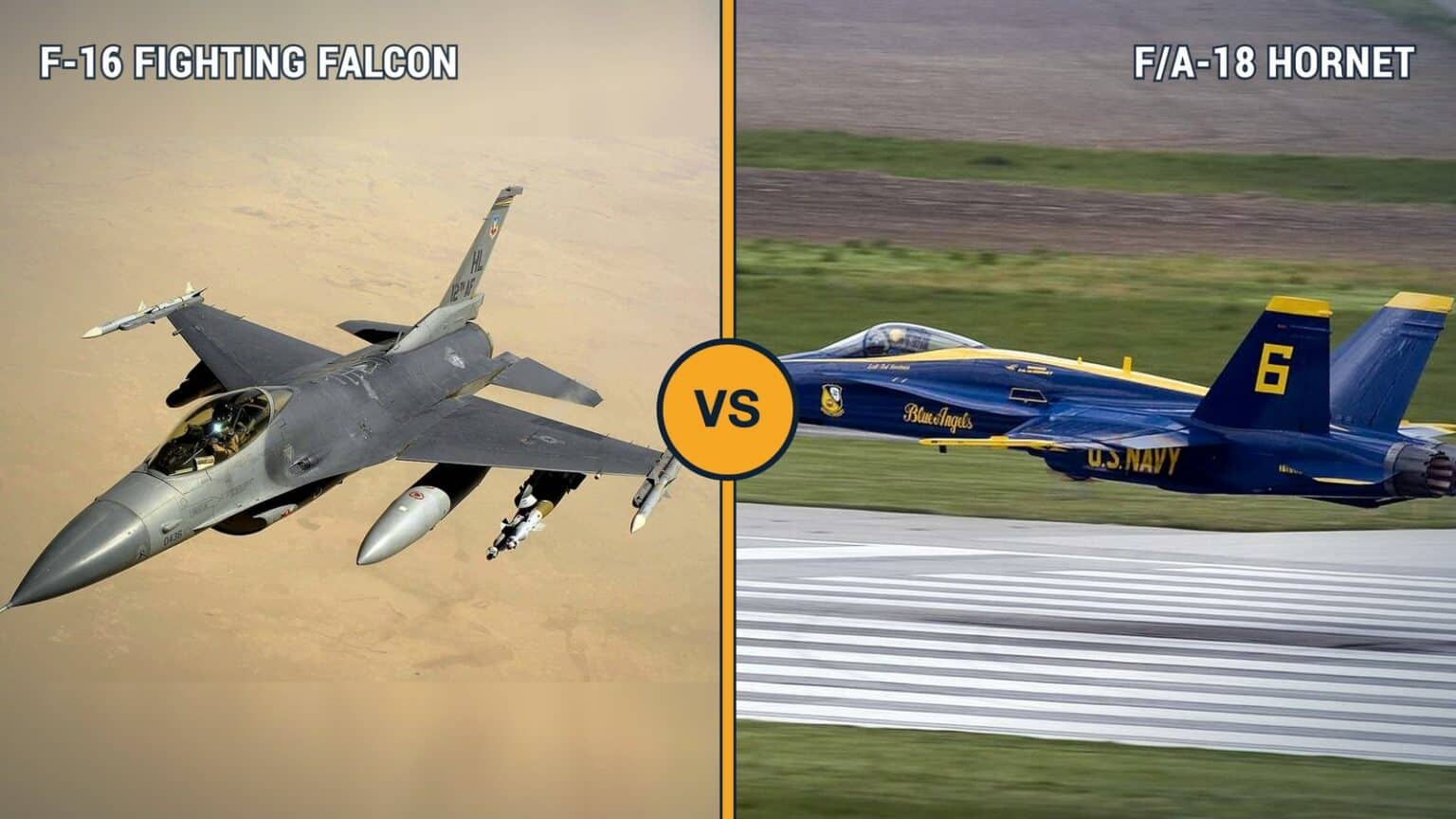
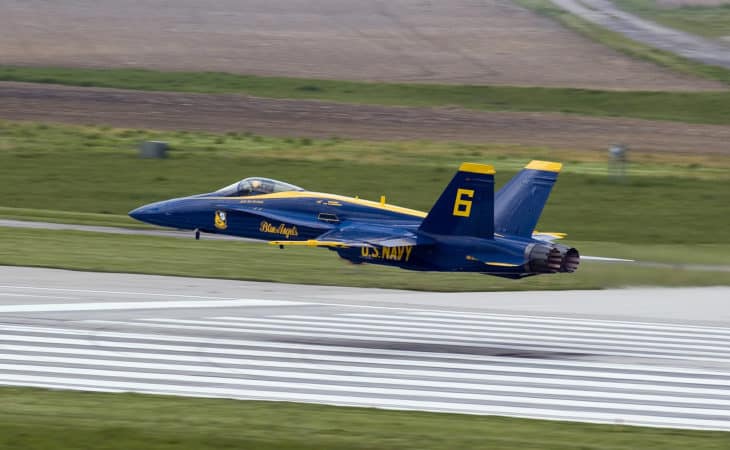
The Navy’s Blue Angels flew Hornets from 1986 before moving to the Super Hornet. Boeing was awarded a contract in 2018 to convert nine single-seat F/A-18Es and two F/A-18Fs for the team.
The last Navy Hornet deployment ended in March 2018, and the type left active Navy service in February 2019 as the F-35C arrived. Marine Corps and foreign air forces continued to fly it.
The Super Hornet replaced the F-14 Tomcat, A-6 Intruder and S-3 Viking, which made it the backbone of carrier aviation. Australia bought 24 F/A-18Fs to replace its F-111s, and Kuwait ordered 22 F/A-18Es and 6 F/A-18Fs.
The Super Hornet has also outlived the plan for its own production. Boeing announced plans to end production in 2025, later extended to 2027 with 17 more Navy orders.
The Navy plans to convert its Block II aircraft to Block III through 2033, so the Super Hornet will fly well beyond the Hornet’s Navy career.
FAQ
Sources and references used for research and fact-checking.
About the Author

Tim is the owner and lead editor of AeroCorner since 2019, overseeing aviation content covering aircraft, airlines, airports, and the broader aviation industry. Through years of researching, writing, editing, and publishing aviation-focused content, he has developed extensive practical knowledge of commercial aviation and air travel. Based in Asia and a frequent traveler himself, Tim also brings firsthand passenger experience to AeroCorner’s coverage. Outside of publishing, he has also explored aviation firsthand through hands-on flight training in New Zealand.