

Table of Contents
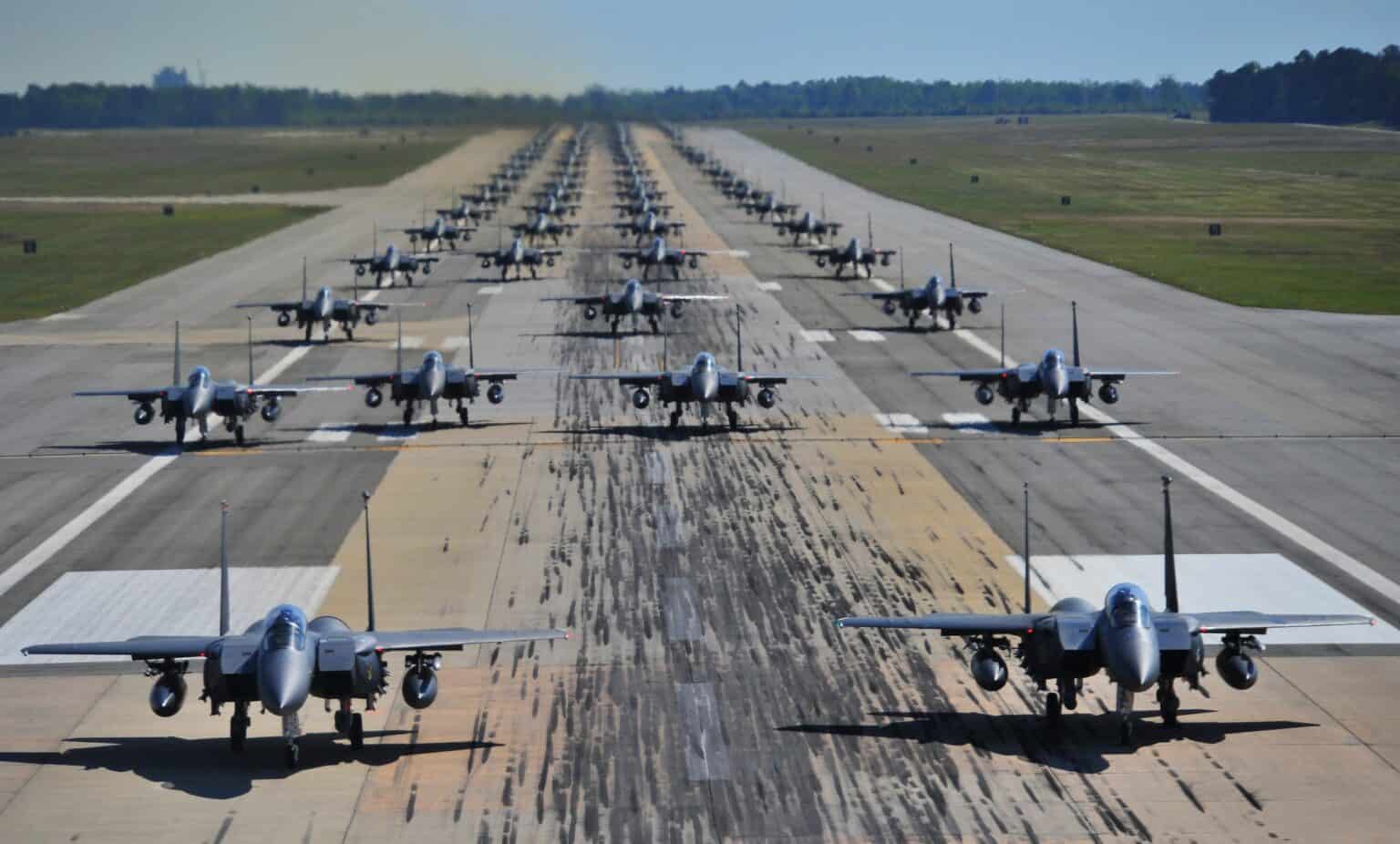
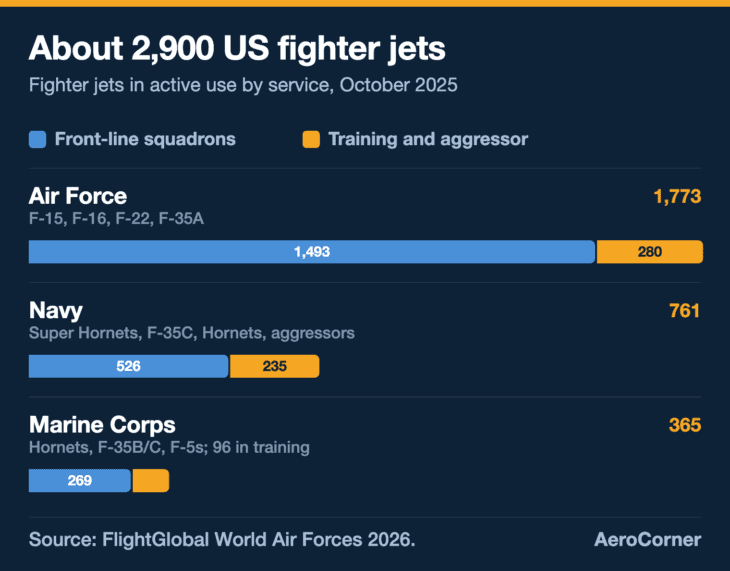
The United States has about 2,900 fighter jets. That is AeroCorner’s total of the fighter types listed in FlightGlobal’s World Air Forces 2026 directory, whose fleet data was drawn on October 1, 2025.
Of those, 2,288 sit in front-line Air Force, Navy and Marine Corps squadrons. The other 611 fly with training and aggressor units, teaching new pilots or playing the enemy in mock combat.
That is not the number the Air Force gives Congress, which is 1,098, and it is nowhere near the 13,000 that circulates online. Here is what is inside the count, and why each of those other numbers is right about something different.
How Many Fighter Jets Does the US Have?
About 2,900, as of October 2025. The Air Force flies 1,773 of them, the Navy 761 and the Marine Corps 365.
The count covers every jet built to fight other aircraft: the F-15, F-16, F-22, F-35, and the F/A-18 Hornet and Super Hornet families. It also includes the F-5s and older F-16s that the Navy and Marines fly as practice adversaries.
It leaves out jets built for ground attack: 174 A-10 Thunderbolt IIs and 89 AV-8B Harriers, trainers included. It also leaves out every bomber and the Navy’s 153 EA-18G Growlers, which use the Super Hornet airframe for electronic attack.
The count at a glance
2,899 fighter jets in FlightGlobal’s World Air Forces 2026 listings, with data drawn on October 1, 2025. Air Force 1,773, Navy 761, Marine Corps 365. Front-line squadrons hold 2,288 and training and aggressor units hold 611. Not counted: A-10 and AV-8B attack jets, EA-18G Growlers and bombers.
The US fighter fleet, service by service
FlightGlobal lists each service’s front-line jets and its training jets in separate sections. Adding the two gives the totals below.
| Service | Aircraft | Front-line | Training and aggressor | Total |
|---|---|---|---|---|
| Air Force | F-15C/D, F-15E, F-15EX | 320 | 15 | 335 |
| Air Force | F-16C/D | 691 | 131 | 822 |
| Air Force | F-22 Raptor | 177 | 0 | 177 |
| Air Force | F-35A | 305 | 134 | 439 |
| Navy | F/A-18E/F Super Hornet | 471 | 114 | 585 |
| Navy | F-35C | 55 | 14 | 69 |
| Navy | F/A-18A to D Hornet | 0 | 41 | 41 |
| Navy | F-5 and F-16 aggressors | 0 | 66 | 66 |
| Marine Corps | F/A-18A to D Hornet | 132 | 45 | 177 |
| Marine Corps | F-35B/C | 137 | 38 | 175 |
| Marine Corps | F-5 aggressors | 0 | 13 | 13 |
| Total | 2,288 | 611 | 2,899 |
The F-16 Fighting Falcon is still the most numerous US fighter type, at 822 jets. In the Air Force’s own inventory, its F-16s average almost 34 years old.
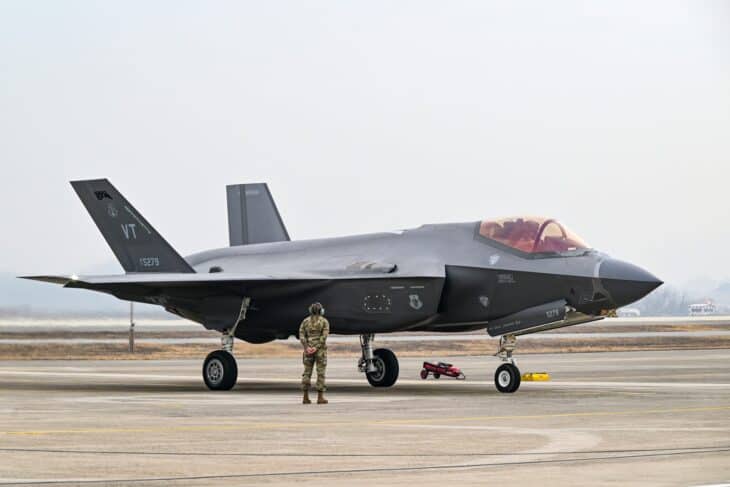
The F-35 Lightning II is catching up from three directions at once. Add the Air Force’s F-35As, the Navy’s F-35Cs and the Marines’ F-35Bs and F-35Cs, and the US flies 683 of them.
The Navy’s fighter force is close to a one-aircraft fleet: 585 of its 761 fighters are F/A-18E/F Super Hornets. How the types stack up against each other is in our guide to the best American fighter jets.
Why the numbers differ
Search this question and you will find answers from about 1,100 to more than 13,000. Most of them are accurate. They are counting different things.
The US does not have 13,000 fighter jets
Figures of 13,000 and up are the size of the entire US military fleet. FlightGlobal counts 13,033 US military aircraft of every kind, and fighters are only about a fifth of them. Army helicopters alone outnumber every US fighter jet.
13,033 is every aircraft in the US military in the same FlightGlobal directory, with helicopters, tankers, transports and trainers included. It is a quarter of all military aircraft in the world.
2,718 is FlightGlobal’s US “combat aircraft” total. It adds A-10s, Harriers, gunships and 132 bombers to the front-line fighters, but leaves out the 611 jets in training units.
1,978 is the Air Force’s own fighter and attack inventory on September 30, 2025, published in the Air & Space Forces Almanac. Take out its 163 A-10s and the Air Force counts 1,815 fighters, about 40 more than FlightGlobal does.
The gap is mostly definition. FlightGlobal drops jets in storage, in upgrade or assigned to test work, while the Air Force counts every aircraft assigned for mission, training, test or maintenance. The biggest difference is the F-35A: 500 in the Air Force’s books, 439 in FlightGlobal’s.
1,098 is the number the law cares about. On May 5, 2026, Air Force Secretary Troy Meink told Congress the service had 1,098 fighters, 47 below the 1,145 combat-coded fighters that federal law requires.
The legal measure, primary mission aircraft inventory, counts only jets assigned to a unit’s wartime mission. Backup aircraft, attrition reserves, trainers and test jets are all left out.
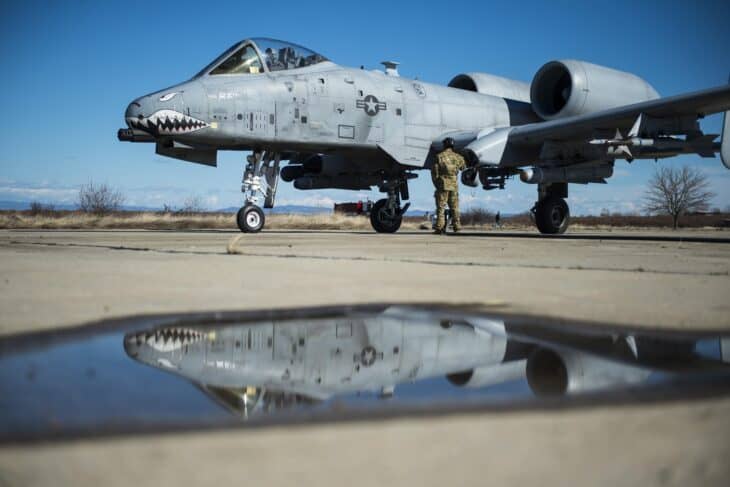

The same law defines a fighter more loosely than this article does. Any aircraft with an F- or A- prefix counts, so in the eyes of Title 10 of the US Code, the A-10 is a fighter.
How many can fly on a given day?
Far fewer than the inventory suggests. In fiscal 2025, the F-35 fleet was mission capable, meaning able to fly at least one of its assigned missions, 44 percent of the time, down from 67 percent in fiscal 2021, the Government Accountability Office found.
It could fly every one of its assigned missions only 25 percent of the time. Air Force officials blamed part of the drop on new jets waiting for software, along with scarce parts and corrosion.
.jpg)
Age is the other drag. The Air Force puts the average age of its fighter fleet at about 27.4 years, and the F-15E Strike Eagles in its inventory average more than 32. Its F-35As average under 5.
Across the whole Air Force fleet, availability fell from 72.9 percent in 1994 to 53.9 percent in 2024. Over the same years, the average aircraft went from 17.2 to 31.7 years old.
How the number got here, and where it is going
The Air Force alone had 4,729 active fighters in 1968, according to the Congressional Research Service. The count has fallen steeply since.
1968
4,729 Air Force fighters. The Cold War fleet, dominated by the F-4 Phantom.
1991
About 3,939. The Cold War ends and the peace dividend begins.
2003
About 2,431. Procurement of new fighters lags retirements of old ones.
2009
The F-22 is cut short. Defense Secretary Robert Gates moves to cap the Raptor buy at 187.
2013
About 2,091. Budget caps bring further cuts and delays.
May 2026
Below the legal floor. The Air Force reports 1,098 primary mission fighters against a 1,145 minimum.
Fiscal 2027
F-15EX buys ramp up. The Air Force plans up to 24 a year, rising to 36 by fiscal 2030.
2030
The projected low point. The CBO expects the Air Force fighter fleet to shrink until 2030, then grow.
2035
The Air Force target. 1,558 combat-coded fighters, counting backups and attrition reserves.
The figures from 1968 to 2013 are the CRS count of Air Force fighters. The May 2026 number uses the narrower primary mission definition, so it is not a like-for-like step down.
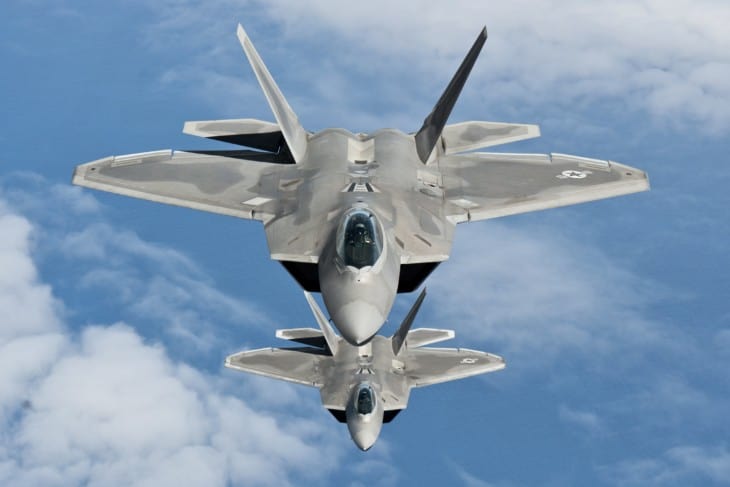
The next big change is Boeing’s F-47. Boeing is expected to build at least 185 of them to replace the F-22 Raptor. The Navy has 23 more F-35Cs on firm order and options or letters of intent for 157 more.
How the US compares with China and Russia
No country is close. FlightGlobal’s broader combat aircraft count, which includes bombers and attack jets, gives the US 2,718, or 19 percent of the world’s 14,074 combat aircraft.
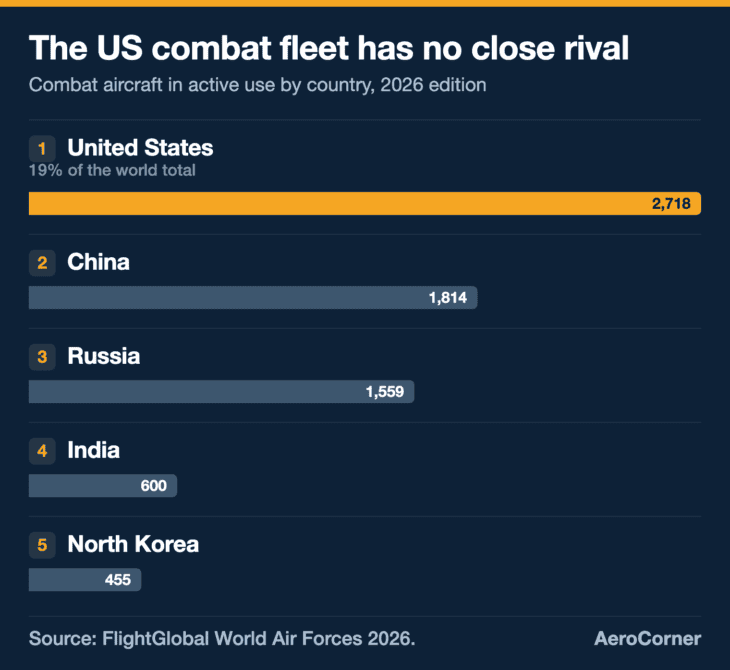
China is second with 1,814 and Russia third with 1,559. The full ranking, fighters and everything else, is in our list of the largest air forces in the world.
China is the country closing the gap. FlightGlobal raised its estimate of operational J-20 stealth fighters to 250 in its 2026 edition, up from 19, and some analysts expect China to field around 1,000 by 2030.
Even at 250, that is more J-20s than the Air Force has F-22s. How the two fleets match up type by type is in our US vs China fighter jet comparison.
FAQ
Sources and references used for research and fact-checking.
- FlightGlobal, World Air Forces 2026
- Air & Space Forces Magazine, 2026 USAF & USSF Almanac Equipment: Total Aircraft Inventory (TAI)
- Congressional Research Service, Air Force Fighter Force Structure: Background and Issues for Congress (R49338)
- Defense News, Only 1 in 4 F-35s is fully mission capable, GAO finds
Get the Newsletter
The latest aviation news and stories sent to your inbox.
About the Author

Tim is the owner and lead editor of AeroCorner since 2019, overseeing aviation content covering aircraft, airlines, airports, and the broader aviation industry. Through years of researching, writing, editing, and publishing aviation-focused content, he has developed extensive practical knowledge of commercial aviation and air travel. Based in Asia and a frequent traveler himself, Tim also brings firsthand passenger experience to AeroCorner’s coverage. Outside of publishing, he has also explored aviation firsthand through hands-on flight training in New Zealand.