

Table of Contents
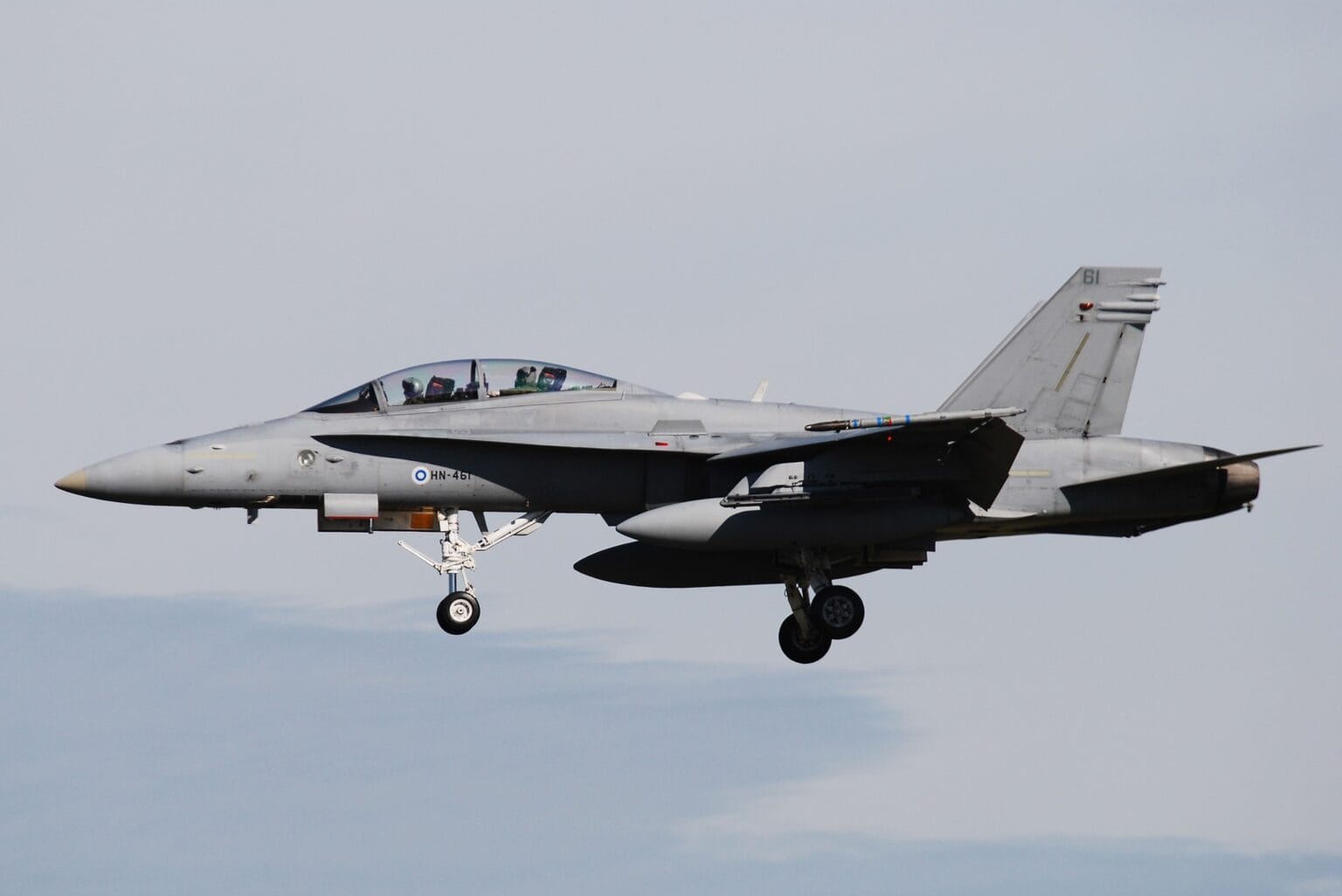
The Finnish Air Force is a 60-jet Hornet force in the middle of becoming a 64-jet F-35 force. Its first two F-35As landed at Rovaniemi on September 18, 2026, and the last Hornet is due to leave service by the end of 2030.
Until then, the F/A-18C and D Hornets still fly the alert missions. FlightGlobal’s World Air Forces 2026 directory counts 53 single-seat C models and 7 two-seat D models, behind a small support fleet of Hawk jet trainers, C295 transports, Learjets, PC-12s and Grob trainers.
This guide ranks all seven types Finland flies by how much they matter to its air defense as of October 2026. It then covers what Finland borrows from allies, why it trains on highways, and how the old blue swastika finally came off its emblems.
| Rank | Aircraft | Role | Fleet | Status |
|---|---|---|---|---|
| 1 | F-35A Lightning II | Stealth multirole fighter | 10 delivered, 64 ordered | Entering service |
| 2 | F/A-18C/D Hornet | Multirole fighter | 53 C, 7 D | Retiring by end of 2030 |
| 3 | BAE Hawk Mk 51/51A/66 | Advanced jet trainer | 30 to 35 | Replacement under study |
| 4 | Airbus C295 | Transport, electronic warfare | 3 (1 electronic warfare) | In service |
| 5 | Learjet 35A(S) | VIP, cargo, surveillance | 2 | Being replaced |
| 6 | Pilatus PC-12NG | Liaison | 6 | In service |
| 7 | Grob G 115E | Basic trainer | 28 | In service |
How this ranking works
Aircraft are ranked by their weight in Finland’s air defense in October 2026: fighters first, then the trainers that produce fighter pilots, then transport and liaison types. Fleet counts come from FlightGlobal’s World Air Forces 2026 directory unless a newer source shows a change. The Finnish Air Force does not publish its numbers, so where Janes and FlightGlobal disagree both figures are shown. Helicopters are not listed because Finland’s NH90s belong to the Army.
1. F-35A Lightning II: 64 Ordered, Two at Home
.jpg)
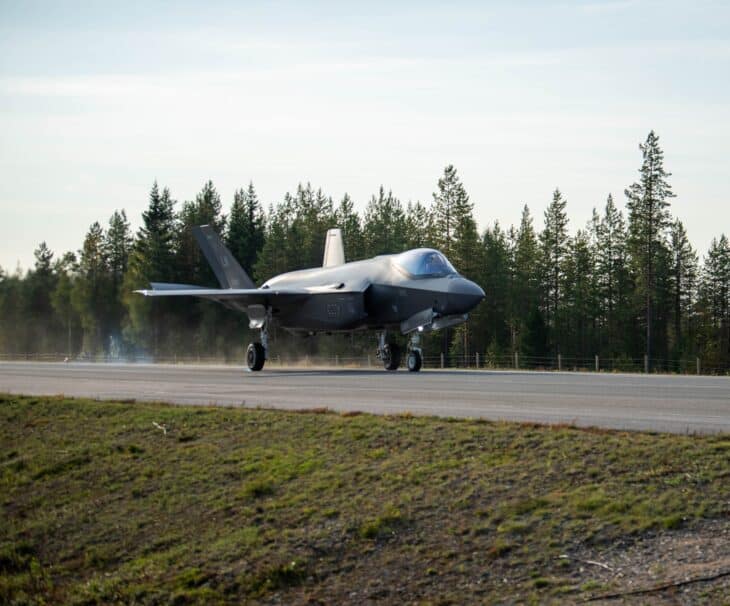
Finland picked the F-35A Lightning II on December 10, 2021, at the end of a fighter competition known as HX. The package covers 64 jets in the Block 4 configuration, weapons, training and support through 2030, for about 8.378 billion euros.
The first Finnish jet, JF-501, rolled out in December 2025. By October 1, 2026, Finland had received 10 of its 64 aircraft, and eight of them stay at Ebbing Air National Guard Base in Arkansas to train Finnish pilots and maintainers.
The first two to come home, JF-510 and JF-512, landed at Rovaniemi at 5:45 p.m. local time on September 18, 2026, escorted by Finnish Hornets. US Air Force pilots flew the delivery from Fort Worth via the Azores. A third jet, JF-511, stayed behind at Lajes with a technical problem.
Both joined Fighter Squadron 11 of the Lapland Air Wing. Maintenance training starts at Rovaniemi in late 2026 and pilot training in January 2027, with most F-35 instruction moving from the US to Finland in 2028.
The plan has three milestones. Lapland flies only F-35s from early 2028, the Karelia Air Wing at Rissala gets its first jets the same year, and the fleet reaches full operational capability in late 2030.
Finland now builds part of every F-35 it can
Earlier in 2026 the Finnish company Patria became the first firm other than Lockheed Martin to produce the F-35’s forward fuselage. Patria also assembled 57 of Finland’s 64 Hornets in the 1990s, so the same company has built the front line twice.
2. F/A-18C/D Hornet: Still Flying the Alert Missions
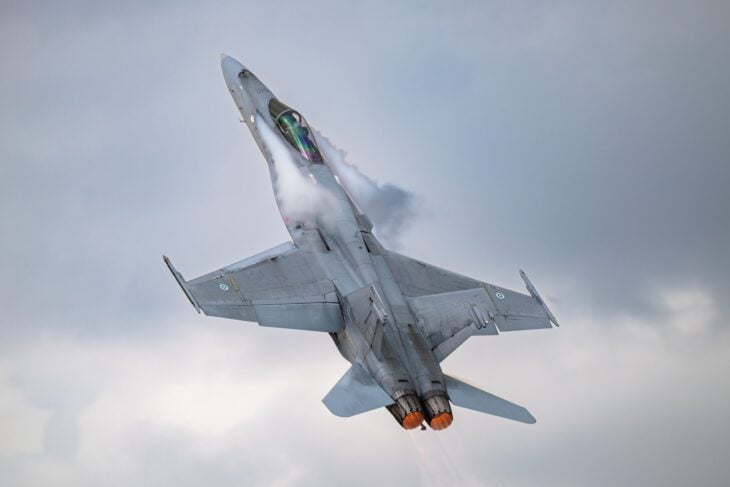

The F/A-18 Hornet has been Finland’s only fighter since the MiG-21 and Saab Draken retired, in 1998 and 2000. Finland chose it in 1992 and took 64 between November 1995 and 2000: 57 single-seaters assembled by Patria in Finland and seven two-seaters built in the United States.
Two mid-life upgrades, in 2006 to 2010 and 2012 to 2016, kept the jets current. They added JDAM and JSOW precision weapons in 2017 and the long-range JASSM cruise missile in 2018, which turned an air-defense fighter into a strike jet as well.
FlightGlobal now counts 53 C models and 7 D models. One of the gaps is HN-409, which crashed at Rovaniemi on May 7, 2025, during practice for a display routine; the pilot ejected with minor injuries.
The Hornets are not idle. On September 24, 2026, Finnish Hornets and Swedish Gripens intercepted a group of Russian aircraft over the Gulf of Finland together, the first joint identification mission the two air forces have flown.
Why not give the old Hornets to Ukraine?
The jets that leave service are not going anywhere. Since April 2024, retired Hornets have been flown to Pirkkala and stripped for spare parts to keep the rest of the fleet flying until 2030. The Air Force has said those airframes are not suitable for transfer to Ukraine.
3. BAE Hawk: The Trainer Running Out of Hours
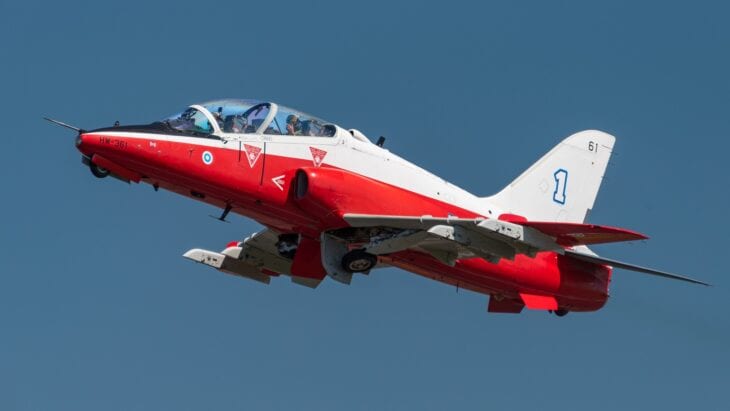

Every Finnish fighter pilot learns fast-jet flying in the BAE Hawk. The first one arrived on December 19, 1980, and Finland eventually acquired 75, including 18 secondhand Mk 66s from Switzerland.
Fatigue has cut that fleet hard. FlightGlobal lists 35 Hawks of the Mk 51 and 66 variants in 2026, while Janes counts 30. They fly with Fighter Squadron 41 at the Air Force Academy in Tikkakoski, which also supplies the four-ship Midnight Hawks display team, flying since 1997.
The Hawk is the next problem. On June 2, 2026, a parliamentary defense working group said Finland must start buying “a new national training solution” to support F-35 pilot training and replace the Hawk, which is expected to retire gradually during the 2030s. No aircraft has been chosen.
4. Airbus C295: Transport and a Quiet Electronic Warfare Jet
Finland’s largest aircraft is the twin-turboprop Airbus C295. FlightGlobal lists three: two transports and one configured for electronic warfare.
They fly with the Supporting Air Operations Squadron of the Satakunta Air Wing at Pirkkala, near Tampere. Anything heavier comes from allies, covered below.
5. Learjet 35A(S): A 1982 Business Jet on Its Way Out
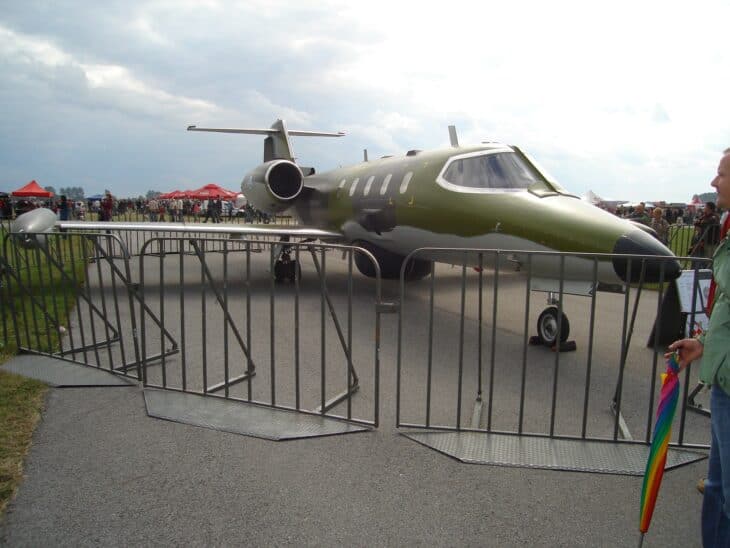

Three Learjet 35A(S) jets, all built in 1982, have flown VIP and cargo trips plus aerial photography, reconnaissance and maritime surveillance. Each carries up to five passengers and a flight engineer, and all three had life-extension upgrades in 2018.
The first, LJ-1, retired in May 2026 and went to the Air Force Academy as a ground training airframe, leaving LJ-2 and LJ-3 active. A program called JETX will buy three new light or midsize business jets, with Embraer, Pilatus and Textron in the running after Bombardier dropped out; turboprops were ruled out.
A winner was expected in June 2026, but we could find no published selection as of early October. Our look at how fast a Learjet goes covers the family Finland is replacing.
6. Pilatus PC-12NG: Six Single-Engine Liaison Planes
_Tour_de_Sky_2014-08-09_01.JPG)
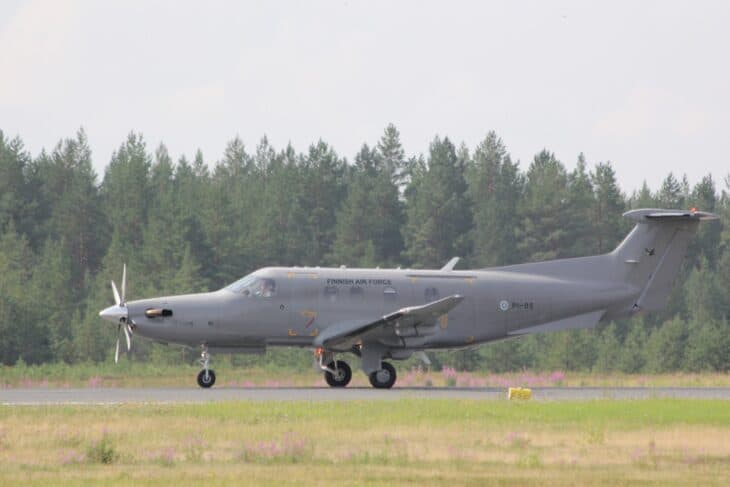
Six Pilatus PC-12NG turboprops move people and small loads between Finland’s bases. They share the Pirkkala squadron with the C295s and Learjets.
All four of Finland’s main air bases share their runways with civil airports, and the PC-12s are the everyday link between them: crews, staff and spare parts rather than combat loads.
7. Grob G 115E: Where Every Pilot Starts
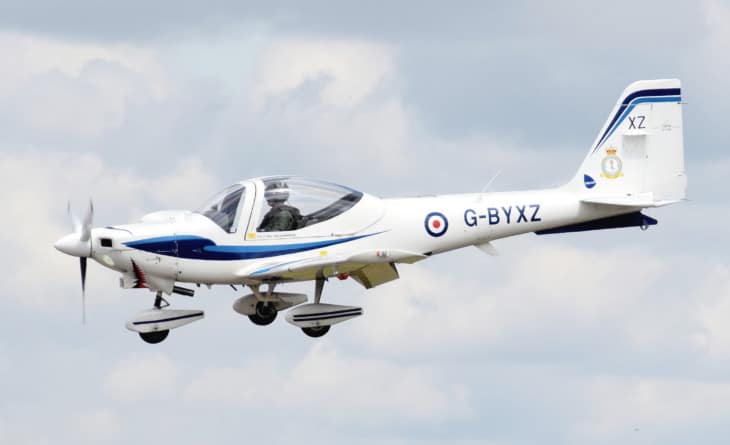
Finnish military pilots fly their first hours in the Grob G 115E, a German two-seat piston trainer. Finland bought 28, with deliveries from 2016.
Students who pass go on to the Hawk, then to the fighter squadrons. That pipeline, Grob to Hawk to fighter, is the part the parliament report says must be rebuilt around the F-35.
What Finland Borrows From Its Allies
Finland owns no tankers, no large airlifters and no airborne radar planes. It fills those gaps through shared fleets instead.
It is a member of the Strategic Airlift Capability, which flies three C-17 Globemaster IIIs from Pápa Air Base in Hungary. In July 2026, Finland also joined the Multi Role Tanker Transport Capability, its first access to air-to-air refueling.
The same month it signed letters of intent on a national airborne early warning capability linked to NATO’s planned Saab GlobalEye fleet, and on up to five MQ-4C Triton surveillance drones shared with Denmark, Germany and Norway. Both are letters of intent, not orders.
Why the Finnish Air Force Trains on Highways
Finland’s fighters practice flying from closed sections of public road, so they can keep operating in a crisis if the main bases are hit. The wartime road bases are secret, but the training strips are announced because the roads have to close.
In November 2025, Hornets used the Hiirola highway strip on main road 72 near Mikkeli for a week. The next exercise, Protective Fence 26, runs from November 18 to 25, 2026, with Hornets on the Jännevirta strip of Highway 9 near Rissala.
Allies now join in. From June 8 to 12, 2026, US Marine Corps F-35Bs flew from a highway strip at Tervo during Exercise Ramstein Flag, the first time Marine F-35Bs had done so in Finland. Twelve Finnish Hornets took part.
The Blue Swastika: Where It Came From and Where It Went
The Finnish Air Force dates its founding to March 6, 1918, when the Swedish Count Eric von Rosen donated a Thulin Typ D during the Finnish Civil War. He had painted his personal good-luck symbol on it, a blue swastika, and Finnish military aircraft carried it until 1945.
Because it predated Nazism, it stayed on unit emblems, flags and decorations for decades after the war. The Air Force Command quietly swapped its swastika emblem for a golden eagle and a circle of wings in January 2017, a change that only became public in 2020.
The last holdouts are unit flags introduced in the 1950s and flown by four units. In August 2025 the Defence Forces told the Associated Press those flags would be renewed with an eagle design, without giving a date.
A Small Air Force With a Large War Record
Finland went into the Winter War on November 30, 1939, with about 100 aircraft against roughly 700 Soviet fighters and 800 bombers sent against it. Its fighter pilots were credited with 218 Soviet aircraft shot down for 47 of their own lost in air combat.
The most famous result came from the American Brewster Buffalo, which appears on our list of the worst fighter planes of WW2 for its record elsewhere. In Finnish hands it was credited with 459 victories for 15 losses in air combat.
Finland’s top ace, Ilmari Juutilainen, scored 94 confirmed victories and finished the war without his plane ever being hit by an enemy fighter. That record is the root of the service’s reputation for doing a lot with little.
The number that came back
The 1947 Paris Peace Treaty capped Finland at 60 combat aircraft, a limit Finland declared no longer applicable in 1990. FlightGlobal’s 2026 count of Finnish Hornets, single-seat and two-seat combined, is exactly 60.
How Strong Is the Finnish Air Force?
By aircraft count, it is small: about 60 fighters today and 64 once the F-35 transition ends. Its strength is in the system around the jets, an air force built to disperse, to fly from roads and to keep flying after its bases are hit.
The F-35 changes the ceiling. When the last Hornet leaves in 2030, Finland will fly the same fifth-generation fighter as Norway and Denmark, and our ranking of the best air forces in the world shows how far a modern fleet of that size can rise.
FAQ
Sources and references used for research and fact-checking.
- FlightGlobal, World Air Forces 2026 directory
- Lockheed Martin, Finland and Lockheed Martin Celebrate Historic Arrival of First Finnish F-35
- Aviation24.be, Finland's first F-35 fighters arrive at Rovaniemi Air Base
- Defence Industry Europe, Arrival of Finland's first F-35A fighters opens new era for Finnish Air Force
- The Barents Observer, Finland's first F-35s arrive in Rovaniemi
- MiGFlug, Finnish Air Force
- Wikipedia, Finnish Air Force
- Wikipedia, Ilmari Juutilainen
- Janes, Finnish parliament calls for Hawk replacement
- Aviation News, Finnish Air Force Prepares to Replace Long-Serving Hawk Jet Trainers
- ch-aviation, Finnish Air Force begins Learjet phase-out, eyes replacement
- Air-Shows.org.uk, Finnish Air Force F/A-18 accident during display practice
- AeroCorner, Finnish and Swedish Fighters Intercept Russian Jets Together for the First Time
- City of Mikkeli, Finnish Air Force to train in Mikkeli in November 2025
- The Aviationist, USMC F-35Bs land on Finnish highway during Ramstein Flag
- Municipality of Siilinjärvi, Protective Fence 26 exercise notice
- BBC News, Finland's air force quietly drops swastika symbol
- The Times of Israel (AP), Finland to finally remove swastikas from air force flags
Get the Newsletter
The latest aviation news and stories sent to your inbox.
About the Author

Tim is the owner and lead editor of AeroCorner since 2019, overseeing aviation content covering aircraft, airlines, airports, and the broader aviation industry. Through years of researching, writing, editing, and publishing aviation-focused content, he has developed extensive practical knowledge of commercial aviation and air travel. Based in Asia and a frequent traveler himself, Tim also brings firsthand passenger experience to AeroCorner’s coverage. Outside of publishing, he has also explored aviation firsthand through hands-on flight training in New Zealand.