

Table of Contents
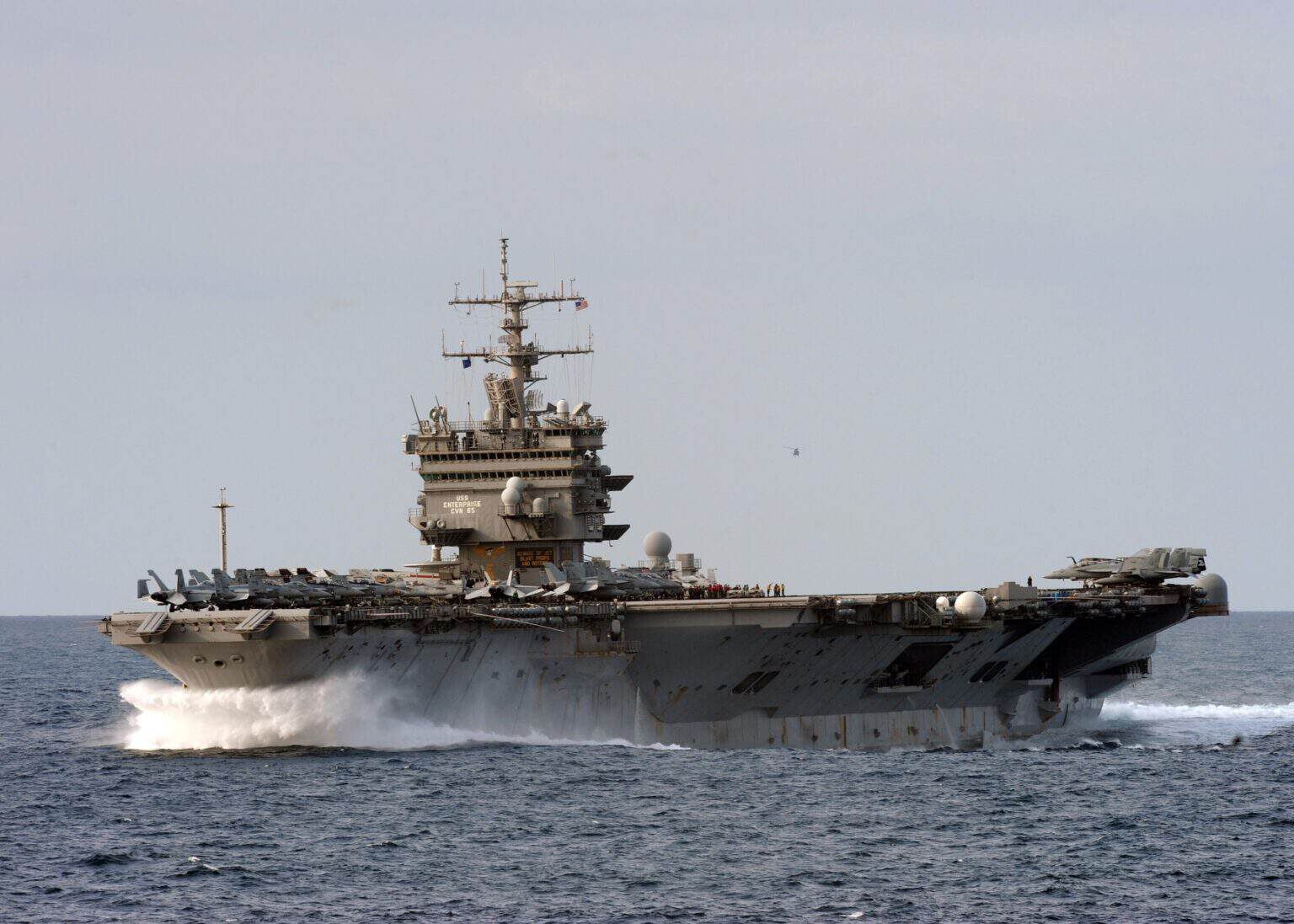
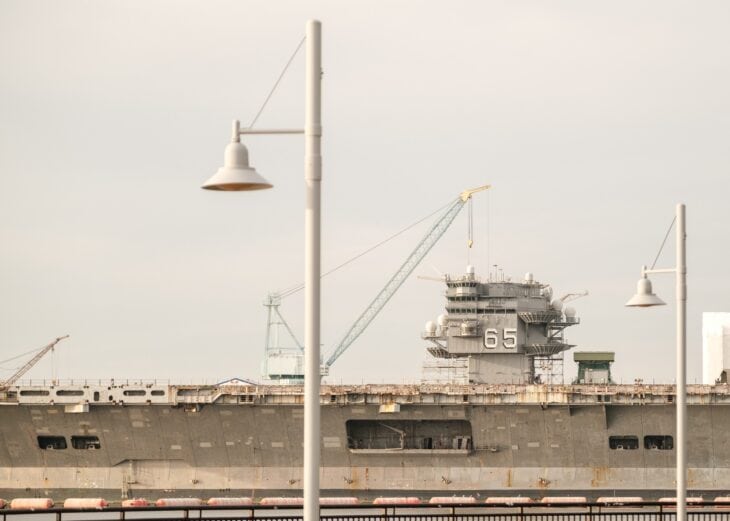
At a pier in Newport News, Virginia, the hull of the world’s first nuclear-powered aircraft carrier has been waiting since the Navy retired it in 2012. Its fuel is gone and its mast has been cut away. In July 2026, the Navy finally hired a company to tow it to Mobile, Alabama, and take it apart.
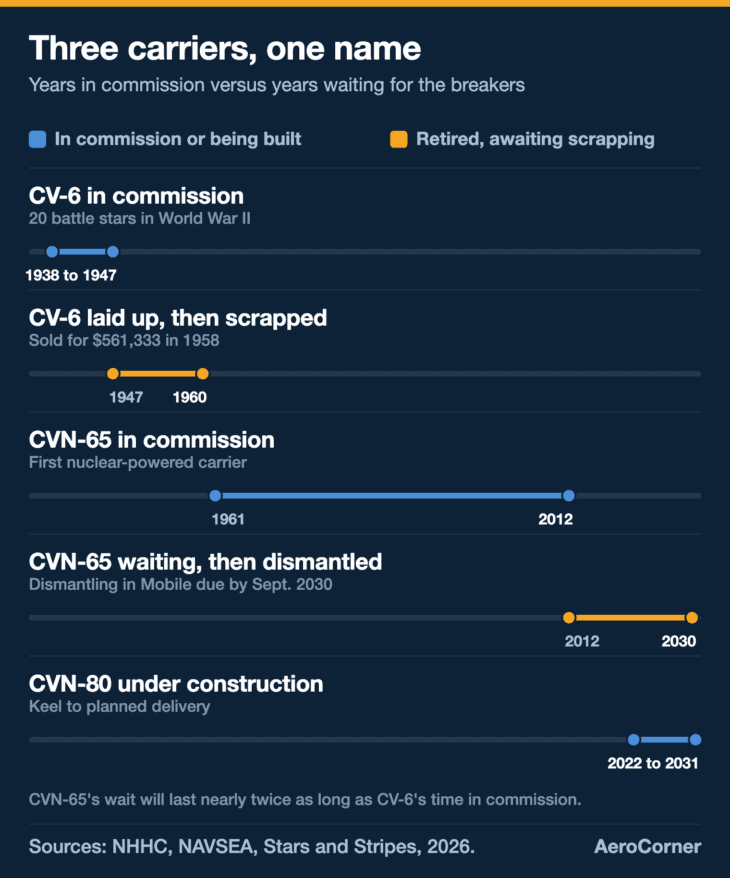
That ship was the eighth USS Enterprise. The seventh, the carrier the Navy calls the most decorated warship of World War II, went to the breakers in 1958, 13 years after President Harry Truman approved a plan to preserve it.
This is the Navy’s Enterprise, not the starship. Here is which carrier is which, where each one is today, and why the United States has never kept one.
Where Is the USS Enterprise Now?
Three aircraft carriers have carried the name. The World War II Enterprise, CV-6, was cut up for scrap in Kearny, New Jersey, between 1958 and February 1960. Its stern plate survived and is headed for the new National Museum of the United States Navy in Washington, D.C.
The nuclear Enterprise, CVN-65, is a defueled hull at Newport News, awaiting a tow to Mobile, where dismantling is due to finish by September 2030. The ninth Enterprise, CVN-80, is under construction in the same Virginia shipyard, with delivery now planned for March 2031.
| Enterprise (CV-6) | Enterprise (CVN-65) | Enterprise (CVN-80) | |
|---|---|---|---|
| Type | Yorktown-class carrier | The first nuclear-powered carrier | Ford-class carrier |
| Keel laid | July 16, 1934 | Feb. 4, 1958 | April 2022 |
| In commission | May 12, 1938 to Feb. 17, 1947 | Nov. 25, 1961 to 2012 (inactivated) | Delivery planned March 2031 |
| Length | 809 feet 6 inches (247 m) | 1,123 feet (342 m) | Not yet delivered |
| Known for | 20 battle stars, the most of any WWII ship | Eight reactors, 25 deployments | Sponsored by Simone Biles and Katie Ledecky |
| Where it is now | Scrapped in Kearny, N.J., by 1960 | Hull at Newport News, Va., awaiting dismantling in Mobile, Ala. | Under construction at Newport News, Va. |
The Big E Fought From Pearl Harbor to Okinawa
CV-6 was laid down at Newport News in 1934 and commissioned on May 12, 1938. It was the seventh Enterprise in the Navy’s count, a name that goes back to the Revolutionary War.
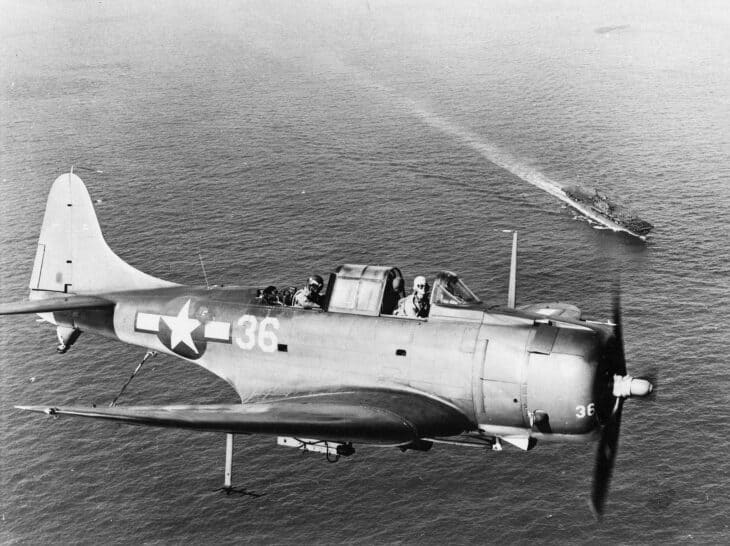
On the morning of December 7, 1941, Enterprise was about 200 miles (320 km) west of Pearl Harbor, returning late from delivering fighters to Wake Island. Its scout bombers reached Oahu in the middle of the Japanese attack. Three days later, an Enterprise SBD Dauntless sank the submarine I-70, the first Japanese warship sunk by U.S. aircraft in the war.
In April 1942, Enterprise provided air cover for USS Hornet as it carried Army B-25 Mitchell bombers toward Japan for the Doolittle Raid.
Two months later, at the Battle of Midway, dive bombers led by Lt. Cmdr. Clarence W. McClusky put at least four bombs into the carrier Kaga, and a handful led by Lt. Richard Best hit the flagship Akagi. Both carriers sank, and an afternoon strike flown from Enterprise and Hornet doomed a third, Hiryu.
_1944.jpg)
After USS Hornet was lost at the Battle of the Santa Cruz Islands in October 1942, Enterprise was briefly the only operational U.S. fleet carrier in the South Pacific. Its last battle came on May 14, 1945, when a kamikaze pilot crashed through the flight deck just behind the forward elevator, killing 14 men and wounding 68.
The record that made it famous
Enterprise steamed more than 275,000 miles during the war, by the Navy’s count. Its aircraft were credited with sinking or helping to sink 71 enemy ships and damaging 192 more, and the ship earned 20 battle stars, three more than any other warship of World War II.
A President Wanted It Saved. It Sold for $561,333.
After the war, Enterprise carried more than 10,000 veterans home during Operation Magic Carpet. Navy Secretary James Forrestal then proposed keeping it alongside USS Constitution as one of the Navy’s historic ships, and President Harry Truman approved his letter on November 1, 1945.
“The men who have fought her love this ship,” Forrestal wrote. “It would grieve me to put my name to the documents which would consign her to be broken up for scrap.”
Enterprise was decommissioned on February 17, 1947, and nearly 1,400 of its veterans formed the Enterprise Association to save it, led for a time by Fleet Admiral William Halsey. A Navy inspection board declared the ship unfit for further service in 1956, and it was struck from the Navy list that October.
Congress still authorized it as a national memorial in Washington, D.C., in August 1957. But berthing a carrier in the capital meant dredging the channel and strengthening seawalls, and the estimated $1 million for repairs, a berth and the tow was never raised.
On July 1, 1958, the Navy sold Enterprise to the Lipsett Corporation for $561,333. Eight tugs moved it to Kearny, New Jersey, that August, and the breakers finished by February 1960.
Myth: you can see the Enterprise on a carrier in New York
The Enterprise on display aboard an aircraft carrier in Manhattan is the space shuttle, not the warship. NASA planned to call the test orbiter Constitution until a write-in campaign by Star Trek fans got it renamed Enterprise, and it has been displayed aboard the carrier USS Intrepid, now a museum, since July 2012. No carrier named Enterprise has ever been preserved.
The First Nuclear Carrier Ran on Eight Reactors
The eighth Enterprise was laid down at Newport News on February 4, 1958, and commissioned on November 25, 1961. Its eight reactors made it the world’s first nuclear-powered aircraft carrier, which is the N in its CVN hull code, and at 1,123 feet (342 m) it is the longest naval ship ever built.
It was meant to lead a class of six, but construction costs climbed so high that the other five were canceled. Every carrier the Navy has built since, except USS John F. Kennedy, has been nuclear-powered, including the ten ships of the Nimitz class.
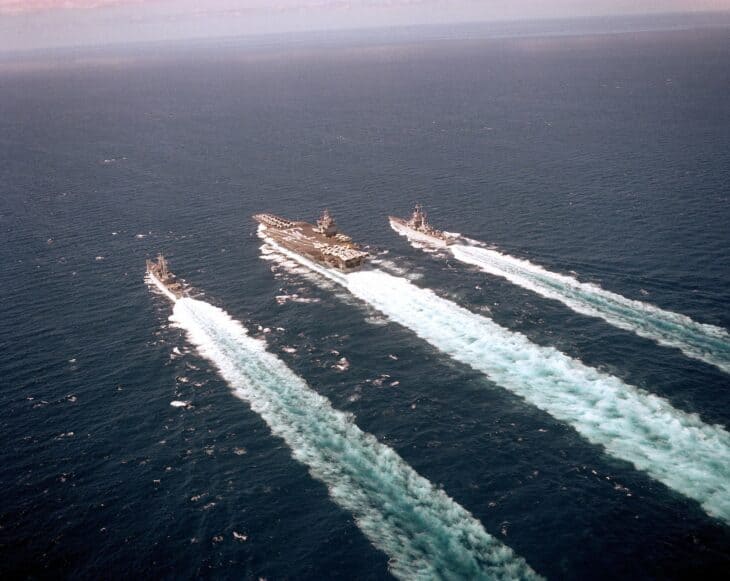
Within a year of commissioning it was enforcing the Cuban quarantine of 1962. In 1964, it sailed around the world with the cruiser Long Beach and the frigate Bainbridge in Operation Sea Orbit, the first all-nuclear task force, and from 1965 it flew combat missions over Vietnam.

On January 14, 1969, off Hawaii, exhaust from a starter cart overheated a Zuni rocket under the wing of an F-4J Phantom on the flight deck. The warhead exploded and ignited the jet’s fuel tanks. In all, 18 explosions blew five holes in the deck and destroyed 15 aircraft, and 28 men died and 314 were injured.
Enterprise went on to complete 25 deployments over 51 years. In 1985 it hosted the Top Gun film crew at sea off San Diego, and it came home to Norfolk for the last time on November 4, 2012.
Why the Nuclear Enterprise Can’t Be a Museum Either
The Navy inactivated Enterprise on December 1, 2012, and formally decommissioned it on February 3, 2017, after the nuclear fuel had been removed. Veterans and enthusiasts asked for a museum ship. The Navy judged it too expensive, because the eight reactors are built so deeply into the hull that taking them out safely means cutting the ship open anyway.

Sinking it was ruled out too. Many of its compartments are radiologically contaminated, so it cannot be used as a target ship and sunk in a live-fire exercise.
In 2018, the Government Accountability Office found the job could cost more than $1 billion. One option had a Navy shipyard in Washington state cut out the reactor section; the other gave the whole ship to a commercial company, which no one had ever done with a nuclear carrier.
The Navy chose the commercial route and awarded NorthStar Maritime Dismantlement Services a $536.7 million contract in June 2025. A rival bidder, HII ShipCycle, protested, and the Court of Federal Claims ordered the competition reopened.
NorthStar won again in July 2026, at $418.5 million, about $118 million less. A Mobile subcontractor will do the physical teardown, low-level radioactive waste goes to a licensed disposal site in Andrews, Texas, and the work is due to finish in September 2030.
The Navy treats the job as a pilot for the day the Nimitz-class carriers retire. As of August 2026, the hull was still at its Newport News pier, and no tow date had been announced.
The Ninth Enterprise Is Running Late
At the 2012 inactivation ceremony, Navy Secretary Ray Mabus announced that the name would pass to a new Ford-class carrier, CVN-80. It will be the ninth Navy ship and the third carrier called Enterprise.

.jpg)
Its sponsors, the Olympians Katie Ledecky and Simone Biles, attended the first steel cutting at Newport News on August 21, 2017. The keel was laid in April 2022.
Delivery was once planned for March 2028. It slipped to July 2030 after critical equipment arrived late, and the Navy’s 2027 budget books moved it again, to March 2031. Shipyard space tied up by the late Enterprise also helped push the next carrier, Doris Miller, back two years to 2034.
When it joins the fleet, it will help hold the line on a force the Navy keeps at 11 aircraft carriers, and part of it will be built from the old one. Steel recovered from CVN-65 is to be recycled into CVN-80.
So the eighth Enterprise will not survive as a ship, but some of it will sail again under the same name. The seventh’s stern plate, displayed for decades behind centerfield of a River Vale, New Jersey, ballpark, is bound for the Navy museum in Washington, where the first phase is due to open in 2030.
Sources and references used for research and fact-checking.
- Naval History and Heritage Command, Dictionary of American Naval Fighting Ships, Enterprise VII (CV-6)
- Naval History and Heritage Command, Enterprise (CV-6)
- Naval History and Heritage Command, Enterprise (CVN-65)
- Naval Sea Systems Command, Naval Ship Historical Evaluation: Enterprise (CVN-65)
- Naval History and Heritage Command, H-025-2: The USS Enterprise (CVAN-65) Conflagration, 14 January 1969
- U.S. Government Accountability Office, Aircraft Carrier Dismantlement and Disposal: Options Warrant Additional Oversight and Raise Regulatory Questions (GAO-18-523)
- NBC 15 (WPMI), Navy awards new $418M contract to dismantle ex-USS Enterprise in Mobile
- Nuclear Engineering International, USS Enterprise dismantling contract awarded
- 19FortyFive, The Hull of US Navy Aircraft Carrier USS Enterprise Will Be Towed Past the Mothballed SS United States on Her Way to the Scrapyard
- Stars and Stripes, Fourth new Gerald Ford-class carrier delayed until 2034, Navy says
- Wikipedia, USS Enterprise (CVN-80)
- Wikipedia, USS Enterprise (CVN-65)
- NASA, 45 Years Ago: Space Shuttle Enterprise Arrives at NASA's Kennedy Space Center
- Wikipedia, Space Shuttle Enterprise
- AFI Catalog of Feature Films, Top Gun (1986)
- Township of River Vale, N.J., The USS Enterprise Stern Plate to be Preserved by the U.S. Navy
Get the Newsletter
The latest aviation news and stories sent to your inbox.
About the Author

Tim is the owner and lead editor of AeroCorner since 2019, overseeing aviation content covering aircraft, airlines, airports, and the broader aviation industry. Through years of researching, writing, editing, and publishing aviation-focused content, he has developed extensive practical knowledge of commercial aviation and air travel. Based in Asia and a frequent traveler himself, Tim also brings firsthand passenger experience to AeroCorner’s coverage. Outside of publishing, he has also explored aviation firsthand through hands-on flight training in New Zealand.