

Table of Contents
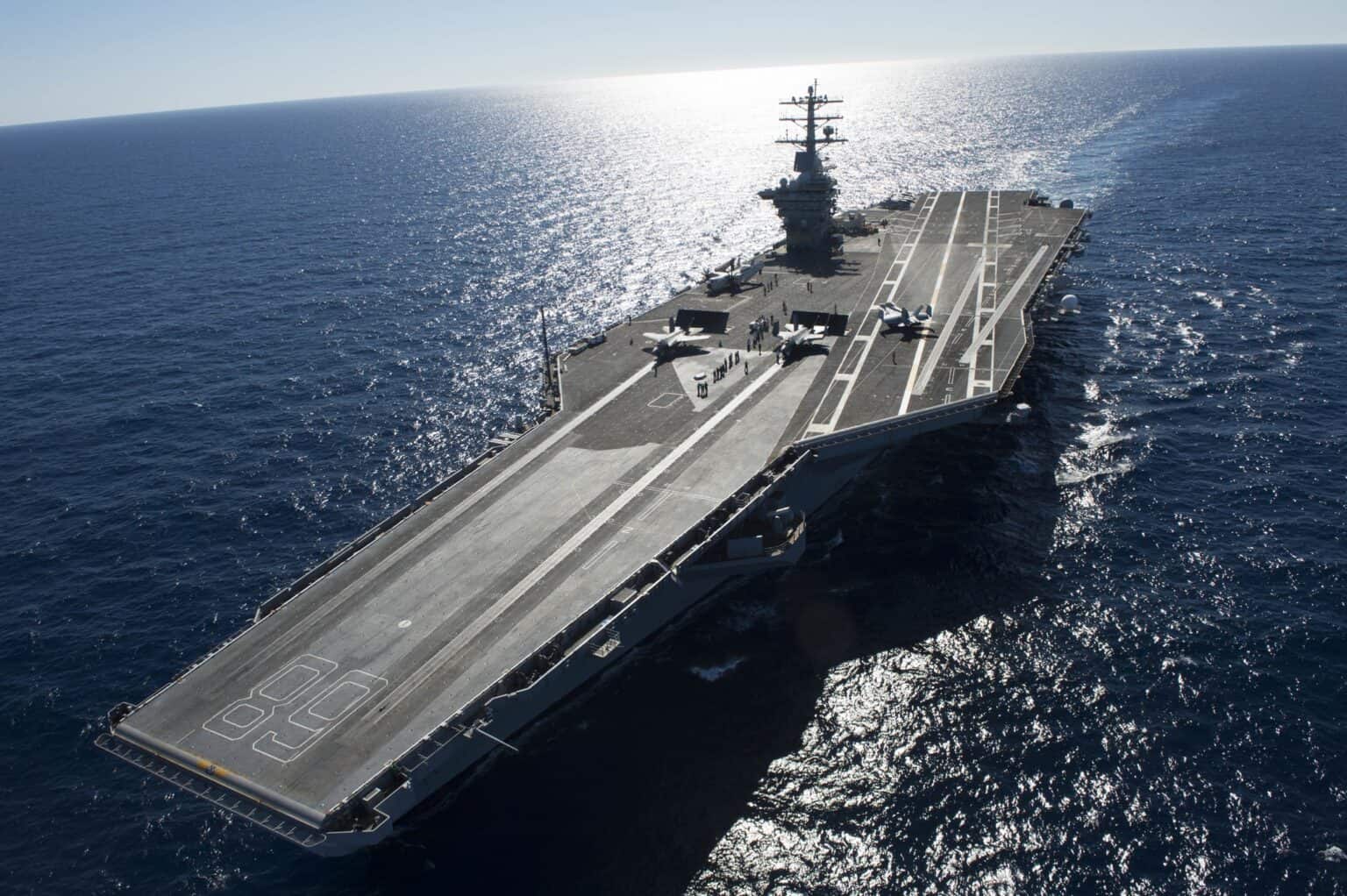
On June 22, 1968, shipbuilders at Newport News, Virginia, laid the keel of the first Nimitz-class aircraft carrier. Apollo 11 was still more than a year from landing on the Moon.
That ship, USS Nimitz, now sits at Norfolk training new carrier pilots while it waits to be retired in March 2027. Its youngest sister, USS George H.W. Bush, spent five months of 2026 on station in the Middle East.
Ten ships share one class name across more than 40 years, from the first keel to the last commissioning. Here is what the Nimitz class is, where all 10 ships are now, how they differ, and what it takes to keep a nuclear carrier running for half a century.
What Is a Nimitz-Class Aircraft Carrier?
The Nimitz class is a group of 10 nuclear-powered aircraft carriers built for the US Navy by Newport News Shipbuilding, now part of Huntington Ingalls Industries. They were commissioned between 1975 and 2009, and they were the largest warships in service until USS Gerald R. Ford joined the fleet in 2017.
Today they make up 10 of the Navy’s 11 carriers; the 11th is the Ford itself. That count is not arbitrary: it is the floor set by law, explained in how many aircraft carriers the US has.
The class takes its name from the lead ship, which honors Fleet Admiral Chester W. Nimitz, the last living US Navy officer to hold that five-star rank.
The Nimitz class at a glance
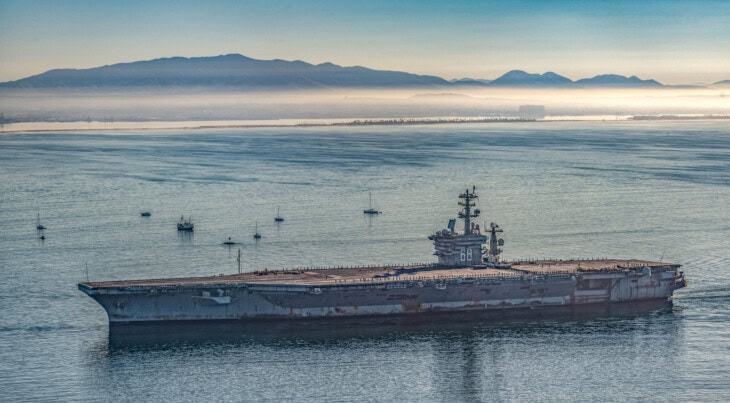
Builder: Newport News Shipbuilding, Virginia. Ships: 10, CVN-68 to CVN-77, commissioned 1975 to 2009. Length: 1,092 feet. Flight deck width: 252 feet. Displacement: about 97,000 tons full load (Navy figure). Power: two nuclear reactors, four shafts. Speed: 30+ knots. Aircraft: 60+. Crew: about 3,000 to 3,200 ship’s company plus a 1,500-strong air wing. Design life: about 50 years, with one midlife refueling. Cost: about $8.5 billion per ship in fiscal 2012 dollars.
How Many Nimitz-Class Carriers Are There?
Ten were built, and all 10 are still in commission as of October 2026. On any given week they are spread across deployments, shipyards and homeports, which is normal for a carrier fleet.
| Ship | Commissioned | Status, early October 2026 |
|---|---|---|
| CVN-68 Nimitz | May 3, 1975 | Training carrier at Norfolk; inactivation planned for March 2027 |
| CVN-69 Dwight D. Eisenhower | Oct. 18, 1977 | Back in Norfolk after an arresting-gear failure on Sept. 28 |
| CVN-70 Carl Vinson | March 13, 1982 | Finished maintenance in June; returned to San Diego in September |
| CVN-71 Theodore Roosevelt | Oct. 25, 1986 | Deployed from San Diego on Sept. 27, crossing the Pacific |
| CVN-72 Abraham Lincoln | Nov. 11, 1989 | Heading home to San Diego after more than 300 days deployed |
| CVN-73 George Washington | July 4, 1992 | Japan-based; deployed in the Arabian Sea |
| CVN-74 John C. Stennis | Dec. 9, 1995 | In midlife overhaul at Newport News since May 2021 |
| CVN-75 Harry S. Truman | July 25, 1998 | Starting its midlife overhaul at Newport News |
| CVN-76 Ronald Reagan | July 12, 2003 | Left Bremerton after maintenance; arrived in San Diego in early October |
| CVN-77 George H.W. Bush | Jan. 10, 2009 | Deployed; port call in Phuket, Thailand, on Oct. 4 |
Old does not mean idle. Between November 2023 and June 2024, the Eisenhower strike group fought the Houthi attacks on Red Sea shipping, hitting more than 460 targets in Yemen.
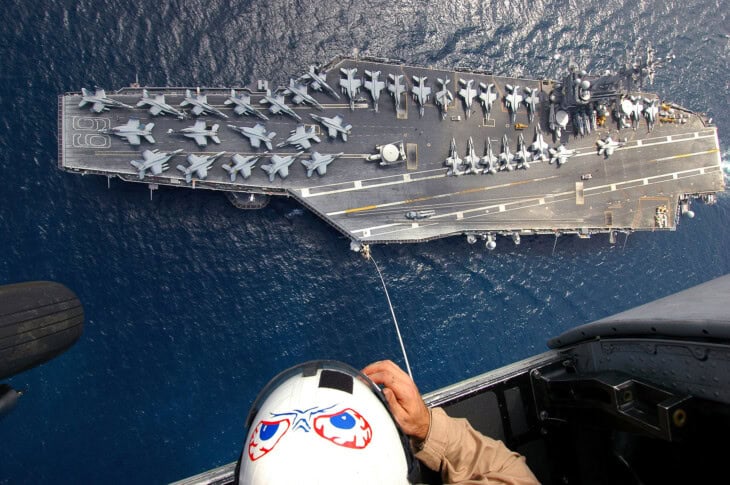
By the Navy’s count, the group fired 155 Standard Missiles and 135 Tomahawks, counting two destroyers that joined it. Its aircraft fired nearly 60 air-to-air missiles and dropped 420 air-to-surface weapons.
Abraham Lincoln’s current deployment, which began on Nov. 21, 2025, had reached 311 days by Sept. 28. USNI News ranks it the second-longest US carrier deployment since the Cold War, behind the Ford’s 326 days.
How Big Is a Nimitz-Class Carrier?
The Navy lists the class at 1,092 feet (333 m) long, with a hull 134 feet (41 m) wide at the waterline and a flight deck 252 feet (77 m) across. Two nuclear reactors turn four shafts for a top speed the Navy gives only as “30+ knots.”
That flight deck is why USS Nimitz had to sail around the tip of South America in 2026 to reach its final homeport in Norfolk. The Panama Canal’s newer locks take ships up to 168 feet (51 m) wide.
Weight is where the sources disagree. The Navy’s fact file gives “approximately 97,000 tons” at full load, while the ship-by-ship figures compiled from naval analyst Norman Polmar’s reference work run from about 100,000 to 104,600 long tons.
Each ship carries “approximately 60+” aircraft, according to the Navy, organized as a nine-squadron air wing on Eisenhower’s 2023 to 2024 combat cruise. The fighters are F/A-18E/F Super Hornets, flown alongside EA-18G Growlers for electronic attack.
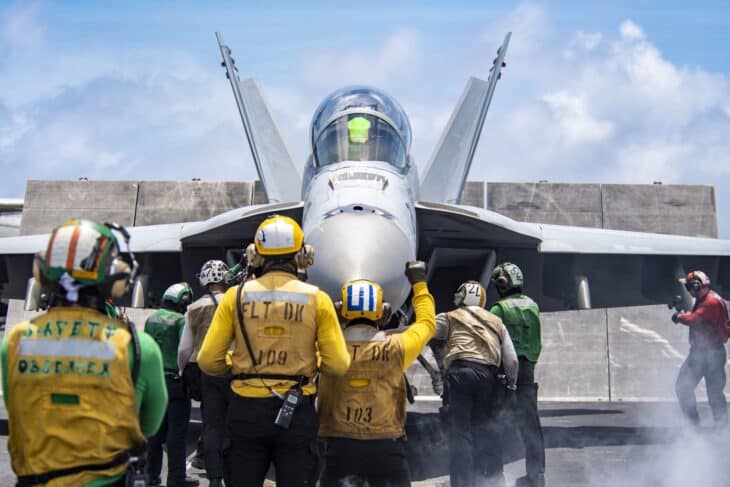

Running all of it takes a small town. The Navy counts 3,000 to 3,200 sailors in the ship’s company, about 1,500 in the air wing and another 500 in other roles.
The carrier is only the center of the formation it sails with; the destroyers and supply ships around it are covered in how a carrier strike group works.
Why No Two Nimitz-Class Carriers Are Quite the Same
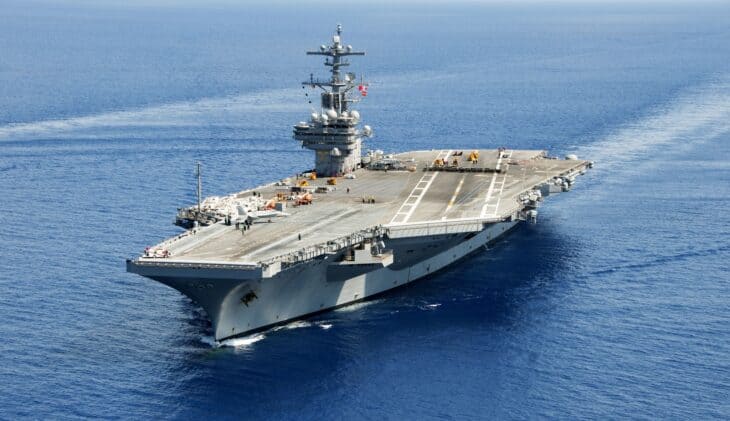
The Navy treats all 10 ships as one class, but a design built over four decades did not stand still. Naval references split it into the original ships and two later sub-groups.
From Theodore Roosevelt (CVN-71) onward, the carriers were built in modules: whole sections were welded up with their plumbing and wiring already fitted, then lifted into the dry dock. George Washington got upgraded flight deck protection, and from John C. Stennis the hulls used a stronger high-strength steel known as HSLA-100.
Ronald Reagan (CVN-76) was the first with a bulbous bow, the rounded bulge below the waterline that cuts wave drag. It also got a redesigned island, the same height as before but with one fewer level, the first major island change since the original 1960 design.
George H.W. Bush (CVN-77) was built as a deliberate “transition ship” toward the Ford class. It has a modernized island and radar tower, an improved propeller, a reduced radar cross-section and a lighter deck covering that saved 100 tons.
.jpg)
The changes added weight over time. In Polmar’s figures, Nimitz displaces about 100,000 long tons and Theodore Roosevelt 104,600.
One admiral, seven presidents and two lawmakers
USS Nimitz is the only ship in the class named for a naval officer. Seven honor presidents, Carl Vinson honors a Georgia congressman and John C. Stennis a Mississippi senator. CVN-75 was originally named USS United States and was renamed Harry S. Truman in February 1995.
What every Nimitz shares is the way it launches and recovers jets: steam catapults and arresting wires, with four large elevators moving aircraft between the flight deck and the hangar. The Ford class swapped the steam catapults for electromagnetic ones, which is the story of the Ford-class aircraft carrier.
How Does a Nuclear Carrier Refuel?
Myth: a nuclear carrier never needs refueling
It does, once. Each Nimitz-class ship is designed for about 50 years with a single midlife refueling, and getting it done takes the carrier out of service for years, not weeks.
A Nimitz-class carrier runs on two A4W reactors that can operate for more than 20 years without new fuel. At the midpoint of its life, the ship goes back to Newport News for a Refueling and Complex Overhaul, or RCOH.
The overhaul replaces the reactor fuel and rebuilds much of the ship around it. HII, the builder, says the RCOH accounts for 35% of all the maintenance and modernization in a carrier’s service life.
Those overhauls keep getting longer. Nimitz went first, from May 1998 to June 2001, about 37 months; Eisenhower’s ran 46 months to March 2005, and Carl Vinson’s 44 months to July 2009.
Theodore Roosevelt’s took 48 months, ending in August 2013, and Abraham Lincoln’s 49.5 months, ending in May 2017. George Washington entered in August 2017 and did not come out until May 2023, after 69 months.
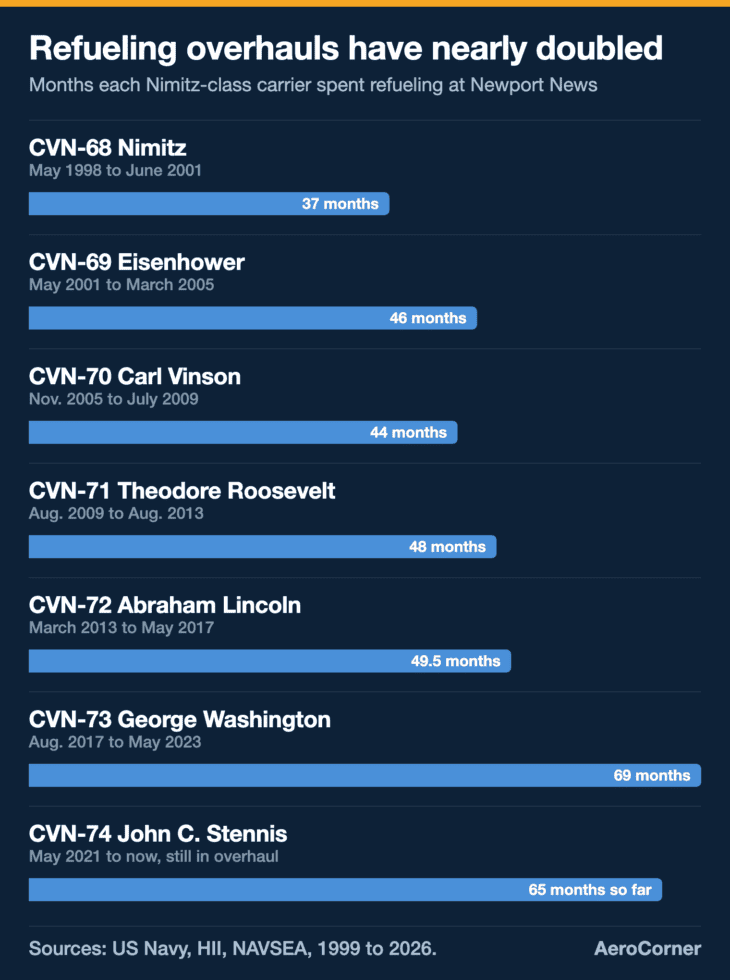
John C. Stennis entered its overhaul in May 2021 under a $3 billion contract, and it was due out by August 2025. In 2024 the Navy said it was tracking October 2026.
The Navy’s fiscal 2026 budget request then funded “an additional 13-month delivery delay,” pointing to November 2027, according to Janes. As of early October 2026, the ship had not been redelivered.
Truman is next. In late September 2026, HII won a $5.1 billion contract for its overhaul, which USNI News reports is expected to finish in November 2031.
Every extra month a carrier spends in the yard is a month it cannot deploy, and that is how a shipyard schedule turns into a fleet problem. The payoff is a second life: the Navy says George Washington is now set to serve until 2048 or beyond.
Is the USS Nimitz Being Decommissioned?
Yes. USS Nimitz is scheduled to be inactivated in March 2027, about 10 months later than its original May 2026 date.
The delay is about arithmetic, not need. Federal law, 10 U.S.C. 8062(b), requires “not less than 11 operational aircraft carriers,” and the ship meant to restore that count, the Ford-class John F. Kennedy, is due for delivery in March 2027.
The Navy took preliminary acceptance of Kennedy on Sept. 29, 2026. Until it arrives, Nimitz stays on the books, as covered in why USS Nimitz still cannot retire.
Nimitz flew its final deployment in 2025, then left Bremerton in March 2026 and reached Norfolk on July 9. The Navy has already given Newport News a $96 million contract to plan its inactivation and order long-lead materials.
Eisenhower is next in line. The Navy’s fiscal 2027 shipbuilding plan, as reported by USNI News, would recycle it in fiscal 2030.
What Is the Oldest Aircraft Carrier Still in Service?
USS Nimitz. Commissioned on May 3, 1975, it is the oldest aircraft carrier in service anywhere in the world.
Nothing else on the current list comes close. The next oldest by commissioning date are the amphibious assault ship USS Wasp, from 1989, and Russia’s Admiral Kuznetsov, from 1991.
For how the American ships compare with the rest of the world’s, see the best aircraft carriers in the world.
So the next time a Nimitz-class carrier turns up in the news, check which one. It might be a ship laid down before the Moon landing or one commissioned in 2009, and the Navy still calls them the same class.
Sources and references used for research and fact-checking.
- US Navy, Aircraft Carriers - CVN (fact file, archived Nov. 6, 2024)
- Wikipedia, Nimitz-class aircraft carrier
- Wikipedia, USS Nimitz
- Wikipedia, List of aircraft carriers in service
- Wikipedia, USS Harry S. Truman
- NASA, Apollo 11
- Wikipedia, Panamax
- MarineLink, Imposing Reagan Joins the Navy
- Northrop Grumman Shipbuilding, George H.W. Bush (CVN 77) design enhancements (archived)
- USNI News, USNI News Fleet and Marine Tracker: Oct. 5, 2026
- USNI News, Carrier USS George H.W. Bush makes port call in Thailand
- USNI News, Four Injured After Growler Landing Mishap Aboard USS Dwight D. Eisenhower, Crew Safely Recovered
- USNI News, Carrier USS Dwight D. Eisenhower to return to port after Growler mishap
- DVIDS, USS Carl Vinson completes planned incremental availability
- USNI News, USNI News Fleet and Marine Tracker: Sept. 8, 2026
- USNI News, USS Theodore Roosevelt deploys from San Diego, USS Abraham Lincoln near Hawaii
- USNI News, Carrier USS Abraham Lincoln pulls into Guam for logistics stop, deployment now at 302 days
- USNI News, USS Gerald R. Ford breaks post-Cold War deployment record
- USNI News, Carrier USS George Washington returns to Japan
- US Navy, Unprecedented: Dwight D. Eisenhower Carrier Strike Group Returns from Combat Deployment
- USNI News, Navy Extends USS Nimitz Service Life to 2027, in Line with Carrier John F. Kennedy's Delivery
- Breaking Defense, Aircraft carrier Nimitz gets service life extension, won't be decommissioned until 2027
- USNI News, USS Nimitz: an aircraft carrier's final journey
- USNI News, USNI News Fleet and Marine Tracker: July 13, 2026
- USNI News, Carrier USS Nimitz returns to Bremerton, wraps final deployment
- USNI News, Navy Partially Accepts Carrier John F. Kennedy from HII Newport News Shipbuilding
- USNI News, New Navy shipbuilding plan: Trump-class battleship will be nuclear powered, carrier design is under review
- Cornell Law School Legal Information Institute, 10 U.S. Code 8062: Navy: composition; functions
- HII, Aircraft Carrier Refueling and Inactivation
- Federation of American Scientists, Navy wire: Nimitz RCOH (Dec. 1999)
- RAND Corporation, Refueling and Complex Overhaul of the USS Nimitz (CVN 68): Lessons for the Future (MR-1632)
- Navy NewsStand via GlobalSecurity, USS Dwight D. Eisenhower redelivered after RCOH
- Northrop Grumman via GlobalSecurity, Northrop Grumman redelivers USS Carl Vinson
- HII, Newport News Shipbuilding redelivers USS Theodore Roosevelt following RCOH
- Marine Log, CVN 72 arrives at NNS for refueling after six-week delay
- HII, Huntington Ingalls Industries redelivers USS Abraham Lincoln
- US Navy, Refueling complex overhaul completed on USS George Washington (CVN 73)
- US Navy, USS John C. Stennis leaves dry dock, begins second phase of refueling and complex overhaul
- USNI News, Carrier USS John C. Stennis overhaul delayed, work will take more than 5 years to complete
- Janes, Pentagon budget 2026: US Navy requests funding to cover aircraft carrier overhaul cost increases
- NAVAIR Lakehurst, Electromagnetic Aircraft Launch System (EMALS)
- The Maritime Executive, USS Harry S. Truman begins $5.1B mid-life refueling and overhaul
Get the Newsletter
The latest aviation news and stories sent to your inbox.
About the Author

Tim is the owner and lead editor of AeroCorner since 2019, overseeing aviation content covering aircraft, airlines, airports, and the broader aviation industry. Through years of researching, writing, editing, and publishing aviation-focused content, he has developed extensive practical knowledge of commercial aviation and air travel. Based in Asia and a frequent traveler himself, Tim also brings firsthand passenger experience to AeroCorner’s coverage. Outside of publishing, he has also explored aviation firsthand through hands-on flight training in New Zealand.