

Table of Contents
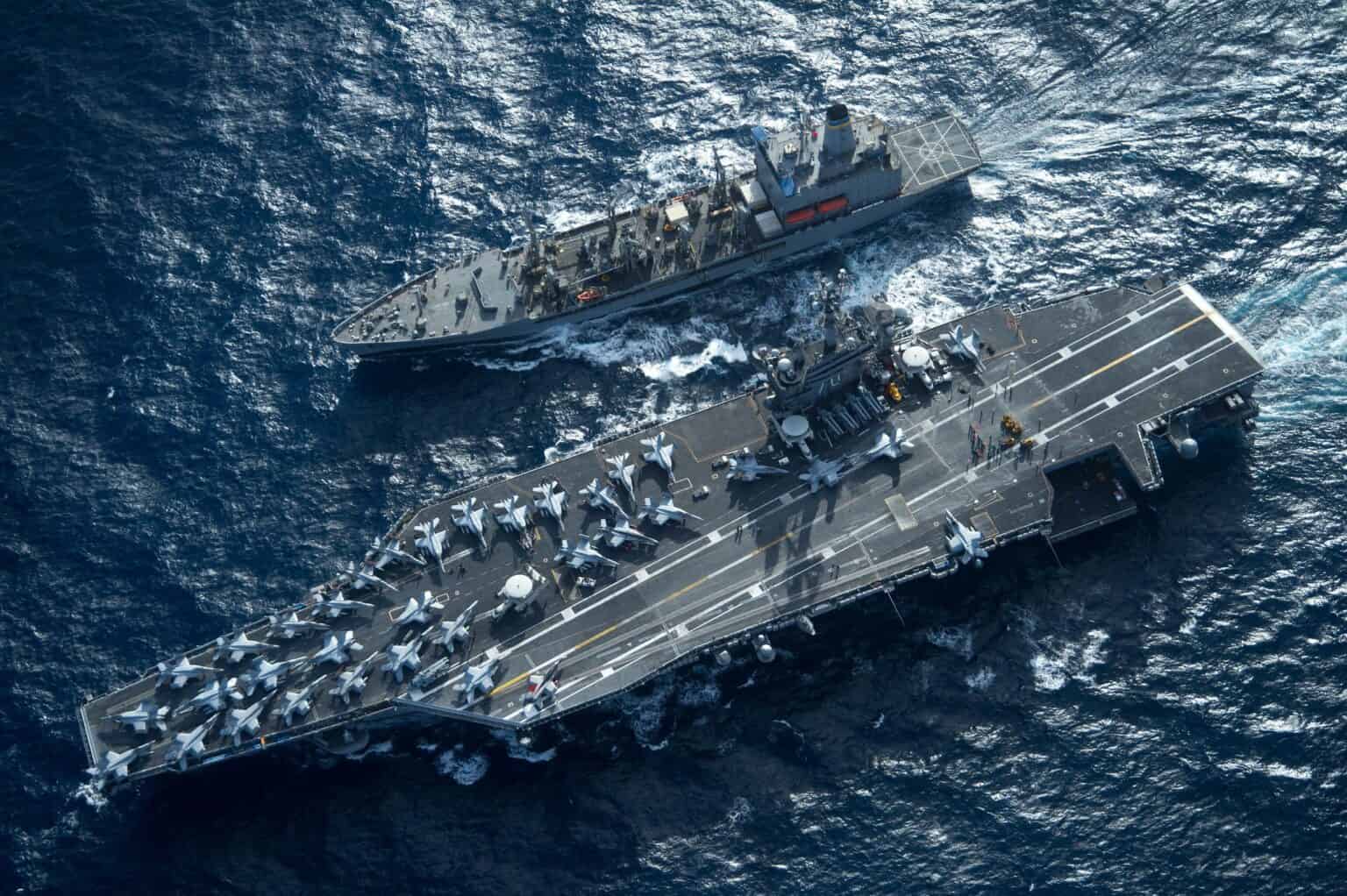
In early 2026, the headlines said a carrier strike group was in the Arabian Sea. It sounded like an armada. In practice it was one carrier with nine squadrons of aircraft aboard and three destroyers around it.
That group, built around USS Abraham Lincoln, had half the escort ships that the Eisenhower group took to sea ten years earlier. Nobody had made a mistake. The Navy’s most famous formation simply has no fixed size.
Here is what a carrier strike group actually contains, what each piece is for, and why the ships around the carrier matter less than the aircraft on it.
What Is a Carrier Strike Group?
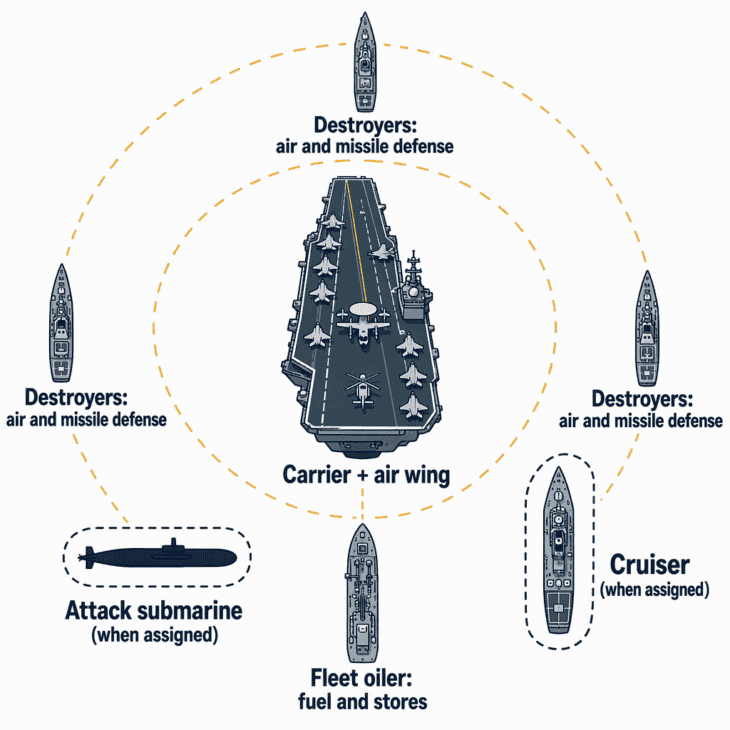
A carrier strike group is the US Navy’s standard fighting formation: one aircraft carrier, the air wing that flies from it, a squadron of guided-missile destroyers, and the logistics ships that keep them all at sea. Some groups add a cruiser or an attack submarine.
Reference figures put a full group at roughly 7,500 people. The Navy described the Lincoln group on its 2025 to 2026 deployment as “more than 5,000 Sailors and Marines,” a reminder that the headcount moves with the number of escorts.
Two commanders ride aboard the carrier. A rear admiral commands the whole strike group, and a captain known as the commodore runs the destroyer squadron. For Lincoln, those were the staffs of Carrier Strike Group 3 and Destroyer Squadron 21.
A carrier strike group at a glance
One Nimitz- or Ford-class carrier. One air wing of nine squadrons and 65 to 70+ aircraft. Two to four guided-missile destroyers, sometimes a cruiser. Sometimes an attack submarine. A civilian-crewed fleet oiler for fuel and supplies. Roughly 5,000 to 7,500 people, depending on the escorts assigned.
The Air Wing Is the Reason the Group Exists
The carrier is the centerpiece, but the aircraft are the weapon. Nimitz- and Ford-class carriers are the largest warships in the world, and the Navy itself calls them “the most adaptable and survivable airfields in the world.” Our ranking of the best aircraft carriers in the world shows how they compare with foreign designs.
Lincoln’s air wing, Carrier Air Wing 9, flew nine squadrons and more than 70 aircraft on its 2025 to 2026 deployment. That is a fairly typical load: reference figures for a carrier air wing run from 65 to 70 aircraft, and you can see how other nations’ carriers compare in our breakdown of how many planes an aircraft carrier holds.
| Squadrons | Aircraft | Main job |
|---|---|---|
| 3 | F/A-18E/F Super Hornet | Strike and air-to-air combat |
| 1 (Marine Corps) | F-35C Lightning II | Stealth strike |
| 1 | EA-18G Growler | Electronic attack, jamming enemy radar |
| 1 | E-2D Advanced Hawkeye | Airborne early warning |
| 2 | MH-60R and MH-60S Seahawk | Submarine hunting, rescue, resupply |
| 1 | CMV-22B Osprey | Carrier logistics: people, parts, mail |
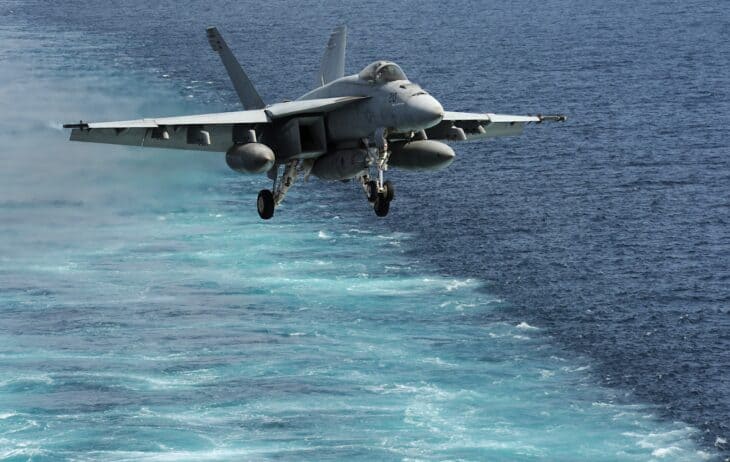
The Super Hornet is still the workhorse, with three of the nine squadrons. One squadron flies the carrier version of the F-35 Lightning II, and on Lincoln that squadron belonged to the Marine Corps, not the Navy.
_137_approaches_the_flight_deck_of_the.jpg)
The rest of the wing makes the fighters useful. The EA-18G Growler blinds enemy radar, the E-2D Hawkeye watches the sky far beyond the ships’ horizon, and the Ospreys keep the carrier supplied. Take those away and the strike fighters are flying half blind.
The Escorts: Who Guards the Carrier
The ships around the carrier exist mainly to protect it. Their job is to stop drones, missiles and submarines before they reach the flight deck, and to add their own firepower to strikes on land targets.
Guided-missile destroyers
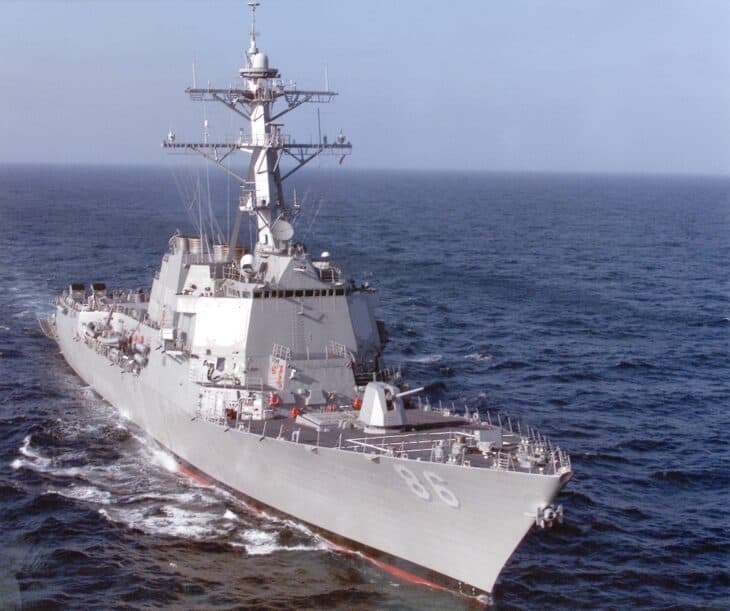
The backbone of every modern strike group is the Arleigh Burke-class destroyer. Each one carries the Aegis combat system, a phased-array radar that tracks aircraft and missiles, plus 90 to 96 vertical launch cells for air-defense missiles, anti-submarine rockets, and Tomahawk cruise missiles.
_class_guided_missile_Destroyer_USS_Shoup_(DDG_86).jpg)
A Flight IIA destroyer has a crew of 329 and carries two MH-60R Seahawk helicopters, so every escort adds its own submarine hunters to the group. Lincoln’s escorts were USS Frank E. Petersen Jr., USS Spruance, and USS Michael Murphy.
The cruiser, while it lasts
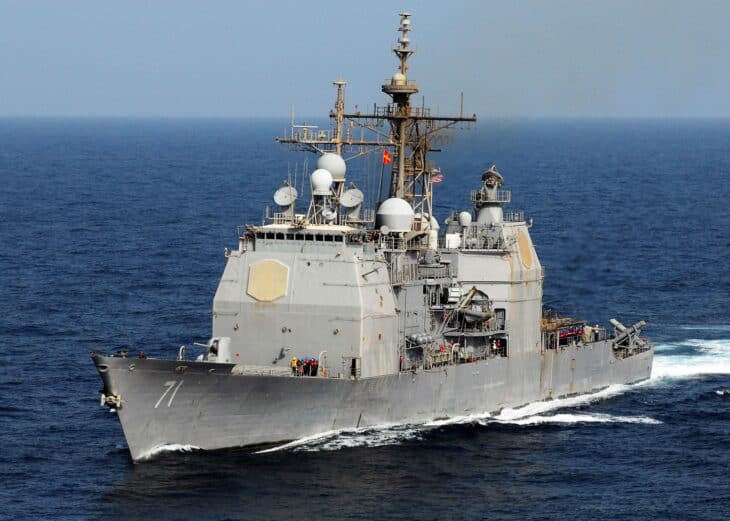
For decades, a strike group sailed with one or two Ticonderoga-class cruisers. They were designed as air and missile defense command centers, and each carries 122 launch cells, more than any destroyer.
_steams_in_the_Indian_Ocean_supporting_maritime_security_operations_in_the_U.S._5th_Fleet_area_of_responsibility.jpg)
They are disappearing. Only 10 remained in April 2025, and USS Shiloh and USS Lake Erie are on the Navy’s 2026 inactivation list. Three, USS Gettysburg, USS Chosin and USS Cape St. George, have had their service lives extended into 2029.
The Navy’s plan is for the newest Flight III destroyers to take over the cruiser’s air-defense command role. A purpose-built successor, the DDG(X), was not expected before 2032 under the Navy’s 2024 plans.
The submarine and the oiler
Reference descriptions of a strike group include up to two attack submarines. None appears in the Navy’s published lineup for the Lincoln group, which tells you something about how much the Navy says about its submarines.
The least glamorous ship matters most for staying power. A fleet replenishment oiler from Military Sealift Command, crewed largely by civilian mariners, keeps the group supplied with fuel. In March 2025, USNS John Lewis made the first deployment of its class, supporting the Nimitz strike group in the Indo-Pacific.
A nuclear carrier still needs a tanker
Nimitz- and Ford-class carriers are designed to run about 50 years with a single midlife reactor refueling. Their aircraft are not nuclear, and neither are the gas-turbine destroyers around them. Every jet and every escort burns fuel, which is why a strike group never sails far without its oiler.
Why It Is Called a “Strike” Group
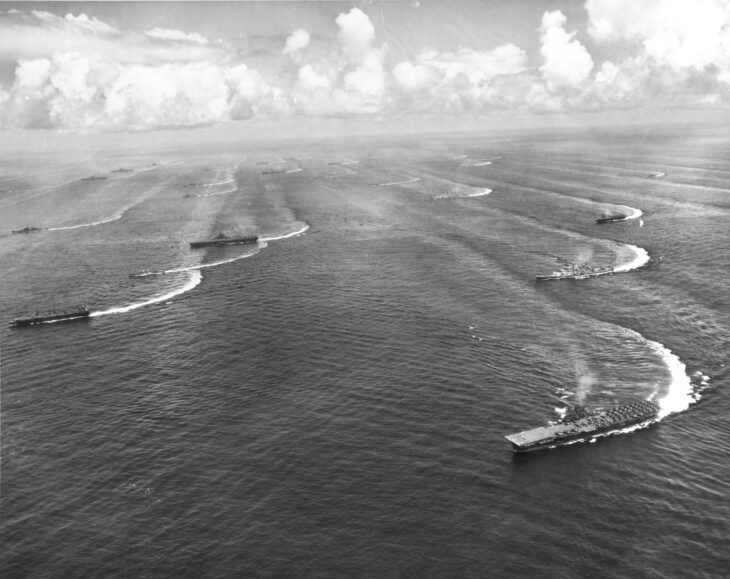
The formation is older than the name. In World War II, US carriers fought in numbered task forces, split into task groups of three or four carriers each, with the escorts arranged in a circle around them.
Those forces were enormous. In December 1944, Task Force 58 counted 17 carriers, six battleships, 13 cruisers, 58 destroyers and about 1,100 aircraft. The single-carrier battle group came later, born of the drawdown that followed the war.

On October 1, 2004, the Navy redesignated its carrier groups and cruiser-destroyer groups as carrier strike groups. The switch from “battle” to “strike” is generally linked to a growing emphasis on projecting air power ashore rather than fighting other fleets.
How Many Carrier Strike Groups Does the US Have?
The most recent published tally, from 2023, lists 11 numbered carrier strike groups. Nine are paired with deployable carriers. The other two, Carrier Strike Group 4 on the Atlantic side and Carrier Strike Group 15 on the Pacific side, exist to train and test the rest.
Their main tool is the composite training unit exercise, known as COMPTUEX: a workup in which ships, submarines and aircraft play the enemy. It is the last major test before a group is cleared to deploy.
Having 11 carriers does not mean 11 groups at sea. Most are in maintenance or training at any moment, which we cover in detail in how many aircraft carriers the US has. On September 30, 2026, four carriers were deployed, and one of them, Lincoln, was heading home after 314 days away.
The hull number on a carrier is just its place in the sequence. Lincoln is CVN 72, and Theodore Roosevelt is CVN 71.
The Myth: A Strike Group Is a Fixed Package
The myth
A carrier strike group is a standard set of ships, so every group that deploys looks the same. In reality the Navy assigns escorts deployment by deployment and even swaps them mid-cruise. The three groups compared below sailed with three, four and six escorts.
Put three real strike groups side by side and the spread is obvious. The escort count halved between Eisenhower’s 2016 workup and Lincoln’s 2025 deployment, and the cruiser comes and goes.
| Strike group | Cruisers | Destroyers | Total escorts |
|---|---|---|---|
| Eisenhower (CSG 10), April 2016 | 2 | 4 | 6 |
| Abraham Lincoln (CSG 3), deployed November 2025 | 0 | 3 | 3 |
| Theodore Roosevelt, deployed September 2026 | 1 (USS Chosin) | 3 | 4 |
Escorts also change during a deployment. In 2023, during the Israel-Hamas war, the destroyers USS The Sullivans and USS Delbert D. Black joined the Gerald R. Ford group mid-deployment and relieved the destroyers it had sailed with.
The Navy is now loosening the model on purpose. In early 2026, Chief of Naval Operations Adm. Daryl Caudle said the service would send smaller, tailored forces to missions such as minesweeping or chokepoint defense rather than a full strike group.
“I just, quite frankly, don’t need a strike group to do all those,” he said. His plan leans on unmanned surface and undersea vessels to fill some of the gaps.
So the next time a carrier strike group is “moved” somewhere, read it the right way. A carrier and its 70-odd aircraft are on the way, with however many destroyers the Navy could spare that year.
The ships are the wrapping. The air wing is what gets delivered.
Sources and references used for research and fact-checking.
- Wikipedia, Carrier strike group
- Wikipedia, Task Force 58
- DVIDS, Abraham Lincoln Carrier Strike Group
- Naval Air Force, U.S. Pacific Fleet, Carrier Strike Group 3
- The National Interest, How the US Navy Is Rethinking the Carrier Strike Group
- Breaking Defense, Navy advances plans to reshuffle traditional carrier strike group model
- The War Zone, Full Retirement Of Ticonderoga Cruisers On Hold, Trio To Remain In Service Into 2029
- Defense News, Navy releases list of ships it plans to inactivate this year
- The War Zone, Where Are The Aircraft Carriers?: September 30, 2026
- U.S. Navy, Destroyers (DDG 51)
- U.S. Navy, Aircraft Carriers (CVN)
- U.S. Navy, Ike CSG Ready for Deployment Following COMPTUEX
- Military Sealift Command, MSC Fleet Replenishment Oiler USNS John Lewis Deploys in Support of Nimitz Carrier Strike Group
Get the Newsletter
The latest aviation news and stories sent to your inbox.
About the Author

Tim is the owner and lead editor of AeroCorner since 2019, overseeing aviation content covering aircraft, airlines, airports, and the broader aviation industry. Through years of researching, writing, editing, and publishing aviation-focused content, he has developed extensive practical knowledge of commercial aviation and air travel. Based in Asia and a frequent traveler himself, Tim also brings firsthand passenger experience to AeroCorner’s coverage. Outside of publishing, he has also explored aviation firsthand through hands-on flight training in New Zealand.