

Table of Contents
The main types of navy ships are aircraft carriers, amphibious warships, cruisers, destroyers, frigates, littoral combat ships, submarines, mine countermeasures ships, and the support ships that keep all of them fueled and fed. Every one of them carries a short letter code, such as CVN for a nuclear aircraft carrier or DDG for a guided missile destroyer.
The aircraft carrier is the biggest and most important of them. The Navy calls its carriers the largest warships in the world, and the rest of the fleet is largely built to protect, supply, and fight alongside them.
This guide uses the US Navy as its reference fleet, because its hull codes are the shorthand most readers meet. As of October 1, 2025, the Navy counted 293 battle force ships. Figures below are current as of September 2026.
| Ship type | Hull code | Current US class | In US service (2026) |
|---|---|---|---|
| Aircraft carrier | CVN | Nimitz, Gerald R. Ford | 11 |
| Amphibious assault ship | LHA / LHD | America, Wasp | 9 |
| Amphibious transport dock | LPD | San Antonio | 13 |
| Dock landing ship | LSD | Whidbey Island, Harpers Ferry | Being retired |
| Cruiser | CG | Ticonderoga | Down to 3 by end of 2026 |
| Destroyer | DDG | Arleigh Burke, Zumwalt | 70+ |
| Frigate | FFG | Constellation | None (2 under construction) |
| Littoral combat ship | LCS | Freedom, Independence | About 2 dozen |
| Attack submarine | SSN | Virginia, Seawolf, Los Angeles | About 50 |
| Ballistic missile submarine | SSBN | Ohio (Columbia building) | 14 |
| Guided missile submarine | SSGN | Ohio | Retiring |
| Mine countermeasures ship | MCM | Avenger | 4 |
| Command ship | LCC | Blue Ridge | 2 |
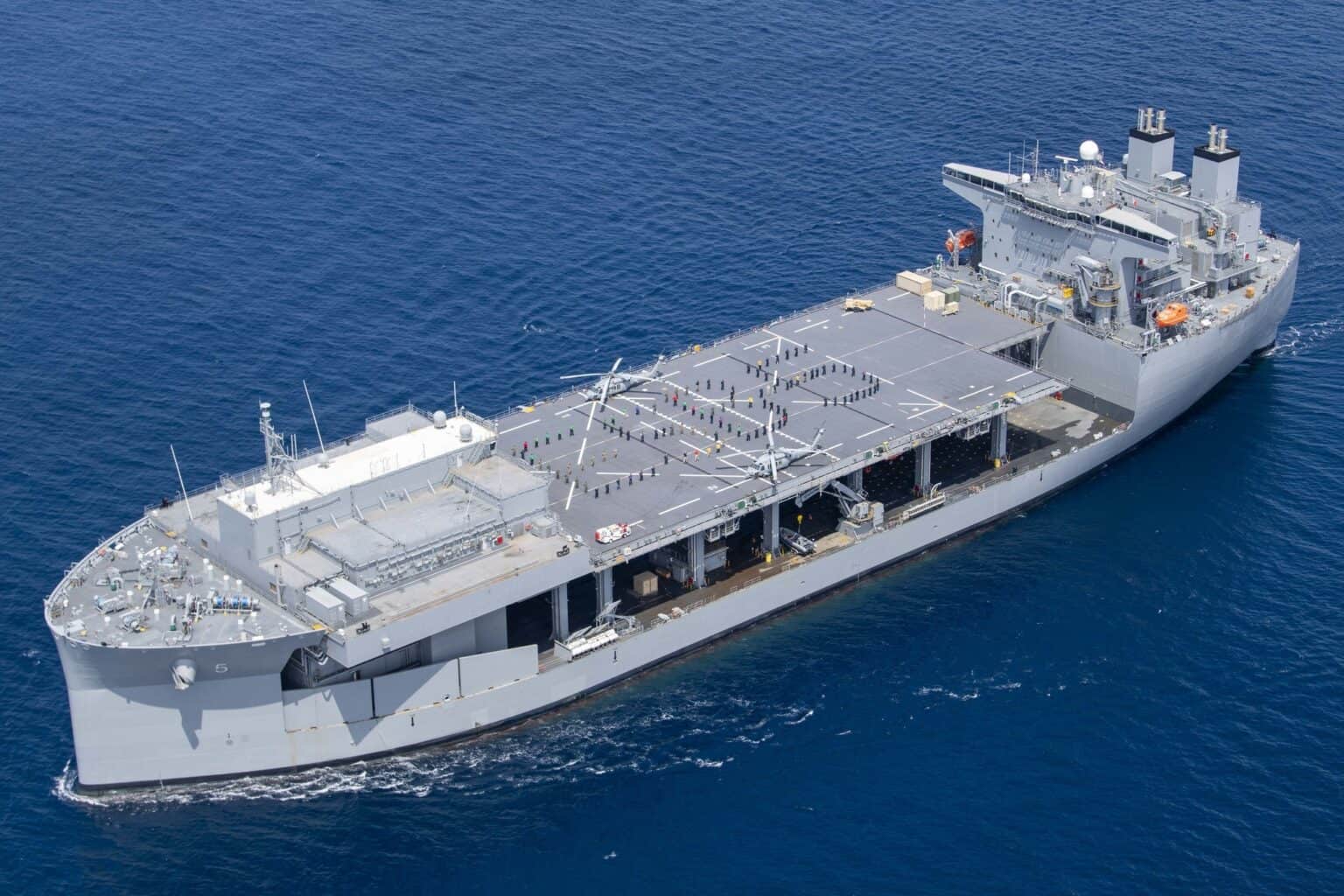
| Expeditionary sea base | ESB | Lewis B. Puller | 5 (sixth due 2026) |
| Fleet oiler | T-AO | Henry J. Kaiser, John Lewis | Under 20 |
| Hospital ship | T-AH | Mercy | 2 |
How this guide is organized
Ship types are grouped by job: aircraft carriers first, then amphibious warships, surface combatants, submarines, mine warfare, and finally the support ships. Counts reflect ships in commission or delivered to the fleet as of September 2026. Ships that are only on order are noted but not counted. Types retiring this year are shown as retiring rather than given a count that will be out of date within months.
How navy hull codes work
The US Navy introduced its modern hull classification system on July 17, 1920. Every symbol has at least two letters, and the hull number after it identifies one specific ship, such as CVN 68 for USS Nimitz.
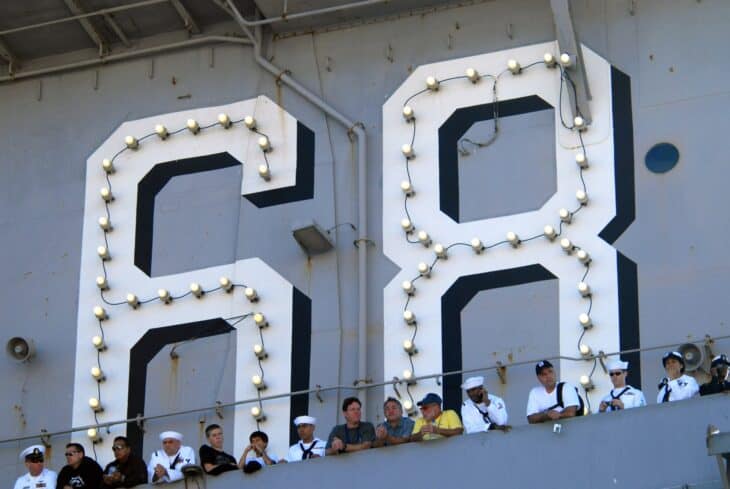
_Sailors_along_with_their_family_and_friends_stand_at_the_rails_as_the_ship_is_moored.jpg)
The extra letters carry meaning. N means nuclear powered, so CVN is a nuclear carrier and SSN is a nuclear attack submarine. G means guided missile, as in DDG for a guided missile destroyer.
A T in front of the code, as in T-AO, marks a ship run by Military Sealift Command with a crew of civilian mariners. Those ships carry the prefix USNS instead of USS.
1. Aircraft carriers (CVN)
_underway_on_8_April_2017.JPG)
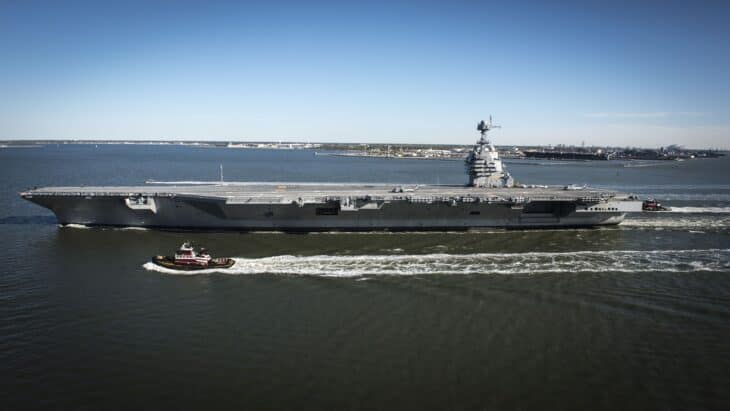
An aircraft carrier is a floating airfield, and it is the ship the rest of the fleet is organized around. The Navy describes the Nimitz and Gerald R. Ford classes as the largest warships in the world, each designed to serve about 50 years with a single mid-life refueling.
The Navy operates 11 carriers, the minimum federal law requires: ten Nimitz-class ships and USS Gerald R. Ford. A Nimitz-class carrier displaces roughly 100,000 tons at full load, and the Ford is 1,092 feet (333 m) long. Our look at how many aircraft carriers the US has shows how few are at sea on a normal day.
The oldest, USS Nimitz, is next to retire. Its decommissioning has been pushed back to at least March 2027 so it can line up with the commissioning of the second Ford-class ship, John F. Kennedy (CVN 79), and keep the count at 11.
A carrier’s real weapon is its air wing of fighters, radar planes, and helicopters. Our guides to the types of Navy planes and types of Navy helicopters cover what flies from the deck, and how many planes an aircraft carrier holds covers how many fit.
2. Amphibious assault ships (LHA and LHD)
_F-35B_loaded.jpg)
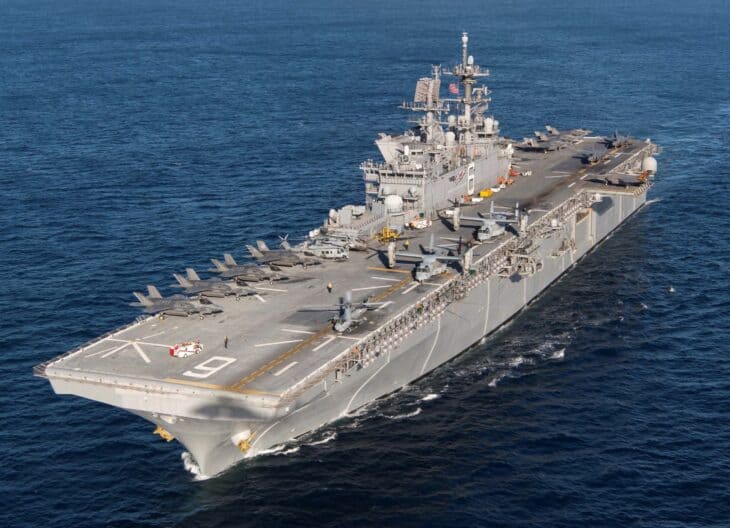
An amphibious assault ship looks like a small aircraft carrier, and that is roughly what it is. Its job is to put a Marine expeditionary unit ashore by helicopter, tiltrotor, and landing craft.
The Navy runs two America-class LHAs and seven Wasp-class LHDs. USS America is 855 feet (261 m) long, displaces about 43,700 tons, and carries up to 1,687 troops.
These big decks fly F-35B jets that take off from a short run and land vertically, plus the MV-22 Osprey tiltrotor and a mix of Marine helicopters. The F-35 Lightning II gives these ships a strike punch of their own. The next ship, Bougainville (LHA 8), is scheduled for delivery in 2026.
3. Amphibious transport docks (LPD) and dock landing ships (LSD)
,_front,_and_USS_New_York_(LPD_21)_are_underway_together_in_the_Atlantic_Ocean_off_the_coast_of.jpg)
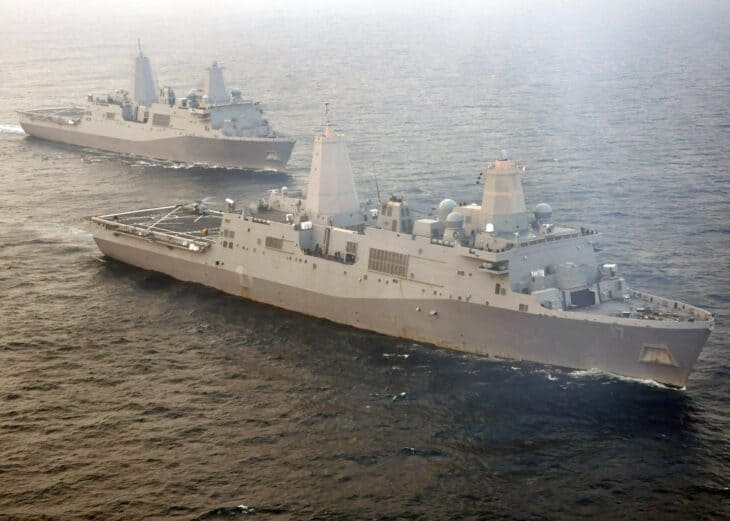
These ships carry the Marines, vehicles, and landing craft that the big decks cannot. Their defining feature is a well deck at the stern that floods, so landing craft can drive straight out of the ship.
The San Antonio-class LPD is the modern version, with 13 in service. Each is 684 feet (208 m) long, displaces about 25,300 tonnes, and can land two MV-22 Ospreys on its flight deck at once.
The older dock landing ships of the Whidbey Island and Harpers Ferry classes are 609 feet (186 m) long. The Whidbey Island class was designed specifically to carry four air-cushion landing craft, known as LCACs.
These ships are now leaving service. USS Germantown is on the Navy’s 2026 list to become a parts donor for the ships that remain.
4. Cruisers (CG)
_steams_in_the_Indian_Ocean_supporting_maritime_security_operations_in_the_U.S._5th_Fleet_area_of_responsibility.jpg)
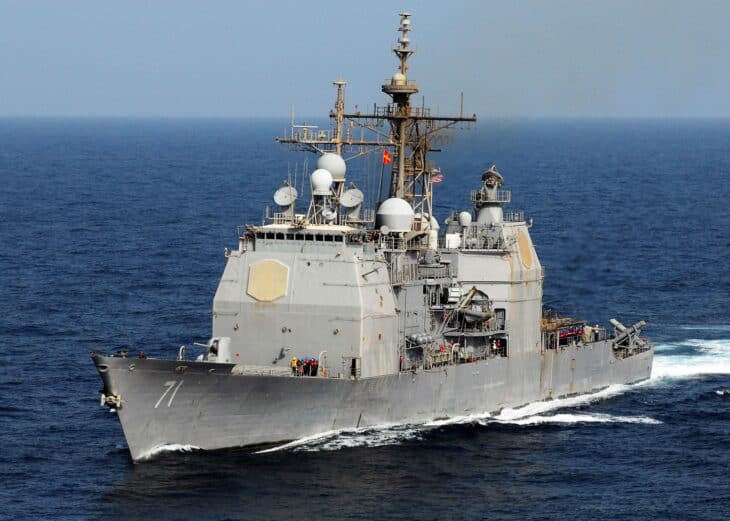
A cruiser is a large multi-mission surface combatant, and in the US Navy its main job is air defense for a carrier group. The Ticonderoga class was the first class to carry the Aegis combat system, which pairs a powerful radar with Standard missiles.
Each Ticonderoga is 567 feet (173 m) long, displaces 9,600 tons, and has 122 vertical launch cells for missiles. That is more than any Arleigh Burke destroyer, which is why losing them is controversial.
The Navy built 27 of them, and only 10 remained in April 2025. USS Shiloh and USS Lake Erie are being turned into parts donors, and the class is expected to be down to three ships by the end of 2026. Gettysburg, Chosin, and Cape St. George have been extended into 2029.
The cruiser has no replacement yet
No new cruiser is in service or under construction. The Navy’s stated plan is for Flight III Arleigh Burke destroyers to take over the air defense command role, while a planned successor destroyer, known as DDG(X), is still years from joining the fleet.
5. Destroyers (DDG)
_class_guided_missile_Destroyer_USS_Shoup_(DDG_86).jpg)
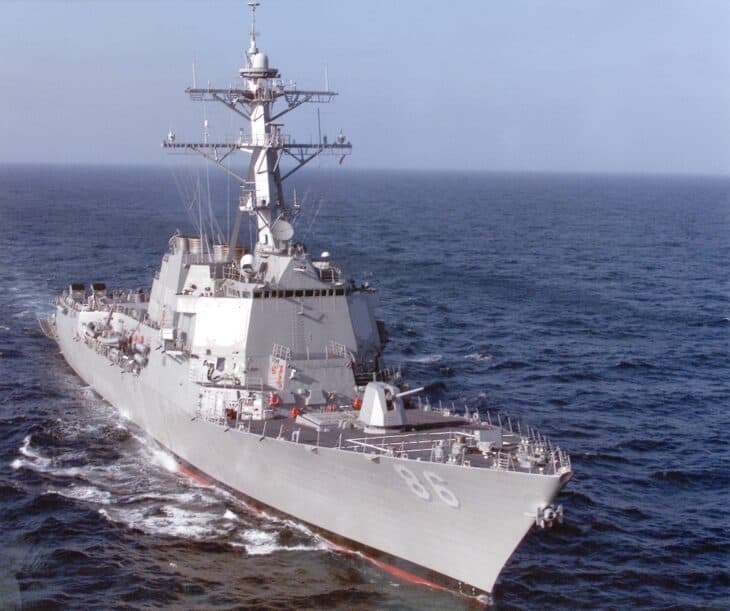
The destroyer is the workhorse of the modern Navy. A guided missile destroyer can hunt submarines, attack ships and land targets with Tomahawk missiles, and on newer ships shoot down ballistic missiles.
The Arleigh Burke class is the largest class of warship in the fleet, with more than 70 in service and dozens more under construction or on contract. The first, USS Arleigh Burke, was commissioned on July 4, 1991, and the class is still in production.
Newer Flight IIA and III ships are 509.5 feet (155 m) long, and the class displaces between 8,230 and 9,700 tons. The newer ships carry two MH-60R Seahawk helicopters. The Flight III ships add the SPY-6 radar, which lets them handle air defense and missile defense at the same time.
The Navy also has the Zumwalt class, three angular stealth destroyers 610 feet (186 m) long. The Navy calls the Zumwalt the largest surface combatant in the world, and it is being fitted with the Conventional Prompt Strike hypersonic missile.
6. Frigates (FFG)
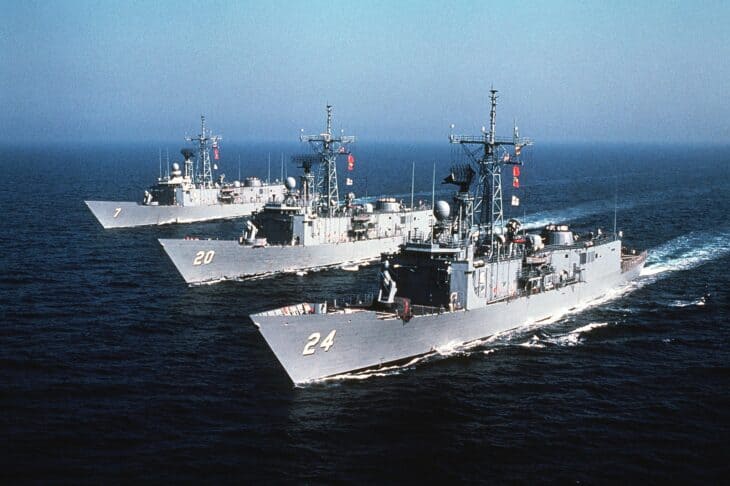

A frigate is a smaller warship built mainly to escort other ships and hunt submarines. Many navies build their fleets around frigates, and some add even smaller corvettes below them.
The US Navy has not had a frigate in service since USS Simpson, the last Oliver Hazard Perry-class ship, was decommissioned on September 29, 2015. Its replacement, the Constellation class, ran about three years late.
On November 25, 2025, the Navy canceled all but the first two Constellation ships, which are still being finished. A month later it announced that its new frigate program, FF(X), would be based on the Coast Guard’s National Security Cutter design.
A decade without a frigate
The US Navy has gone more than ten years with no frigates at all. The Constellation class was meant to end that gap, and its cancellation in 2025 means the wait now runs to a second design that has not yet been built.
7. Littoral combat ships (LCS)
_underway_in_San_Diego_Bay_on_19_April_2019_(190419-N-KG738-1051).JPG)
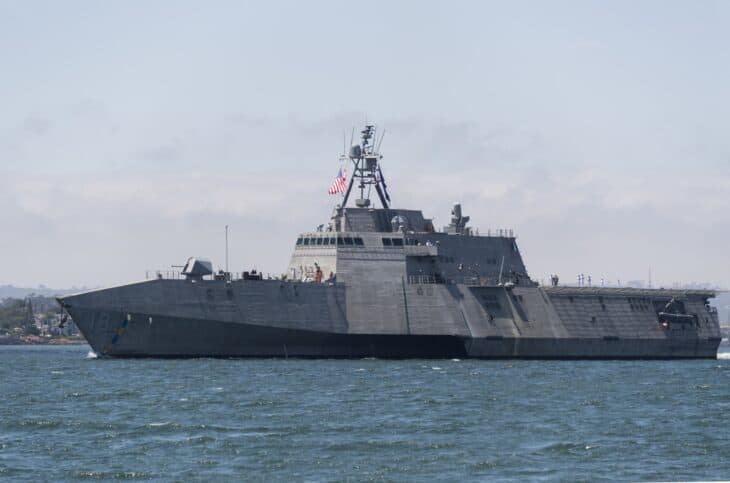
The littoral combat ship was designed to fight close to shore, with swappable mission packages for surface warfare or mine clearing. It comes in two very different designs.
The Freedom variant is a steel monohull 387.6 feet (118 m) long that can top 40 knots. The Independence variant is an aluminum trimaran 421.5 feet (128 m) long with an unusually wide 103.7 foot (32 m) beam.
Several early ships have already been decommissioned, leaving about two dozen in service. The Independence ships fitted with the mine countermeasures package are taking over the job of the retiring Avenger-class minesweepers.
8. Attack submarines (SSN)
.jpg)
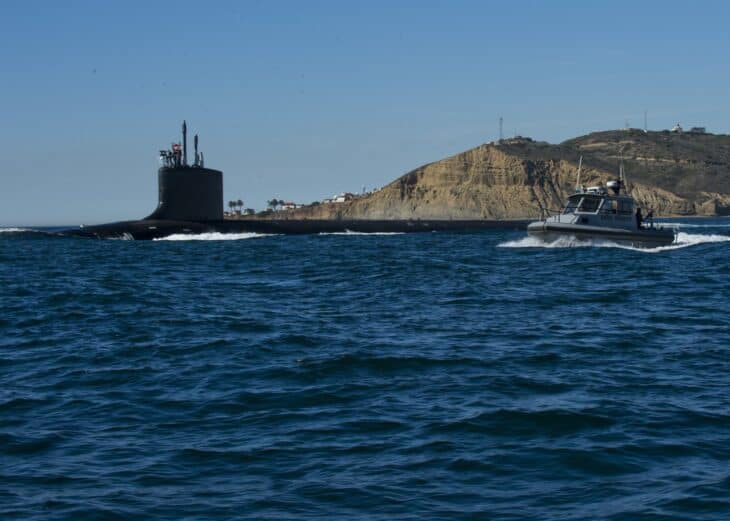
An attack submarine hunts enemy submarines and surface ships, fires Tomahawk missiles at land targets, gathers intelligence, and carries special operations forces. All three US classes are nuclear powered.
Three classes are in service. The Virginia class is the current production boat, with two dozen commissioned. Each is 377 feet (115 m) long, or 461 feet (141 m) with the new Virginia Payload Module, which adds 28 Tomahawks.
The three Seawolf-class boats are larger, with eight torpedo tubes and room for up to 50 weapons in the torpedo room. The older Los Angeles class, once the backbone of the force, is being retired as new Virginias arrive.
9. Ballistic and guided missile submarines (SSBN and SSGN)
_off_the_coast_of_Cape_Canaveral_9_May_2019.jpg)
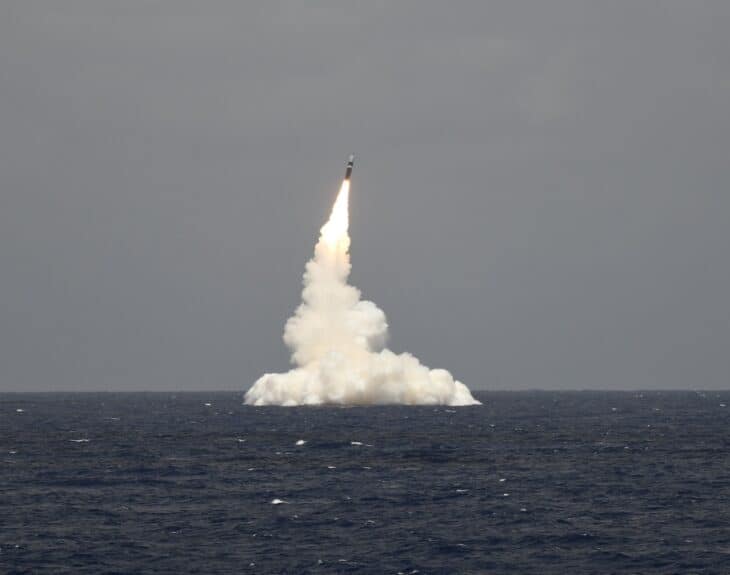
The ballistic missile submarine is the sea leg of the US nuclear deterrent. Its only job is to stay hidden and survive, so it can retaliate after any attack.
The Navy has 14 Ohio-class SSBNs. Each is 560 feet (171 m) long and carries 20 Trident II D5 missile tubes, cut from 24 in 2017 to comply with the New START treaty.
They will be replaced by 12 Columbia-class submarines, also 560 feet long, with 16 Trident tubes each. The first two are under construction.
Four more Ohio boats were converted in the 2000s into guided missile submarines, each carrying up to 154 Tomahawks. They are reaching the end of their lives with no planned replacement, and USS Georgia is on the Navy’s 2026 list for recycling.
10. Mine countermeasures ships (MCM)
_is_underway_in_the_Yellow_Sea.jpg)
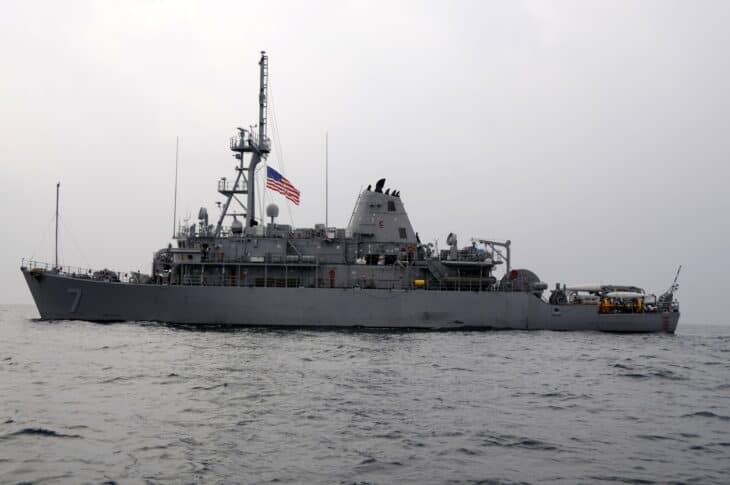
A mine countermeasures ship finds and destroys sea mines. The Avenger class was built mostly of wood covered in fiberglass, which lowers its magnetic signature so it is less likely to set off the mines it is hunting.
Each Avenger is about 223 feet (68 m) long and displaces about 1,300 tons. Fourteen were built, starting with USS Avenger in 1987.
The four ships based in Bahrain were retired in September 2025. The last four, Patriot, Pioneer, Warrior, and Chief, are based in Sasebo, Japan, and are scheduled to leave service in fiscal 2029.
11. Command ships (LCC)
_underway_in_the_Yellow_Sea_in_August_2014.JPG)
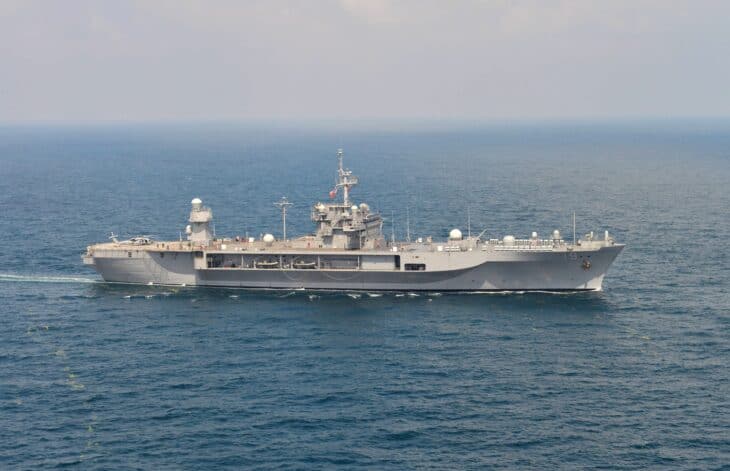
A command ship is a floating headquarters for a fleet commander. The two Blue Ridge-class ships are the only US ships designed from the keel up for that role.
USS Blue Ridge is the Seventh Fleet flagship in Yokosuka, Japan, and USS Mount Whitney is the Sixth Fleet flagship in Gaeta, Italy. Both date from the early 1970s and are 634 feet (193 m) long. Their service lives have been extended to 2039.
12. Expeditionary sea bases and fast transports (ESB and EPF)
_underway_in_the_Pacific_Ocean_on_19_August_2021_(210819-N-WY048-2631).JPG)
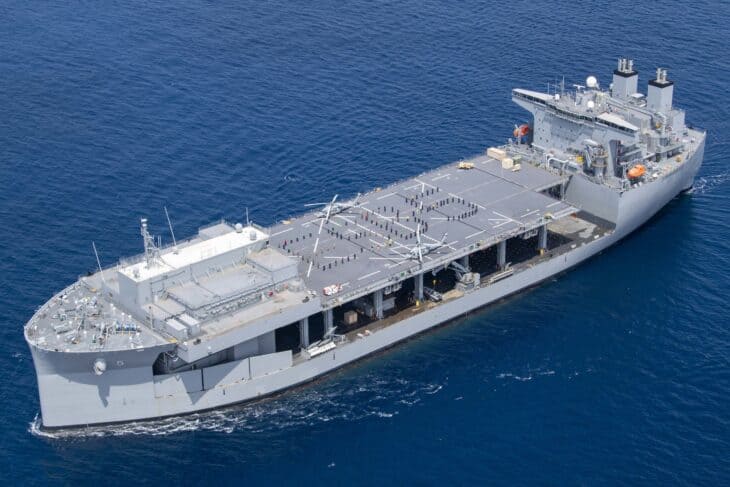
The expeditionary sea base is a mobile base at sea. It gives the Navy a place to stage forces, equipment, and supplies where there is no friendly port, and three of the class are forward deployed to Bahrain, Greece, and Saipan.
Each ESB is 785 feet (239 m) long and displaces 90,000 tons fully loaded. The eighth and last ship is due in 2026.
The support ship that rivals a supercarrier
An expeditionary sea base displaces 90,000 tons fully loaded. That is close to a Nimitz-class carrier at about 100,000 tons, yet it cruises at 15 knots with a crew of just 44 Military Sealift Command personnel plus 101 military.
The expeditionary fast transport sits at the opposite end of the scale. The Spearhead class is a 338 foot (103 m) catamaran that can reach 35 to 40 knots, drive an Abrams tank off its ramp, and operate from shallow ports. Fifteen have been delivered.
13. Combat logistics ships (T-AO and T-AKE)
_pulls_alongside_the_Military_Sealift_Command_Fleet_replenishment_oiler_USNS_John_Ericsson_(T-AO_194),_while_USS_Kitty_Hawk_(CV_63)_refuels.jpg)
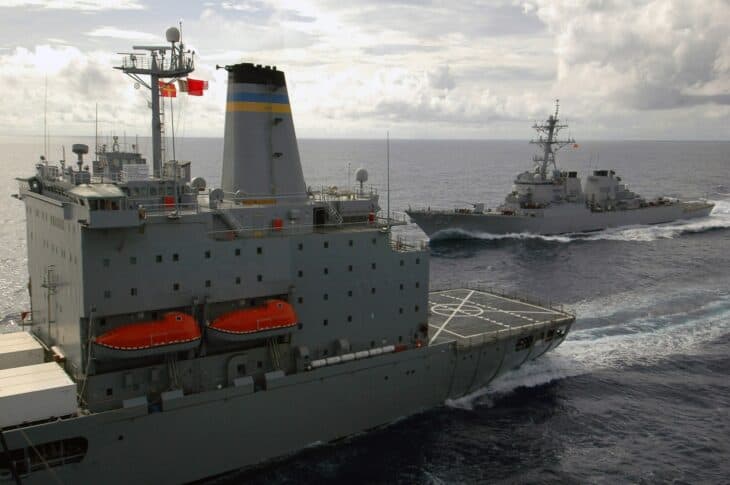
A warship at sea runs out of fuel, food, and ammunition, and combat logistics ships refill it without a port call. They pull alongside and pass cargo across on cables while both ships keep moving, which is called underway replenishment.
Fleet oilers carry the fuel. The Henry J. Kaiser class holds 180,000 barrels of aviation and diesel fuel, and it is being replaced by the John Lewis class, of which five had been delivered by December 2025.
The 14 Lewis and Clark-class dry cargo and ammunition ships carry everything else, from ammunition to frozen food. Each is 689 feet (210 m) long and is run by a civilian crew of 53.
14. Hospital ships (T-AH)
_is_underway_past_the_ship_during_a_Conti.jpg)
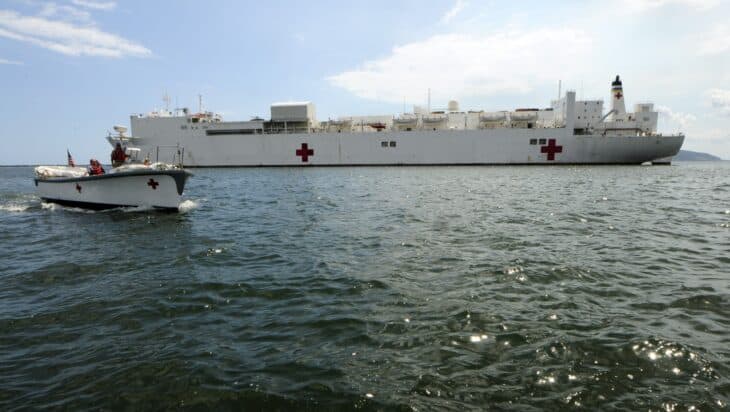
The Navy’s two hospital ships, USNS Mercy and USNS Comfort, are among the largest ships it operates at 894 feet (272 m) long. Each has 12 operating rooms and 1,000 hospital beds.
They treat wounded troops in wartime and support disaster relief and humanitarian missions in peacetime. In March 2020 both were sent to Los Angeles and New York to support the COVID-19 response.
What about battleships?
The US Navy has no battleships in service. The Iowa-class USS Missouri, the last battleship the United States commissioned, was decommissioned for the final time on March 31, 1992, and is now a museum ship at Pearl Harbor.
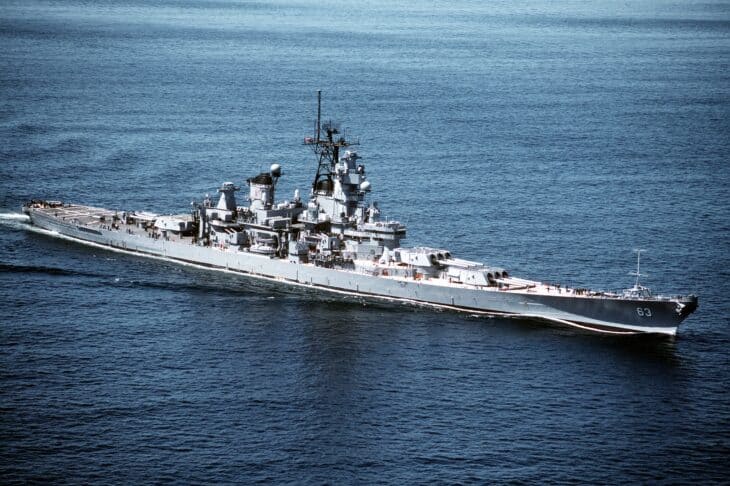
_underway_for_the_Bremerton_Navy_Yard_after_returning_from_the_Persian_Gulf_War._The_MISSOURI_will_remain_in_serv_-_DPLA_-_f7d6121876d386732d88a9c9909b7051.jpeg)
The type may return. On December 22, 2025, the Navy announced the Trump-class guided missile battleship, with the first ship to be named USS Defiant (BBG 1). The Navy says it will be triple the size of an Arleigh Burke destroyer and able to launch hypersonic missiles.
The new battleship is a plan, not a ship
No Trump-class battleship has been built, and the design is still at an early stage. The Navy’s Golden Fleet goal calls for 15 to 25 of them, but as of May 2026 the first was expected to be delivered in 2036. Until then, the answer to whether the US has battleships is no.
The oldest ship still in commission is not a battleship either. USS Constitution, launched in 1797, is the oldest commissioned warship afloat in the world and still carries a Navy crew in Boston.
FAQ
Sources and references used for research and fact-checking.
- Congressional Research Service, Navy Force Structure and Shipbuilding Plans: Background and Issues for Congress (RL32665, updated January 20, 2026)
- U.S. Navy, Aircraft Carriers - CVN
- U.S. Navy, Amphibious Assault Ships - LHD/LHA(R)
- U.S. Navy, Dock Landing Ship - LSD
- U.S. Navy, Cruisers - CG
- U.S. Navy, Destroyers (DDG 51)
- U.S. Navy, Destroyers - DDG 1000
- U.S. Navy, Littoral Combat Ship Class - LCS
- U.S. Navy, Attack Submarines - SSN
- U.S. Navy, Guided Missile Submarines - SSGN
- U.S. Navy, Amphibious Command Ships - LCC
- U.S. Navy, Expeditionary Sea Base (ESB)
- U.S. Navy, Expeditionary Fast Transport (EPF)
- U.S. Navy, Fleet Replenishment Oilers - T-AO
- U.S. Navy, Dry Cargo/Ammunition Ships T-AKE
- U.S. Navy, Mine Countermeasures Ships - MCM
- U.S. Navy, USS Constitution
- U.S. Navy, President Trump Announces New Battleship
- U.S. Navy, U.S. Navy Decommissions Avenger-class Mine Countermeasures Ships in Bahrain
- Zona Militar, After nearly 40 years and 14 ships, the Avenger-class nears its final departure from the U.S. Navy
- Navy Times, Navy releases list of ships it plans to inactivate this year
- The War Zone, Full Retirement Of Ticonderoga Cruisers On Hold, Trio To Remain In Service Into 2029
- Meta-Defense, The US Navy Will Have Only 3 Ticonderoga Cruisers by End of 2026, and Still No True Successor
- The Aviationist, USS Nimitz Given Brief Lifeline as Decommissioning Pushed Back to 2027
- Wikipedia, Constellation-class frigate
- Wikipedia, Oliver Hazard Perry-class frigate
- Wikipedia, Trump-class battleship
- Wikipedia, Nimitz-class aircraft carrier
- Wikipedia, Gerald R. Ford-class aircraft carrier
- Wikipedia, San Antonio-class amphibious transport dock
- Wikipedia, Ohio-class submarine
- Wikipedia, Columbia-class submarine
- Wikipedia, Mercy-class hospital ship
- Wikipedia, Hull classification symbol
- Wikipedia, USS Missouri (BB-63)
- USO, How Many Navy Fleets Does the U.S. Have?
Get the Newsletter
The latest aviation news and stories sent to your inbox.
About the Author

Tim is the owner and lead editor of AeroCorner since 2019, overseeing aviation content covering aircraft, airlines, airports, and the broader aviation industry. Through years of researching, writing, editing, and publishing aviation-focused content, he has developed extensive practical knowledge of commercial aviation and air travel. Based in Asia and a frequent traveler himself, Tim also brings firsthand passenger experience to AeroCorner’s coverage. Outside of publishing, he has also explored aviation firsthand through hands-on flight training in New Zealand.