

Table of Contents
The tanker aircraft that carries the most fuel today is Russia’s Ilyushin Il-78M, with about 304,000 pounds (138 t) on board and 233,070 pounds (105.7 t) of it available to pass to other aircraft. The biggest Western tanker is the Airbus A330 MRTT, at about 245,000 pounds (111 t).
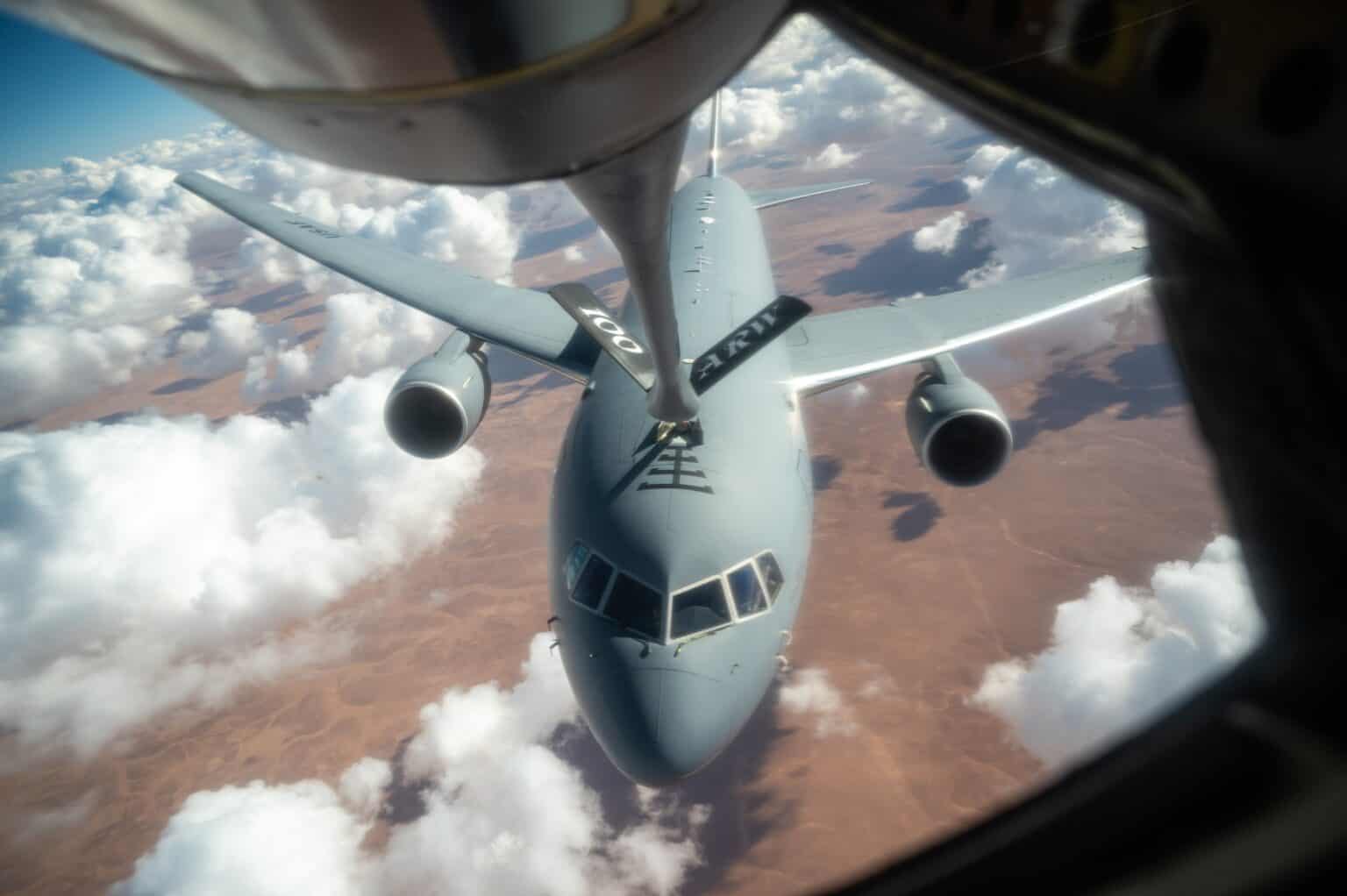
The tanker that matters most is older than both. Roughly 370 Boeing KC-135 Stratotankers still serve with the US Air Force in 2026, even though the last one was delivered in 1965.
This list covers every tanker type flying air-to-air refueling missions as of October 2026, ranked by the largest fuel figure its maker or operator publishes. It does not cover firefighting air tankers that drop retardant on wildfires, which are a different machine covered in our guide to firefighting airplanes.
The field is lopsided. FlightGlobal’s World Air Forces 2026 directory counts 610 US military tankers, which is roughly 75 percent of the world’s tanker fleet on paper.
| Rank | Tanker | Fuel figure (as published) | Refueling method | Main operators (2026) |
|---|---|---|---|---|
| 1 | Ilyushin Il-78M Midas | About 304,000 lb (138 t) total; 233,070 lb (105.7 t) transferable | Hose and drogue, 3 pods | Russia; the Il-78 family also flies in India, Algeria, China and Pakistan |
| 2 | Airbus A330 MRTT | About 245,000 lb (111 t) | Boom plus hose and drogue | France, UK, Saudi Arabia, Australia, NATO fleet and others (67 delivered) |
| 3 | Boeing KC-46A Pegasus | 212,299 lb (96,297 kg) | Boom plus hose and drogue | United States, Japan, Israel |
| 4 | Boeing KC-135 Stratotanker | 200,000 lb (90,719 kg) transferable | Boom (drogue adapter available) | United States, Turkey, Chile, contractor Metrea |
| 5 | Boeing KC-767 | 160,660 lb (72,877 kg) | Boom; Italy’s also have hose and drogue | Japan, Italy, Colombia |
| 6 | Airbus A400M Atlas | About 137,000 lb (62.2 t) with two hold tanks | Hose and drogue, 2 pods | Germany, France, Spain and others |
| 7 | Lockheed Martin KC-130J | 57,500 lb (26,082 kg) offload at 500 nm | Hose and drogue, 2 pods | US Marine Corps, Italy, Kuwait, Saudi Arabia, France, Germany |
| 8 | Embraer KC-390 Millennium | About 55,000 lb (25 t) | Hose and drogue, 2 pods | Brazil, Portugal and a growing list of others |
| 9 | Boeing F/A-18E/F Super Hornet (buddy tanker) | About 29,000 lb (13,150 kg) with the refueling store | Single centerline hose | US Navy |
| 10 | Xian YY-20A and H-6U | Not published | Hose and drogue | China |
| 11 | Boeing 707 tankers | Not published | Varies by conversion | Israel, Iran, Saudi Arabia, contractor Omega |
How this ranking works
We rank each tanker type by the largest fuel figure its manufacturer or main operator publishes. That is total fuel on board where it is given, transferable fuel for the KC-135 (nearly all of its fuel can go through the boom), and offload at a 500-nautical-mile radius for the KC-130J, so read the qualifier in each row. A type qualifies only if it flies as a tanker in October 2026. Many fighters can carry a buddy refueling pod; we include only the Super Hornet, which flies the US Navy’s entire carrier tanking mission. China and the 707 operators publish no fuel figure, so those tankers sit at the bottom. Retired tankers like the KC-10 and ones still in testing like the MQ-25 are covered at the end.
1. Ilyushin Il-78M Midas
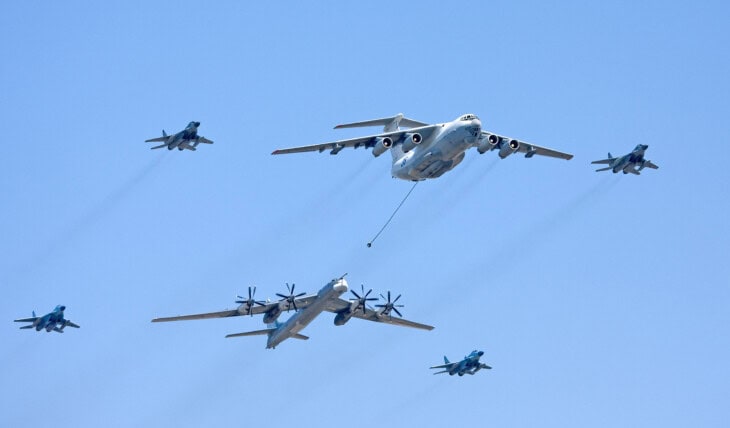
The Il-78 is a tanker version of the Ilyushin Il-76 four-engine transport. The basic Il-78 first flew on June 26, 1983, and entered service in June 1987, and the higher-capacity Il-78M followed in the late 1980s.
The Il-78M carries about 304,000 pounds (138 t) of fuel in total, and 233,070 pounds (105.7 t) of it can be transferred. That transferable load alone is more than a KC-46 carries in total.
Distance eats into it fast. According to the manufacturer’s figures, an Il-78M can give away about 163,000 pounds (74 t) at 621 miles (1,000 km) from base, and about 88,000 pounds (40 t) at 1,864 miles (3,000 km).
It refuels with three hose-and-drogue pods, two under the wings and one on the rear fuselage. Only 32 Il-78s, 13 Il-78Ms and a single export Il-78E were built, all at Tashkent between 1984 and 1993.
That small production run is spread thin. Russia had 5 Il-78s and 10 Il-78Ms in 2024 according to the Military Balance, India flies six Il-78MKIs with Western-compatible pods, and Algeria, China and Pakistan bought ex-Ukrainian aircraft.
India’s fleet shows the age problem. Defense News has reported serviceability as low as 49 percent because of parts shortages, and India has cancelled three tanker tenders since 2006. Israel Aerospace Industries has reportedly won a deal to convert six used Boeing 767s for India, with deliveries from 2030.
Russia’s successor, the Il-78M-90A, first flew on January 25, 2018, and 10 were ordered in December 2020. We found no confirmed delivery to the Russian Aerospace Forces. Ukraine claimed Il-78s among the aircraft hit in its June 2025 Operation Spiderweb drone strikes, but no loss has been independently confirmed.
2. Airbus A330 MRTT
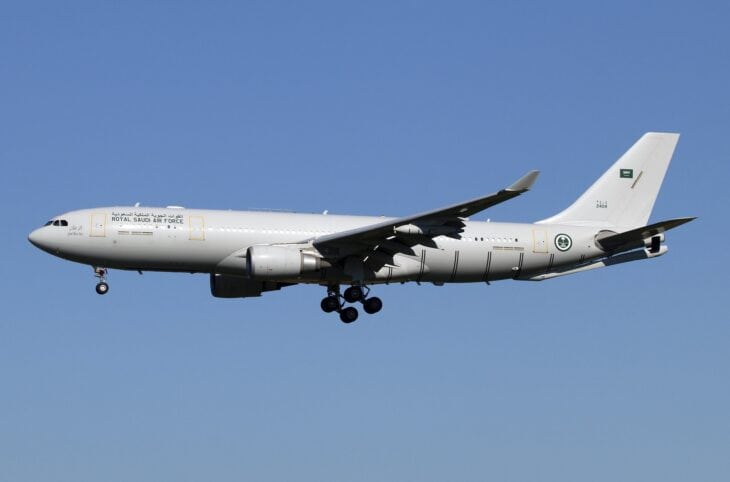
The Airbus A330 MRTT carries 111 t, about 245,000 pounds, of fuel in its standard tanks, with no extra tanks in the cabin. Airbus says it can offload up to 154,000 pounds (70 t) during a one-hour loiter 1,250 nautical miles from takeoff.
Because the cabin stays free, it also carries up to 300 passengers or 99,000 pounds (45 t) of payload. Its boom pumps up to 1,200 US gallons a minute, and its wing pods 420 gallons a minute each.
This is the West’s best-selling tanker. Airbus’s order book to September 30, 2026, shows 91 ordered and 67 delivered, and the company claims more than 90 percent of the market outside the United States.
Operators include France, the UK, Saudi Arabia, Australia, Singapore, South Korea, the UAE, Spain and a NATO pool shared by nine nations. Italy signed for six on April 16, 2026, to replace its KC-767s, and Canada and Thailand are waiting for theirs.
The RAF’s version, the Voyager, has no boom at all. Its 14 aircraft are owned by the AirTanker consortium under a private finance deal, and the RAF quotes their fuel load as up to 109 t.
It is also the first tanker that can fly the boom itself. In February 2026, Singapore’s air force became the first to bring Airbus’s automatic boom system into service, cleared for day and night use.
3. Boeing KC-46A Pegasus
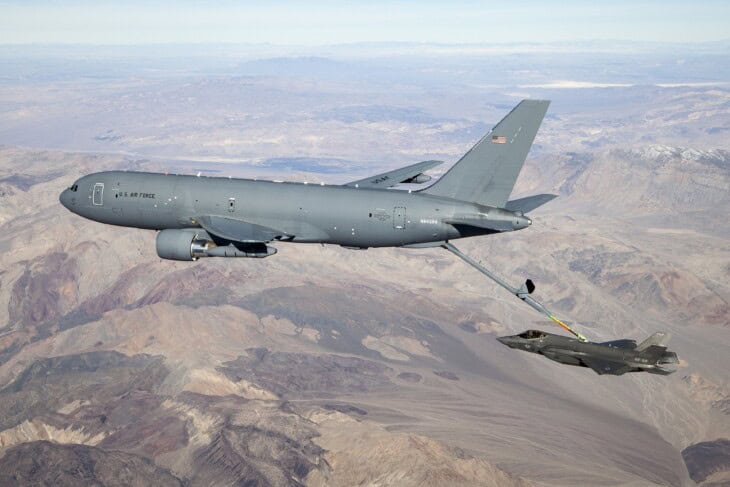
The KC-46A carries 212,299 pounds (96,297 kg) of fuel, according to the US Air Force. It can pass that fuel through a boom, a centerline hose, or wing pods, and with the pods fitted it can refuel more than one receiver at once.
It is the KC-135’s replacement and a workhorse transport too, with room for 65,000 pounds (29,484 kg) of cargo or 58 passengers. The first one reached McConnell Air Force Base, Kansas, on January 25, 2019.
Boeing said in May 2026 that more than 110 KC-46As were flying, 107 of them with the US Air Force. Japan had six by late 2025, and Israel took its first two of six on order in May and August 2026, replacing 707s that have served for about 60 years.
The program’s problem is the jet’s remaining deficiencies. In 2025 the Air Force dropped a separate “bridge tanker” competition in favor of 75 more KC-46s, but in March 2026 its vice chief of staff said that contract would wait until the deficiencies are worked through.
4. Boeing KC-135 Stratotanker
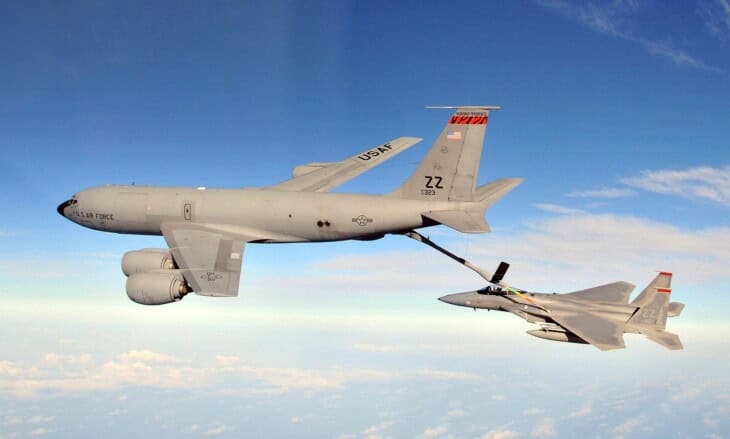
The KC-135 Stratotanker can transfer up to 200,000 pounds (90,719 kg) of fuel, nearly all of it through the flying boom. The Air Force rates it at 1,500 miles (2,414 km) with 150,000 pounds (68,039 kg) still available to give away.
It first flew in August 1956, and the Air Force received 732 of them before production ended in 1965. About 370 remain in 2026, which still makes it the most numerous tanker in the world, and the service plans to retire another 20.
The boom is the Air Force’s way of refueling, and it does not fit Navy and Marine jets, which use a probe. For those receivers, the KC-135 bolts a short hose and drogue onto the end of its boom. Our explainer on how airplanes refuel in the air covers both systems.
The fleet took real losses in the 2026 Iran war. A KC-135 went down over western Iraq on March 12, 2026, killing all six crew, and the Air Force said hostile or friendly fire was not the cause.
Five more were damaged on the ground by an Iranian missile at Prince Sultan Air Base, Saudi Arabia, and a second attack there on March 27 hit more tankers.
Outside the US, Turkey flies seven KC-135Rs and Chile three KC-135Es. France and Singapore retired theirs, and both fleets went to a private company.
A private company now owns more tankers than most air forces
Metrea, a US defense services company, bought Singapore’s four retired KC-135Rs in 2020 and agreed in 2024 to buy France’s 14 C-135-family tankers. Metrea says that gives it the world’s largest commercial aerial refueling fleet, bigger than the tanker fleet of all but four countries. India now wet-leases one Metrea KC-135R, flown by Metrea crews, to train its pilots, and in July 2026 the Pentagon extended US Navy refueling contracts with Metrea and Omega Aerial Refueling Services that carry a combined ceiling of $938.9 million.
5. Boeing KC-767
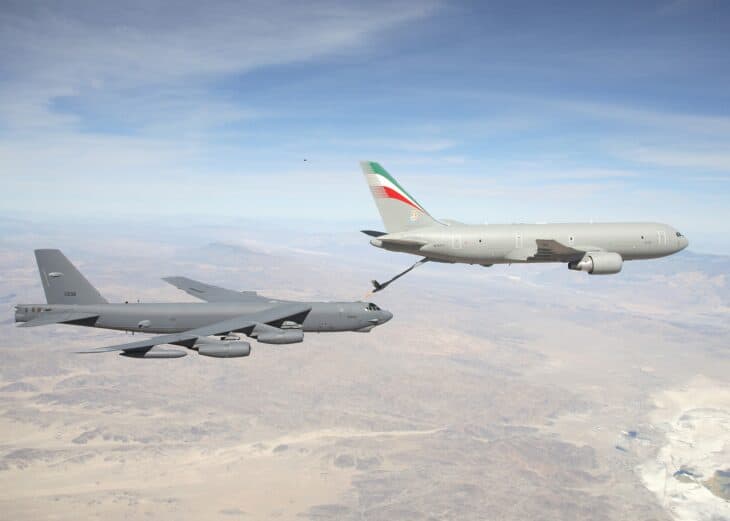

The KC-767 is the tanker Boeing sold abroad before the KC-46, built on the same 767 airliner. Its maximum fuel load is 160,660 pounds (72,877 kg).
Only two air forces bought it new, four aircraft each. Japan’s KC-767Js have a boom only and arrived from February 2008, while Italy’s KC-767As add hose-and-drogue pods and entered service in May 2011.
Colombia flies a single converted 767 tanker. Italy’s four are now on their way out, replaced by the six A330 MRTTs ordered in 2026.
6. Airbus A400M Atlas
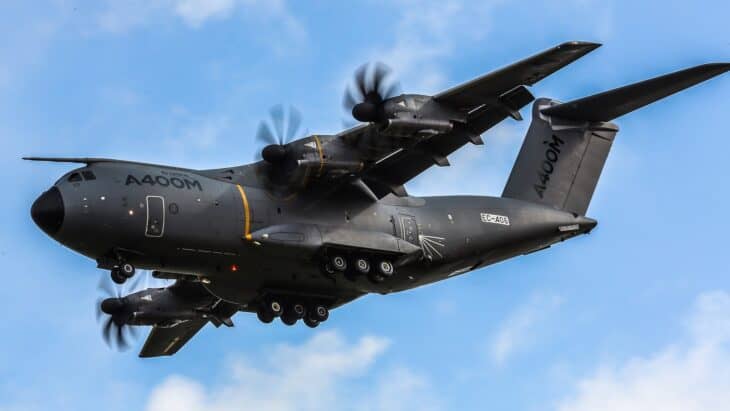
The Airbus A400M is a four-engine turboprop airlifter that doubles as a tanker. It holds 50.8 t, about 112,000 pounds, of fuel in its wings and center wing box, and two cargo-hold tanks of 5.7 t each lift the total to about 137,000 pounds (62.2 t).
Its party trick is refueling helicopters, which fly far slower than the jets most tankers are built for. In 2021 trials it refueled helicopters at speeds as low as 105 knots, including two at once, and France cleared it in early 2025 to refuel its H225M Caracals on operations.
Germany was the first nation to use the A400M as a tanker, in 2019. Airbus counts 178 orders from 10 nations, and not every operator uses the refueling kit.
7. Lockheed Martin KC-130J
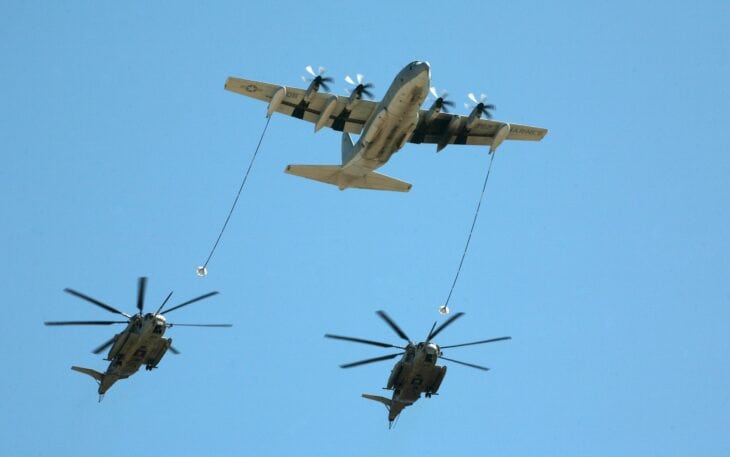

The KC-130J is the tanker version of the C-130J Super Hercules. Lockheed Martin rates it at 57,500 pounds (26,082 kg) of fuel offload on a 500-nautical-mile radius mission using only its wing and external tanks, and a fuselage tank adds another 24,392 pounds (11,064 kg).
Two wing pods let it refuel jets, tiltrotors and helicopters, which makes it the US Marine Corps’ tanker of choice. Italy, Kuwait, Saudi Arabia, France and Germany fly KC-130Js too, and the French and German ones exist mainly to refuel helicopters.
The US Air Force uses Hercules tankers for special missions. Its HC-130J rescue aircraft and MC-130J special operations aircraft refuel helicopters and tiltrotors, often at night.
8. Embraer KC-390 Millennium
.jpg)
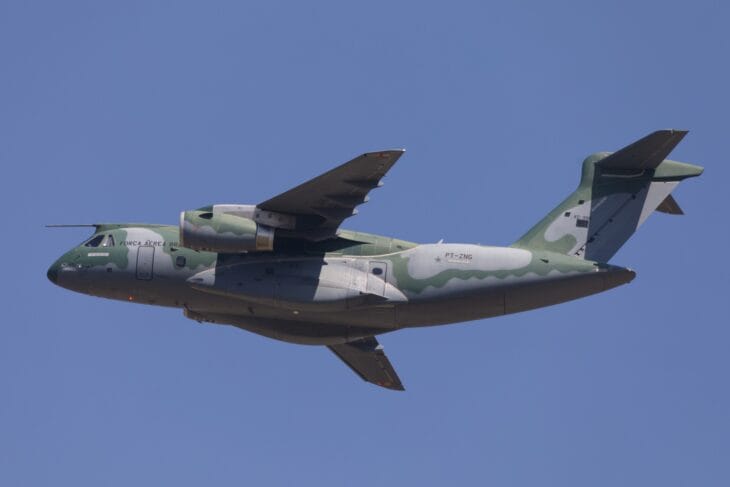
The Embraer KC-390 is a twin-jet airlifter that carries up to 25 t, about 55,000 pounds, of fuel. As a tanker it adds two wing pods and roll-on, roll-off tanks in the cargo hold.
Its order book is growing fast, with 62 firm orders and 16 deliveries as of September 2026. For several buyers it is their first tanker of any kind: Portugal received its first tanker-equipped KC-390 in January 2026, and Greece’s order is its first-ever refueling aircraft.
Embraer qualified it to refuel another KC-390 in 2021, so one tanker can top up another. It only has hose-and-drogue pods, which limits its use with US Air Force jets, and Northrop Grumman and Embraer are now exploring an autonomous boom for it.
9. Boeing F/A-18E/F Super Hornet (Buddy Tanker)
.jpg)
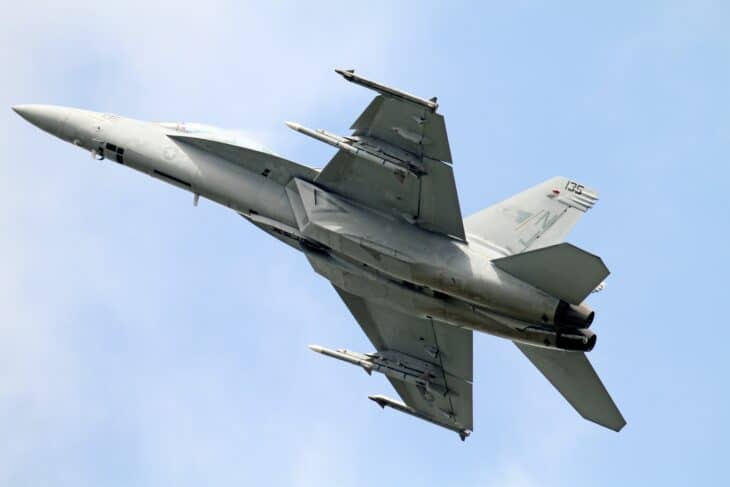
The US Navy’s carrier tanker is a fighter. A Super Hornet carrying the aerial refueling store, a 330-gallon centerline tank with a hose reel, plus four 480-gallon drop tanks has about 29,000 pounds (13,150 kg) of fuel aboard.
Navy rules require Super Hornets fitted with that store for every carrier-based tanking mission. USNI News has reported that 20 to 30 percent of Super Hornet sorties go to tanking, which is flight time the fighter is not spending as a fighter.
That is exactly the job the unmanned MQ-25 Stingray is meant to take over, though not before about 2029.
10. China’s Tankers: Xian YY-20A and H-6U
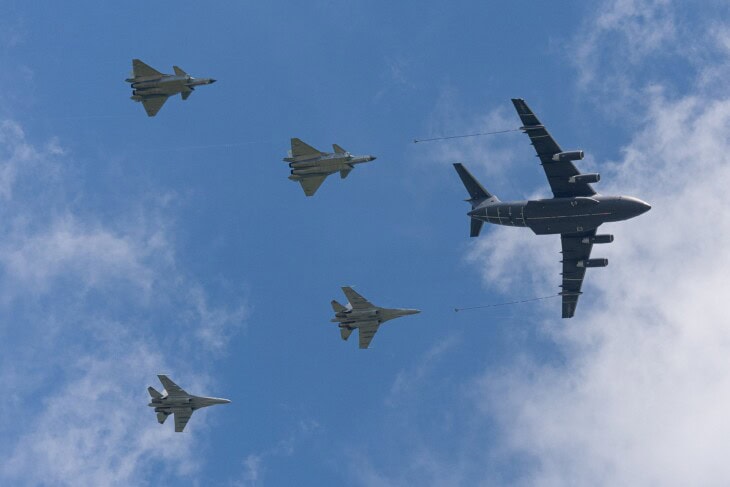
China does not publish fuel figures for its tankers, which is why they sit at the bottom of a ranking by fuel. The newest is the YY-20A, also called the Y-20U, a tanker version of the Xian Y-20 heavy transport.
The Pentagon’s 2024 China Military Power Report counted 16 Y-20Us as of March 2024. It noted that in January 2024 one refueled seven J-10 fighters on their way to an air show in Saudi Arabia, the first published foreign deployment of the type.
The rest of the fleet is older. The H-6U is a converted Xian H-6 bomber, itself a copy of the 1950s Soviet Tu-16, and China also flies three ex-Ukrainian Il-78s.
A January 2026 Lowy Institute analysis put the whole Chinese air force tanker fleet at around 35 aircraft, against more than 550 in US service. For long-range air operations, that gap matters more than any fighter count.
11. Boeing 707 Tankers
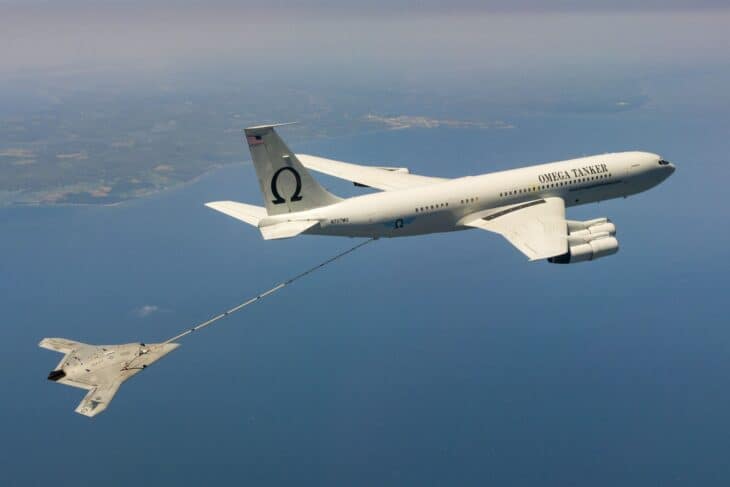

The last tankers built on the Boeing 707 airliner are now around 60 years old. Their fuel figures vary by conversion and none is published, so they rank last.
Israel’s 707 Re’em tankers played a key role in its recent wars against Iran, and the KC-46 is now replacing them. Sources put the remaining fleet at six or seven aircraft. Saudi Arabia has also flown 707-based KE-3A tankers.
Iran’s tanker force has been shrinking under fire. Israel said it struck an Iranian refueling aircraft at Mashhad in June 2025, about 1,430 miles (2,300 km) from Israel, and more 707 tankers were reported destroyed at Tehran’s Mehrabad airport in March 2026. Our Iran air force guide tracks what is left.
One civilian company still flies 707 tankers: Omega Aerial Refueling Services, which has refueled US Navy jets under contract since 2001.
The Tankers That Did Not Make the List
What about the KC-10 Extender?
The KC-10 would top this list if it were still in service. It carried more than 356,000 pounds (161,500 kg) of fuel, more than any tanker flying today. The US Air Force retired its last one, serial 79-1948, at Travis Air Force Base on September 26, 2024. DC-10-based tankers still fly in civilian hands with Omega Aerial Refueling Services, but those are converted airliners, not ex-Air Force KC-10s.
Boeing MQ-25 Stingray. A developmental example of the Navy’s unmanned carrier tanker flew in April 2026, and the program got its first production contract, worth $562 million, in September 2026. It is meant to deliver at least 14,000 pounds (6,350 kg) of fuel 500 nautical miles from the carrier, but initial operational capability is not expected until 2029.
Airbus A310 MRTT. Germany retired its last A310 tanker in June 2022. Canada’s CC-150T Polaris is the last of the type, it is being retired, and its replacement, the A330-based CC-330 Husky, is due to deliver its first tanker in 2027.
Brazil’s KC-30. Brazil bought two A330s to become KC-30 tankers, but they have no refueling equipment and the conversion is unfunded as of September 2026. Brazil’s working tanker is the KC-390.
The stealth tanker. The US Air Force’s Next-Generation Air-refueling System (NGAS) is still a concept. Its 2027 budget request moves the money into a broader Advanced Tanker Systems effort, so a stealthy successor is many years away.
FAQ
Sources and references used for research and fact-checking.
- U.S. Air Force, KC-46A Pegasus fact sheet
- U.S. Air Force, KC-135 Stratotanker fact sheet
- U.S. Air Force, Six confirmed deceased in loss of U.S. KC-135 over Iraq
- Military Times, Iran missile strike damages five KC-135 tankers in Saudi Arabia, officials say
- The Aviationist, Iranian attack on Prince Sultan Air Base
- Air & Space Forces Magazine, Air Force tanker fleet in the 2027 budget
- Air & Space Forces Magazine, Air Force vice chief: extra KC-46 contract waits on deficiencies
- Boeing, Boeing delivers first KC-46 to the Israel Air Force
- Boeing, Boeing KC-46 Lot 12 contract
- The Times of Israel, Israeli Air Force receives second of six new KC-46 refueling planes
- The Aviationist, Israeli Air Force takes delivery of its first KC-46A
- Airbus, A330 MRTT
- Airbus, Airbus military aircraft orders and deliveries, summary to 30 September 2026
- Airbus, A330 Multinational MRTT Fleet: six years of European strategic cooperation
- Airbus, Airbus and Singapore achieve world first on A330 MRTT auto refuelling full certification
- Breaking Defense, Italy buying six Airbus A330 MRTT tankers
- The Aviationist, Italy will procure six A330 MRTT tankers
- Royal Air Force, Voyager
- Airbus, A400M
- Airbus, A400M conducts major helicopter refuelling certification
- Airbus, A400M and H225M: a winning duo
- Bundeswehr, Airbus A400M
- Bundeswehr, Binational Air Transport Squadron Rhin-Rhein in Evreux
- Lockheed Martin, Lockheed Martin begins deliveries of fully configured KC-130J tankers to the U.S. Marine Corps
- Wikipedia, Lockheed Martin KC-130
- U.S. Air Force, HC-130J Combat King II fact sheet
- U.S. Air Force, MC-130J Commando II fact sheet
- Airdata News, Embraer KC-390 performs first aerial refueling in the Brazilian Air Force
- Airdata News, Portugal takes delivery of fourth KC-390 with aerial refueling capability
- EDR Magazine, Embraer successfully concludes aerial refueling qualification between two KC-390 Millennium aircraft
- Axios, Northrop and Embraer KC-390 tanker plans
- Wikipedia, List of Embraer C-390 Millennium orders and deliveries
- Wikipedia, Ilyushin Il-78
- Wikipedia (Russian), Ил-78
- Airforce Technology, IL-78 Midas aerial refuelling tanker
- Militarnyi, Drone strikes destroyed Russian bombers in Spiderweb operation
- Defense News, India's on-again, off-again aerial tanker saga edges closer to an end
- Globes, India signs $1.1b IAI tanker aircraft deal, report
- Metrea, Metrea announces acquisition of French Air and Space Force tanker fleet
- Wikipedia, Metrea
- U.S. Department of Defense, Contracts for July 23, 2026
- Wikipedia, Boeing KC-135 Stratotanker
- Wikipedia, Boeing KC-767
- Wikipedia, Omega Aerial Refueling Services
- Omega Aerial Refueling Services, Customers
- Air & Space Forces Magazine, KC-10 Extender
- U.S. Department of Defense, Military and Security Developments Involving the People's Republic of China 2024
- Lowy Institute, China grows its air-to-air refueling capacity with an eye on Taiwan
- Wikipedia, Xian H-6
- Aerospace Global News, Biggest aerial refuelling tanker fleets
- The Aviationist, Iranian tanker destroyed in 2,300 km airstrike
- United24 Media, Satellite images show Iran's military airlift burning
- Simple Flying, The world's 5 largest tanker aircraft fleets
- Wikipedia, Boeing F/A-18E/F Super Hornet
- NAVAIR, A/A42R-1 aerial refueling store
- USNI News, Navy on track to deploy MQ-25A carrier tanker in 2026
- Congressional Research Service, Navy MQ-25 Stingray unmanned aircraft
- Defense News, US Navy, Boeing ink first MQ-25A Stingray production contract
- Airdata News, German Air Force retires last A310 MRTT
- Wikipedia, Airbus CC-150 Polaris
- Government of Canada, Strategic Tanker Transport Capability project
- AIN, Brazil welcomes first Airbus A330 into service
- Sociedade Militar, Airbus A330 da FAB parado em Viracopos
- DefenseScoop, Air Force shifts sixth-gen tanker strategy from NGAS to ATS
Get the Newsletter
The latest aviation news and stories sent to your inbox.
About the Author

Tim is the owner and lead editor of AeroCorner since 2019, overseeing aviation content covering aircraft, airlines, airports, and the broader aviation industry. Through years of researching, writing, editing, and publishing aviation-focused content, he has developed extensive practical knowledge of commercial aviation and air travel. Based in Asia and a frequent traveler himself, Tim also brings firsthand passenger experience to AeroCorner’s coverage. Outside of publishing, he has also explored aviation firsthand through hands-on flight training in New Zealand.