

Table of Contents
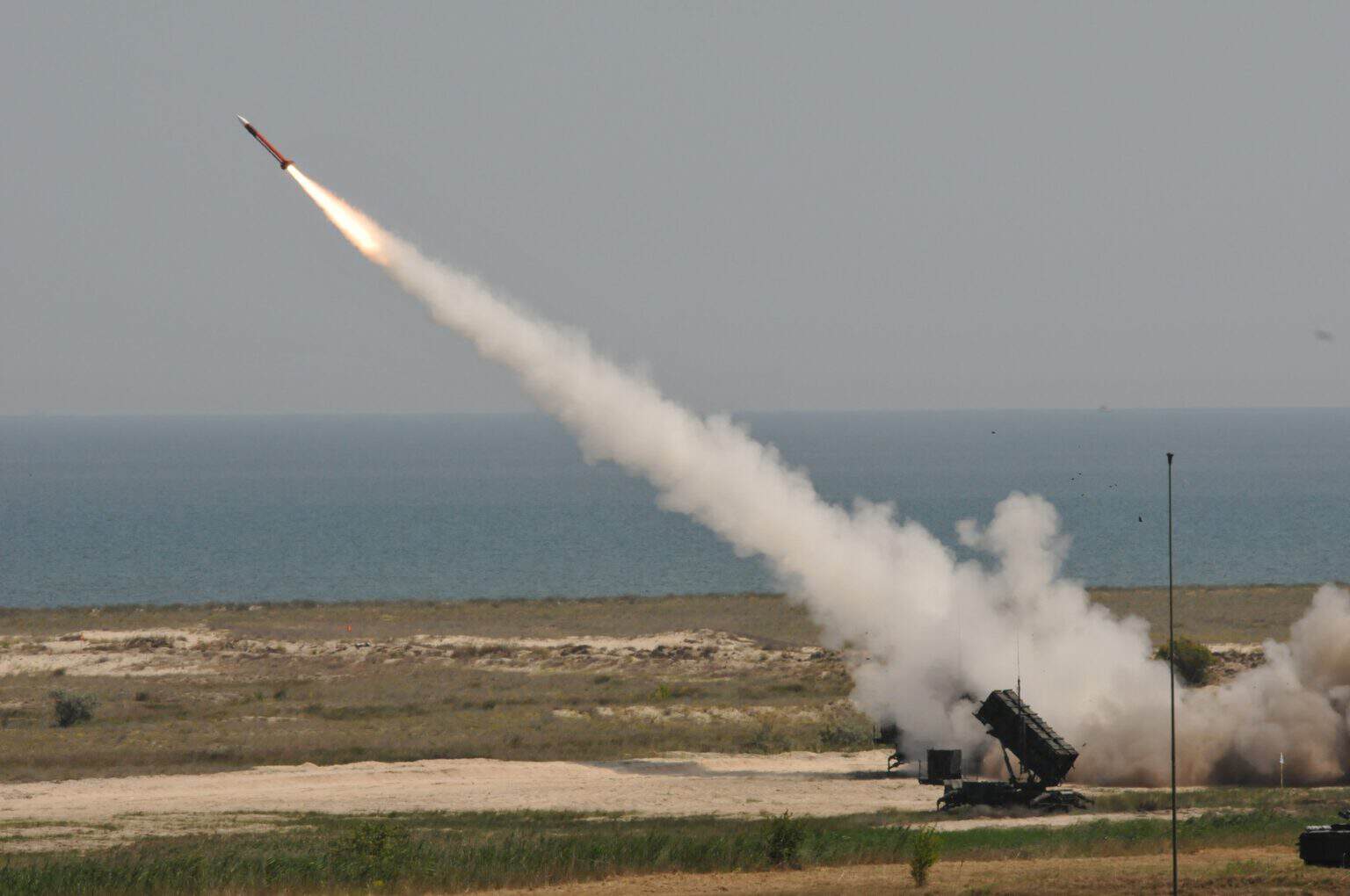
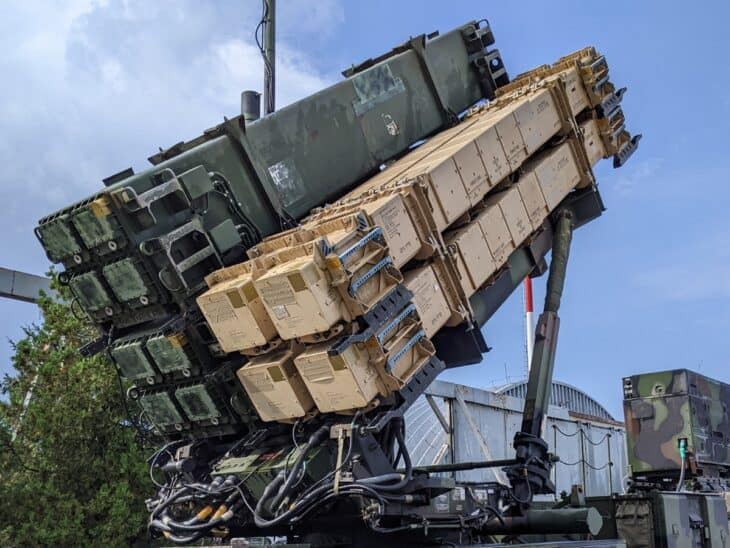
On the news it is always the same picture: a truck with a stack of boxy canisters tilted toward the sky, parked somewhere in Poland, Saudi Arabia or Ukraine. That truck is what most people mean when they say “a Patriot.”
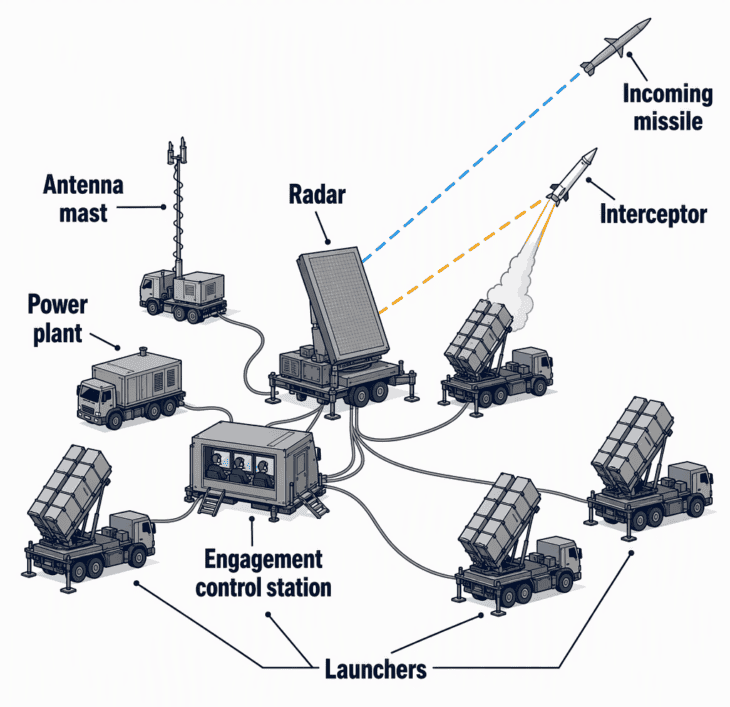
It is only one piece. A Patriot battery is a radar, a control van, a power plant and a spread of launchers, run by about 90 soldiers. In combat, three of them make the decisions.
Development began in the 1960s, and the system was designed to shoot down aircraft. Its newest interceptor is something different: a missile meant to fly straight into an incoming warhead. Here is how the whole thing works, what its first war really proved, and why there are not enough of the missiles in 2026.
How Does the Patriot Missile System Work?
Patriot is a mobile, ground-based air and missile defense system run by the US Army. A phased-array radar finds and tracks incoming threats, a computer in the engagement control station works out an intercept, and an operator approves the shot.
A launcher fires an interceptor, and the radar keeps guiding it until the missile’s own seeker takes over for the final approach.
It can engage aircraft, drones, cruise missiles and short-range or tactical ballistic missiles. It is a point defense, built to protect a specific base, city or asset rather than a whole country.
Patriot at a glance
Name: Phased Array Tracking Radar to Intercept on Target, a backronym. Builders: RTX (formerly Raytheon) for the radar and ground system, Lockheed Martin for the PAC-3 interceptor. First battalion: May 1982. Job: defend a specific location against aircraft, cruise missiles, drones and short-range ballistic missiles. Crew in combat: three operators in one van.
Inside a Patriot Battery
The battery is the basic firing unit. According to the Congressional Research Service, its radar can detect, track and prioritize more than 100 potential targets at a range of more than 60 miles (100 km).
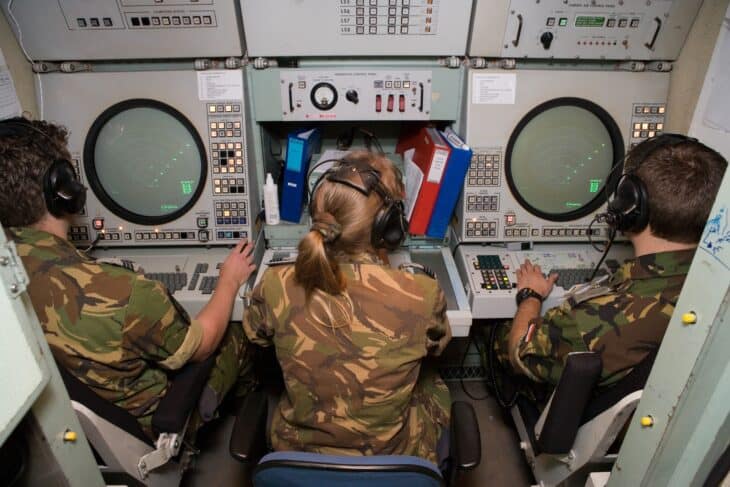
The radar is remotely controlled from the engagement control station, the only crewed vehicle in the unit. Inside sit typically three operators, who talk to the launchers, to other Patriot units and to higher headquarters. A truck with two 150-kilowatt generators powers the radar and the station.
The launchers can sit apart from the radar and van, and each one can be ready to fire in under 9 seconds. A Gulf War-era battery typically had eight launchers; the CSIS Missile Defense Project gives six to eight for a typical battery today.
Four batteries make a US Patriot battalion. The Army told CRS it has 15 Patriot battalions in the active component, with three more planned, one a year from 2029 to 2031.
The system has two firing modes. In semiautomatic mode the computer classifies tracks, checks them for a friendly identification signal and recommends a shot, but a human makes the go or no-go call. A fully automatic mode still exists in the software, and the Army no longer uses it, for reasons covered below.
Two Kinds of Interceptor: One Explodes, One Collides
The radar and the van have been modernized over the years, but the biggest changes to Patriot have been to its missiles. They fall into two families that kill in completely different ways.
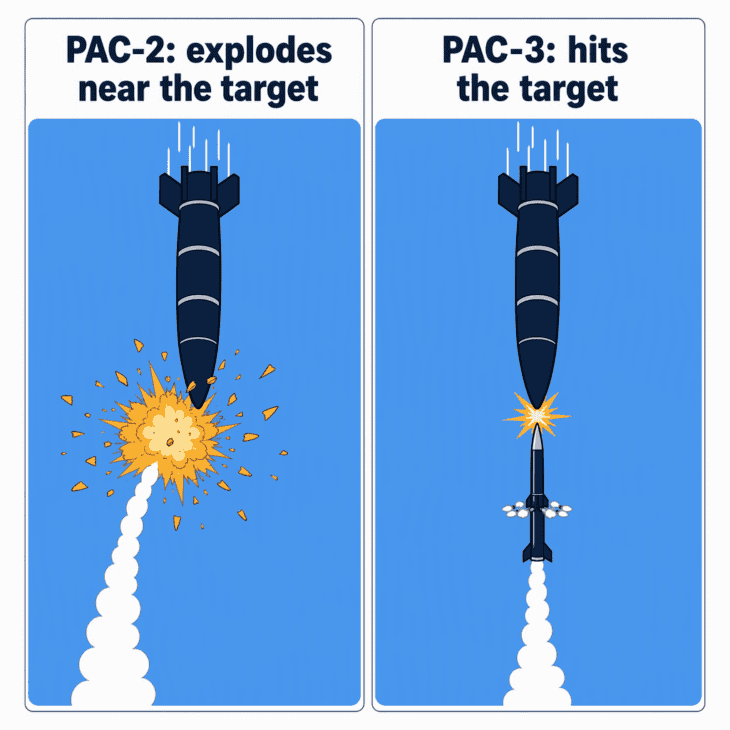
The older PAC-2 family carries a proximity fuze and a blast-fragmentation warhead. It does not need to touch its target: when it senses the target close by, it detonates and throws metal fragments into it. That suits aircraft and cruise missiles.
The PAC-3 family, now built as the PAC-3 MSE (Missile Segment Enhancement), is a much smaller missile designed for ballistic missiles. It is a hit-to-kill interceptor: an active radar seeker and a collar of small rocket thrusters steer it into the incoming warhead itself, destroying it by the force of the collision.
Being smaller pays off on the launcher. The current M903 launcher holds up to four PAC-2 missiles or 12 PAC-3 MSEs, or a mix of the two.
| PAC-2 family | PAC-3 MSE | |
|---|---|---|
| How it kills | Explodes near the target (blast-fragmentation) | Flies into the target (hit-to-kill) |
| Built mainly for | Aircraft and cruise missiles | Tactical ballistic missiles, plus aircraft, cruise missiles and drones |
| Per M903 launcher | Up to 4 | Up to 12 |
| Maker | Raytheon (now RTX) | Lockheed Martin |
Hit-to-kill, with a backup
The PAC-3 is not purely a flying bullet. It also carries a small explosive “lethality enhancer.” In the original PAC-3 this was a 330-gram charge that pushes out 24 metal fragments of about 95 grams each, widening the kill zone against slower targets such as cruise missiles. The MSE uses titanium fragments.
NATO’s figures, quoted by CRS, put the interceptor’s ceiling at about 12 miles (20 km). Against incoming ballistic missiles, the same figures give Patriot about 9 to 12 miles (15 to 20 km) of area coverage.
That small footprint is why Patriot is deployed in layers, with the Army’s THAAD system working alongside it against ballistic missiles. It also answers a common question, “is Patriot better than Iron Dome?” They are built for different threats: Israel’s Iron Dome is designed for short-range rockets, while Patriot targets ballistic missiles and aircraft. Our ranking of the best air defense systems compares both, and Russia’s S-400, by combat record.
What the Gulf War Really Proved
When Iraq invaded Kuwait in August 1990, Patriot had no capability against Iraq’s extended-range Scud, the Al-Hussein. It flew at 2,000 to 2,200 meters per second, around 4,500 to 4,900 mph, faster than the Soviet missiles Patriot had been tuned for.
The Army rewrote the software in less than a week. It also had only three of the improved PAC-2 missiles in inventory at the time of the invasion; emergency production put about 600 in the region by the end of January 1991.
The myth: Patriot shot down nearly every Scud
An early Army report credited Patriot with destroying about 96 percent of the Scuds it engaged in Saudi Arabia and Israel. The Army itself kept lowering that number, and the government’s auditors concluded that the data to prove how well Patriot performed does not exist.
The Army’s figures slid from 96 percent to 80 percent in Saudi Arabia and 50 percent in Israel, then to 70 and 40 percent in an April 1992 revision. Those revised numbers counted a Scud as a success if it was destroyed, disabled or pushed off course away from a protected area.
The General Accounting Office (now the Government Accountability Office) then looked at the evidence. The Army was highly confident of a destroyed or disabled warhead in about 25 percent of engagements. Only about 9 percent were backed by the strongest evidence, such as a recovered Scud with Patriot fragment holes or radar data showing debris after the intercept.

Part of the problem was the Scud itself. The Al-Hussein tended to break up in flight, so a radar full of tumbling pieces made it hard to tell a kill from a miss. Units also typically fired two Patriots at each target to raise the odds.
The war’s worst moment came on February 25, 1991, at Dhahran in Saudi Arabia. A Patriot battery failed to engage an incoming Scud, which hit an Army barracks and killed 28 American soldiers.
The cause was a rounding error. The system counted time in tenths of a second and converted it using 24-bit registers, so a tiny error grew the longer the computer ran.
Alpha Battery had been running for about 100 hours, enough to put its clock off by 0.34 seconds and shift the radar’s tracking window about 2,250 feet (687 m) away from the Scud.
Army officials knew about the drift from Israeli data and had written a fix. It arrived in Dhahran on February 26, the day after the attack. A simple reboot, which took 60 to 90 seconds, would also have reset the clock.
2003: Nine for Nine, and Two Friendly Jets
Patriot’s next war went better against missiles. A Defense Science Board task force found that in the 2003 invasion of Iraq, all nine Iraqi tactical ballistic missiles that threatened Patriot-defended areas were engaged. Eight were judged successes and the ninth a probable success, and none caused damage or loss of life.
The same report described three friendly-fire incidents. In two of them, Patriots fired at coalition aircraft and killed three aircrew.
On March 23, 2003, a battery misidentified an RAF Panavia Tornado as an anti-radiation missile and shot it down, killing both crew. A US Navy F/A-18 Hornet was also shot down by a Patriot, and its pilot was killed.
The board’s diagnosis was blunt. Patriot crews were trained to trust a largely automatic system built for a heavy missile barrage, but in Iraq they faced nine ballistic missiles amid some 41,000 coalition sorties, a friendly-to-enemy ratio of about 4,000 to 1. The fix was more human control, which is why the operator now makes the call.

What Does a Patriot Missile Cost?
The Army does not publish official system costs, but estimates are consistent. CRS cites a cost of about $4 million per Patriot interceptor, and a CSIS estimate of about $1.1 billion for a new battery: about $400 million for the equipment and about $690 million for its missiles.
The newest configuration costs more. CRS puts a four-battery battalion equipped with the Army’s new LTAMDS radar and IBCS battle command system at an estimated $1.792 billion in procurement.
That price explains a choice CSIS noted in the 2026 Iran war. The United States rarely fired Patriots at cheap drones, using helicopters and aircraft with guns instead and saving the interceptors for ballistic missiles.
Why There Are Not Enough Patriots in 2026
Patriot’s first known use in Ukraine came on the night of May 4, 2023. Ukraine’s air force said a Patriot over the Kyiv region had shot down a Kh-47 Kinzhal, the air-launched ballistic missile Russia fires from the MiG-31.

Since then, Ukraine’s demand has collided with another war’s. In the war with Iran that began on February 28, 2026, the United States leaned on Patriot and THAAD against Iranian ballistic missiles; CSIS concluded there are “no good alternatives” to the pair. In July 2026, CSIS estimated US Patriot inventories at under 1,000 interceptors.
Production is climbing, slowly. Lockheed Martin delivered more than 600 PAC-3 MSEs in 2025, and in January 2026 it signed a framework agreement with the Pentagon to raise annual capacity from about 600 to 2,000 over seven years.
Everyone is waiting in the same line. In September 2026, Germany said it would send Ukraine PAC-2 missiles from its own stocks, while Ukraine said most of the roughly 1,000 Patriot missiles it is contracting for will arrive only in the coming years. Kyiv has not published an official count of its Patriot systems.
Buyers are noticing. CRS lists 19 foreign governments that have bought or been cleared to buy Patriot, but Denmark chose the European SAMP/T in September 2025 partly over delivery times, and Switzerland was reported in March 2026 to be weighing a European alternative after warnings of four- to five-year delays.
So the next time a Patriot launcher shows up on the news, picture what is really there. A radar sweeping for more than 100 targets, three people in a van making the call, and a missile that costs about $4 million and is meant to hit something falling at several thousand miles an hour.
Patriot has been fixed and upgraded for more than 40 years. What it has never been is cheap, or plentiful.
Sources and references used for research and fact-checking.
- Congressional Research Service, U.S. Army's Patriot Air and Missile Defense System (IF13299)
- Congressional Research Service, PATRIOT Air and Missile Defense System for Ukraine (IF12297)
- CSIS Missile Defense Project, Patriot
- U.S. General Accounting Office, Patriot Missile Defense: Software Problem Led to System Failure at Dhahran, Saudi Arabia (IMTEC-92-26)
- U.S. General Accounting Office, Operation Desert Storm: Project Manager's Assessment of Patriot Missile's Overall Performance Is Not Supported (T-NSIAD-92-27)
- U.S. General Accounting Office, Operation Desert Storm: Data Does Not Exist to Conclusively Say How Well Patriot Performed (NSIAD-92-340)
- Defense Science Board, Report of the Defense Science Board Task Force on Patriot System Performance
- Forces News, Only RAF aircraft lost in Iraq remembered 20 years later
- The War Zone, Patriot PAC-3 Hit-To-Kill Interceptors Also Pack A Little-Known Explosive Warhead
- PBS NewsHour, Ukraine says it downed Russian hypersonic missile with U.S. Patriot defense system
- Center for Strategic and International Studies, Last Rounds? Status of Key Munitions at the Iran War Ceasefire
- Center for Strategic and International Studies, Renewed Iran War Would Test Diminished Interceptor Inventories
- Lockheed Martin, Lockheed Martin and U.S. Government Reach Historic Deal to Turbo Charge PAC-3 MSE Production
- Meduza, Germany to send Ukraine PAC-2 missiles from its own stockpile
- Wikipedia, 2026 Iran war ceasefire
Get the Newsletter
The latest aviation news and stories sent to your inbox.
About the Author

Tim is the owner and lead editor of AeroCorner since 2019, overseeing aviation content covering aircraft, airlines, airports, and the broader aviation industry. Through years of researching, writing, editing, and publishing aviation-focused content, he has developed extensive practical knowledge of commercial aviation and air travel. Based in Asia and a frequent traveler himself, Tim also brings firsthand passenger experience to AeroCorner’s coverage. Outside of publishing, he has also explored aviation firsthand through hands-on flight training in New Zealand.