

Military Transport Planes
Boeing C-17 Globemaster III
ICAO: C17
The 1950s jet tanker still refueling the U.S. Air Force
Updated: by Tim de Vries
The latest aviation news and stories sent to your inbox.
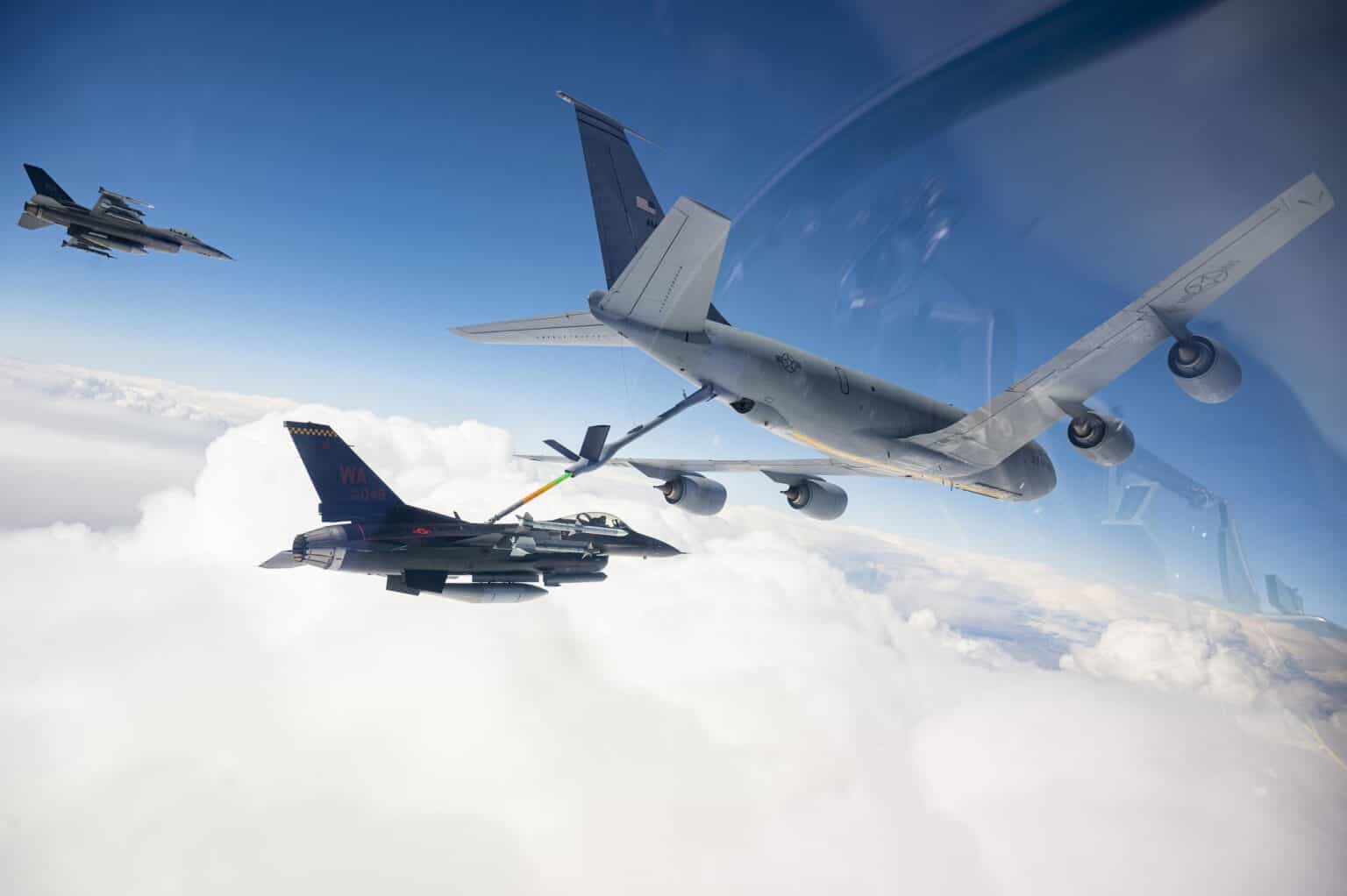
The Boeing KC-135 Stratotanker is the aerial refueling tanker that still provides the core of the U.S. Air Force’s refueling capability, a jet developed alongside the Boeing 707 from the Dash 80 prototype. Boeing delivered the last one in 1965, yet roughly 370 remain in service, re-engined with CFM56 turbofans and refueling Air Force, Navy, Marine Corps and allied aircraft.
Live Fleet Activity (K35R)
Fetching live data…


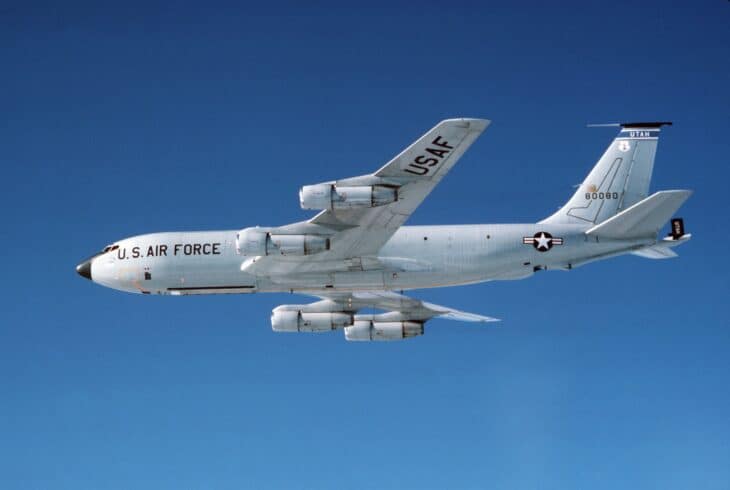
The Boeing KC-135 Stratotanker is a four-engine jet tanker that refuels other aircraft in flight. It was the U.S. Air Force’s first jet-powered refueling tanker, and the Air Force fact sheet still calls it the core of the service’s aerial refueling capability.
It flew for the first time on August 31, 1956, and the last one was delivered in 1965. Every KC-135 still in U.S. service is therefore about 60 years old or more, which makes it one of the oldest military planes still in service.
Besides the Air Force’s own jets, it refuels Navy, Marine Corps and allied aircraft, carries cargo and passengers, and flies aeromedical evacuation missions with patient support pallets.
In the early 1950s the Air Force refueled its bombers with the KC-97 Stratofreighter, a piston-engined tanker that burned gasoline for its own engines. It was so slow that jet bombers and fighters had to slow down to meet its boom.
Boeing’s answer was the Model 367-80, the “Dash 80” prototype that also became the Boeing 707 airliner. The tanker is not simply a gray 707, though: it has a narrower fuselage, is shorter, and is structurally a different airplane.
Lockheed actually won the Air Force’s jet tanker competition in 1955. Because Boeing’s design was already flying, the Air Force ordered KC-135s as a stopgap, and the Lockheed tanker was dropped before it was ever built.
The Air Force bought its first 29 in 1954. The first production Stratotanker went to Castle Air Force Base, California, in June 1957, and Boeing’s Renton plant built 820 aircraft of the C-135 family, 732 of them as tankers.
Boeing gave the tanker the internal model number 717. Boeing later gave the 717 number to a different aircraft.
The KC-135’s main tool is the flying boom, a rigid telescoping tube at the tail. The boom operator lies prone in a pod at the back of the aircraft, looks out through a window under the tail, and “flies” the boom into a receptacle on the receiving aircraft.
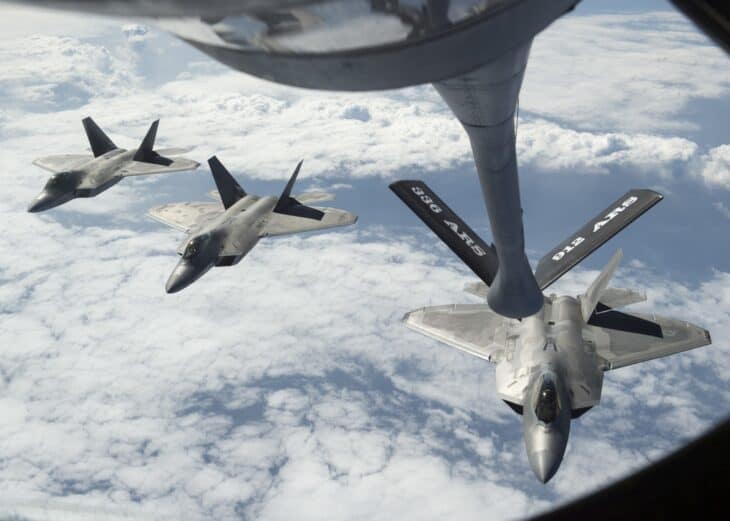
Nearly all of the tanker’s internal fuel can be pumped out through the boom. The Air Force rates the maximum transfer fuel load at 200,000 pounds.
The boom only suits receivers built with a receptacle, which covers most Air Force aircraft. Navy and Marine Corps jets use probes instead, so crews can fit a short hose with a basket-shaped drogue to the end of the boom.
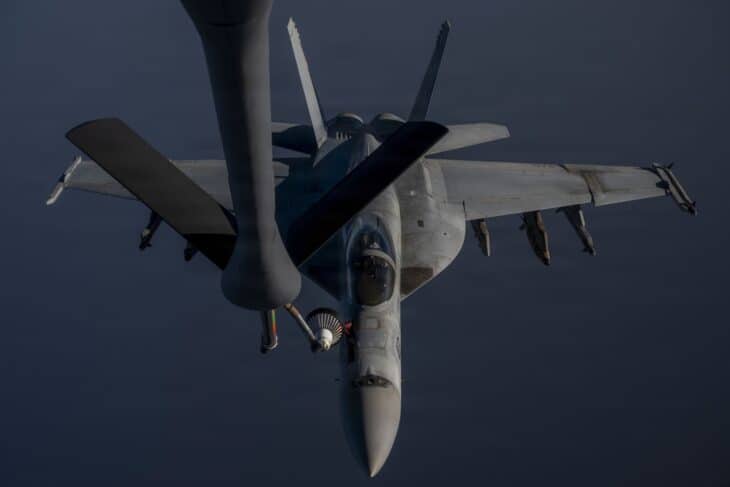
That drogue adapter is unforgiving: it tolerates much less pilot error than a normal trailing hose, and the tanker cannot refuel by the normal boom method until it is removed. Some KC-135s therefore carry the Multi-point Refueling System, two drogue pods mounted at the wingtips that let the tanker refuel two probe-equipped aircraft at the same time.
A cargo deck sits above the fuel system. It has six pallet positions and can take a mixed load of passengers and freight. For a plain-language walkthrough of the boom and drogue methods, see our guide to how airplanes refuel in the air.
The first KC-135As flew with Pratt & Whitney J57 turbojets. For heavy takeoffs, crews injected water into the engines for about three minutes to cool the air and gain thrust, a system that later featured in a fatal 1989 accident at Dyess Air Force Base when it failed on takeoff.
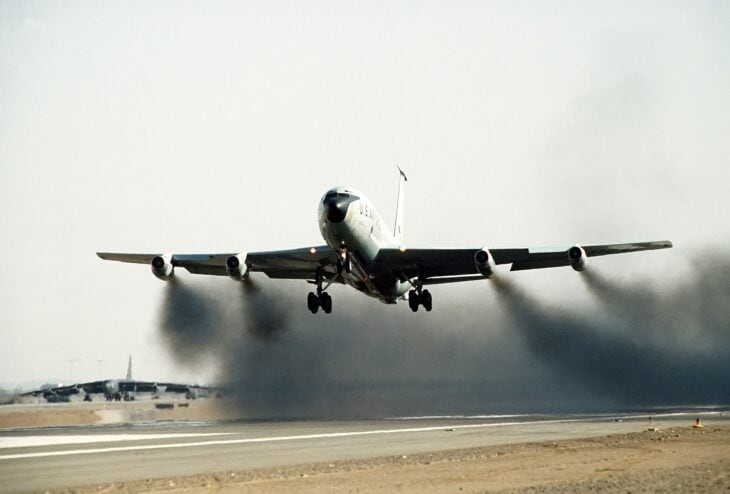
In the 1980s the Air Force Reserve and Air National Guard tankers received Pratt & Whitney TF33 turbofans taken from retired 707 airliners, becoming the KC-135E. The last KC-135E left the inventory in 2009.
The bigger change was the CFM International CFM56, designated F108 by the military. More than 417 KC-135As were re-engined with it and became the KC-135R, while tankers modified for the SR-71 became the KC-135T.
According to the Air Force, the re-engined tanker can offload 50 percent more fuel, is 25 percent more fuel efficient, costs 25 percent less to operate and is 96 percent quieter than the KC-135A. Those gains are why a design from the 1950s is still worth flying.
The Pacer CRAG program (compass, radar and GPS) ran from 1999 to 2002. It modernized navigation across the fleet and removed the navigator from the standard crew, which is why the Air Force now lists a crew of three: pilot, co-pilot and boom operator.
A navigator can still be added for some missions, using a limited number of removable navigator suites. The later Block 45 program replaced the analog instruments with a Rockwell Collins glass cockpit, a digital autopilot and flight director, and a radio altimeter.
The full specification table for the KC-135R is on this page. A few of its figures need context, because a tanker’s numbers describe a trade between the fuel it keeps and the fuel it gives away.
The range figure is a working mission, not a maximum distance. The Air Force quotes 1,500 miles while carrying 150,000 pounds of fuel to pass to other aircraft; flown as a ferry mission with nothing offloaded, the same fact sheet gives up to 11,015 miles.
The fuel capacity and the payload are also two different loads. The fuel figure is the tanker’s giveaway fuel, while the payload figure is cargo, and the Air Force says the cargo the KC-135 can carry depends on how its fuel storage is configured.
The engine figure is thrust per engine, not for the aircraft, and there are four of them. The cruise speed in the table is the Air Force’s published speed at 30,000 feet.
The KC-135 entered service to refuel Strategic Air Command’s nuclear bombers. In November 1957 Air Force Vice Chief of Staff Gen. Curtis LeMay tested the first KC-135 on a long-haul flight from Westover Air Force Base, Massachusetts, to Buenos Aires.
Vietnam turned it into a tactical asset. Boeing records 813,000 aerial refuelings of combat aircraft during nine years of the conflict, letting F-105s, F-4s and B-52s reach distant targets and stay on station for hours instead of minutes.
During the 1991 Gulf War, Boeing counted 18,700 hookups and 278 million pounds of fuel transferred by KC-135s. When Strategic Air Command was inactivated in 1992, most of the fleet moved to the new Air Mobility Command.
In March 2026, during U.S. air operations against Iran, the fleet suffered its first losses of the campaign. On March 12 a KC-135 went down over western Iraq during a combat mission, killing all six crew from the 6th Air Refueling Wing at MacDill and Ohio’s 121st Air Refueling Wing.
A second KC-135 involved in the same incident landed safely with significant damage to its vertical stabilizer. The military ruled out hostile and friendly fire and a midair collision was suspected. As of September 2026 we found no published investigation report.
Days later, officials told reporters that an Iranian missile strike had damaged five KC-135s parked at Prince Sultan Air Base in Saudi Arabia without destroying them. President Trump disputed the extent of the damage, and a further strike on the same base on March 27 was reported to have damaged several more refueling aircraft.
Air Force budget documents released in April 2026 put the fleet at roughly 370 KC-135s, alongside about 105 KC-46 Pegasus tankers. The service planned to retire 20 KC-135s in fiscal 2027.
That retirement pace is slower than before. The Air Force had been retiring a KC-135 for every KC-46 delivered, but Congress set a rising floor for the tanker fleet, from 466 aircraft toward 502, so the old jets now have to stay while the new ones arrive.
A handful fly outside the Air Force. Turkey’s air force operates KC-135Rs, Chile received KC-135Es from 2010, and the private defense company Metrea flies tankers it bought from Singapore and France.
France and Singapore both replaced their Stratotankers with the Airbus A330 MRTT. France’s 12 C-135Fs, in service from 1964, were built new for the French Air Force rather than taken from U.S. stocks.
Replacing a fleet this size has taken more than 20 years. A plan to lease KC-767 tankers from Boeing collapsed in a procurement corruption scandal, and the contract was canceled in 2006.
The KC-X competition that followed was first awarded to a Northrop Grumman and EADS tanker based on the A330 in 2008. The Government Accountability Office upheld Boeing’s protest, the competition was rerun, and in 2011 the Air Force chose Boeing’s 767-based design, which became the KC-46 Pegasus. The first KC-46 was delivered in January 2019.
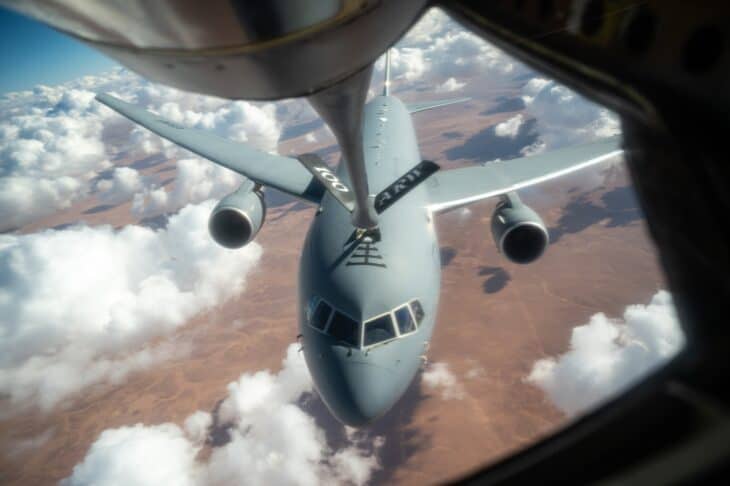
The Air Force has since dropped plans for a separate “bridge tanker” competition, chosen to buy an extra 75 KC-46s instead, and began exploring a Next-Generation Air Refueling System. Even so, officials said in September 2026 that hundreds of KC-135s will still be flying once KC-46 buying ends.
“The last KC-135 pilot has not been born,” Maj. Gen. Gerald Donohue said that month. The larger KC-10 Extender was bought to supplement the KC-135, not to replace it.
The original J57-powered production tanker. Boeing built 732, and many were later converted into the reconnaissance, command post and test aircraft of the wider C-135 family.
Guard and Reserve KC-135As re-engined with TF33 turbofans from retired 707s. They were the only KC-135s fitted with thrust reversers, and all were retired to the boneyard at Davis-Monthan by September 2009.
The KC-135Q carried JP-7, the special fuel of the SR-71 Blackbird, in its body tanks while its own engines burned standard jet fuel from the wing tanks. Re-engined with CFM56s, the Q became the KC-135T, which can still keep the body and wing fuel separate.
The CFM56-powered tanker that makes up today’s fleet. Eight KC-135Rs were fitted with their own receiver systems, so these KC-135R(RT)s can take on fuel in flight from another tanker.
New-build tankers for France with a drogue adapter on the boom. The survivors were re-engined with CFM56s as C-135FRs between 1985 and 1988 and later fitted with wingtip refueling pods.
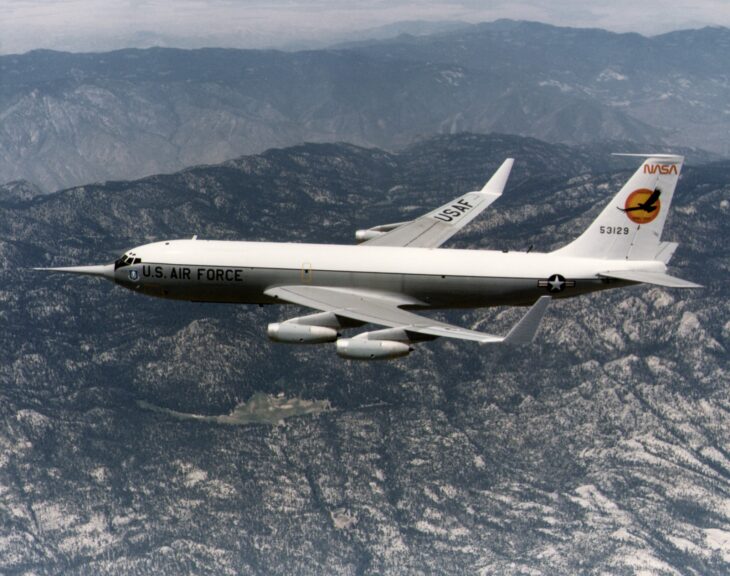
NASA flew KC-135s with the tanker gear removed as its “Vomit Comet” zero-gravity trainer. The longest-serving one, KC-135A 59-1481, flew that role from 1973 to 1995.
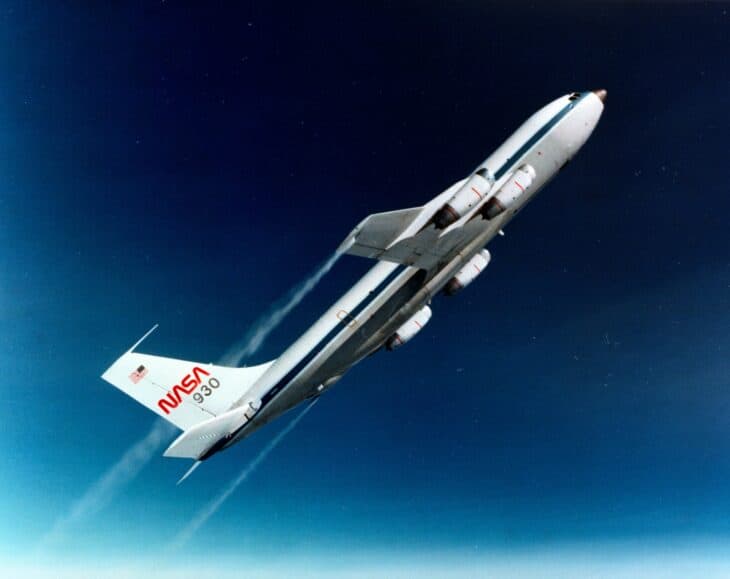
In 1979 and 1980, NASA tested Richard Whitcomb’s winglets on an NKC-135A borrowed from the Air Force. The results showed drag reductions that could stretch cruise range by up to 7 percent, research that helped put winglets on later airliners and business jets.
Six decades of flying have included serious accidents, many of them in the early J57-powered years. A fuel pump overheating problem caused several explosions, and after five such accidents crews were told to keep 3,000 pounds of fuel in the affected tank.
The most recent loss before 2026 came on May 3, 2013, when a KC-135R broke up in flight after taking off from Manas in Kyrgyzstan, killing its three crew. Investigators found that a rudder power control unit malfunction caused a Dutch roll the crew did not recognize, and their rudder inputs made it worse until the tail failed.
Roughly 370 were in U.S. Air Force service according to budget documents released in April 2026, with 20 retirements planned for fiscal 2027. A small number also fly with Turkey, Chile and the contractor Metrea.
The Air Force gives a range of 1,500 miles while carrying 150,000 pounds of fuel to transfer, and up to 11,015 miles on a ferry flight with nothing offloaded. The eight receiver-capable KC-135R(RT)s can also take on fuel from another tanker to stay up longer.
One through the tail boom. KC-135s fitted with Multi-point Refueling System wingtip pods can refuel two probe-equipped aircraft at the same time.
The Air Force lists a unit cost of $39.6 million in fiscal 1998 constant dollars. None has been built since 1965, so that figure reflects the value of the aircraft rather than a price anyone can pay for a new one.
Up to 200,000 pounds, according to the Air Force. Nearly all of the tanker’s internal fuel can be pumped through the boom.
No. Both come from the Dash 80 prototype and look alike, but the KC-135 has a narrower, shorter fuselage and a different structure, and it predates the 707.
The Boeing KC-46 Pegasus is partly replacing it, with about 105 delivered by April 2026 and 75 more planned. Air Force leaders expect hundreds of KC-135s to keep flying for decades alongside it.
Sources and references used for research and fact-checking.

.jpg)
.jpg)

.jpg)

