

Military Transport Planes
Boeing KC-135 Stratotanker
ICAO: K35R
The 767-based tanker replacing the KC-135
Updated: by Tim de Vries
The latest aviation news and stories sent to your inbox.
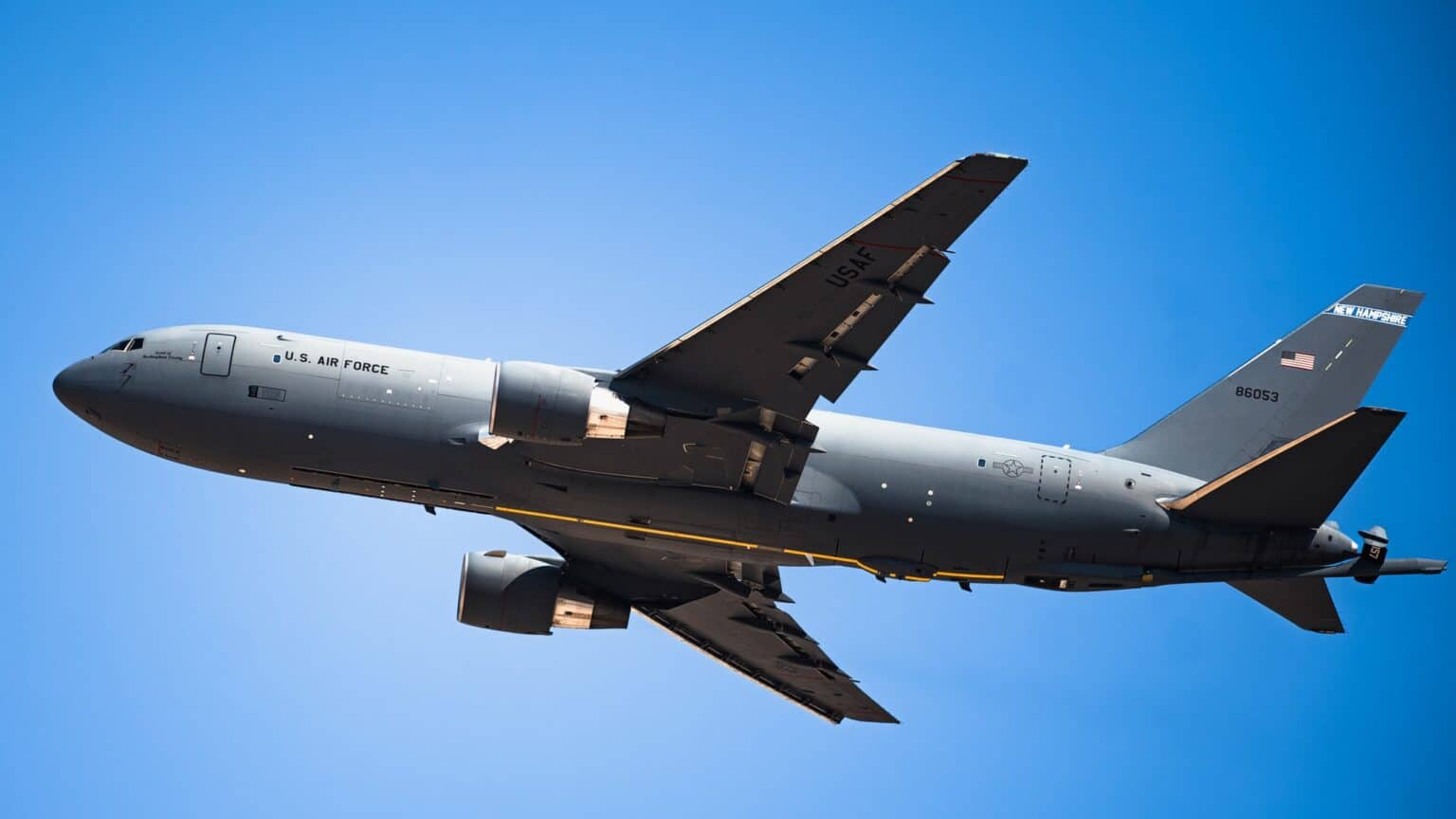
The Boeing KC-46 Pegasus is the U.S. Air Force’s newest aerial refueling tanker, a modified 767 that replaces the Eisenhower-era KC-135. It carries a fly-by-wire boom and wing pods, doubles as a cargo and passenger jet, and has also been one of the most troubled aircraft programs of the past decade.


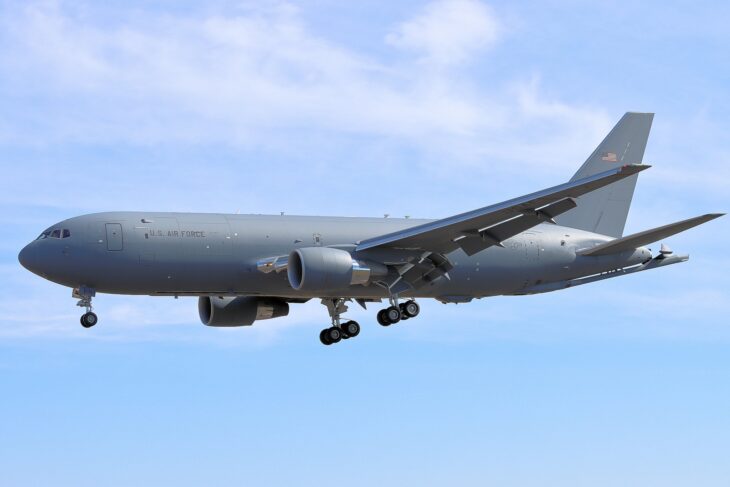
The Boeing KC-46 Pegasus is an aerial refueling tanker that also carries cargo, passengers and patients. It is built on the Boeing 767-200 airliner and assembled at Boeing’s Everett, Washington plant.
The Air Force bought it to replace the KC-135 Stratotanker, which has been the service’s primary tanker for more than 50 years. Boeing says 168 are on contract and more than 100 are in service.
For a plain-language look at how tankers pass fuel in flight, see how airplanes refuel in the air.
The Pegasus carries two refueling systems on one airframe. A fly-by-wire boom under the tail serves aircraft with a receptacle, while a centerline hose and drogue and two wing pods serve aircraft with a probe.
That lets one tanker refuel Air Force, Navy, Marine Corps and allied aircraft on the same sortie. Boeing lists the boom at 1,200 gallons per minute and each drogue system at 400 gallons per minute.
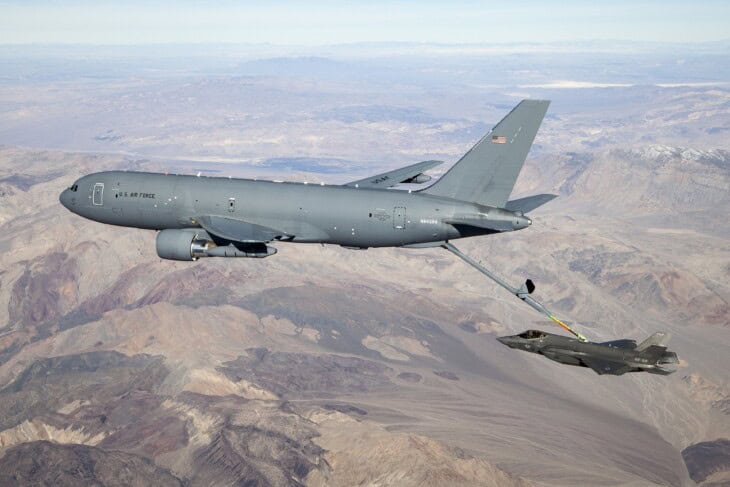
Boeing says the boom’s receiver envelope is three times larger than the KC-135’s, and that 28 boom and drogue receivers are certified, including the F-35, F-16, F-15QA and P-8.
The Pegasus can also take on fuel itself. Boeing lists a receptacle that accepts fuel at the same 1,200 gallons per minute, which gives the tanker a way to top up from another tanker.
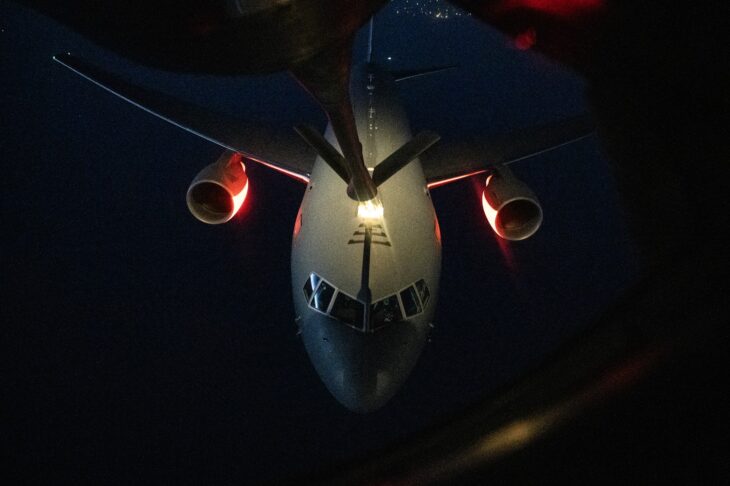
The Pegasus is not only a gas station. The Air Force fact sheet lists 18 pallet positions and a maximum cargo load of 65,000 pounds, with seating for 58 passengers.
Boeing says the cabin can switch between roles in about two hours, using cargo rollers compatible with Air Force loaders. For aeromedical evacuation, the Air Force expects to add a basic crew of five, two flight nurses and three medical technicians.
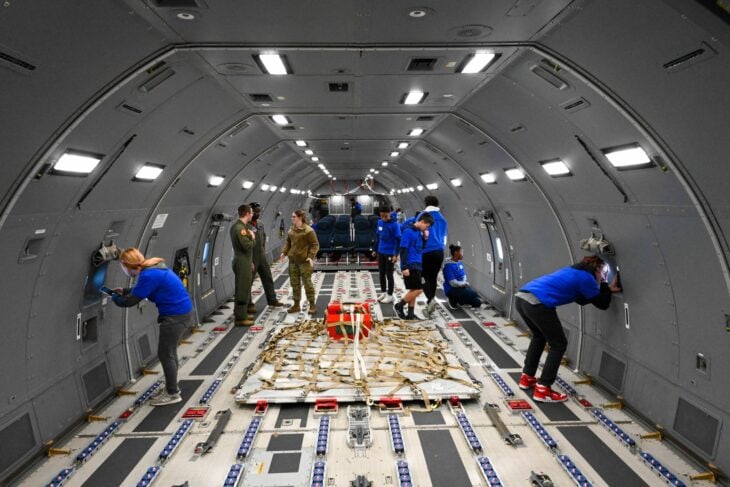
The basic crew is two pilots and a boom operator. The Air Force counts 15 permanent seats for aircrew, including aeromedical evacuation crew.
The full specification table for the aircraft is on this page. A few figures need context that a table cannot give.
Speed first. Boeing quotes a maximum airspeed of Mach 0.86, which is the figure to use when comparing the tanker with other airliner-derived jets.
Fuel is the second one. The jet holds more fuel than it can give away, because some has to stay on board to fly the tanker itself. Wikipedia lists 207,672 pounds as the maximum available for transfer, against the 212,299 pounds of total capacity that the Air Force and Boeing print.
The weight figures also describe different jobs. The jet takes off heavy with fuel to transfer, but its maximum landing weight is much lower, which is why a tanker burns or offloads fuel before it returns.
Boeing flew a 767-2C test aircraft in December 2014 as the base for the tanker. The first production aircraft reached the Air Force on January 10, 2019, years behind the original plan.
Boeing took the contract at a fixed price. Military Times reports the company has absorbed more than $7 billion in losses on the development effort.
Early deliveries were interrupted more than once. In 2019 the Air Force restricted cargo and passengers after floor cargo locks came unlocked in flight, and that deficiency was closed by December 2019. A fuel-leak problem was later raised to a Category 1 deficiency in March 2020.
A KC-46 boom operator does not lie in a pod looking out a window. Instead the operator sits on the flight deck and flies the boom by camera, through the Remote Vision System, or RVS.
Early RVS video was degraded by strong sunlight and distorted depth, which made it harder to judge the boom’s position. As of May 2025 the Air Force listed five Category 1 deficiencies, and two of them came from the RVS.
The fix is RVS 2.0, which is designed to add 4K video and LiDAR-based distance sensing. Air & Space Forces Magazine reports it slipping to summer 2027, about three years behind its original schedule.
Simple Flying also reports that the boom can bind in a receiver’s receptacle and, in some incidents, whip up and strike the tanker’s tail. Boeing is working on a redesign so the boom retracts with less force.
The Air Force accepted its 100th KC-46A in December 2025, according to Simple Flying. Deliveries were paused briefly in early 2025 after cracks were found in control surface components, and resumed that May.
Congress has capped KC-46 purchases at 183 jets until the major deficiencies are resolved. The Air Force’s program of record is 263, and its fiscal 2027 request asks for 15 more aircraft, rising to 18 per year from 2028 to 2031.
Military Times puts the unit cost in the budget at $199.8 million in fiscal 2027, rising to $321.9 million in fiscal 2028. That is a program-level figure, not a flyaway price, so it should not be compared directly to a manufacturer’s list price.
Abroad, Japan operates the type and Israel received its first aircraft in May 2026. The State Department page for a possible sale of four aircraft to Qatar is dated August 2026.
Against the KC-135, the Pegasus is a different class of jet. It has a modern fly-by-wire boom, wing pods, a larger boom receiver envelope and a cabin that carries real cargo, where the older tanker needs an adapter to handle probe-equipped aircraft.
The Airbus A330 MRTT is the other widely used tanker in this class, and several air forces fly it. Italy halted its own KC-46 purchase and chose the Airbus jet instead, according to Wikipedia.
The Air Force’s plan after the Pegasus is unsettled. In July 2025 it skipped a competition for new tankers and moved toward buying up to 75 more KC-46s, and Simple Flying reports the stealthy NGAS tanker was dropped from the fiscal 2027 request.
Boeing lists electromagnetic pulse hardening, flight deck armor, infrared countermeasures and radio frequency warning among the survivability features. Night vision lighting lets it work covertly.
The tanker can also pass data through its wing pods using the Advanced Battle Management System. Air & Space Forces Magazine says the Air Force cleared it for worldwide combat support to 85 percent of receiver types in September 2022.
The KC-46 can refuel stealth aircraft as well. One photo in this gallery shows a KC-46 feeding a B-2 Spirit over Edwards Air Force Base.
It is an aerial refueling tanker that also moves cargo, passengers and patients. It refuels Air Force, Navy, Marine Corps and allied aircraft through a boom, a centerline drogue and wing pods.
The Air Force accepted its 100th KC-46A in December 2025, according to Simple Flying, and Boeing says more than 100 are in service worldwide. Counts differ by source and date, so check Boeing or the Air Force for a current total.
Yes. Boeing lists a receptacle that accepts fuel at 1,200 gallons per minute, and photos show a KC-46 receiving fuel from a KC-135 boom.
Israel received its first KC-46 in May 2026, according to Boeing. Wikipedia reports a second delivered by August 2026 and more on order, but order totals have been reported as four and as six, so the final number is not settled.
The main problems are the Remote Vision System, which has distorted depth and washed out in sunlight, and a boom that can bind in a receiver. RVS 2.0 is projected for summer 2027.
Sources and references used for research and fact-checking.
.jpg)
.jpg)
