

Military Transport Planes
Lockheed CC-130H Hercules
ICAO: C130
The workhorse Hercules, still flying with the U.S. Guard and Reserve as the C-130J takes over
Updated: by Tim de Vries
The latest aviation news and stories sent to your inbox.
The C-130H is the long-serving version of the Lockheed Hercules, a four-engine turboprop airlifter that moves troops, vehicles and cargo from short, rough runways. It entered service in the 1960s and the last one rolled off the line in the 1990s, yet it is still flown by the U.S. Air National Guard, the Air Force Reserve and air forces around the world.
Live Fleet Activity (C130)
Fetching live data…


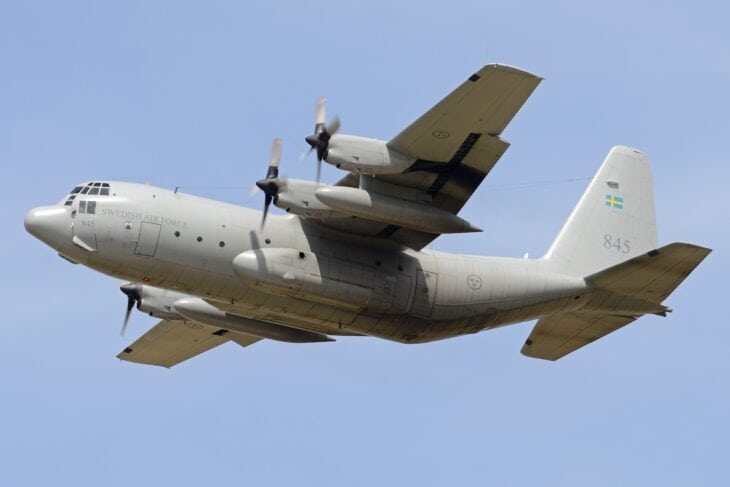
The C-130H is one of the most widely used versions of the Lockheed Hercules. It is a four-engine turboprop transport built to carry troops, vehicles and pallets into short, rough airfields.
It sits between the older C-130E and the modern C-130J Super Hercules. More than 60 years after the first deliveries, it is still working.
The United States Air Force flies it with the Air National Guard and the Air Force Reserve. Many other air forces, from New Zealand to Sweden to Egypt, have flown it as well.
The H kept the C-130E airframe and changed what mattered most. It gained uprated Allison T56-A-15 turboprops, a redesigned outer wing and updated avionics.
Initial deliveries began in 1964, to the Royal New Zealand Air Force. An improved H followed in 1974, and Australia bought 12 of them in 1978 to replace its original 12 C-130A models.
That 1974 date is the one the Air Force uses. Its own fact sheet lists the C-130H as deployed in June 1974, which is why the older “1964” and newer “1974” figures both appear in print.
Aircraft built from 1992 to 1996 became the C-130H3 in USAF service. They added ring laser gyros, GPS receivers, a partial glass cockpit, a color weather radar and an integrated radar and missile-warning system.
A stretched version, the C-130H-30, adds a 100-inch plug behind the cockpit and an 80-inch plug at the rear of the fuselage.
Production ended in the 1990s. According to the 37th Training Wing, tail number 96-7325 entered service at Peterson Space Force Base, Colorado, in 1997 as the final C-130H to roll off the production line.
The full specification table for the aircraft is on this page. A few of those figures need context, because published sources disagree with each other, and the disagreements are not mistakes so much as different conditions.
Start with range. The panel shows 2,050 nmi, which is the figure in Wikipedia’s C-130H specification block. The Air Force’s own fact sheet gives 1,050 nautical miles at maximum normal payload and 1,300 nautical miles with 35,000 pounds.
Wikipedia also lists a ferry range of 3,995 nautical miles. A Hercules flying empty with extra fuel goes much farther than one carrying a full load of cargo.
The ceiling works the same way. The panel shows the empty-aircraft figure of 33,000 ft. The Air Force fact sheet quotes 23,000 feet with a 42,000-pound payload, which is closer to what a loaded aircraft does on a real mission.
Speed comes from the same fact sheet: 318 knots true airspeed, or Mach 0.52, at 20,000 feet. That is slower than a jet airliner, which is the trade for a turboprop that can work from short strips.
Cost needs a caveat too. The Air Force lists a unit cost of $30.1 million in fiscal 1998 constant dollars. It is expressed in fiscal 1998 dollars, so it is not a current price.
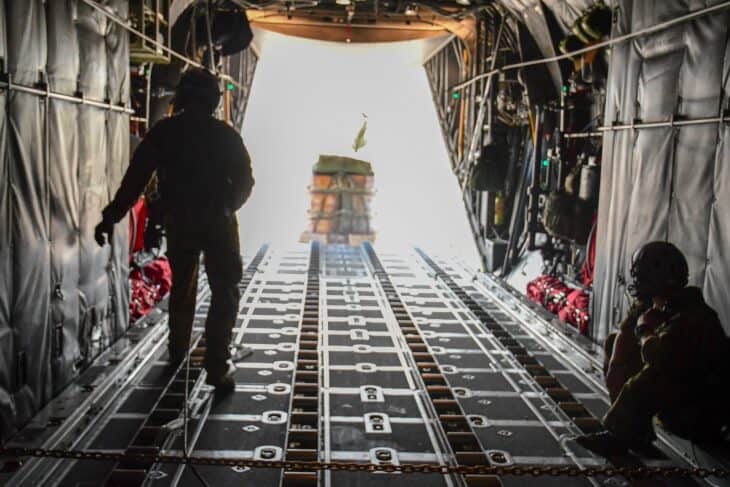
The cargo hold opens onto a rear ramp, which is how loads are driven aboard and dropped by parachute. The Air Force fact sheet says it takes six pallets, 74 litters, 16 container delivery system bundles, 92 combat troops or 64 paratroopers.
The crew is five: two pilots, a navigator, a flight engineer and a loadmaster. The J model dropped the navigator and flight engineer, which is one of the biggest practical differences between the two.
The J looks like the H from a distance, but nearly everything inside it is new. It uses Rolls-Royce AE 2100D3 turboprops with six-bladed composite scimitar propellers, in place of the H’s four-bladed Hamilton Standard props.
The J’s crew is two pilots and a loadmaster. The H still carries a navigator and a flight engineer.
For an air force, that means two fewer crew members on every cargo flight. The full details of the newer aircraft are on the C-130J Super Hercules page.
The H is the base for a long list of special-mission Hercules. Some of the better known are:
The EC-130H Compass Call is an electronic attack aircraft. The MC-130H Combat Talon II descends from a Vietnam-era special operations design.
The HC-130H is flown by the U.S. Coast Guard for long-range search and rescue, drug interdiction, migrant patrols and logistics. The LC-130H carries skis for Arctic and Antarctic missions, and the Air Force inventory lists 10 of them in the Air National Guard.
Three H airframes were modified into YMC-130Hs, with rocket packs on the fuselage, for Operation Credible Sport, the second attempt to rescue the Iran hostages in 1980. The rockets were removed after the mission was canceled.
Canada flew its own version, which is covered on the Lockheed CC-130H Hercules page. Canada retired 12 of them in January 2026 and has conditionally sold 10 to Coulson Aviation for conversion to firefighting aircraft.
Coulson Aviation also developed RADS XL, a firefighting system that fits a C-130H with an in-floor discharge system and a removable tank of 3,500 or 4,000 gallons.
The Air & Space Forces Magazine almanac lists 269 C-130H aircraft in the U.S. Air Force at the end of September 2025. That was 101 in the active force, 126 in the Air National Guard and 42 in the Air Force Reserve.
The Air Force fact sheet, with data from May 2014, listed 145 active, 181 Guard and 102 Reserve aircraft, or 428 in all. The fleet has shrunk by more than a third since.
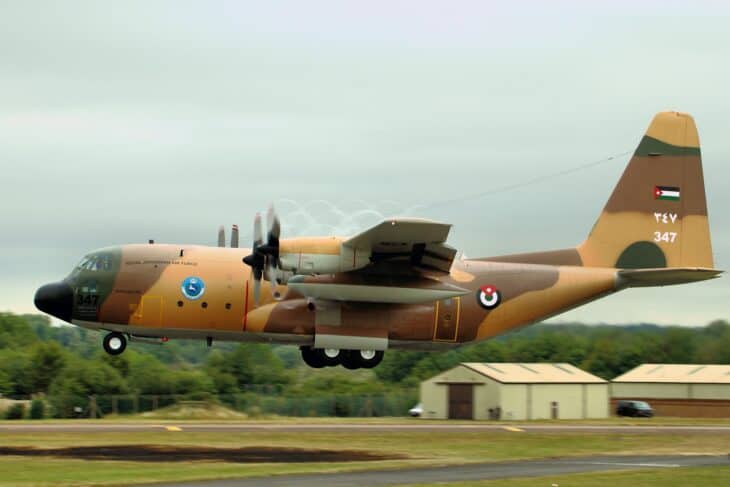
Abroad, this page’s photo gallery shows H models from Jordan, Sweden, Belgium, Egypt, Colombia, Japan, Indonesia, Nigeria and South Korea. Argentina flies five C-130Hs under a U.S.-funded security assistance arrangement, leased since June 2023 through the Georgia Air National Guard.
An airframe designed in the 1950s survives on upgrades. The Avionics Modernization Program, awarded to Boeing in 2000 with a contract of $1.4 billion, was supposed to cover 198 aircraft. It was hit by delays and cost overruns until it was restructured in 2007.
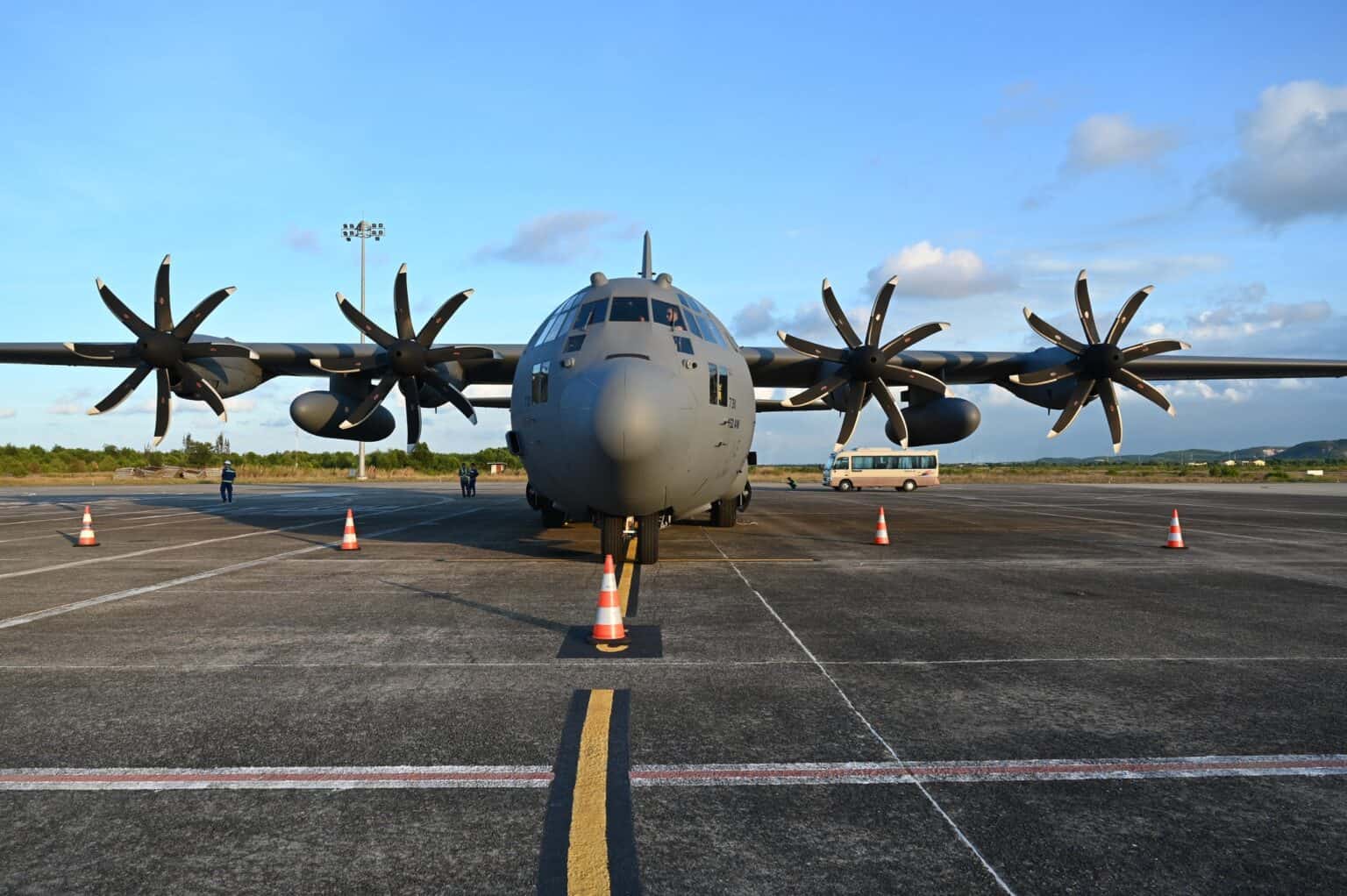
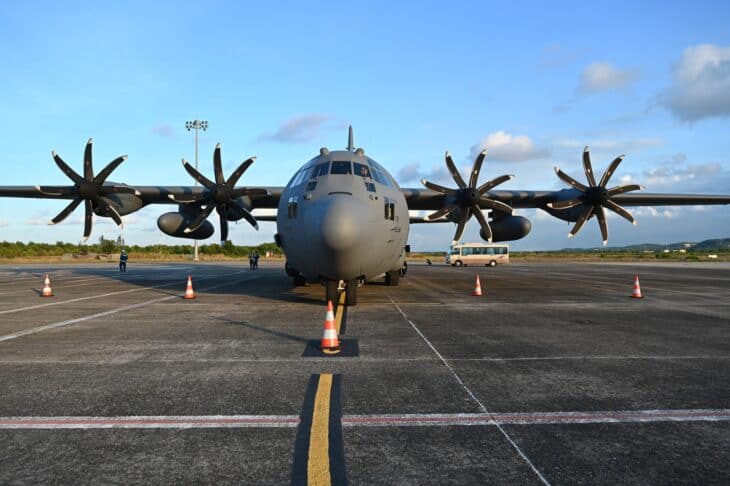
In the 2000s, Lockheed Martin and the Air Force also began fitting eight-bladed NP2000 propellers to the C-130 fleet.
Structural work matters as much as electronics. Later H models got a fatigue-life-improved center wing, which was retrofitted to many earlier aircraft. In August 2026, Garuda Maintenance Facility completed a center wing box replacement, an avionics upgrade and a structural integrity program on Indonesian Air Force C-130H A-1319.
There are new roles as well. In 2021 the Air Force Research Laboratory demonstrated Rapid Dragon, which turns a C-130 into a strike platform that can launch 12 JASSM-ER cruise missiles from a standoff distance of 575 miles (925 km).
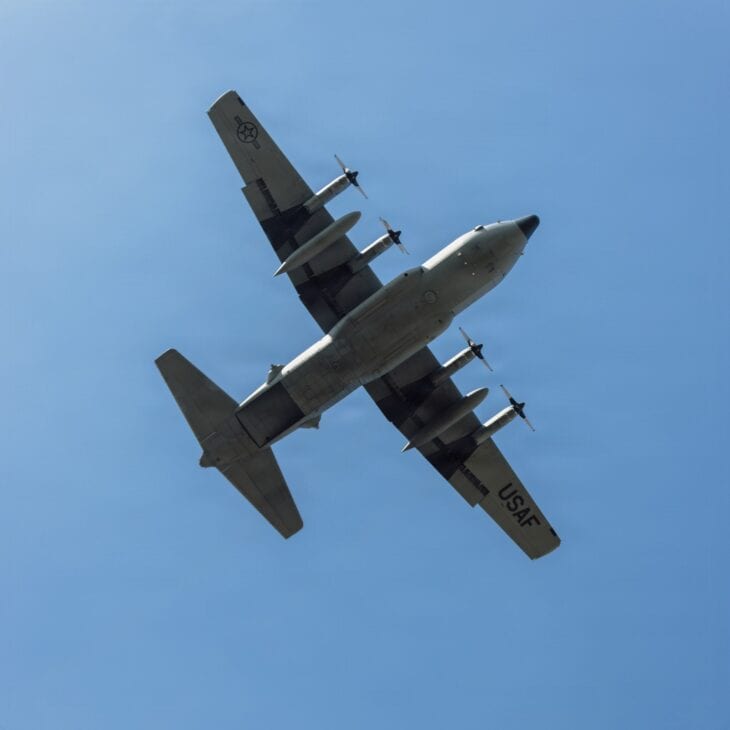
Not yet, but the retirement is under way. As of October 2026, the C-130H still flies for the U.S. Guard and Reserve and for many foreign air forces.
The Air Force asked to retire 14 C-130Hs in its fiscal 2026 budget request. The service has also begun giving them second careers.
Two retiring C-130Hs landed at Kelly Field on August 25, 2026, to serve as training platforms for Basic Military Training. One of them is 96-7325, the last C-130H built, which logged 10,980 flight hours.
That aircraft joined the West Virginia Air National Guard in 2015 and the Montana Air National Guard in 2021, and flew a D-Day commemoration mission in June 2026.
The same retirement shows up in the Air Force’s unusual jobs. Our look at the Air Force mosquito-spraying C-130 unit reports that the Reserve’s last C-130Hs are due to leave in 2027, before the J models can fly the spray mission.
The H is a tactical airlifter, built around short, rough runways. The C-17 Globemaster is the strategic airlifter that moves heavier loads over longer distances.
Newer designs that compete for similar work include the Airbus A400M and the Embraer KC-390. For a navy angle on the family, see our story of the C-130 that landed on an aircraft carrier.
The C-130J has new Rolls-Royce AE 2100D3 engines with six-bladed composite propellers and a crew of two pilots and a loadmaster. The C-130H has Allison T56-A-15 engines with four-bladed propellers and a five-person crew that includes a navigator and a flight engineer.
It is a tactical airlifter. It carries troops, paratroopers, litters and cargo pallets, and it drops loads by parachute from the rear ramp. Variants fly electronic attack, special operations, Coast Guard rescue and polar support missions.
No. As of October 2026 the type still flies for the U.S. Guard and Reserve and for many other air forces. The Air Force counted 269 in its fleet at the end of September 2025, asked to retire 14 in its fiscal 2026 budget, and is replacing the type with the C-130J.
The Air Force fact sheet lists 92 combat troops or 64 paratroopers, or 74 litters, plus the five-person crew.
The AC-130 is a gunship conversion of the Hercules, and its price depends on the variant and its weapons and sensors. This page covers the C-130H, whose unit cost the Air Force lists as $30.1 million in fiscal 1998 dollars.
It depends on the load. The Air Force quotes 1,050 nautical miles at maximum normal payload and 1,300 nautical miles with 35,000 pounds, while a lightly loaded aircraft carrying extra fuel can ferry much farther, up to 3,995 nautical miles in Wikipedia’s figure.
Sources and references used for research and fact-checking.
.jpg)
.jpg)
.jpg)