

Military Transport Planes
Lockheed C-130H Hercules
ICAO: C130
Canada's search-and-rescue Hercules, retired in 2026 and headed for a second life as a wildfire airtanker
Updated: by Tim de Vries
The latest aviation news and stories sent to your inbox.
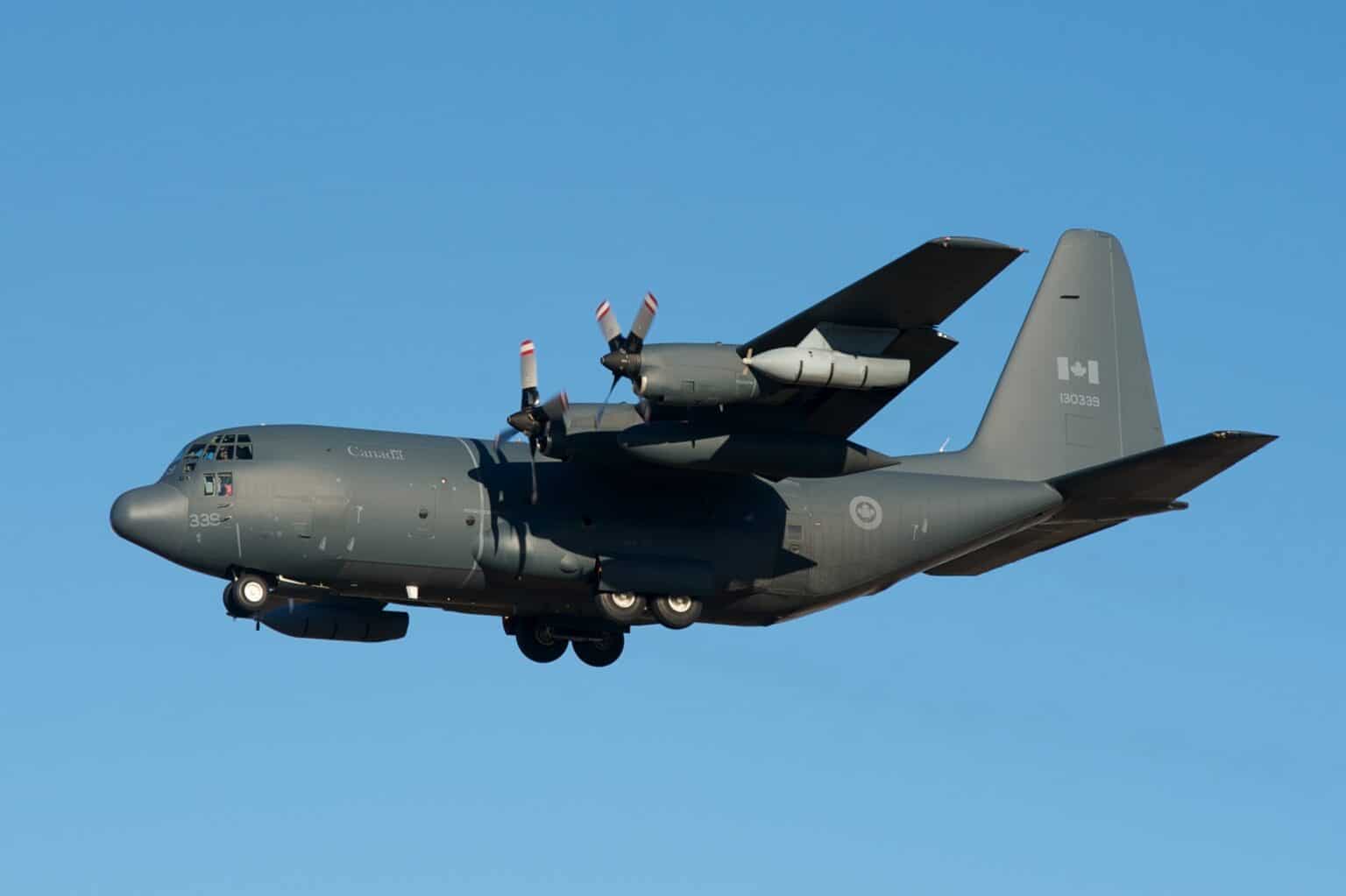
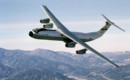
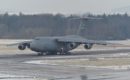
The CC-130H is the Canadian Armed Forces designation for the C-130H Hercules, a four-engine turboprop that served the Royal Canadian Air Force as a search-and-rescue aircraft, tactical transport and air-to-air tanker. Canada bought 14 of them from 1974, and the fleet retired in January 2026. In August 2026 the government conditionally sold 10 of the retired aircraft to Coulson Aviation to be converted into firefighting airtankers.
Live Fleet Activity (C130)
Fetching live data…


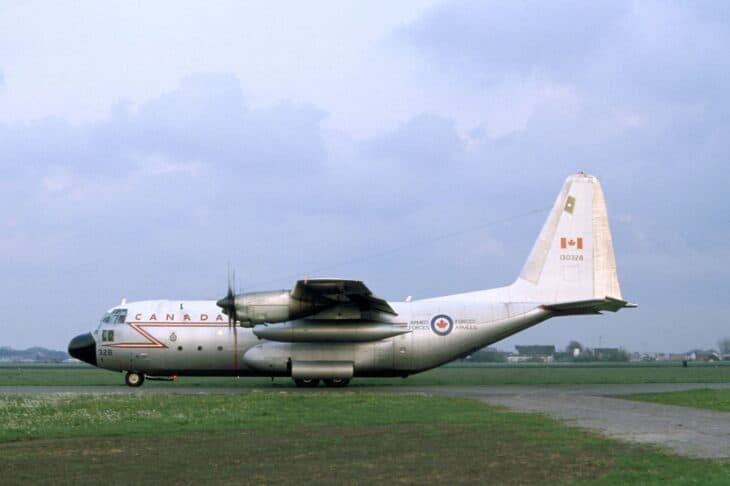
The CC-130H is the Canadian designation for the C-130H Hercules, the four-engine turboprop that served the Royal Canadian Air Force for more than five decades as a transport, a search-and-rescue aircraft and, in a smaller role, a tactical tanker. Canada bought 14 of them, and the first was delivered in September 1974.
The Government of Canada says the Air Force retired 12 CC-130H aircraft in January 2026. On August 7, 2026, it announced the conditional sale of 10 of the retired aircraft to Coulson Aviation, which plans to turn them into wildfire airtankers.
Canada has flown the Hercules since 1960 and has owned the B, E, H and J models. The Canadian Warplanes serial history lists 14 CC-130H aircraft, serials 130329 to 130342, plus two stretched CC-130H-30 aircraft, serials 130343 and 130344.
CC-130 is the Canadian designation for its Hercules. Apart from the prefix, the CC-130H is the standard C-130H, with four Allison T56 turboprop engines driving four-bladed propellers. It shares its basic design with the C-130J Super Hercules, which has newer engines and, in the RCAF’s version, a longer fuselage.
The aircraft was built for the jobs that suit a high-wing, rear-ramp transport: carrying heavy loads into short, unpaved strips, and flying in weather that grounds smaller aircraft. The RCAF’s own fact sheet says the CC-130H can carry approximately 80 passengers and operate on short unpaved runways.
The RCAF describes the CC-130H as primarily a search-and-rescue aircraft. Its fact sheet says the combination of range, load and rough-field capability made it well suited to rescues over Canada’s central and northern regions.
413 Squadron at Greenwood, Nova Scotia, began flying the H model as a search-and-rescue platform in 1990, according to Skies Magazine. 435 Squadron at Winnipeg, Manitoba, flew the type for airlift, search and rescue and tanker missions. The fleet was also used to move people during disaster response, including wildfire evacuations in 2025.
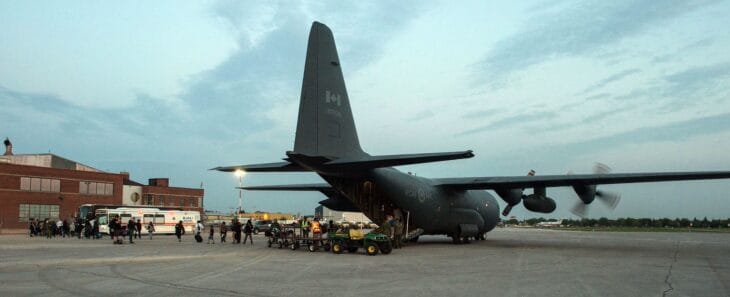
Skies Magazine’s retirement report lists rescues that include a helicopter crew near Ramea, Newfoundland, and a snowmobiler at Lake of the Woods during a February blizzard.
The last 413 Squadron aircraft, serial 130333, flew to Cascade Aerospace in Abbotsford, British Columbia, in January 2026. Skies describes it as the “Triple Pig” and says it had logged more than 37,000 flight hours.
The tanker version is the CC-130H’s most unusual chapter. Canada identified a need for a tactical refueler in 1986 and looked at buying KC-130 tankers from Lockheed.
In the summer of 1990, with the Gulf War approaching, the Canadian Forces needed airlifters more urgently. According to a 1993 article in The Voxair, Lockheed supplied five Hercules for tactical airlift, three of them in time to serve in the Gulf War, and agreed to refit all five with air-to-air refueling systems within two years.
The article called it the first time in recent history that a standard Hercules had been converted into a tanker after purchase.
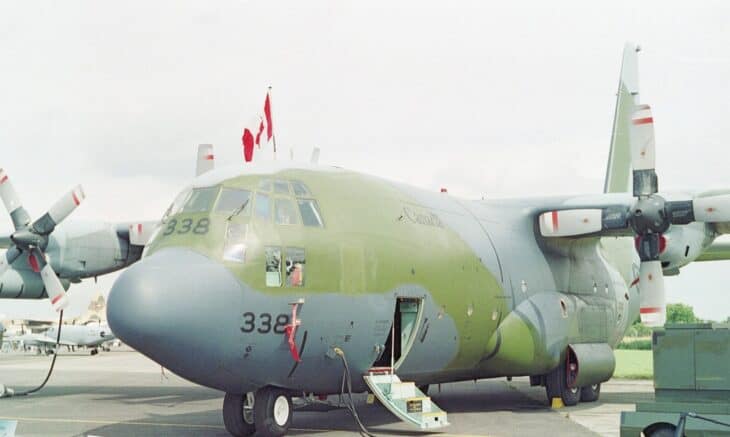
North West Industries of Edmonton, a Lockheed subcontractor, did the work. It fitted a removable refueling pod under each wing, built by Flight Refuelling Limited in Britain and the same type used on the Royal Australian Air Force’s Boeing 707 tankers. Inside the cargo bay went a removable 15,000 liter (about 3,960 US gallons) fuel tank with its own high-speed pumps.
The tanker had two configurations. With the pods and tank it refueled other aircraft. Without them, or with pods only, it was an ordinary transport or rescue aircraft.
The Canadian Forces conditionally accepted the first modified aircraft in June 1992. All five were in service by June 1993, based at 18 Wing Edmonton and operated by 435 Squadron. The squadron moved to Winnipeg in 1994.
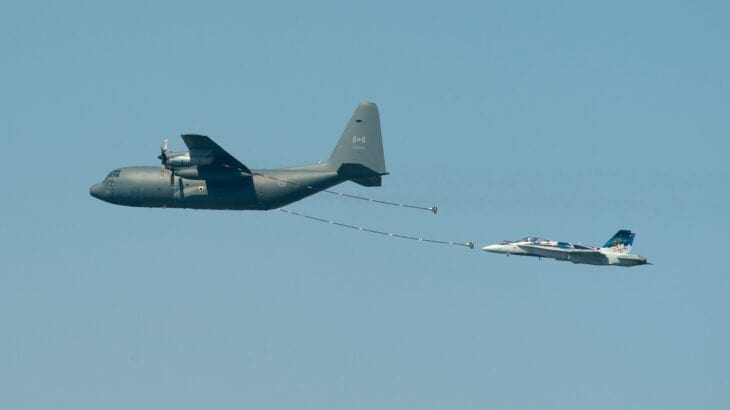
The tankers also deployed. Canadian Warplanes records that serial 130342 went to Trapani-Birgi in Italy in spring 2011 as tanker support for Operation MOBILE, Canada’s contribution to United Nations operations over Libya. It also shows 130338 refueling a CF-18 Hornet during an Arctic exercise in May 2015.
The full specification table for the aircraft is on this page. Three of its figures need context, because the sources disagree and the CC-130H has more than one honest answer.
Start with weight. The RCAF’s CC-130H fact sheet gives a maximum gross weight well above the 155,000 lb (70,307 kg) that Air & Space Forces Magazine and Wikipedia publish for the standard C-130H.
We have not found an explanation for the gap. The panel uses the RCAF figure because it is the operator’s own number for this variant, and the lower number is the usual baseline for the type.
Range depends on what the aircraft carries. The panel uses the RCAF’s published figure, which it gives as the range without external tanks. The U.S. Air Force’s C-130H profile lists a far shorter 1,496 miles with a 35,000 lb payload.
Takeoff distance depends on weight in the same way. The panel’s figure is the one the Wikipedia spec block publishes for a 155,000 lb takeoff. The same block lists a much shorter run at 80,000 lb, so the distance varies a great deal with the load.
On February 21, 2012, serial 130342 was making a touch-and-go at Naval Air Station Key West, Florida, when a fire broke out in the cargo bay.
The loadmaster saw an orange flame cross the cargo ramp floor. The pilot landed straight ahead with runway to spare, stopped the aircraft, and all nine crew got out; one received a minor injury.
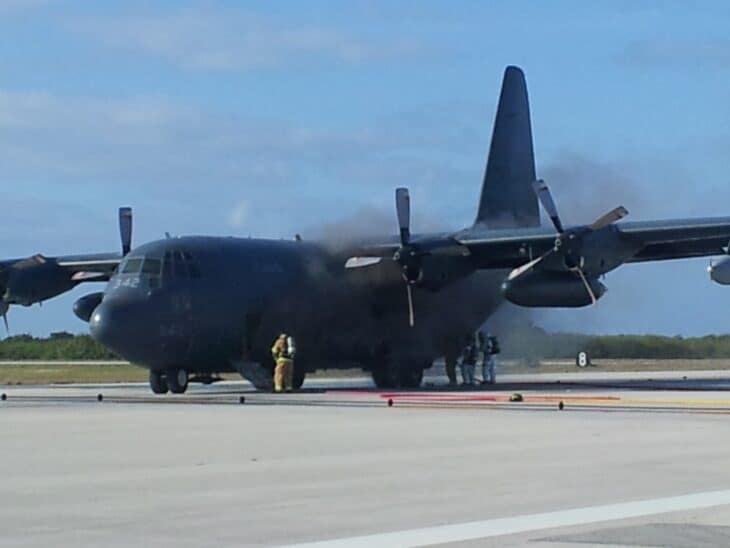
According to the account in Canadian Warplanes, which quotes the investigation, a modification that added ground test connections to the auxiliary hydraulic system left a wire and a pressurized hydraulic hose chafing against each other. Arcing pierced the hose, and high-pressure fluid ignited. The aircraft was written off as a Category A loss.
The Government of Canada says the Royal Canadian Air Force retired 12 CC-130H aircraft in January 2026, and named the CC-295 Kingfisher as the replacement fleet. Skies Magazine reported that the CC-130J would take on other roles. The C-295 is a smaller twin-engine transport.
On August 7, 2026, Canada announced that it had conditionally sold 10 of the 12 to Coulson Aviation of Port Alberni, British Columbia. The other two are to be displayed at bases and museums. The price is confidential.
The sale depends on contractual arrangements and on Transport Canada approvals for civil use. Coulson says it will convert the aircraft into airtankers with its RADS-XXL retardant system, which carries up to 4,000 US gallons of water or retardant, and that it is doubling its C-130H fleet from 10 to 20 aircraft.
Air Data News reported that each conversion takes about 20,000 labor hours and that the first aircraft could be ready for the 2027 wildfire season, with only one or two finished at first. As of those August 2026 announcements the sale was still conditional and no conversion was finished, and we found no later update when this page was written in October 2026.
Wildfire work is new for this airframe but not for the Hercules family: Congress authorized the Modular Airborne FireFighting System, a roll-on firefighting tank for C-130s, in the early 1970s. Our guide to firefighting airplanes covers the aircraft that fight fires today.
Not as a type. The Royal Canadian Air Force retired its CC-130H fleet in January 2026, but Coulson Aviation already operates C-130H airtankers and says its Canadian purchase doubles that fleet from 10 to 20 aircraft.
Search and rescue was its main job in recent years, according to the RCAF. It also flew tactical transport and, in the CC-130H(T) version, air-to-air refueling for CF-18 fighters.
The Government of Canada names the CC-295 Kingfisher as the replacement fleet. Skies Magazine reported that the CC-130J Hercules would take over other roles.
There is no difference in the basic aircraft. CC-130H is the Canadian Forces designation for the C-130H, and five of Canada’s aircraft were refitted as tankers in the early 1990s.
The government’s release says the sale keeps the aircraft serving Canadians and strengthens private-sector firefighting capacity. Coulson Aviation plans to convert them into airtankers at its own expense.
Yes. In 1963 a U.S. Navy pilot flew a borrowed Marine Corps KC-130F tanker onto USS Forrestal for 21 full-stop landings and 21 takeoffs, without a tailhook or catapult. The Navy chose the smaller C-2 Greyhound instead. Our article on the C-130 carrier landing has the full story.
No. The AC-130 is an armed gunship conversion of the Hercules. In Canadian service the CC-130H was a rescue, transport and tanker aircraft.
Sources and references used for research and fact-checking.
_(2).jpg)
_(cn_382-5175)_Canadian_Armed_Forces._(6950476374).jpg)
.jpg)