


Table of Contents
The test worked. The Navy said no anyway, and the reason it gave in 1963 shaped every carrier cargo plane it has bought since.
Beginning on October 30, 1963, Navy Lieutenant James H. Flatley III flew a borrowed Marine Corps KC-130F onto the deck of USS Forrestal and back off it again. He made 29 touch-and-go landings, 21 full-stop landings and 21 takeoffs, with no tailhook to stop the airplane and no catapult to launch it.
It remains the largest and heaviest aircraft ever landed on an aircraft carrier. The Navy chose the far smaller Grumman C-2 Greyhound for the job instead, and flew it for 60 years.
Greyhounds made their last carrier landing on June 25, 2026. Their job now belongs to an aircraft that does not need the runway at all.
The Navy’s cargo plane could not carry a jet engine
In the early 1960s, carriers resupplied at sea through a system called carrier onboard delivery, or COD. The aircraft doing it was the Grumman C-1 Trader, a twin piston-engine transport with a range of about 300 miles (480 km).
That was not enough for carriers now operating as far away as the Indian Ocean. The Trader also could not carry an oversize load like a General Electric J79 jet engine, which is exactly the kind of part a deployed air wing cannot wait weeks for.
,_circa_in_1963.jpg)
So the Chief of Naval Operations ordered a feasibility test of a “Super COD,” a much bigger transport. The C-130 Hercules was picked for its stability, its long range and its payload.
The Marines lent the Navy a nearly new KC-130F tanker, Bureau Number 149798, delivered on October 8, 1963. Lockheed changed very little: a smaller nose-gear orifice, a better anti-skid braking system, and the underwing refueling pods removed.
Flatley was a fighter pilot. His reaction to the assignment, as he later told it, was “Operate a C-130 off an aircraft carrier? Somebody’s got to be kidding.”

Flatley later disputed the cargo framing, saying the real purpose was supporting Lockheed’s U-2 spy plane, which the CIA began trying to operate from carriers in 1963. The official record still calls it a Super COD trial, and that is the question the Navy answered.
267 feet to stop, 15 feet from the island
The first trials ran about 500 miles (800 km) off Boston in moderately rough North Atlantic seas, into a 40-knot wind. Flatley flew with Lieutenant Commander W.W. Stovall as copilot, and Lockheed test pilot Ted Limmer rode along for some of the early landings.
They tested gross weights from 85,000 pounds (38,600 kg) up to 121,000 pounds (54,900 kg). At the lighter weight, the Hercules stopped in 267 feet (81 m), roughly twice its own wingspan.
At the maximum weight it needed 460 feet (140 m) to land and 745 feet (227 m) to take off. On a typical cycle it touched down about 150 feet from the end of the deck, stopped, and took off again from where it sat, with a couple of hundred feet to spare.
The margin that mattered was sideways. The Hercules has a 132-foot (40 m) wing, and it rolled down a specially painted line that kept its starboard wingtip just under 15 feet (4.6 m) from the carrier’s island.
Look Ma, No Hook
Those four words were painted on the side of the fuselage for the trials. Lockheed’s chief engineer, watching from the bridge, recalled the airplane stopping right opposite the captain, to cheering and laughter.

The program took four days at sea and earned Flatley the Distinguished Flying Cross. The Navy’s analysis concluded that a C-130 could carry 25,000 pounds (11,300 kg) of freight 2,500 miles (4,020 km) and land it on a carrier.
That was roughly eight times the range of the Trader it would have replaced. The Navy still decided it was not practical.
A carrier cannot stop being a warship to unload a truck
What the test required was the problem. For the Hercules to land, Forrestal‘s arresting wires were removed and the flight deck was emptied, with the carrier’s air wing either flown ashore or parked below on the hangar deck.
Operationally, that meant every delivery would clear the deck of combat aircraft. As one pilot put it, “A carrier with no tactical aircraft on deck makes a skipper antsy.”
That constraint is built into every ship on any list of the best aircraft carriers in the world. The flight deck is the weapon, and anything that shuts it down costs more than the cargo is worth.

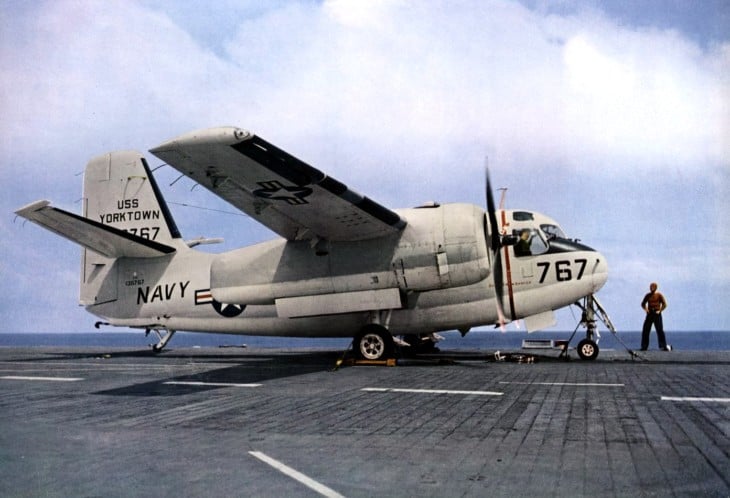
The Greyhound solved it by fitting in. Developed from the E-2 Hawkeye radar plane, it shared that aircraft’s engines and folding wings, used the same wires and catapults as the air wing, and could be stowed with everything else.
It first flew on November 18, 1964, and entered service in 1966. Grumman built 17 of the original C-2As, then 39 new “Reprocured” C-2As under a 1984 contract, the last delivered in 1990.

The Navy’s own tally of those 60 years: more than 250,000 arrested landings, 500,000 flight hours, 100 million pounds (45 million kg) of cargo and 2.5 million passengers. Its load was up to 10,000 pounds (4,500 kg), less than half of what the Navy’s analysis said the Hercules could bring.
Then the 1963 problem came back in a new shape. The Greyhound could not carry the power module of the F-35C’s F135 engine, the same kind of oversize engine load that had sent the Navy looking at a C-130 in the first place.
The Greyhound’s job now belongs to a tiltrotor
The Navy’s answer was the CMV-22B, its version of the V-22 Osprey, chosen in part because its cargo bay takes that F135 power module. One made the first at-sea delivery of the part to USS Carl Vinson on February 11, 2021.
On paper it carries a 6,000-pound (2,700 kg) internal payload about 1,150 nautical miles. It can refuel in the air, which the Greyhound could not, and it lands vertically, so it needs neither wires nor catapult.

The transition was not smooth. Ospreys were grounded worldwide for about three months after a US Air Force CV-22B crashed off Japan in November 2023, and Navy Ospreys then flew under limits tied to divert airfields that the Navy only began lifting in January 2026.
The Greyhounds covered the gap. On June 25, 2026, two of them from squadron VRC-40 made the type’s last arrested landing and catapult launch, aboard USS Nimitz during an Atlantic fleet exercise.
On July 28, 2026, the final Greyhound flight landed at Naval Air Station Pensacola, and the aircraft went to the National Naval Aviation Museum. That same day, the Marine Corps accepted its last MV-22B Osprey in Amarillo, Texas.
The Navy now expects to buy up to 53 CMV-22Bs. The Greyhound it retired will share the Pensacola museum with KC-130F 149798, which flew in on March 1, 2005, after more than four decades of Marine Corps service.
So the airplane that proved a carrier could take a Hercules and the airplane the Navy chose instead now belong to the same museum. Their replacement settles the question neither of them could: it brings the engine without shutting the deck.
Sources and references used for research and fact-checking.
- Code One Magazine (Lockheed Martin), C-130 Carrier Landing Trials
- The Aviationist, Look Ma, No Hook: how a C-130 Hercules managed to land on an aircraft carrier
- Naval Historical Foundation, Landing a Cargo Plane on a Postage Stamp
- Defense Media Network, C-130 Carrier Landing
- National Naval Aviation Museum, Museum's Historic C-130 Hercules Gets a Facelift
- Wikipedia, Lockheed C-130 Hercules
- Wikipedia, Lockheed U-2
- Wikipedia, Grumman C-2 Greyhound
- DVIDS (US Department of Defense), VRC-40 Holds Sundown Ceremony, Closing the Final Chapter of the C-2A Greyhound Era
- The War Zone, The C-2 Greyhound Has Made Its Last Landing Aboard A Carrier
- Army Recognition, US Navy's C-2A Greyhound completes last-ever aircraft carrier landing after 60 years of logistics operations
- The Aviationist, C-2 Greyhound Flies for the Last Time
- Naval News, US Navy CMV-22B Delivers F135 Engine to a CVN for the First Time
- DVIDS (US Department of Defense), Strengthening Global Reach for Decades to Come, U.S. Marine Corps Receives Final MV-22B Osprey
Get the Newsletter
The latest aviation news and stories sent to your inbox.
About the Author

Tim is the owner and lead editor of AeroCorner since 2019, overseeing aviation content covering aircraft, airlines, airports, and the broader aviation industry. Through years of researching, writing, editing, and publishing aviation-focused content, he has developed extensive practical knowledge of commercial aviation and air travel. Based in Asia and a frequent traveler himself, Tim also brings firsthand passenger experience to AeroCorner’s coverage. Outside of publishing, he has also explored aviation firsthand through hands-on flight training in New Zealand.