

Table of Contents
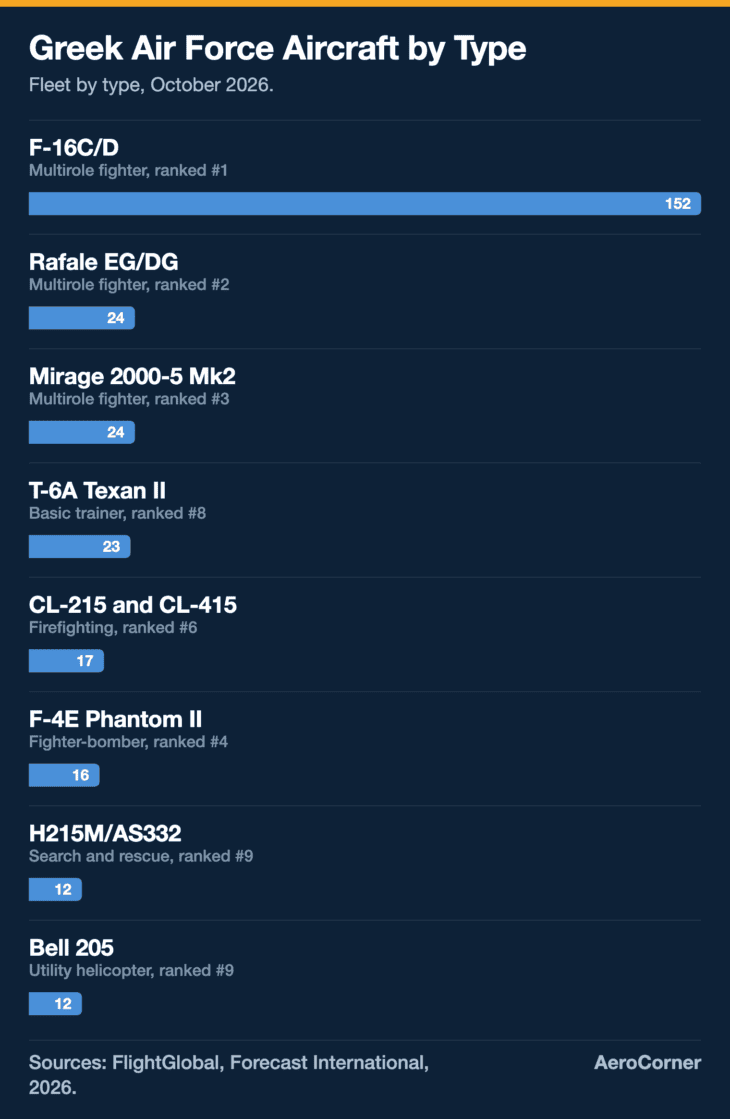
The Greek Air Force, officially the Hellenic Air Force, is built around the F-16. FlightGlobal’s World Air Forces 2026 directory counts 152 of them, 113 single-seat F-16Cs and 39 two-seat F-16Ds, and 83 are being rebuilt to the newest F-16V Viper standard.
Behind them sit 24 Rafales, 24 Mirage 2000-5s and one of the world’s last F-4 Phantom squadrons. That adds up to about 216 fighters, with 20 F-35As on order and the first due in 2029.
This guide ranks every type Greece flies by how much it matters to the country’s air defense as of October 2026. It then covers what is on order, why the Air Force flies the nation’s firefighting planes, and how a force founded in 1912 got here.
| Rank | Aircraft | Role | Fleet | Status |
|---|---|---|---|---|
| 1 | F-16C/D Fighting Falcon | Multirole fighter | 113 C, 39 D | 83 becoming F-16V Vipers |
| 2 | Dassault Rafale EG/DG | Multirole fighter | 24 | In service |
| 3 | Mirage 2000-5 Mk2 | Multirole fighter | 24 | Offered for sale |
| 4 | F-4E Phantom II | Fighter-bomber | 16 | Retiring |
| 5 | EMB-145H Erieye | Airborne early warning | 4 | In service |
| 6 | Canadair CL-215 and CL-415 | Firefighting | 10 CL-215, 7 CL-415 | DHC-515s on order |
| 7 | C-27J Spartan and C-130B/H | Transport | 8 C-27J, 6 C-130 active | C-390s approved |
| 8 | M-346 and T-6A Texan II | Trainers | 10 M-346, 23 T-6A | In service |
| 9 | H215M/AS332 Super Puma and others | Search and rescue, utility | 12 Super Puma, 12 Bell 205, 2 AW109 | In service |
How this ranking works
Aircraft are ranked by their weight in Greece’s air defense in October 2026: fighters first, then the radar planes that direct them, then firefighting, transport, training and helicopters. Fleet counts come from FlightGlobal’s World Air Forces 2026 directory unless a newer source shows a change. FlightGlobal files the 39 two-seat F-16Ds under training, but they are combat-capable, so they are counted with the fighters here. Army and Navy helicopters are left out, and so are aircraft still on order.
1. F-16C/D Fighting Falcon: 152 Jets and a Viper Rebuild
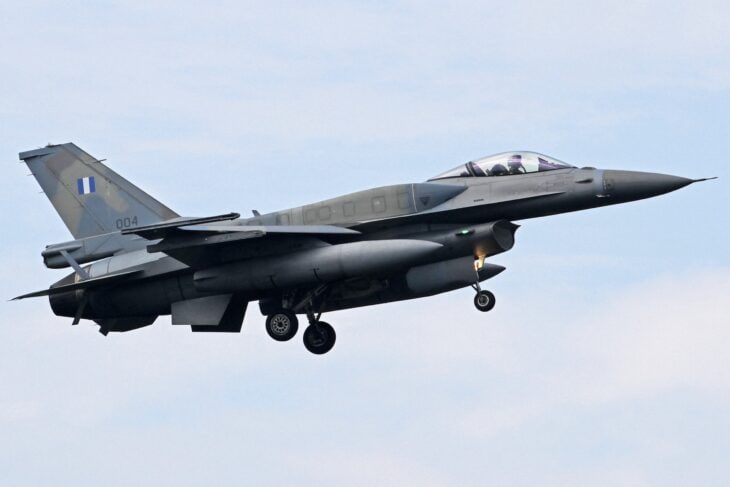
Greece has bought about 170 F-16 Fighting Falcons in four batches called Peace Xenia. The first 40 were Block 30 jets delivered in 1989 and 1990 to replace the F-5, followed by 40 Block 50s in 1997 and 1998.
Then came 60 Block 52+ jets ordered in 2000 and a final 30 delivered in 2009 and 2010. The Block 52+ carries conformal fuel tanks along its spine, which give it the range to reach Cyprus.
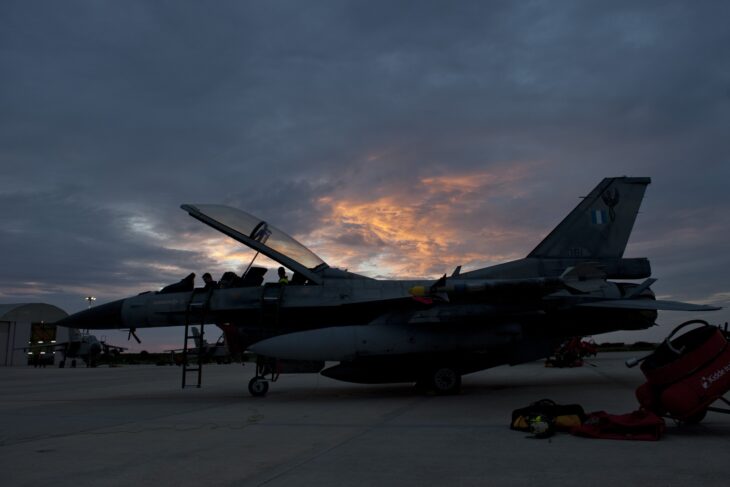

In 2018 Greece contracted Lockheed Martin to bring its newest F-16s up to the Block 70/72 standard, known as the F-16V Viper, with an AESA radar and a new cockpit. Hellenic Aerospace Industry does the work in Greece, and the program now covers 83 Block 52+ and Block 52+ Advanced jets.
As of July 2026, 56 upgraded Vipers had been delivered, and the last are due in 2027. Greece has also asked Washington to upgrade 38 Block 50s for about 1.1 billion euros, which would make 121 Vipers; that request was still awaiting US acceptance at last report.
The oldest Block 30s are not part of the plan. In March 2024 Defense Minister Nikos Dendias said older F-16s would be sold off.
2. Dassault Rafale: 24 Jets in Four Years
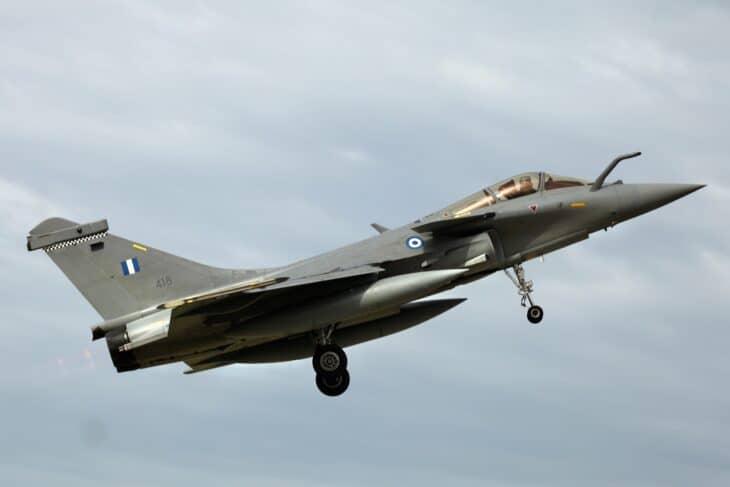

Greece ordered the Dassault Rafale in a January 2021 deal worth 2.5 billion euros for 18 jets. Twelve were taken from French Air Force service and six were new.
The first arrived in July 2021, and a March 2022 contract added six more new aircraft. The 24th and last landed at Tanagra on January 9, 2025, completing the fleet of 18 single-seat EGs and 6 two-seat DGs.
All of them fly with 332 Squadron of the 114 Combat Wing at Tanagra, north of Athens, where they replaced older Mirage 2000s. Our guide to the French Air Force covers the home fleet the first 12 came from.
3. Mirage 2000-5 Mk2: Upgraded, Then Put Up for Sale
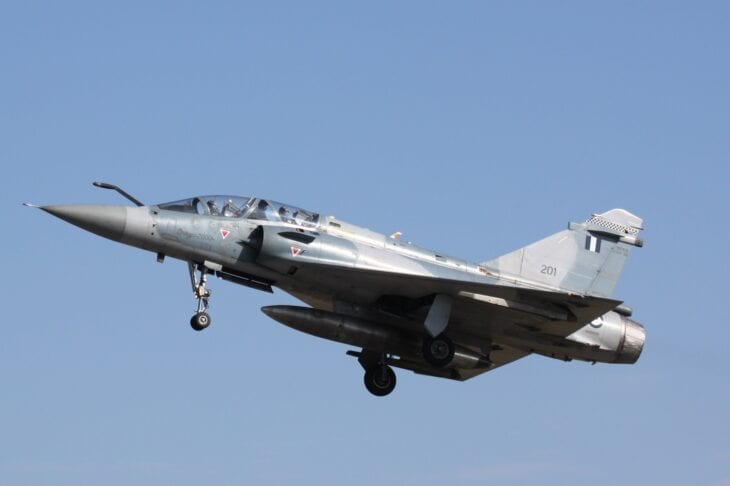

In 2004 Greece decided to bring its Mirage 2000s up to the Mirage 2000-5 Mk2 standard and buy 15 new ones. FlightGlobal counts 24 in service today, also based at Tanagra.
Their future is short. Older Mirage 2000s went back to Dassault in 2023 as part of the Rafale deal, and in June 2025 Greece formally offered 15 Mirage 2000-5s to India during a visit by the Indian Air Force chief.
The Indian Air Force was cautious, citing the jets’ age and their differences from its own Mirage 2000H fleet. Greece’s support contract with Dassault for the type runs until 2027.
4. F-4E Phantom II: One of the World’s Last Phantom Squadrons
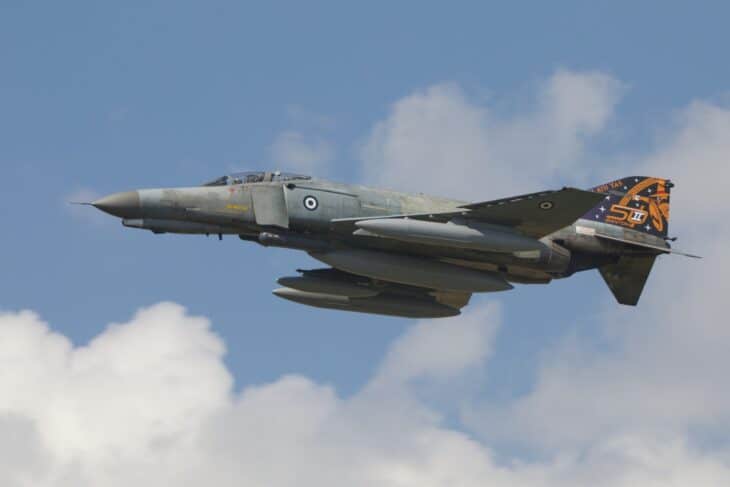

The F-4E Phantom II entered Greek service in 1974. Greece ordered 56 F-4Es and 6 RF-4E reconnaissance jets, then added secondhand US and German airframes until it flew 121 Phantoms in 1993.
In August 1997 the German firm DASA won a contract to modernize the fleet, a program called Peace Icarus 2000. It gave 38 jets the APG-65 radar, a new head-up display and GPS navigation, and Hellenic Aerospace Industry upgraded 37 of them at Tanagra.
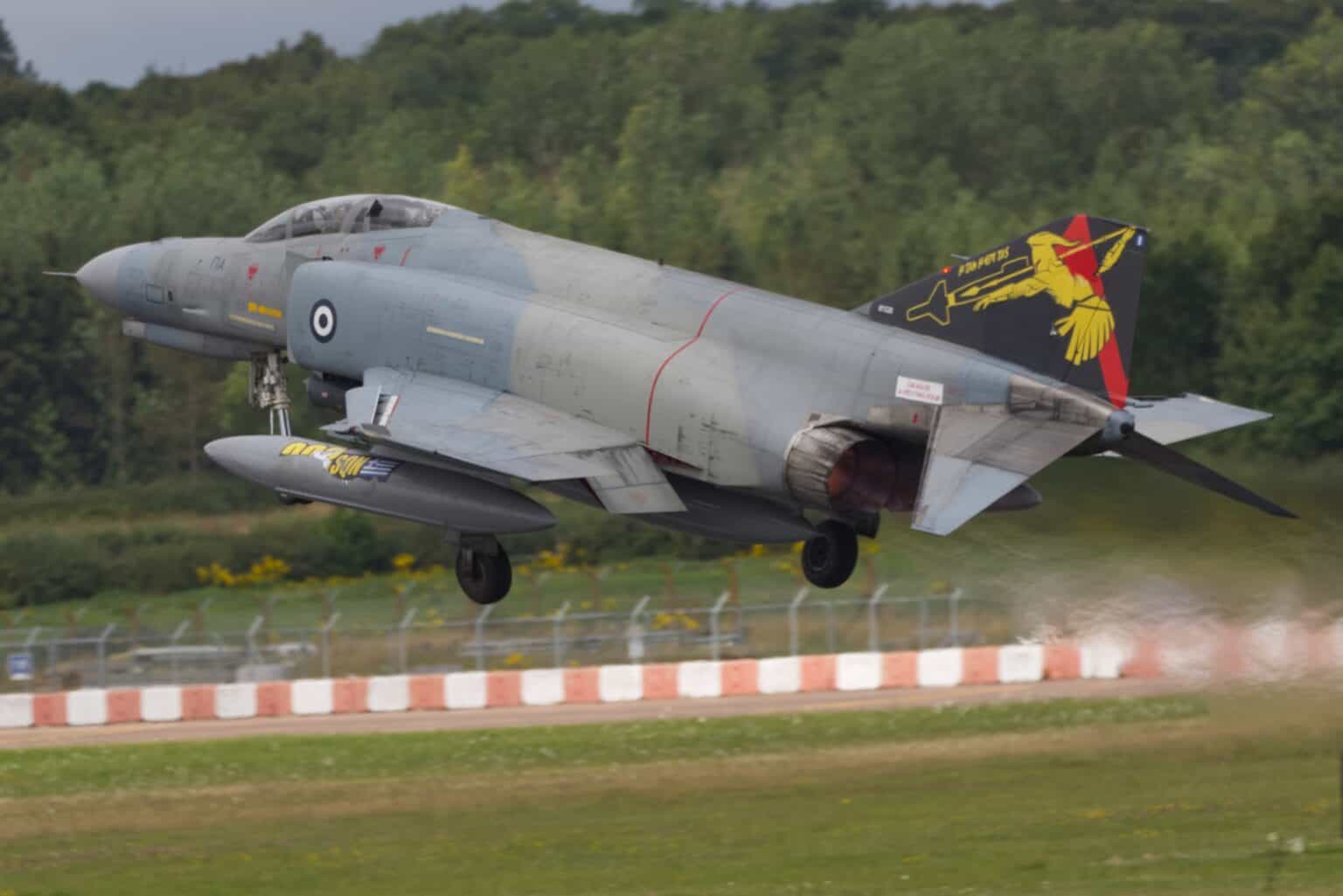
Dendias announced the Phantom’s retirement in March 2024, but no final date has been set. FlightGlobal counted 17 in its 2026 directory, all with 338 Squadron of the 117 Combat Wing at Andravida.
That fell to 16 on September 5, 2026, when a Greek F-4 crashed during its display at Athens Flying Week near Tanagra, killing both pilots. The cause is under investigation by an Air Force board of inquiry.
A 1958 design still on the front line
The F-4 first flew in 1958. Greece, Turkey and Iran are the last three air forces still flying it, and the Greek jets wear an all-gray Aegean Ghost camouflage applied after the Peace Icarus 2000 upgrade.
Our look at the air forces still flying the F-4 in 2026 compares the Greek fleet with the Turkish and Iranian ones.
5. EMB-145H Erieye: Four Radar Planes Over the Aegean
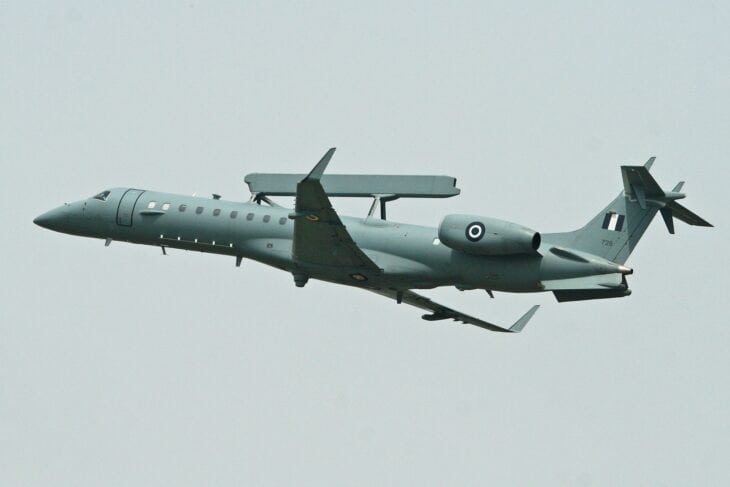

Greece’s airborne early warning comes from four Embraer EMB-145H jets carrying Saab’s Erieye radar in a long beam on the fuselage. They are the Greek version of the Embraer R-99 flown by Brazil.
The four fly from Elefsina, near Athens, home of the 112 Combat Wing, and entered operational service there in February 2009. They watch the airspace over the Aegean and direct the fighters ranked above them.
Embraer supports them under a follow-on agreement that also covers an ERJ-135LR VIP jet. Saab has offered its larger GlobalEye as a replacement, but Greece has not ordered one.
6. Canadair CL-215 and CL-415: The Air Force Fights Greece’s Wildfires
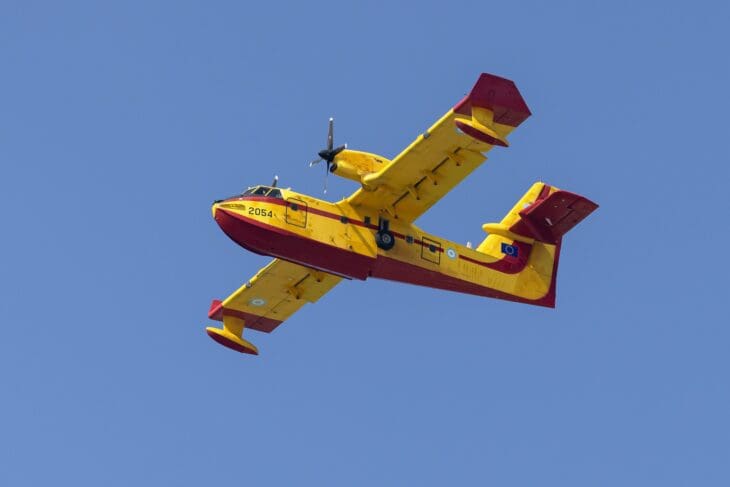

In Greece, the water bombers belong to the Air Force, not a civil agency. Its crews fly 17 Canadair amphibians: 10 piston-engine CL-215s and 7 turboprop CL-415s, which scoop seawater and drop it on fires.
In March 2024 Greece signed for seven new DHC-515s, the updated version of the CL-415, for about 361 million euros. Two of them are paid for by the EU’s rescEU reserve, so Greece can lend them to other member states.
Deliveries are scheduled from 2027 to 2030. Until then, the piston-engine CL-215s keep flying every summer fire season.
7. C-27J Spartan and C-130 Hercules: A Transport Fleet in Transition
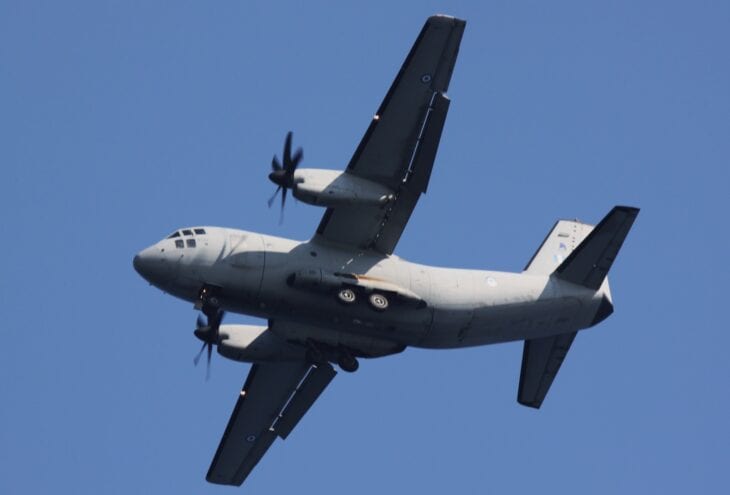

Greece flies 8 C-27J Spartans, an Italian twin-turboprop; it ordered 12, and the last four were cancelled. Heavier loads go in the C-130 Hercules, of which about 15 C-130B and C-130H models remain on the books and FlightGlobal counts 6 as active.
Their replacement has been chosen. On July 23, 2026, Greece’s national security council approved about 600 million euros for three Embraer C-390 Millennium airlifters, with an option for three more.
The deal goes through Portugal, letting Greece take over three production slots Portugal had reserved, so the aircraft arrive sooner than a new order would allow. Embraer had not announced Greece as a customer at last report. A small VIP flight, including a Gulfstream V and the ERJ-135, carries the government.
8. M-346 and T-6A Texan II: Training at Kalamata
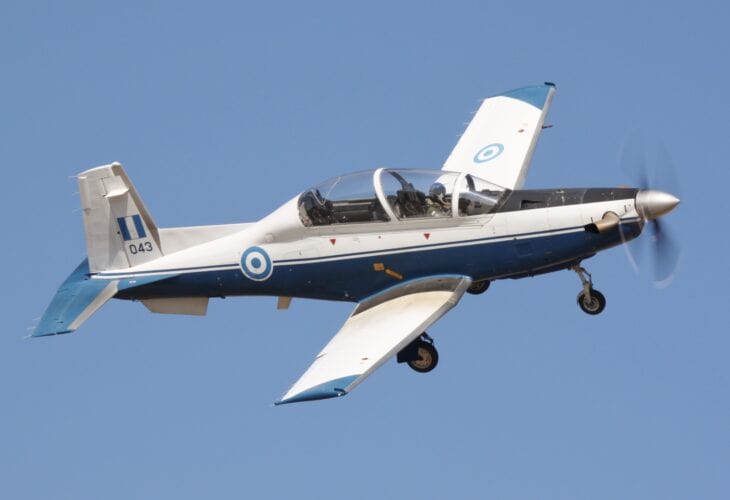

Greek fighter pilots now train at the International Flight Training Center at Kalamata, set up with Israel’s Elbit Systems under a roughly 20-year deal signed in May 2021. It flies 10 Italian M-346 Master jet trainers, which replaced the T-2 Buckeye.
The first two M-346s arrived on May 11, 2023. Students start on the T-6A Texan II turboprop, of which FlightGlobal counts 23.
9. Super Puma and Utility Helicopters
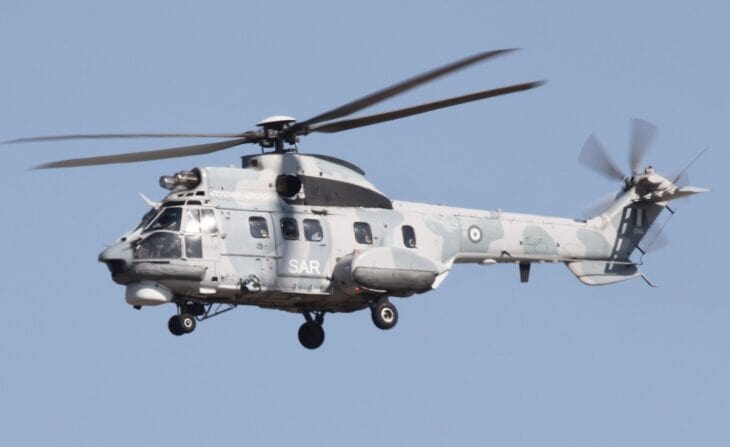

The Air Force’s own helicopters are mostly rescuers. FlightGlobal lists 12 H215M and AS332 Super Puma search and rescue helicopters, 12 Bell 205s and 2 AW109s.
The attack and heavy-lift helicopters, including 28 AH-64 Apaches and 25 CH-47 Chinooks, belong to Hellenic Army Aviation. The Navy flies 14 MH-60R Seahawks from its frigates.
What Greece Has on Order: F-35s Arrive in 2029
Greece signed for 20 F-35A Lightning IIs on July 25, 2024, for an estimated 3.47 billion euros, with an option for 20 more after 2030. The original plan delivered four in 2028 and the other 16 by 2033.
That has slipped. In May 2026 Air Force chief Lt. Gen. Demosthenes Grigoriadis said the first Greek F-35s are expected in 2029.
They will go to the 117 Combat Wing at Andravida, the Phantom base, which is due for an overhaul estimated at about 230 million euros. Greek reports say the jets will carry the AIM-260 missile, still in development in the United States.
Why does Greece fly three fighter types from three eras?
Because each generation was bought before the one before it was retired. Athens has now announced that the Phantoms, the older F-16s and the Mirage 2000-5s will go, leaving a fleet of F-16 Vipers, Rafales and F-35s. Until the F-35 arrives, Greece is keeping 1970s jets flying beside 2020s ones.
Where the Greek Air Force Is Based
The fighter wings are spread across the mainland and Crete. F-16s fly from Nea Anchialos (111 Combat Wing), Larissa, Souda on Crete and Araxos; Rafales and Mirages from Tanagra (114 Combat Wing); and the Phantoms from Andravida (117 Combat Wing).
The radar planes sit at Elefsina (112 Combat Wing) and the training center at Kalamata. Headquarters, the General Air Staff, is at Papagou Camp in Athens.
A Short History: From 1912 to “Always Dominate the Heights”
Greek military aviation began on May 13, 1912, when Lt. Dimitrios Kamberos made the country’s first military flight. Army and Navy air services grew up separately until 1930, when the creation of an Aviation Ministry merged them into a third armed service.
It was the Royal Hellenic Air Force from 1935 to 1973. Its motto, Αἰὲν Ὑψικρατεῖν, translates as “Always Dominate the Heights,” and it marks its anniversary on November 8, the feast of its patron saints, the Archangels Michael and Gabriel.
Before the F-16 and Mirage, it flew a long line of American jets: the F-104 Starfighter and F-5 until the 1980s and the A-7 Corsair II until 2011. The RF-4E reconnaissance Phantom retired on May 5, 2017.
How Strong Is the Greek Air Force?
By numbers, it is a large air force: about 216 fighters, most of them F-16s, with four radar planes to direct them. Its weakness is age, with Phantoms from the 1970s and Mirages it is trying to sell still on the books.
Its long-running rival is Turkey’s air force, also an F-16 force with its own Phantoms. Once 83 Vipers, 24 Rafales and the first F-35s are in service, Greece will field a fleet that can stand comparison with the best air forces in the world at its size.
FAQ
Sources and references used for research and fact-checking.
- FlightGlobal, World Air Forces 2026 directory
- Wikipedia, Hellenic Air Force
- Wikipedia, McDonnell Douglas F-4 Phantom II non-U.S. operators
- AeroCorner, A Greek F-4 Phantom Crashed at an Air Show, Killing Both Pilots
- Aviation News, Greece F-4E Phantom Crashes During Athens Flying Week Display at Tanagra Air Base
- Vintage Aviation News, Greek F-4 Phantoms return to airshows
- To Vima, Greece Advances Fighter Jet and Frigate Modernization Plans
- Global Aviation Resource, F-16 at 40, Part 3: The F-16 in Hellenic Air Force service
- The Defense Post, Greece receives final Rafale
- iefimerida, Rafale order completed with delivery of 24th aircraft at Tanagra air base
- SSBCrack, IAF Holds Talks with Greece on Acquisition of Mirage-2000-5 Fighter Jets
- iefimerida, Greece Secures F-35 Fighter Jets
- Greek City Times, Hellenic Air Force chief reveals timeline for Greece's first F-35 fighter jets
- Greek City Times, Greek F-35 Fighters to Be Armed With New AIM-260 Missiles
- Forecast International, Orders Ramp Up for New DHC-515
- Air Data News, Greece approves purchase of three Embraer C-390 aircraft
- Defence Talk, Erieye officially introduced in Greece
- Air Data News, Embraer closes agreement with Hellenic Air Force to support its ERJ-135LR and ERJ-145 AEW&C aircraft
- The Aviationist, First M-346 Trainers Delivered To Greece
- The Defense Post, Greece receives training jets from Elbit
Get the Newsletter
The latest aviation news and stories sent to your inbox.
About the Author

Tim is the owner and lead editor of AeroCorner since 2019, overseeing aviation content covering aircraft, airlines, airports, and the broader aviation industry. Through years of researching, writing, editing, and publishing aviation-focused content, he has developed extensive practical knowledge of commercial aviation and air travel. Based in Asia and a frequent traveler himself, Tim also brings firsthand passenger experience to AeroCorner’s coverage. Outside of publishing, he has also explored aviation firsthand through hands-on flight training in New Zealand.