

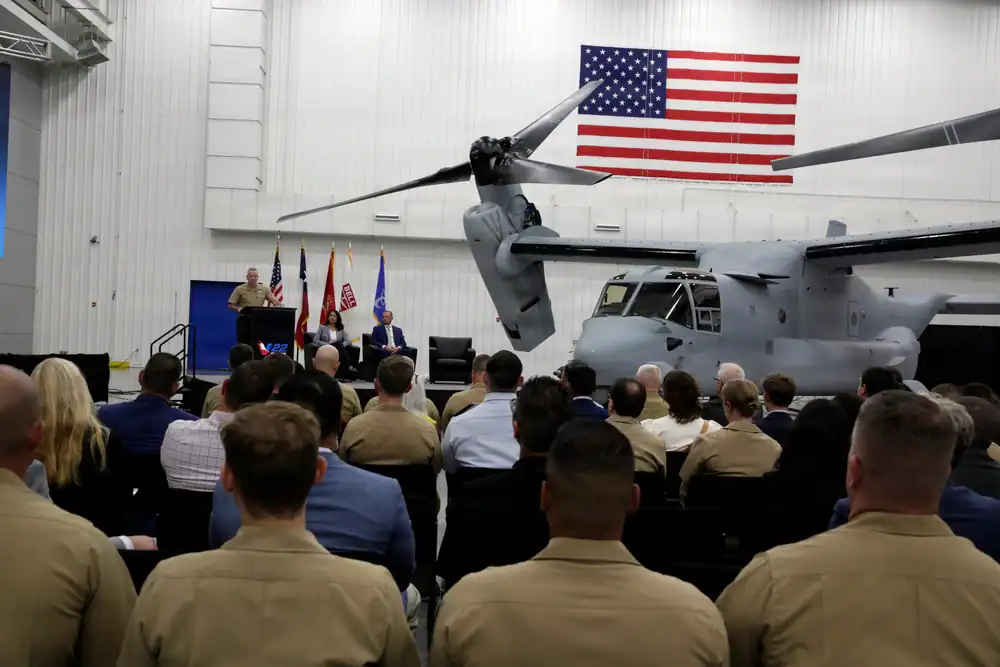
On July 28, 2026, the US Marine Corps accepted its final MV-22B Osprey at Bell’s assembly plant in Amarillo, Texas. The aircraft was the 359th of its kind, closing out a Marine Corps program of record that began nearly two decades ago.
The handover marks the end of Marine Corps procurement of the tiltrotor, not the end of its service. The Marine Corps says it intends to fly and upgrade the Osprey fleet through 2055.
What was delivered, and to whom
The final V-22 Osprey is going to Marine Medium Tiltrotor Squadron 162, part of the 2nd Marine Aircraft Wing at Marine Corps Air Station New River, North Carolina. The Osprey is built jointly by Bell and Boeing, with final assembly in Amarillo.
The Marine Corps declared initial operational capability for the MV-22B in June 2007, so the program spanned nearly 20 years from first squadron to final aircraft. According to the Marine Corps, the Osprey now equips 16 active-duty squadrons and 2 reserve squadrons and accounts for roughly 75 percent of the service’s rotary-wing capability.
Across the fleet, Marine Ospreys have logged more than 686,500 flight hours over 114 deployments. Deputy Commandant for Aviation Lieutenant General William Swan acknowledged the aircraft’s difficult path, saying there were moments when its future was genuinely in doubt.
Why “program of record complete” is not “retired”
A program of record is the total quantity of an aircraft a service has committed to buy. Reaching the last one means procurement is finished, not that the type is leaving service. In the Osprey’s case, the Marine Corps plans decades more of flying.
The Amarillo line is not going dark either. Bell and Boeing continue to build the CMV-22B variant for the US Navy, which uses it for carrier resupply, and they support a nacelle upgrade program for the Air Force’s CV-22 special-operations fleet.
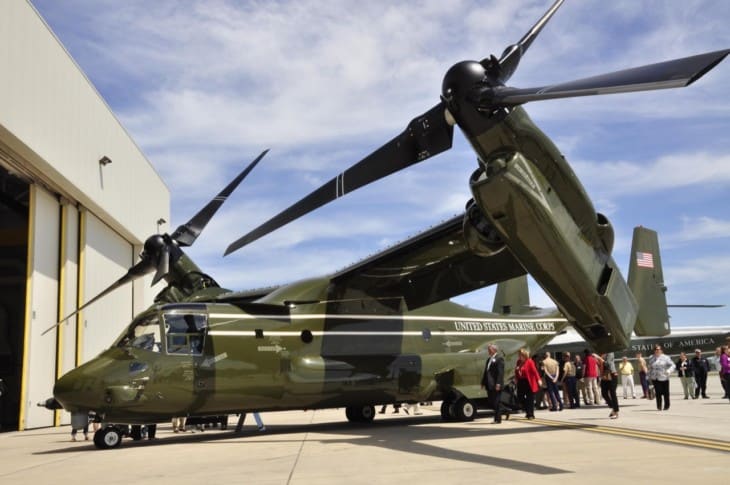
The Osprey is a tiltrotor, which is what makes it unusual. It takes off and lands vertically like a helicopter, then rotates its wingtip engine nacelles forward to cruise like a turboprop airplane. That combination lets it fly faster and farther than a conventional helicopter while still operating from ships and unprepared sites.


A milestone shadowed by a hard safety record
The final delivery arrives after several difficult years. According to DefenseScoop, 20 military personnel have been killed in V-22 crashes since 2022, including eight Air Force airmen in a CV-22 crash off Yakushima, Japan, in late 2023 and five Marines in a 2022 MV-22 crash.
Several of those losses were linked to a proprotor gearbox failure known as hard clutch engagement. The military grounded the V-22 fleet in December 2023 and returned it to flight in 2024 under restrictions, including flight-hour limits meant to reduce the risk of the failure recurring.
The Marine Corps says its sustainment plan includes a redesigned proprotor gearbox introduced in 2025 and a new input quill assembly aimed at resolving the clutch problem. It has not disclosed the exact flight-hour thresholds, citing security concerns.
Reality check
Completing the program of record is a procurement milestone, not a retirement. The Marine Corps plans to fly the MV-22B until 2055, and the fleet still operates under risk-mitigation restrictions tied to the gearbox issue while upgrades are fielded.
Sources and references used for research and fact-checking.
Get the Newsletter
The latest aviation news and stories sent to your inbox.
About the Author

Tim is the owner and lead editor of AeroCorner since 2019, overseeing aviation content covering aircraft, airlines, airports, and the broader aviation industry. Through years of researching, writing, editing, and publishing aviation-focused content, he has developed extensive practical knowledge of commercial aviation and air travel. Based in Asia and a frequent traveler himself, Tim also brings firsthand passenger experience to AeroCorner’s coverage. Outside of publishing, he has also explored aviation firsthand through hands-on flight training in New Zealand.