Military Transport Planes
Brazil's jet-powered tactical airlifter, built to replace the C-130 Hercules
Updated: by Tim de Vries

The latest aviation news and stories sent to your inbox.
The Embraer KC-390 Millennium is a twin-engine jet transport built in Brazil to carry troops, vehicles, pallets and air-dropped cargo, and to refuel other aircraft in flight. It first flew in 2015, entered Brazilian Air Force service in 2019 and is now flown by Portugal, Hungary, the Czech Republic and Uzbekistan as well. Embraer sells it abroad as the C-390 Millennium.
Live Fleet Activity (KC39)
Fetching live data…


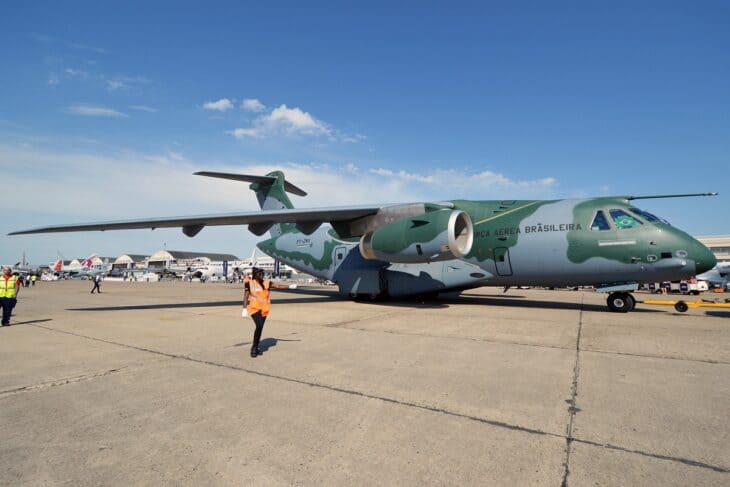
The Embraer KC-390 is a medium-size, twin-engine military transport built in Brazil. Embraer sells it abroad as the C-390 Millennium, a name it announced at the Dubai Airshow in November 2019.
It carries troops, vehicles, pallets and air-dropped loads through a rear ramp, and the KC-390 version can also refuel other aircraft in flight. The designation changed from C-390 to KC-390 in early 2011.
Yes, the KC-390 is a military aircraft. Its basic platform was certified by Brazil’s civil authority to FAA Part 25 standards, and a separate military certification covers the mission systems on top of that.
Embraer’s first studies in the mid-2000s paired the wing and engines of its E190 jetliner with a cabin converted into a cargo hold. The idea was dropped, partly because the E190 wing had too little surface area for the job.
In April 2009 the Brazilian Air Force awarded Embraer a $1.5 billion contract for two prototypes. The design that emerged was all new in its fuselage, wing, flight deck and engines, and it was meant to succeed the air force’s C-130 fleet.
The first prototype rolled out on October 21, 2014 and made its maiden flight on February 3, 2015. Embraer announced a two-year delay that July, blaming the weak Brazilian real and government spending cuts.
Brazilian civil type certification followed on October 23, 2018, and the first production aircraft was delivered to the Brazilian Air Force on September 4, 2019. Final type certification and full operational capability arrived at the end of March 2023.
A planned joint venture with Boeing to market the aircraft was announced in November 2019. Boeing terminated it in April 2020.
Most tactical airlifters of this size, including the Hercules, use turboprops. Embraer chose two IAE V2500-E5 turbofans instead, and Wikipedia notes it was the first military use of that engine family.
Embraer’s reasoning, as Wikipedia reports it, was that a jet engine tolerates dust ingestion better than propeller tips close to the ground can. The engines sit high and forward on the wing for the same reason, and Embraer lists wide-chord metallic fan blades and a Part 33 certified engine.

The payoff is speed. Embraer lists a maximum cruise speed of 470 kt (541 mph, 870 km/h), or Mach 0.80.
In one of its own planning scenarios, Embraer says six aircraft could deliver 500 metric tons of cargo and 1,000 passengers in under two days. It puts that at 40 percent faster than a typical tactical turboprop airlifter.
The cockpit is fly-by-wire with active sidesticks and an autothrottle, built around Rockwell Collins Pro Line Fusion avionics. Two head-up displays and an enhanced vision system with four cameras help the crew of three: two pilots and a loadmaster.
Embraer says the KC-390 can operate from the worst semi-prepared and damaged runways defined by the U.S. standard MIL-B-8866B. It can also make 10 passes on a soft airfield rated CBR 4, which is loose fine sand or soft clay.
Normally it can work from a 4,000 ft semi-prepared soft strip carrying 12 metric tons of cargo over 500 nm. Low-pressure tires and brake-by-wire, wheel-by-wheel braking help it do so.

Brazil has put that to work. In 2022 a Brazilian Air Force C-390 dropped supplies to the Comandante Ferraz Antarctic Station, and Embraer says the type has operated from unpaved ice and snow runways in Antarctica.
The cargo hold is 60 ft 8 in (18.50 m) long, 11 ft 4 in (3.45 m) wide and 9 ft 8 in (2.95 m) high. The ramp can be leveled with the floor, and the aircraft has a winch and hydraulic stabilizer struts to speed up loading.
Embraer lists 80 soldiers, 66 paratroopers, 74 stretchers, seven 463L pallets, three Humvees, one Black Hawk helicopter or one LAV-25 as example loads. Wikipedia adds that the hold fits two M113 armored personnel carriers, and that loads of up to 42,000 lb can be air-dropped.
The KC-390 tanker carries two Cobham 912E series pods under the wings that pass fuel at up to 400 US gallons per minute. Up to three roll-on, roll-off fuselage tanks of 8,800 lb (4,000 kg) each add to the fuel it can give away.
Embraer says the pods can refuel fighters and helicopters, and a receiver probe on the upper forward fuselage lets the aircraft itself take fuel in flight. In the 2023 Salitre exercise in Chile, a Brazilian KC-390 and six F-5 fighters flew 50 combat missions together.
The full specification table for the aircraft is on this page. Five of its figures have context that a single number cannot carry.
Payload comes in two forms. The panel shows Embraer’s maximum concentrated payload of 57,500 lb (26,000 kg), the kind a single heavy vehicle represents. Embraer prints the same load as 57,320 lb, and the panel rounds it for display.
For a load spread across the floor Embraer’s figure is 23 metric tons (50,706 lb).
Range depends entirely on that payload. Embraer lists 1,470 nm with 23 metric tons, which is the figure in the panel, and 1,080 nm with 26 metric tons.
With 14 metric tons the range stretches to 2,710 nm. The ferry range with no cargo is 3,370 nm, or 4,570 nm with extra fuselage tanks.
Older Embraer material and plenty of websites still print 1,520 nm and a 3,310 nm ferry range. Embraer’s current KC-390 brochure uses the lower payload-range figures above.
The Embraer brochures reviewed for this page do not print an empty weight. The panel’s 77,162 lb (35,000 kg) comes from the specification block on Wikipedia, which cites Aviation Week and Embraer. Maximum takeoff weight is 192,000 lb (87,000 kg).
Takeoff and landing distances are blank in the panel because published figures use different definitions. Embraer gives a critical field length of 5,000 ft (1,524 m) at sea level with 23 metric tons over a 500 nm mission, and 3,820 ft (1,165 m) with 16 metric tons.
Its normal landing distance at sea level with 26 metric tons is 3,280 ft (1,000 m). Embraer gives a reference approach speed (Vref) of 116 kt with 25,000 lb of useful load.
The fuel row in the panel shows 23,900 kg of Jet A, which matches Embraer’s figure of 23.9 metric tons of usable fuel in the wing tanks.
As of September 2026, Wikipedia’s orders list counts 62 orders and 16 deliveries. The Brazilian Air Force flies eight, with Portugal, Hungary, the Czech Republic and Uzbekistan also operating the type.
Brazil ordered 28 in 2014 and cut that to 22 and then 19 in 2022. The first Czech aircraft arrived in July 2026, and Uzbekistan took its first in September 2026.
The Netherlands, Austria, Sweden and South Korea have orders in the pipeline. So do the United Arab Emirates, which signed in May 2026 for 10 aircraft with options for 10 more, Greece (three aircraft) and Colombia (two).
Slovakia and Lithuania are in negotiations. Wikipedia describes Morocco as having tested one and selected the type to replace its C-130s.
The type has also flown for Brazil abroad. In February 2021 it joined U.S. Air Force C-17 and C-130 airlifters in a night paratroop drop of 4,000 troops in Louisiana, and in 2022 it flew a repatriation mission for Brazilians and others while delivering humanitarian aid for Ukraine.
Wikipedia lists the Lockheed Martin C-130J Super Hercules, the Airbus A400M and the Kawasaki C-2 as similar aircraft. Embraer calls its pitch against the turboprop Hercules the jet advantage: more payload, delivered faster.
It is a tactical airlifter, a class below strategic haulers such as the C-17 Globemaster III, and Wikipedia says Embraer markets it as a jet-powered alternative to the C-130. The FAQ below puts the two against each other.
Embraer is pitching the aircraft for India’s Medium Transport Aircraft program. On October 1, 2026 it and Mahindra named Nagpur as the site of a possible final assembly line, but only if the Indian Air Force picks the type.
In the United States, Embraer is marketing what it calls an Agile Tanker version for the Next Generation Air Refueling System. It has also announced talks with Northrop Grumman, under a memorandum to explore an autonomous refueling boom. These are pitches rather than orders.
Embraer and the Brazilian Air Force are also studying a C-390 IVR maritime patrol and anti-submarine version, announced in December 2024.
The C-390 is a twin-jet and the C-130J is a four-engine turboprop, so the C-390 is much faster. Embraer lists 470 kt at Mach 0.80, while the Air Force lists 362 kt (417 mph) for the C-130J.
Embraer’s maximum concentrated payload is 57,500 lb (26,000 kg), against a maximum allowable payload of 42,000 lb (19,090 kg) for the C-130J. Compare the full figures on the C-130J page, because both aircraft’s range figures change with payload.
Yes. It is a military transport and tanker built for air forces, and every operator in service is one. It is certified to civil Part 25 standards as a base, with military certification added for its mission systems.
As of September 2026, Brazil, Portugal, Hungary, the Czech Republic and Uzbekistan operate it. The Netherlands, Austria, Sweden, South Korea, the United Arab Emirates, Greece and Colombia have placed orders, according to Wikipedia’s orders list.
Embraer lists 80 soldiers, 66 paratroopers or 74 stretchers as example loads. The aircraft is flown by a crew of three: two pilots and a loadmaster.
Teal Group’s 2016 estimate was about $50 million, the figure in the panel header, with a range that ran slightly higher. Wikipedia reports a price of around 80 million euros as of 2024, and neither figure is an official flyaway price from Embraer.
Yes. Embraer says it can operate from the worst semi-prepared and damaged runways defined by MIL-B-8866B, and the Brazilian Air Force has flown it to Antarctica.
Two IAE V2500-E5 turbofans, each producing 31,330 lbf (139 kN) of takeoff thrust. Wikipedia says this was the first military use of that engine family.
Sources and references used for research and fact-checking.