
Military Trainers
Alenia Aermacchi M-346
ICAO: M346
The turboprop that trains pilots and flies light attack for more than a dozen air forces.
Updated: by Tim de Vries
The latest aviation news and stories sent to your inbox.
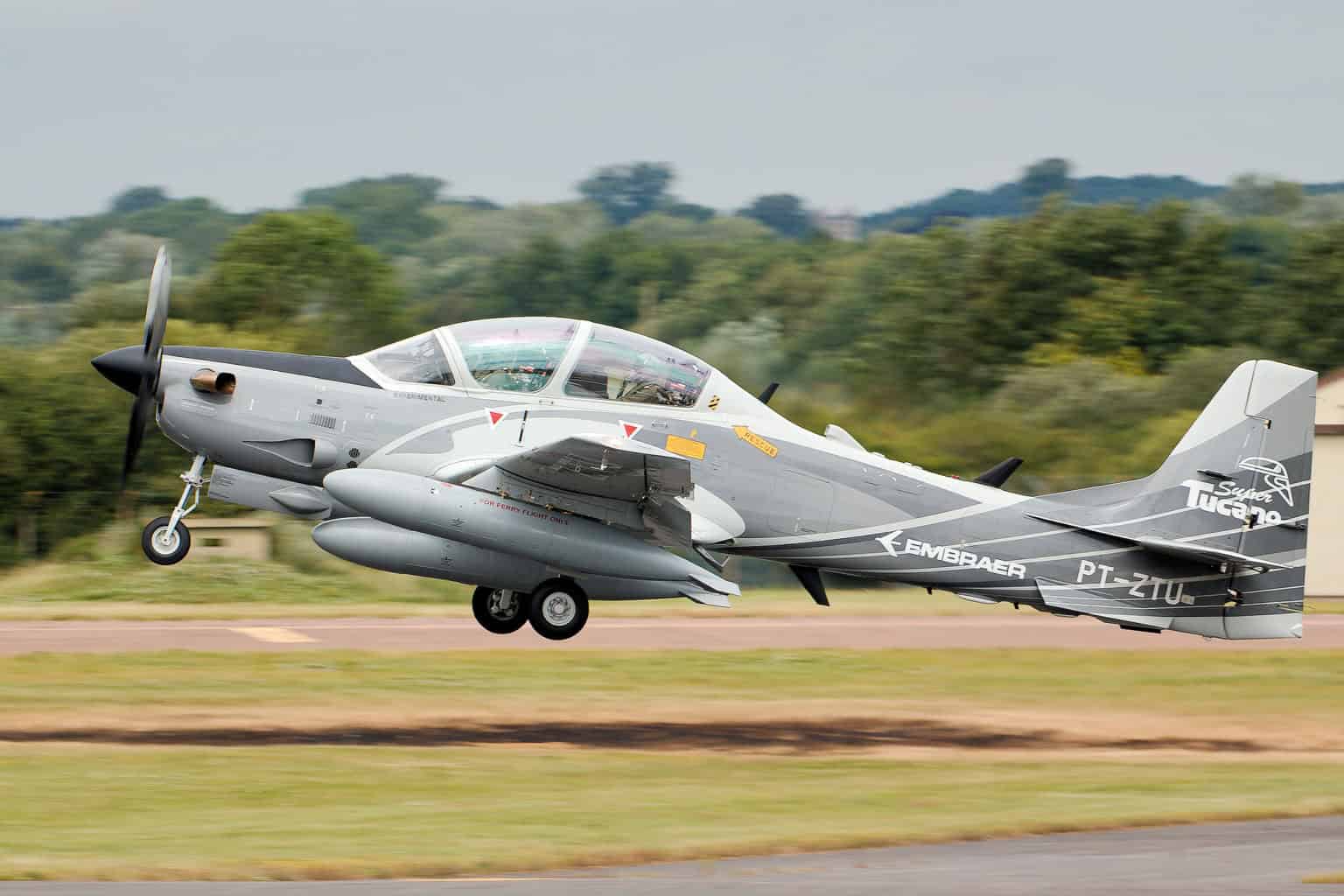
The Embraer Super Tucano is a single-engine turboprop that does two jobs: it trains pilots and it fights light wars. Brazil built it as the A-29, a tandem two-seater with ejection seats, internal machine guns and five weapon stations. More than 290 have been ordered, and it is the aircraft air forces reach for when a jet is too expensive to risk against insurgents.
Live Fleet Activity (E314)
Fetching live data…


The Embraer Super Tucano, designated EMB 314 by the maker and A-29 by most air forces, is a single-engine turboprop that trains pilots and fights light wars. It seats two in tandem and carries guns, rockets and guided bombs on five weapon stations.
It is built in Brazil, powered by a Pratt & Whitney Canada PT6A-68C turboprop, and flown by air forces that need an armed aircraft that costs far less to buy and run than a jet. Embraer reported more than 290 orders in December 2024.
Embraer is a Brazilian company and is not related to Bombardier, which is Canadian.
The Super Tucano grew out of the EMB 312 Tucano trainer. Brazil wanted a replacement for its EMB 326GB Xavante jet trainers, and a stretched, more powerful Tucano was the answer.
A proof-of-concept prototype flew in September 1991. In August 1995 the Brazilian government awarded Embraer a $50 million contract for the ALX program, and the production-configured aircraft first flew on June 2, 1999.
Brazil ordered 76 aircraft in August 2001, and the first was delivered in December 2003. Brazil ended up with 99, made up of 66 two-seat A-29Bs and 33 single-seat A-29s.
The airframe is built for rough use. It has a fatigue life of 8,000 to 12,000 flight hours, and both crew sit on Martin-Baker Mk 10 zero-zero ejection seats.

Two 12.7 mm (.50 caliber) machine guns are built into the wings, with 200 rounds each. Five hardpoints, two under each wing and one on the fuselage centerline, carry everything else.
The external options are broad. They include 70 mm rocket pods, Mk 81 and Mk 82 bombs, a 20 mm cannon pod, and laser- and GPS-guided bombs such as the Paveway II and GBU-38. Air-to-air missiles including the AIM-9L and Python can also be fitted, and the AGM-65 Maverick is on the options list.
A forward-looking infrared turret, a laser rangefinder, a head-up display and a helmet-mounted display let the pilot find and mark targets without help. The cockpit is compatible with night vision goggles.

The full specification table for the aircraft is on this page. A few of its figures need context, because the same aircraft gets quoted with very different ranges.
The panel’s range figure is the ferry range, the longest of the published range figures. Without that extra fuel the published range is about 720 nautical miles (1,330 km).
The figure that matters for a mission is the combat range, which Wikipedia lists at 300 nautical miles (550 km) on a hi-lo-hi profile with 1,500 kg of external stores.
Speed is the other thing to read carefully. The panel lists a top speed and a separate, lower cruise speed. Patrol flying happens at the lower figure, and the published endurance is 8 hours 24 minutes.
Colombia flew the Super Tucano’s first combat mission on January 18, 2007, using Mark 82 bombs, and the aircraft went on to take part in several high-profile operations against FARC rebels. Colombia bought 25.
Afghanistan became the highest-profile user. The Afghan Air Force ordered 26 aircraft, with deliveries running from 2016 to late 2020, and on March 22, 2018 it dropped its first laser-guided weapon, a GBU-58 Paveway II, on the Taliban.
In Africa, Nigeria took delivery of 12 in 2021, six in July and six in October.
The Super Tucano has also been used against drug-smuggling flights. Brazil’s air force fired a warning shot at an illegal Cessna in June 2009, the first use of the country’s Shoot-Down Act.

Yes, in small numbers. Air Force Special Operations Command received three A-29s in 2021 and 2022, assembled by Embraer in Jacksonville, Florida, with Sierra Nevada Corporation adding US weapons and sensors.
The US also paid for the type to fly under another flag. The Pentagon bought Super Tucanos for Afghanistan through a $427 million contract with Sierra Nevada and Embraer.
The path to that deal was bumpy. The US Air Force selected the Super Tucano for its Light Air Support program in 2011, canceled the contract in 2012 after a rival bidder’s appeal, and awarded it again in 2013. In 2017 it was one of two aircraft kept in the service’s Light Attack Experiment.
When the Taliban took Afghanistan in August 2021, some Afghan pilots flew their A-29s out. One crashed in Uzbekistan, and both pilots ejected. Reports say at least one aircraft was captured at Mazar-i-Sharif airport.
A US congressional release in March 2022 said the A-29 was in use by 15 air forces. The list includes Brazil, with 99 aircraft, Colombia, Chile, Ecuador, Indonesia, Nigeria, Lebanon, the Philippines and the Dominican Republic.
New customers keep arriving. Portugal ordered 12 of the NATO-oriented A-29N in December 2024, and Paraguay and Uruguay both signed in 2024.
Brazil is also upgrading its own fleet. A November 2024 contract covers 68 aircraft brought up to A-29M standard, with a data link, a digital head-up display, a helmet-mounted display and a laser rangefinder.

In November 2025 Embraer announced a concept that turns the A-29 into a counter-drone aircraft. It uses laser-guided rockets and the wing guns, with datalinks cueing the pilot toward drone tracks and an electro-optical sensor handling identification and laser designation.
Embraer says the concept relies mostly on sensors and weapons already on the aircraft, so operators can add it without a major refit. In March 2026 it also announced a partnership with the US company Valkyrie Aero on counter-drone work.
That has put the Super Tucano in the Ukraine conversation. In September 2026 Ukrainian politician Petro Poroshenko said he was working on a purchase of 24 aircraft, with a NATO country possibly acting as an intermediary.
As of October 2026 that is a proposal, not a deal. No contract has been made public, Embraer has not confirmed a sale, and Brazil has not authorized military supplies to Ukraine and requires its approval for any re-export. An earlier report of a 12-aircraft deal collapsed in March 2022.
People often compare the Super Tucano with the Soviet-designed Su-25 Frogfoot and the A-10 Warthog, but they are different classes. Both of those are twin-engine jets built to fight armored forces under heavy fire.
The Super Tucano is built for a different fight, against insurgents and drones with little air defense. Its advantage is cost and endurance, and its limit is survivability against modern missiles.
Embraer’s other military program is the KC-390 airlifter, a very different aircraft from the same maker.
Two 12.7 mm machine guns in the wings, plus five hardpoints for rockets, bombs, a 20 mm cannon pod and guided weapons such as the Paveway II and GBU-38. It can also carry air-to-air missiles like the AIM-9L.
No. Embraer is a Brazilian aerospace company that builds the Super Tucano and the E-Jet airliners. Bombardier is a separate Canadian company.
The page header shows a flyaway cost of $18 million (2018). Real prices vary with the weapons, sensors and support package, and contract totals usually include training and spares, so dividing a contract by the aircraft count overstates the cost of the airframe itself.
Yes, but only a few. Air Force Special Operations Command received three A-29s in 2021 and 2022, and the US also bought the aircraft for the Afghan Air Force.
The panel on this page gives a top speed of 320 kt · 368 mph · 593 km/h. In normal use it flies slower, trading speed for long loiter time over a target.
The Taliban captured at least one A-29 at Mazar-i-Sharif airport in August 2021, according to reports. Whether any Afghan Super Tucano has flown for the Taliban is not established in the sources reviewed.
Yes. Embraer reported a firm order for six more in December 2024 with deliveries scheduled for 2026.
Sources and references used for research and fact-checking.