

Table of Contents
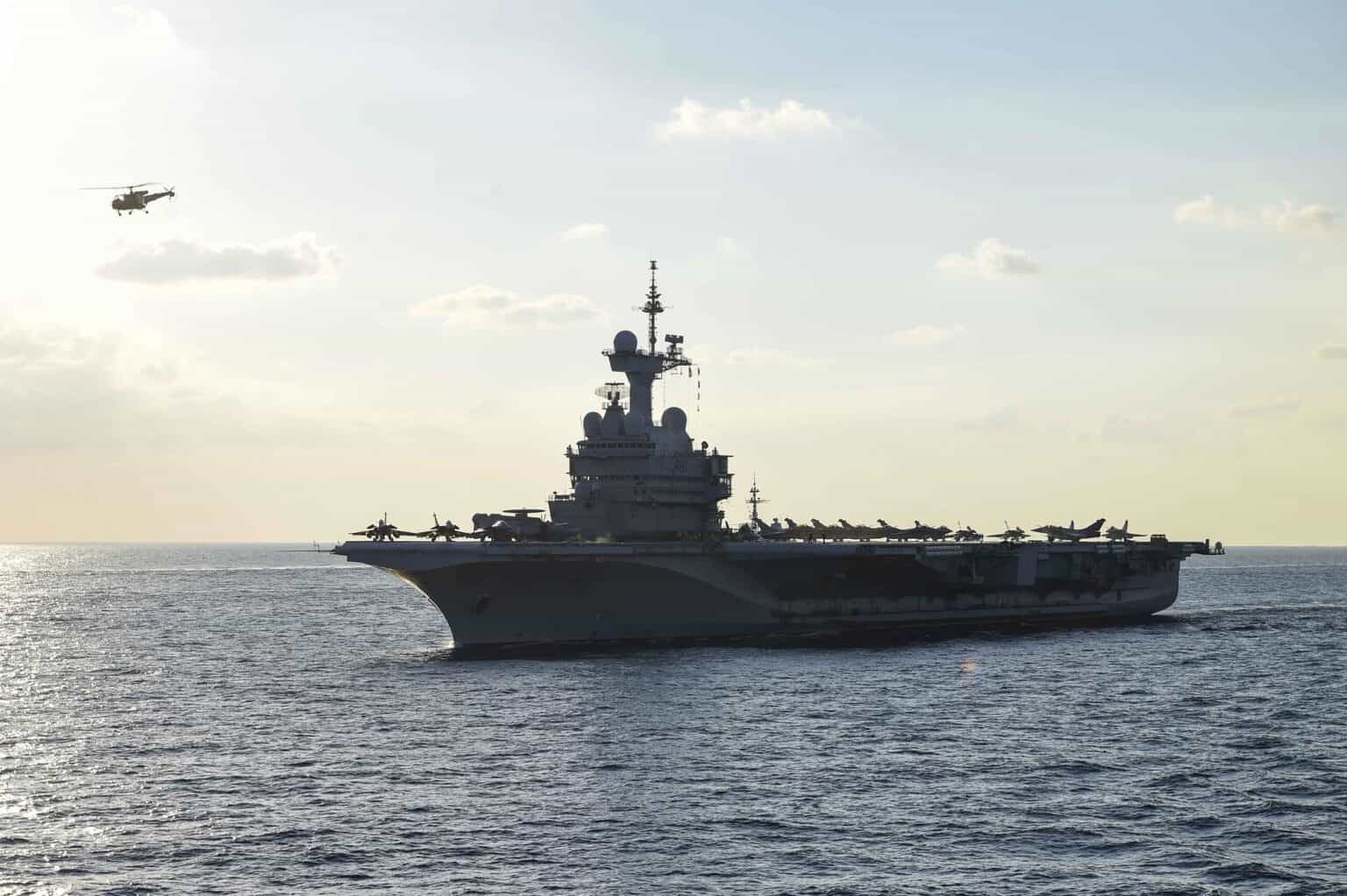
France has one aircraft carrier, the nuclear-powered Charles de Gaulle (R91), as of November 2026. It also runs three Mistral-class amphibious helicopter carriers, which is why some rankings credit France with four.
The one that counts is about to leave. The Charles de Gaulle’s last major refit is scheduled to start in April 2027, and France will have no carrier at all until it comes back.
How Many Aircraft Carriers Does France Have?
One. The Charles de Gaulle was commissioned on May 18, 2001, and is the French Navy’s flagship. It is the only nuclear-powered carrier ever completed outside the US Navy.
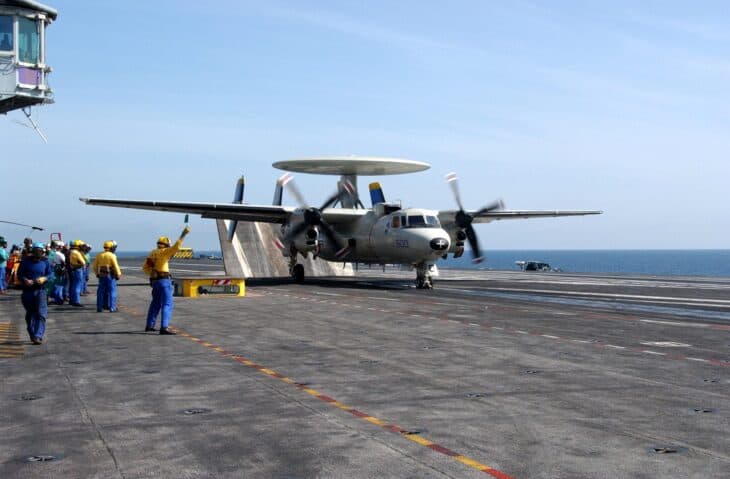
It is also a true catapult carrier. Two 246-foot (75 m) steam catapults launch Dassault Rafale M fighters and E-2C Hawkeye radar planes, and arresting wires catch them on the way back.

The count at a glance
One aircraft carrier in commission as of November 2026: Charles de Gaulle (R91). Three Mistral-class helicopter carriers: Mistral, Tonnerre and Dixmude. None in reserve and none under construction. One replacement planned, France Libre, due around 2038.
France’s Carriers, Ship by Ship
Whether France has one carrier or four depends on what you count as a carrier. Here is every flat-decked ship it has, and the one it is planning.
| Type of ship | Number | Which ships |
|---|---|---|
| Aircraft carriers in commission | 1 | Charles de Gaulle (R91), commissioned May 18, 2001 |
| Amphibious helicopter carriers | 3 | Mistral (2006), Tonnerre (2007), Dixmude (2012) |
| Carriers in reserve | 0 | Foch went to Brazil in 2000 |
| Carriers under construction | 0 | France Libre’s hull is not due to start until about 2031 to 2032 |
| Total, aircraft carriers only | 1 | |
| Total, helicopter carriers included | 4 |
The three Mistrals are big ships. Each is 653 feet (199 m) long and displaces 21,500 metric tons fully loaded, which makes the class the largest in the French Navy after the carrier.
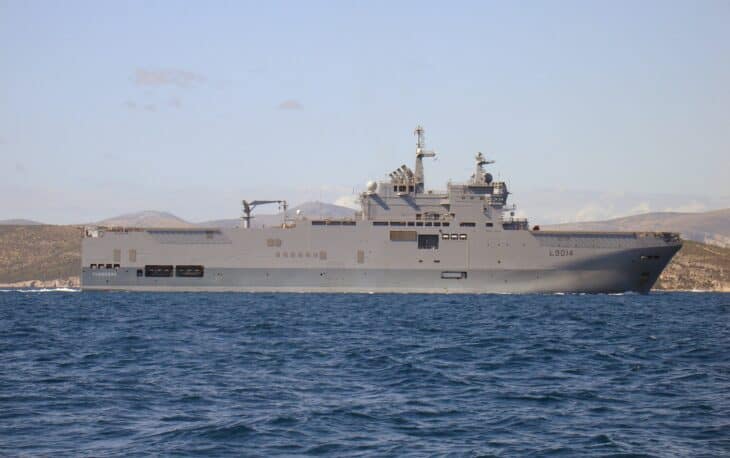

Their hangar holds 16 helicopters, such as the NH90 or the Tiger, and a well deck in the stern holds four landing craft. They are built for helicopters, with no catapults or arresting wires, so France’s Rafale fighters cannot fly from them.
That puts all of France’s carrier aviation on one deck. The air group has three Rafale M squadrons of 15 jets each and one squadron of three E-2C Hawkeyes. In peacetime the ship usually sails with about 30 Rafales out of a 40-aircraft maximum.
Its record is 35 aircraft at once, set during exercises in 2019: 30 Rafale M, two E-2Cs, two Dauphin helicopters and one NH90 Caïman. For how that compares with bigger decks, see how many planes an aircraft carrier holds.
Why the Numbers Differ
You will see France credited with one carrier, and you will see it credited with four. Both are honest counts. They use different definitions.
World Population Review’s 2026 ranking lists France with four carriers: one aircraft carrier and three helicopter carriers. Wikipedia’s list of carriers in service also shows four French ships in commission, because it counts amphibious assault ships with a full-length flight deck.
By the stricter test, a ship that launches and recovers fixed-wing jets, the answer is one. Wikipedia’s list of French carriers says it outright: as of 2026, the Charles de Gaulle is the only French carrier still in service.
The names add to the confusion. France calls the Mistrals “porte-hélicoptères amphibies,” amphibious helicopter carriers, a label it adopted in 2019; before that they were “projection and command ships.” And Dixmude is a reused name: an escort carrier, the former HMS Biter, sailed as Dixmude from 1945.
The fire did not take the carrier out of service
A fire broke out aboard the Charles de Gaulle on Oct. 5, 2026, while it was in maintenance at Toulon. It started in a technical room of no more than 10 square meters near the hangar, nobody was hurt and no impact on the nuclear installations was reported. The ship’s maintenance, under way since late August, was due to finish in early December.
How the Number Got Here
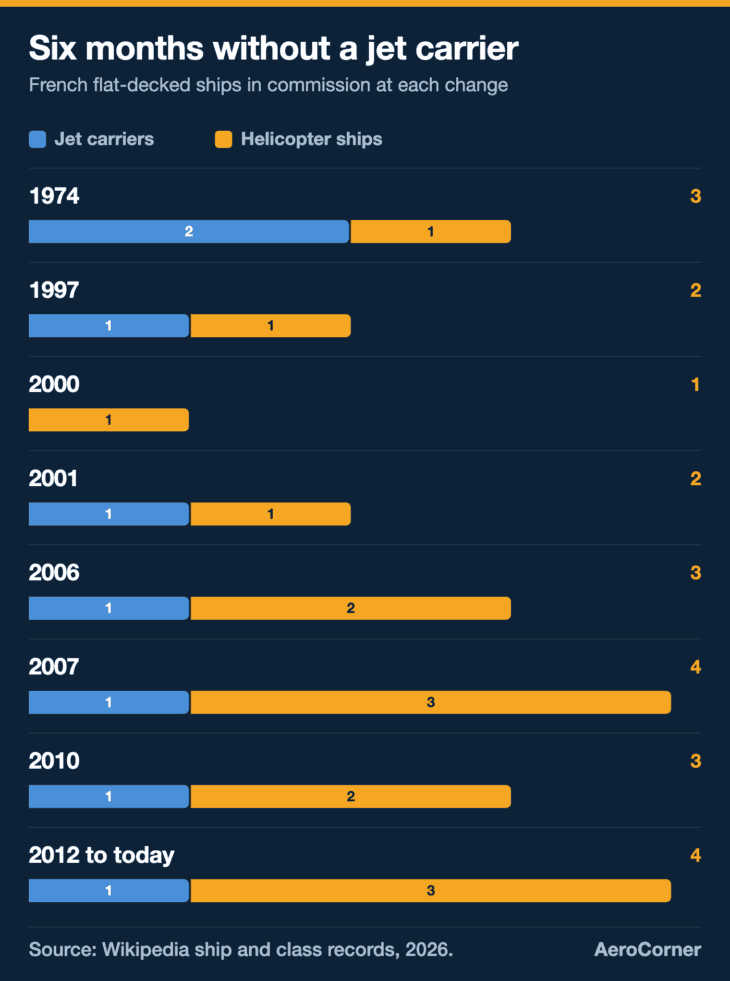
France has been at one carrier, and at zero, before. The table counts its flat-decked ships in commission at each change since 1974, when the British-built Arromanches retired and left the two Clemenceau-class carriers.
| Year | Jet carriers | Helicopter ships | What changed |
|---|---|---|---|
| 1974 | 2 | 1 | Arromanches decommissioned, leaving Clemenceau, Foch and the helicopter cruiser Jeanne d’Arc |
| 1997 | 1 | 1 | Clemenceau decommissioned on Oct. 1 |
| 2000 | 0 | 1 | Foch decommissioned on Nov. 15 and sold to Brazil |
| 2001 | 1 | 1 | Charles de Gaulle commissioned on May 18 |
| 2006 | 1 | 2 | Mistral commissioned |
| 2007 | 1 | 3 | Tonnerre commissioned |
| 2010 | 1 | 2 | Jeanne d’Arc decommissioned |
| 2012 | 1 | 3 | Dixmude commissioned |
France tried to get back to two. The PA2 project began in 2003 to study a second carrier based on Britain’s Queen Elizabeth design. It was suspended in 2009 and canceled in 2013.
The cost of having one shows up every time the ship goes into dock. Its reactors need refueling about every 10 years: the first refit ran 15 months from September 2007, and the midlife overhaul ran 18 months from February 2017 to September 2018.
Where the Number Is Going
Down to zero first. The third and last major refit is scheduled from April 2027 for 18 to 24 months, according to a Nov. 20, 2026 report. It will refuel both reactors and fit a new Thales Sea Fire radar and Setis 3.0 combat system, and the ship then needs about six more months to return to operations.
Then back to one. The replacement, France Libre, was named by President Emmanuel Macron on March 18, 2026. Hull assembly is planned at Chantiers de l’Atlantique in Saint-Nazaire, with commissioning expected in 2038, the year the Charles de Gaulle is due to retire.
France Libre will be nuclear-powered too, with two K22 reactors, three American EMALS electromagnetic catapults, and up to 30 Rafale M F5 fighters and three E-2D Advanced Hawkeyes.
Could France briefly have two? A study is looking at keeping the Charles de Gaulle beyond 2038, possibly to 2040 or later. It is a study, not a decision: its findings are due in early 2029, and the choice belongs to the next military programming law, for 2031 to 2037.
How France Compares
One carrier puts France behind the US Navy’s 11, China’s three and Britain’s two. It matches Russia’s one, which has not been to sea since 2017.
What France has that Britain lacks is catapults and a reactor. As of March 2026, the Charles de Gaulle and China’s Fujian were the only carriers outside the US Navy with catapults, which is why it ranks so high among the best aircraft carriers in the world.
What Britain has that France lacks is a second hull. When a Queen Elizabeth-class ship goes into a yard, its sister keeps sailing. When the Charles de Gaulle does, France has none, and the rest of the French Navy has to work without its flagship.
FAQ
Sources and references used for research and fact-checking.
- Wikipedia, French aircraft carrier Charles de Gaulle
- Wikipedia, List of aircraft carriers of France
- Wikipedia, List of aircraft carriers in service
- World Population Review, Aircraft Carriers by Country 2026
- Wikipedia, Mistral-class landing helicopter dock
- Wikipedia, French ship Dixmude (L9015)
- Wikipedia, Clemenceau-class aircraft carrier
- Wikipedia, French aircraft carrier Foch
- Wikipedia, French cruiser Jeanne d'Arc (R97)
- Wikipedia, French aircraft carrier France Libre
- Militarnyi, Fire breaks out aboard French nuclear aircraft carrier Charles de Gaulle
- AquitaineOnLine, Porte-avions Charles de Gaulle : maintien jusqu'en 2040 et France Libre
Get the Newsletter
The latest aviation news and stories sent to your inbox.
About the Author

Tim is the owner and lead editor of AeroCorner since 2019, overseeing aviation content covering aircraft, airlines, airports, and the broader aviation industry. Through years of researching, writing, editing, and publishing aviation-focused content, he has developed extensive practical knowledge of commercial aviation and air travel. Based in Asia and a frequent traveler himself, Tim also brings firsthand passenger experience to AeroCorner’s coverage. Outside of publishing, he has also explored aviation firsthand through hands-on flight training in New Zealand.