

Table of Contents
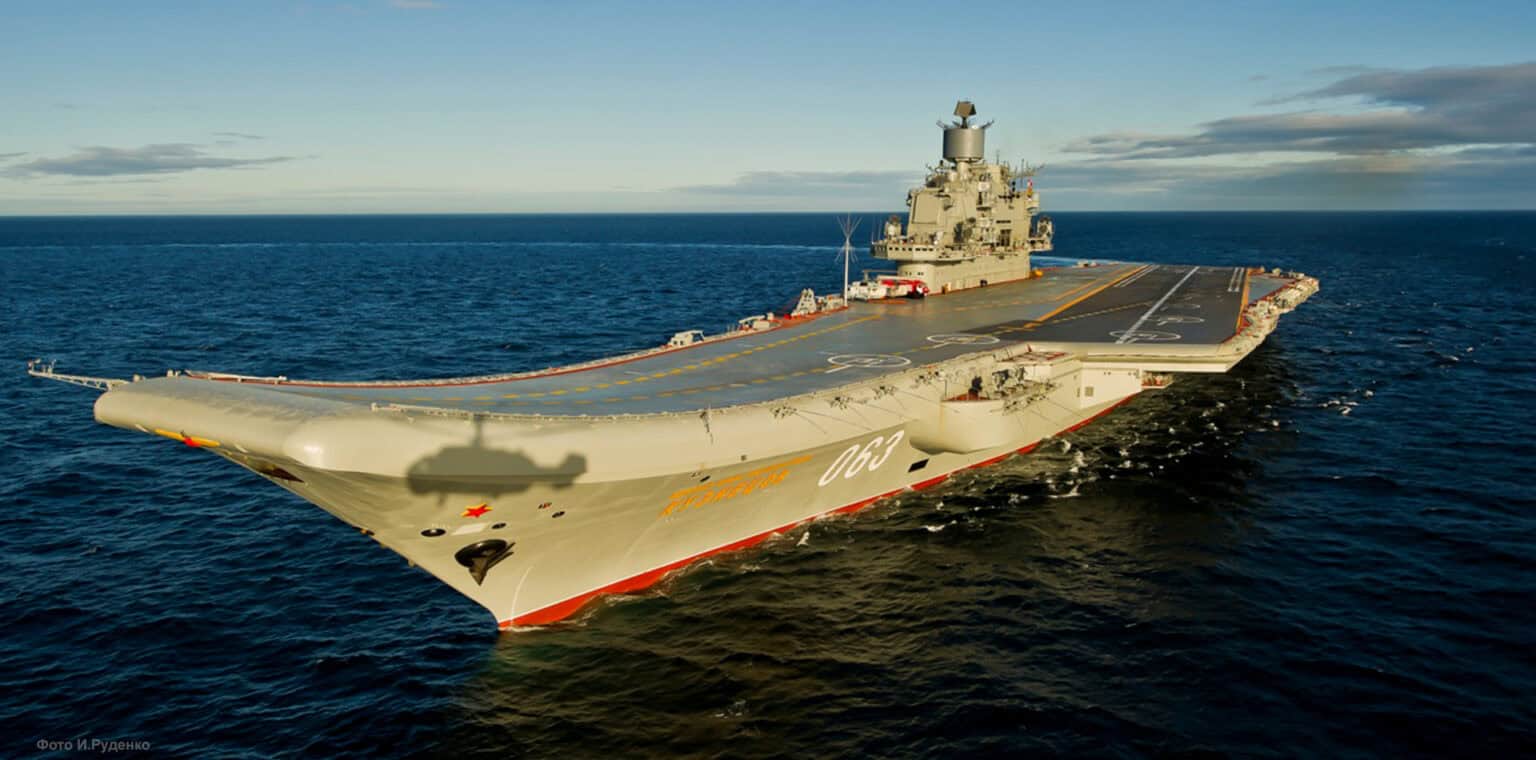
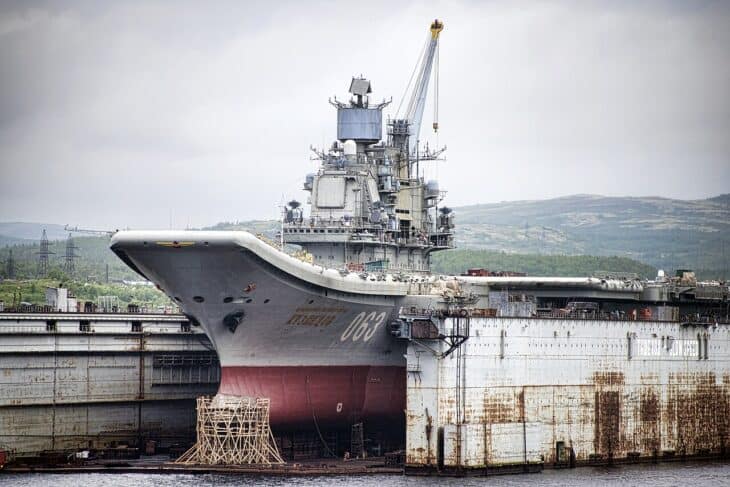
There is a ship at a pier near Murmansk that is just over 1,000 feet (305 m) long and displaces roughly 64,600 tons (58,600 tonnes) fully loaded. It has an upswept bow, an angled landing deck, and arrestor wires. It is, by any ordinary description, an aircraft carrier.
It has no aircraft aboard. Its fighters have been parked at a shore base in the Arctic for years. Its crew has been reduced to the people needed to keep the hull from deteriorating.
The counting question has an easy answer. The interesting part is what happened to the one ship, why Russia spent nearly a decade failing to fix it, and why the answer says more about Russian naval strategy than the number itself does.
How Many Aircraft Carriers Does Russia Have?
One. The Admiral Kuznetsov, commissioned on January 20, 1991, weeks before the Soviet Union that ordered it ceased to exist.
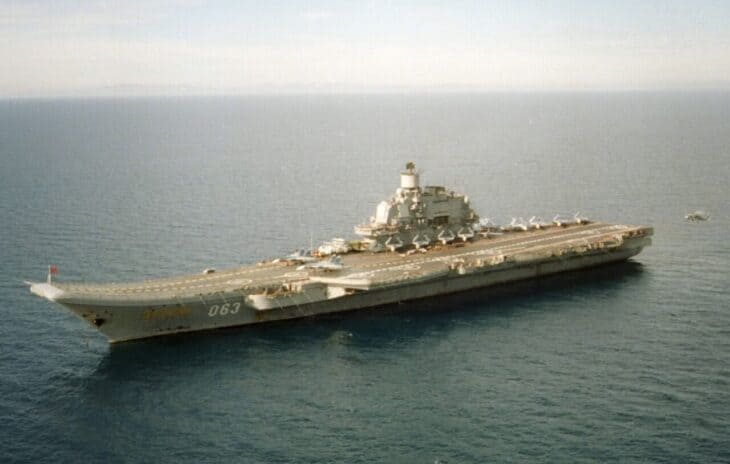
It has not completed an operational deployment since February 2017, when it came home from Syria. It went into the yard that year for a refit, and it is still there. In July 2025 the work was suspended, and as of September 2026 the Russian Navy has not publicly said whether the ship will be finished, sold, mothballed, or cut up.
The short version
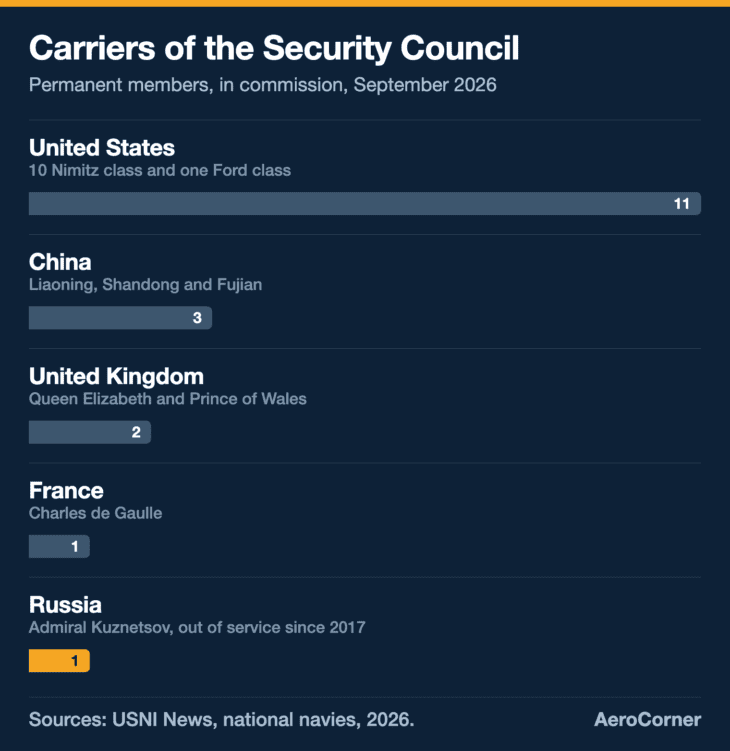
Russia has one aircraft carrier, the Admiral Kuznetsov. It has been out of service since 2017, its refit was suspended in July 2025, and its fate is formally undecided. For comparison, the United States has 11 carriers in commission and China has three.
That is a stark gap for a country with the world’s longest coastline. The US Navy keeps 11 carriers in commission, a floor written into federal law. China commissioned its third, the catapult-equipped Fujian, in November 2025, and now runs a three-carrier fleet that did not exist fifteen years ago.
Russia Never Officially Called It an Aircraft Carrier
In Russian service the Kuznetsov is not a carrier at all. Its official designation is a heavy aircraft-carrying cruiser, and that wording was chosen for a reason that has nothing to do with naval architecture.
The ship was built at Nikolayev, on the Black Sea, in what is now Ukraine. To reach open water it had to pass through the Turkish Straits, and passage there is governed by the 1936 Montreux Convention, which bars aircraft carriers heavier than 15,000 tons from transiting.
A cruiser faces no such tonnage limit. So the Soviet Union called it a cruiser, armed it like one, and sailed it out. No signatory ever formally objected.
The armament that made the label stick
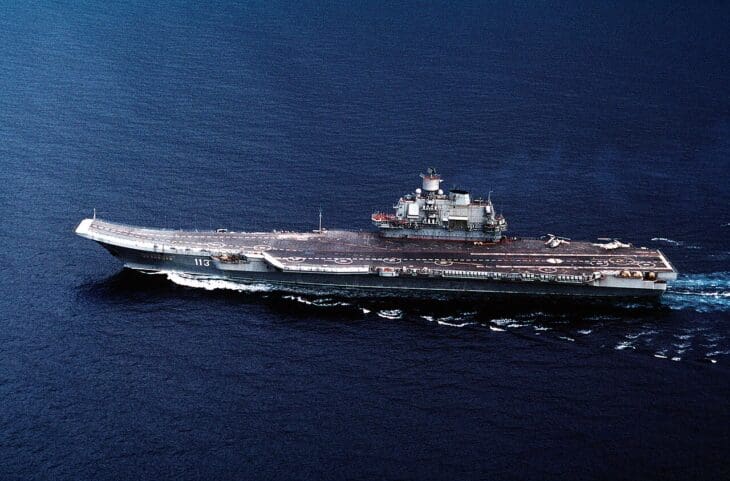
The Kuznetsov carries 12 P-700 Granit anti-ship missiles in silos set into the flight deck itself, just aft of the ski jump. It is real cruiser firepower, and it is also a design flaw: when the launch hatches are open, aircraft cannot take off.
A Ski Jump Instead of a Catapult
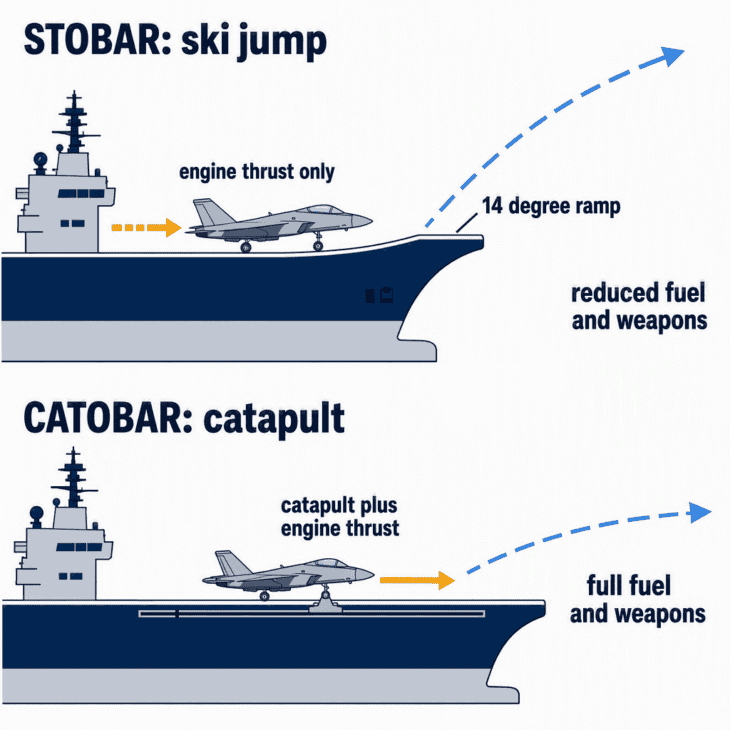
American and now Chinese carriers fling aircraft off the deck with catapults. The Kuznetsov does not have one. It has a 14-degree ramp at the bow, and its fighters take off by running up that ramp on their own engines.
Navies call this arrangement STOBAR, for short take-off but arrested recovery. It is cheaper and mechanically simpler than a catapult, and it costs the air wing dearly. An aircraft that has to accelerate itself off a ramp cannot be as heavy as one a catapult throws, which in practice means carrying less fuel, fewer weapons, or both.
The ship’s only combat deployment exposed the rest of the problem. The Kuznetsov sailed for Syria in October 2016, and within three weeks it lost two of the aircraft it had brought.
A MiG-29K went into the sea on November 14, 2016 and a Su-33 on December 3, both after problems with the arresting gear that stops aircraft on landing. Both pilots were recovered. Much of the air wing then flew its missions from a Russian air base ashore instead.
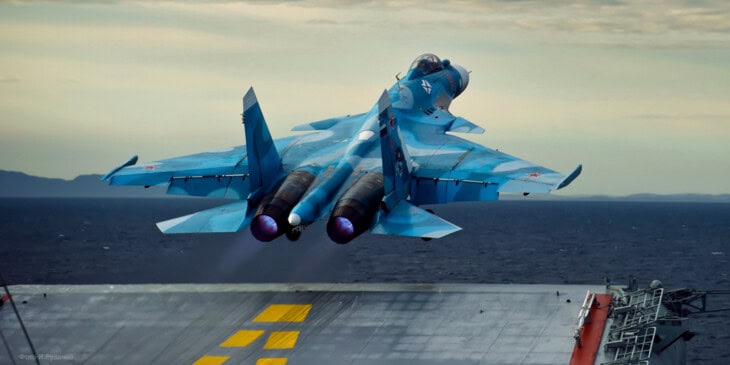
Those fighters never went back aboard. The Su-33s and MiG-29Ks that belong to the carrier now fly from Severomorsk-3 in the Arctic, a naval air base with a runway that does not move. Russia still operates carrier-capable fighters; it just has nowhere to put them.
Eight Years in the Yard, and a Run of Disasters
The refit was supposed to buy the ship another 25 years. It was budgeted at around 20 billion rubles, roughly $257 million at the time, and it was meant to finish in 2022.
What followed is one of the least lucky sequences in modern naval engineering.
2017
The refit begins. The Kuznetsov returns from Syria in February and enters a modernization program intended to extend its life by 25 years.
October 2018
The dry dock sinks underneath it. PD-50, a Swedish-built floating dock rated at 88,000 tons (80,000 tonnes), floods and goes down during a power failure. A 70-ton crane falls onto the flight deck and opens a hole of roughly 13 by 16 feet (4 by 5 m). One shipyard worker was killed.
December 2019
A welding spark starts a major fire. Sparks ignite fuel in a hold and the ship burns for the better part of a day. Reported tolls varied: at least one worker was killed and more than a dozen injured, with Russian outlets later putting the death toll at two.
May 2022
Into an improvised dock. With PD-50 gone, Russia merges two adjacent dry docks at the 35th Shipyard in Murmansk to make one big enough. The carrier finally enters it.
December 2022
Another fire. A smaller blaze breaks out during repair work. The head of the state shipbuilder reports no injuries and no significant damage.
February 2023
Out of dock, still not finished. The ship is undocked and returns to a pier for the remaining work.
July 2025
The work stops. The chairman of Russia’s United Shipbuilding Corporation says there is no point repairing the ship further. Izvestia reports days later that the Navy has decided to mothball it.
.jpg)
Even before any of that, the Kuznetsov had a reputation. It runs on mazut, a heavy fuel oil, through boilers that have failed repeatedly, and the black smoke trailing it became the most photographed thing about the ship.
Russia routinely sent an ocean-going salvage tug along on its deployments. In 2012 that turned out to be the right call: the carrier lost power in the Bay of Biscay and had to be towed.
What Russia Is Building Instead
It would be wrong to read the empty deck as a navy in total decline. Russia has spent its shipbuilding money somewhere, just not on carriers.
The priority has been submarines, frigates, and long-range missiles: weapons that threaten an opponent’s fleet rather than projecting air power over someone else’s coast. That is a coherent strategy for a country whose main naval problem is defending its own approaches, and it is the opposite of the American carrier model.
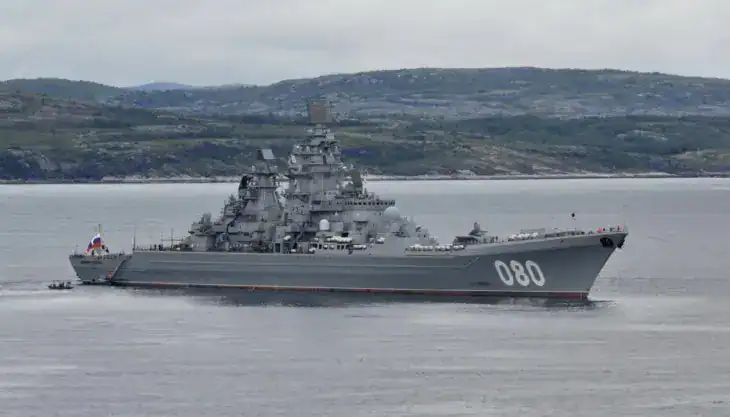
The flagship project of the last decade has been the nuclear battlecruiser Admiral Nakhimov, rebuilt over more than 25 years and refloated in July 2025. It returned to sea under its own power in August 2025 for the first time in nearly three decades, and the Navy’s commander-in-chief has said it should join the Northern Fleet by the end of 2026.
There are also two amphibious assault ships under construction, the Ivan Rogov class, at the Zaliv yard in Kerch in Russian-occupied Crimea. Each is planned at around 44,000 tons (40,000 tonnes) with a flight deck for up to 30 helicopters and drones. Delivery is currently projected for 2028 and 2029.
Those are helicopter carriers, not fighter carriers. No Russian shipyard is building a replacement for the Kuznetsov, and several proposed designs shown over the years never got past the model stage.
The Myth: Russia Would Be the Only Great Power Without a Carrier
The claim you will see repeated
That scrapping the Kuznetsov would make Russia the first permanent member of the UN Security Council to have no aircraft carrier. It is a good line, and it is not true.
The United Kingdom got there first, and recently. HMS Ark Royal was decommissioned on March 11, 2011 and HMS Queen Elizabeth was not commissioned until December 7, 2017, leaving Britain without a carrier for six years and nine months.
France, meanwhile, owns exactly one carrier, the Charles de Gaulle, and when that ship goes into refit the French Navy has none available either. A fleet of one is a fleet with scheduled gaps built into it.
There is a second thing people get wrong, and it is a better story. The Kuznetsov had a sister ship, the Varyag, left unfinished in Ukraine when the Soviet Union collapsed.
In 1998 the hull was sold to a Chinese company registered in Macau, ostensibly to become a floating casino. It was towed to Dalian in February 2002, completed as a warship, and commissioned into the Chinese navy in September 2012 as the Liaoning.
So the most consequential carrier of this design is not Russian at all. It taught China how to run a carrier air wing from scratch, and China has since built two more, the second of them with the catapults the original never had.
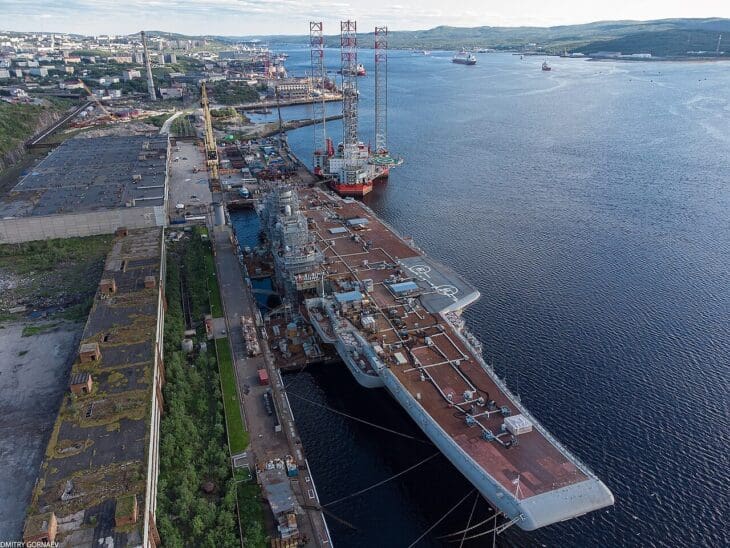
Back at the pier in Murmansk, the number is still one. The number that matters is the nine years since the ship last did the job it was built for.
Nothing has been formally decided, and Russian officials have quietly let the question sit rather than answer it. But a warship that has spent longer under repair than most aircraft spend in frontline service has already told you most of what you need to know.
Sources and references used for research and fact-checking.
- Wikipedia, Russian aircraft carrier Admiral Kuznetsov
- Wikipedia, Kuznetsov-class aircraft carrier
- The Moscow Times, Russia Weighs Scrapping Its Only Aircraft Carrier After Years of Restoration Delays
- Janes, Russia may abandon refit of Admiral Kuznetsov
- Wikipedia, PD-50
- The Diplomat, One of the World's Largest Floating Dry Docks Has Sunk With Russia's Carrier Aboard
- Naval News, Russian Carrier Kuznetsov Leaves Dry Dock... At Last
- Naval News, Russia's Ivan Rogov-class assault vessel nears completion in Crimea
- Wikipedia, Ivan Rogov-class amphibious assault ship
- The War Zone, Russia's Upgraded Nuclear Battlecruiser Back At Sea After Nearly Three Decades
- USNI News, China Commissions 3rd Aircraft Carrier Fujian
- USNI News, Navy Extends USS Nimitz to 2027, in line with JFK Delivery
- Wikipedia, HMS Queen Elizabeth (R08)
- Wikipedia, Russian Naval Aviation
Get the Newsletter
The latest aviation news and stories sent to your inbox.
About the Author

Tim is the owner and lead editor of AeroCorner since 2019, overseeing aviation content covering aircraft, airlines, airports, and the broader aviation industry. Through years of researching, writing, editing, and publishing aviation-focused content, he has developed extensive practical knowledge of commercial aviation and air travel. Based in Asia and a frequent traveler himself, Tim also brings firsthand passenger experience to AeroCorner’s coverage. Outside of publishing, he has also explored aviation firsthand through hands-on flight training in New Zealand.