

Table of Contents
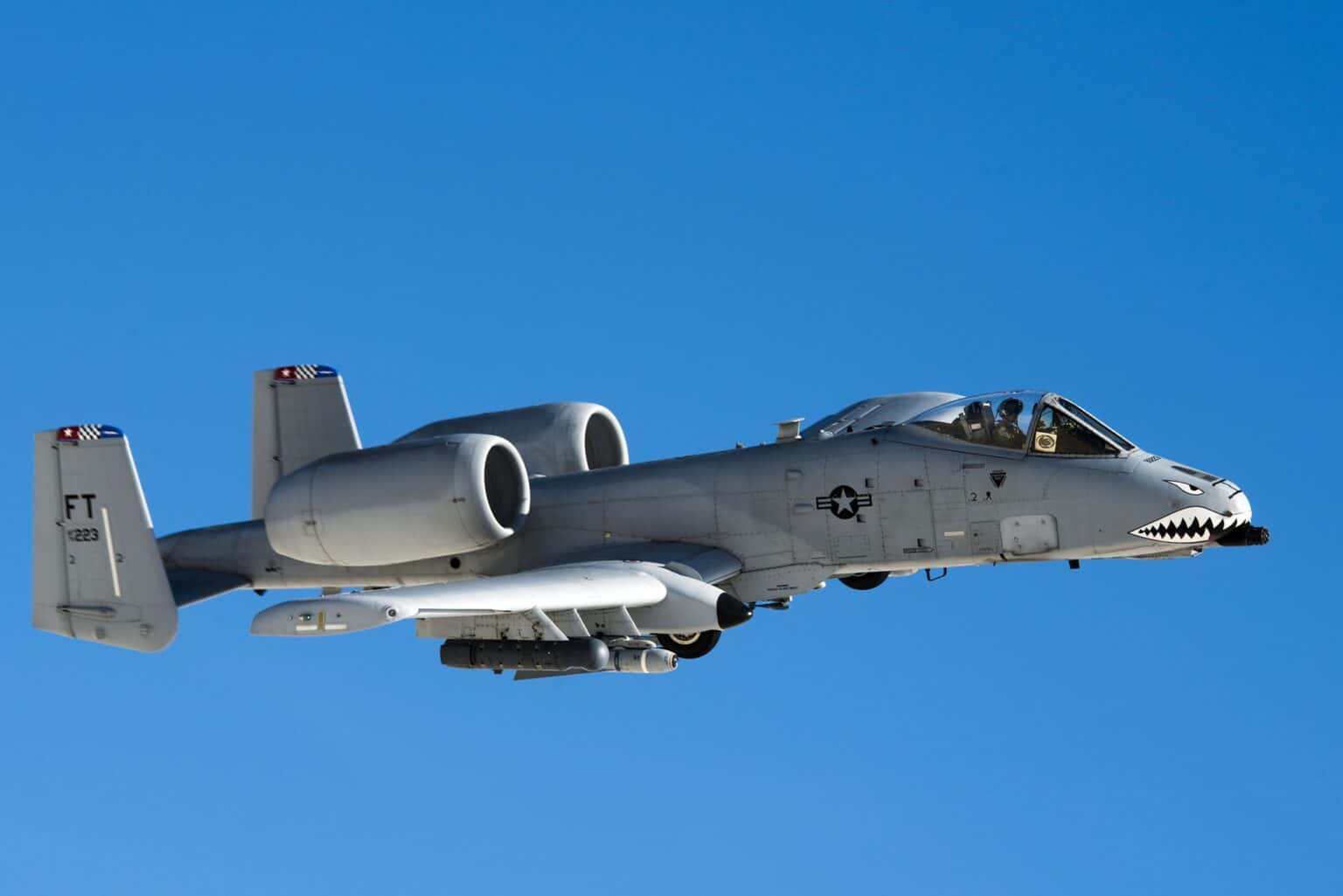
The best ground attack aircraft ever built is the Fairchild Republic A-10 Thunderbolt II, the Warthog. It was designed around one weapon and one job, killing targets near friendly troops, and it is still flying combat missions more than 50 years after its first flight in 1972.
The Soviet Il-2 Shturmovik runs it close. With 36,183 built, it is the most produced military aircraft design in history, and no aircraft mattered more to a single army’s ground war.
This list ranks the 10 best ground attack aircraft of all time, as of November 2026. Each one is judged on four things: what it did to targets on the ground, how well it survived doing it, how long it stayed useful, and how much it changed the way armies fight.
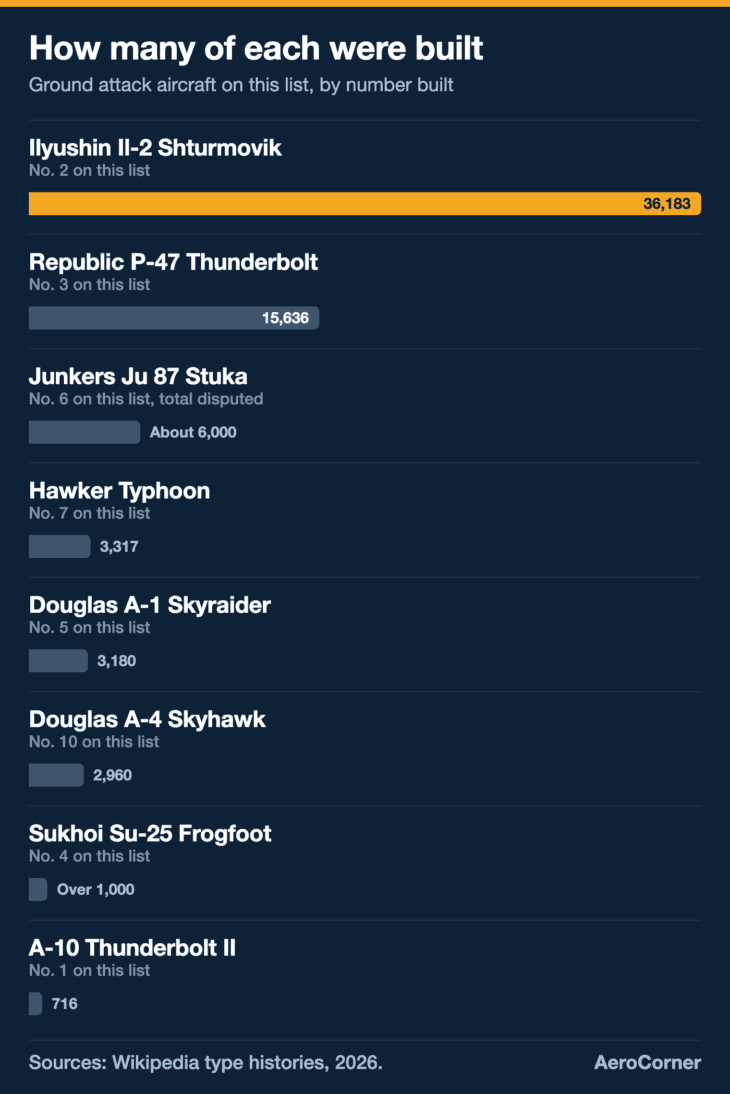
| Rank | Aircraft | First flight | Number built | Status (2026) |
|---|---|---|---|---|
| 1 | A-10 Thunderbolt II | 1972 | 716 | In service, retirement planned for 2030 |
| 2 | Ilyushin Il-2 Shturmovik | 1939 | 36,183 | Retired |
| 3 | Republic P-47 Thunderbolt | 1941 | 15,636 | Retired |
| 4 | Sukhoi Su-25 Frogfoot | 1975 | Over 1,000 | In service |
| 5 | Douglas A-1 Skyraider | 1945 | 3,180 | Retired |
| 6 | Junkers Ju 87 Stuka | 1935 | About 6,000 (disputed) | Retired |
| 7 | Hawker Typhoon | 1940 | 3,317 | Retired |
| 8 | Lockheed AC-130 gunship | 1967 (AC-130A) | Converted from C-130s | In service (AC-130J) |
| 9 | AV-8B Harrier II | 1981 | 337 new-build AV-8Bs | Italian and Spanish navies only |
| 10 | Douglas A-4 Skyhawk | 1954 | 2,960 | Brazil only |
How this ranking works
A ground attack aircraft hits targets on the ground: troops, tanks, trucks, trains and positions, usually close to friendly forces. We rank purpose-built attackers and the fighter-bombers and gunships that defined the role, across every era. Heavy bombers, attack helicopters and drones are left out because they are different jobs. Build totals are shown for scale, not used as the ranking.
1. Fairchild Republic A-10 Thunderbolt II
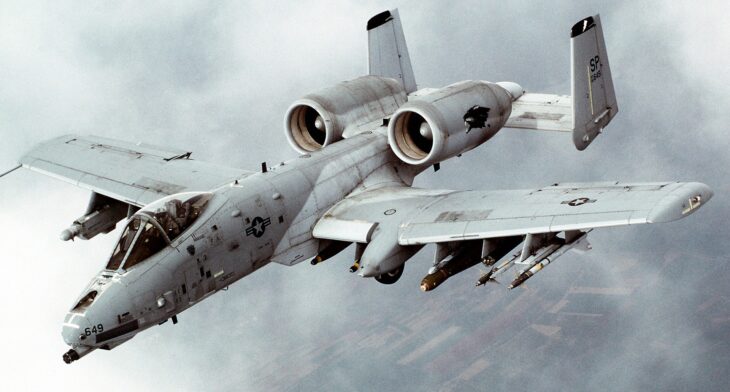
The A-10 Thunderbolt II was built around a gun. Its GAU-8/A Avenger is a 30 mm rotary cannon that fires 3,900 rounds a minute, and the drum usually carries 1,174 rounds.
Everything else follows from flying low and slow over a fight. The pilot sits in a “bathtub” of about 1,200 pounds (540 kg) of titanium armor, the flight controls are double-redundant with a mechanical backup, and 11 hardpoints carry bombs, rockets and Maverick missiles.
It beats the Il-2 because it did the same job with far better odds of bringing its pilot home, and has kept doing it for five decades. Its top speed is only 439 mph (706 km/h) at sea level, clean, and that is the point: it was designed to stay over the target, not race past it.
Fairchild built 716 of them, and the Air Force has tried to retire the type for years. In April 2026, during the Iran war, Air Force Secretary Troy Meink pushed the A-10’s retirement back to 2030, with the fleet shrinking to 36 jets that year. Our count of how many A-10 Warthogs are left tracks the drawdown year by year.
A Thunderbolt twice
The A-10 is named after the P-47 Thunderbolt, number 3 on this list. Fairchild Republic was the last form of Republic Aviation, the company that built the P-47, so the two best American ground attack aircraft came from the same firm 31 years apart.
2. Ilyushin Il-2 Shturmovik
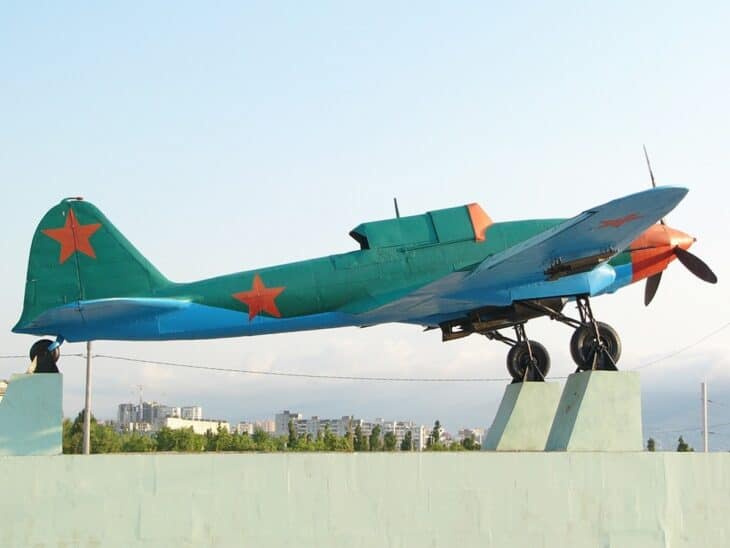

No ground attack aircraft has been built in the numbers of the Il-2. Soviet factories turned out 36,183 between 1941 and 1945, making it the most produced military aircraft design in history.
Its trick was armor as structure. Instead of bolting plates onto an airframe, its designers made the steel armor a load-bearing part of the forward fuselage, protecting the crew, engine and fuel. Soldiers called it the “Flying Tank”.
When deliveries fell behind, Joseph Stalin told factory managers the Il-2 was “as essential to the Red Army as air and bread”. It ranks below the A-10 only because the cost was brutal: in 1943, one Il-2 was lost for every 26 sorties.
3. Republic P-47 Thunderbolt


The P-47 Thunderbolt made its name as a high-altitude escort fighter, then became the foremost American fighter-bomber of World War II. Republic built 15,636 of them.
Built around the Pratt & Whitney R-2800 Double Wasp radial, it weighed up to eight tons fully loaded, one of the heaviest fighters of the war. Between D-Day and VE Day alone, P-47 pilots claimed about 86,000 railroad cars, 9,000 locomotives, 6,000 armored fighting vehicles and 68,000 trucks.
Those are pilot claims, not confirmed kills, and wartime claims ran high on every side. Even discounted heavily, they describe an aircraft that took apart an army’s supply lines, which is why it ranks above every purpose-built attacker but two. It sits among the best American fighter planes of WW2 for the same reason.
4. Sukhoi Su-25 Frogfoot
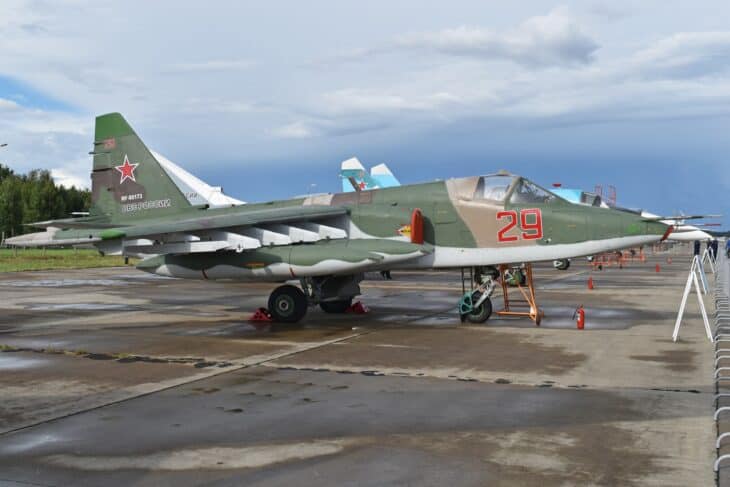

The Su-25 Frogfoot is the Soviet answer to the same question the A-10 answered. It first flew on February 22, 1975, and more than 1,000 were built between 1978 and 2017.
Like the Warthog, it puts the pilot in a bathtub of welded titanium and hangs its weapons on 11 hardpoints. It is also faster, with a top speed of 606 mph (975 km/h) at sea level.
Its combat record is longer than almost any jet’s. In Afghanistan each Su-25 flew an average of 360 sorties a year, more than any other combat aircraft there, and it has since fought in Syria, the 2020 Nagorno-Karabakh war and on both sides of the Russo-Ukrainian war.
5. Douglas A-1 Skyraider
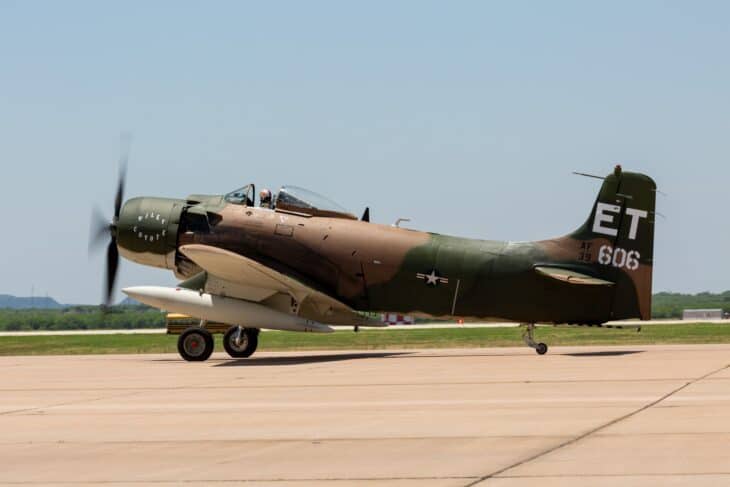

The A-1 Skyraider was a piston-engine attack plane that outlived the jet age’s first generation. It first flew on March 18, 1945, too late for World War II, and Douglas built 3,180 by 1957.
Seven hardpoints on each wing, a long loiter time and armor in the key places made it a flying ammunition dump. In Korea it carried more ordnance with more endurance than any jet of its day.
In Vietnam it flew the “Sandy” escort role that protected rescue helicopters picking up downed airmen, and Skyraider pilots shot down two MiG-17 jet fighters with cannon fire. US forces flew it until 1973.
6. Junkers Ju 87 Stuka
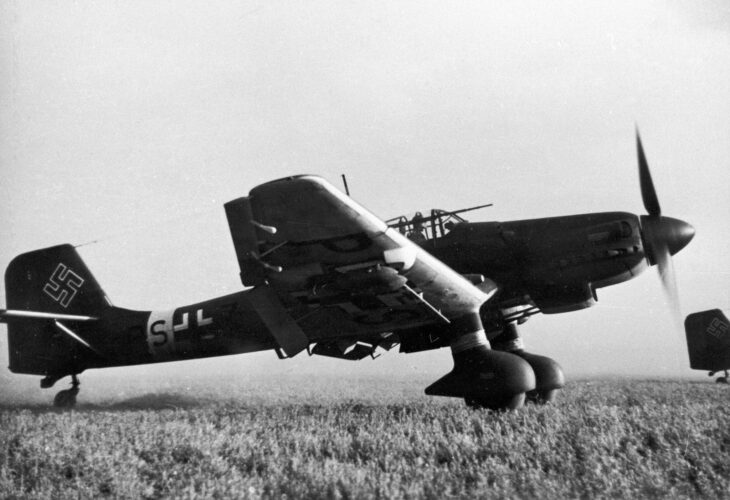

The Ju 87 Stuka is the most recognizable ground attack aircraft ever built. Its gull wings, fixed landing gear and wailing sirens, officially a “noise device” driven by the airflow, became the symbol of the Blitzkrieg victories of 1939 to 1942.
It first flew on September 17, 1935, and the total built is disputed. The usual figure is about 6,000, while Junkers records give 5,126 delivered to the Luftwaffe.
Its top speed was only 255 mph (410 km/h), which left it badly exposed wherever enemy fighters were present, and that limits it to sixth. Its most successful pilot, Hans-Ulrich Rudel, became the most highly decorated German pilot of the war. More German types appear in our German fighter planes of WW2 ranking.
7. Hawker Typhoon
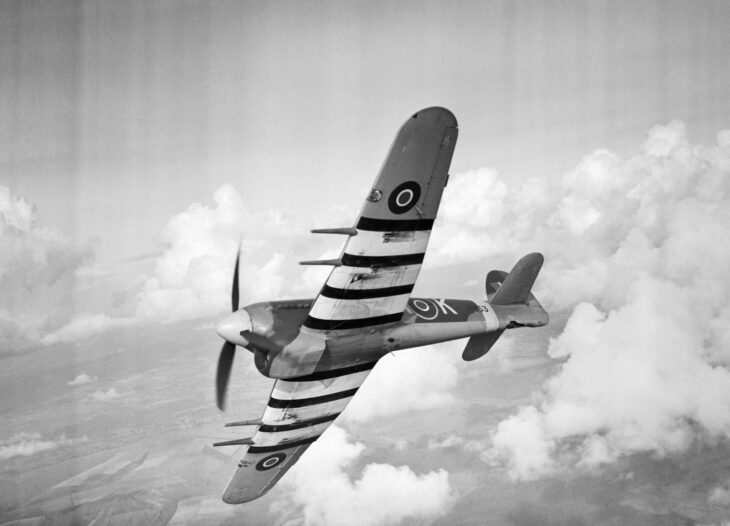

The Hawker Typhoon was meant to replace the Hurricane as a medium-high altitude interceptor, never fully met that requirement, and found its real job low over France. Hawker built 3,317, and it served with the RAF from September 1941 to October 1945.
From September 1943, Typhoons carried eight 60-pound RP-3 rockets, four under each wing, on top of four 20 mm Hispano cannon. By the end of 1943, eighteen rocket-equipped squadrons formed the ground attack arm of the RAF’s 2nd Tactical Air Force.
Its lasting contribution was a method. RAF radio operators traveled with the front-line troops and called in Typhoons circling overhead in a “cab rank”, an early version of the controller-directed strikes armies still rely on. Our explainer on close air support covers how that system grew up.
8. Lockheed AC-130 gunship
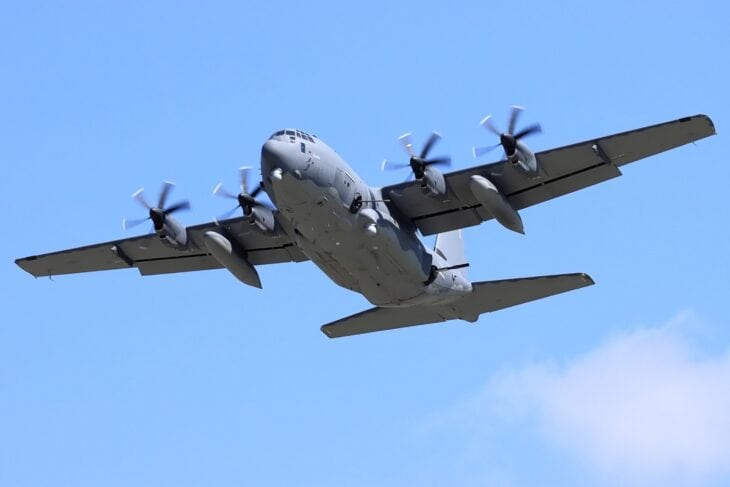
The AC-130 turns a C-130 Hercules transport into a flying artillery battery. Its guns fire from the left side of the fuselage while the aircraft flies a “pylon turn”, a wide circle around the target, so it can keep firing far longer than a jet making strafing passes.
It began in Vietnam as Project Gunship II, replacing the AC-47 Spooky, and the AC-130A flew in 1967. Later versions such as the AC-130H Spectre carried a 105 mm howitzer, and the US Air Force, its only operator, now flies the AC-130J Ghostrider.
It ranks eighth because it can only work where the enemy cannot shoot back well. Flying around 7,000 feet (2,100 m) in a large airframe, it is an easy target, so its missions are usually flown at night.
9. McDonnell Douglas AV-8B Harrier II
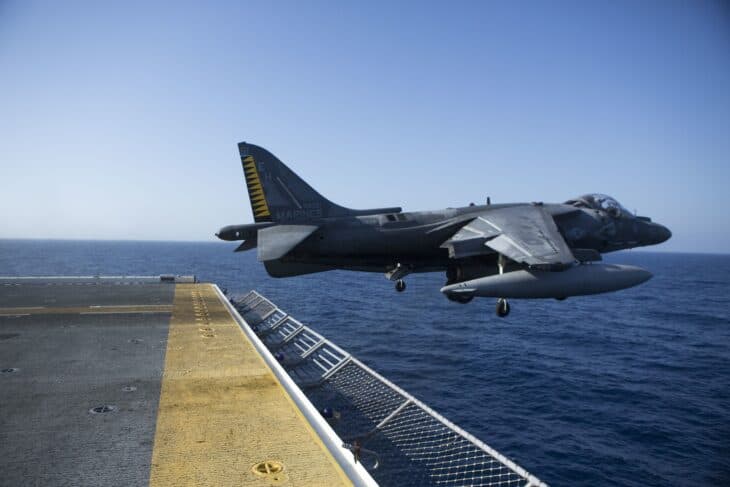

The AV-8B Harrier II brought ground attack to places with no runway. As a V/STOL jet, it can take off in a short distance and land vertically, so it flew from small carriers, amphibious assault ships and simple forward bases close to the troops it supported.
The AV-8B first flew on November 5, 1981, and entered service in January 1985, with 337 new-build AV-8Bs produced. It carries a 25 mm GAU-12 Equalizer rotary cannon in a pod under the fuselage.
The Marines’ last Harrier squadron, VMA-223, held its sundown ceremony on June 3, 2026. The Italian and Spanish navies still fly it.
10. Douglas A-4 Skyhawk

Ed Heinemann designed the A-4 Skyhawk to be as small, light and simple as an attack jet could be. It first flew on June 22, 1954, and 2,960 were built over 25 years, through 1979.
Its most famous combat came in someone else’s hands. In the Falklands War, Argentine Skyhawks sank the Royal Navy destroyer HMS Coventry and the frigate HMS Ardent.
By 2026, only Brazil still operated the A-4, more than seven decades after its first flight. Heinemann also led the design of the Skyraider, so one engineer is responsible for two aircraft on this list.
What about the Il-2’s tank kills?
The most repeated claim about ground attack aircraft is that they won the great tank battles. The Il-2 is credited with wrecking German armor at Kursk in 1943, and the Typhoon’s 2nd Tactical Air Force claimed 257 tanks destroyed in Operation Goodwood in July 1944.
Later studies of Kursk suggest very few German armor losses there were caused by the Il-2 or any other Soviet aircraft. Ground attack aircraft did their real damage elsewhere: to trucks, trains, fuel, guns and the morale of troops who could not move by day.
What about the F-35 and attack helicopters?
The F-35A, F-15E and F-16 are taking over the A-10’s work, but they are multirole fighters that do ground attack among many jobs, so they belong on our list of the best fighter jets. Attack helicopters such as the AH-64 Apache do the same mission from a different kind of aircraft and have their own ranking. Light turboprops such as the Super Tucano are a separate, cheaper class.
For the multirole jets that now share the mission, see the best fighter jets in the world, and for rotary-wing attackers, our ranking of the best attack helicopters.
FAQ
Sources and references used for research and fact-checking.
- Wikipedia, Fairchild Republic A-10 Thunderbolt II
- AeroCorner, Fairchild Built 716 A-10 Warthogs. The Air Force Now Plans to Keep 36 of Them Until 2030
- Wikipedia, Ilyushin Il-2
- Wikipedia, Republic P-47 Thunderbolt
- Wikipedia, Sukhoi Su-25
- Wikipedia, Douglas A-1 Skyraider
- Wikipedia, Junkers Ju 87
- Wikipedia, Hawker Typhoon
- Wikipedia, Lockheed AC-130
- Wikipedia, McDonnell Douglas AV-8B Harrier II
- Wikipedia, Douglas A-4 Skyhawk
Get the Newsletter
The latest aviation news and stories sent to your inbox.
About the Author

Tim is the owner and lead editor of AeroCorner since 2019, overseeing aviation content covering aircraft, airlines, airports, and the broader aviation industry. Through years of researching, writing, editing, and publishing aviation-focused content, he has developed extensive practical knowledge of commercial aviation and air travel. Based in Asia and a frequent traveler himself, Tim also brings firsthand passenger experience to AeroCorner’s coverage. Outside of publishing, he has also explored aviation firsthand through hands-on flight training in New Zealand.